
Introduction
Home improvement is a vast, scary subject. This post focuses on a single aspect: plumbing … not that such a finite project isn’t hugely complicated. If you are contemplating upgrading your plumbing, or if you just like to laugh at another person’s expense, read on.
Why would I replace my plumbing?
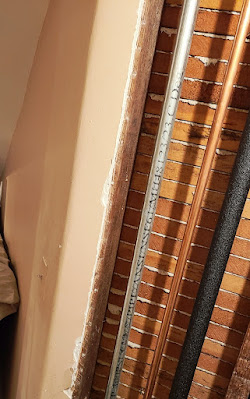
Depending on the age of your home, there could be many reasons to upgrade your plumbing. For one thing, if your pipes are so old they’re made of lead, you are being poisoned and your pipes should be replaced immediately. (Not that I’d expect you to take my advice, because you’re probably already crazier than the Mad Hatter.) If you have that janky plastic plumbing they were doing in the ‘80s, you’re probably tired of it leaking and/or giving you cancer. And if you have galvanized steel pipes, you must be getting sick of how little flow there is due to the plumbing equivalent of arteriosclerosis, and of all the bits of metal that are sloughing off, getting carried along the flow, and clogging up your faucets until they only drool.
What would be the single hardest thing about upgrading my plumbing?
If you live in the Bay Area, there’s a great chance your home has just one bathroom, in which case it’s pretty obvious what the hardest part is: not having a bathroom for some time, possibly weeks. If you’re literally anal retentive, or one of those granola types who’s convinced bathing is bad for your skin, maybe this isn’t too big a deal. For the rest of us, it’s logistically very tough.
What? You have more than one bathroom? Clearly you broke the first three rules of buying real estate: location, location, and location. Why would you buy a home somewhere with such cheap land that your home is big enough to support a second bathroom? Don’t you care about your family?
Should I hire a general contractor?
There are many good reasons to hire a general contractor. First, this person probably knows all the potential gotchas of the project and can plan accordingly. Meanwhile, he or she can easily bring in all the various tradesmen who will be required, and keep everything running smoothly and within budget. All you have to do is make some basic choices, and of course pay the bill.
On the other hand, it’s almost impossible to find a contractor these days who will give you the time of day. Waiting around for them could stall out your project before it’s even begun. And, you could always get a bad one, who cashes your deposit and then skips town. There’s also the matter of their cost, which can be quite high. (This is especially important to consider if you’re a cheap bastard.) Finally, if you do the work without a contractor, you’ll encounter myriad problems and will learn so much. (This is particularly valuable if you’re a blogger.)
I’ve decided to go it alone, sans contractor. What gotchas should I look out for?
Well, you’re going to need more than a good plumber. Lots of a house’s plumbing is behind the walls, so the plumbers will need to cut into them, thus you’ll have to suddenly scramble and line up a drywall crew, and then painters. You’ll probably need to rip out a bunch of bathroom tile as well, which—more than likely—will expose dry rot, meaning you’ll need to get a carpenter in there pronto to replace a bunch of timbers. All these crews will need to be coordinated, and arranging their schedules efficiently may well drag out your project. And last but not least, it’s practically a given that during this convoluted project you’ll discover that your home is built on an Indian burial ground, so you’ll need to arrange some kind of dance to drive out the ghosts—and you’ll also need to ensure that your plumbers, drywallers, painters, carpenters, and tilers are blessed by the Tribal Council. And nobody is more backlogged than those guys.
How should I select my plumber, tiler, etc.? Are references important?
In a perfect world—well, in a perfect world your pipes would have been made of copper to begin with and the whole project would be unnecessary. But in a merely reasonable, fair world you’d be able to follow a logical process in selecting your tradesmen, such as reading reviews, comparing bids, checking references, etc. But in the real world, these people are in such high demand you’ll end up going with the one outfit that actually returned your call. So the question you have to ask yourself as you embark on this home repair journey is: do I feel lucky today? Well do ya, punk?
When the crew of plumbers arrived and checked out the existing plumbing in my beloved home, they actually started laughing. Is this acceptable?
Yeah, I know that must feel pretty insulting, but can you acknowledge that at least they have a point? If you live in an old home like mine (built in 1929), most of the construction is good but maybe the builders just didn’t know any better than to run your pipes outside the walls of the house. And if you live in something built after 1950, well, those builders didn’t have a soul and were just trying to cut costs wherever possible, which is why the plumbing material isn’t even sturdy enough to build a good child’s toy. The good news is, the mockery from the plumbing crew validates your decision to spend a godawful amount of money on this long-overdue upgrade.
I completely failed to anticipate that I’d need drywallers, and suddenly had all these huge sections of missing walls and ceiling in my house. I scrambled to get recommendations from friends and neighbors for a good crew, but all these companies were booked solid through 2026. The plumber said, in so many words, “Don’t worry, I know a guy” and brought in a crew of people I’d never even met, much less vetted, who gave me a verbal quote seemingly pulled out of thin air. I’m almost certain I’m being ripped off. Should I panic? Try to talk them down on price? Put the project on hold? Or what?
Go with that crew, and just pay them whatever they ask for. Try to get them to write something down, just so the price doesn’t go up every time you turn around. If you’re feeling upset about this, don’t. Instead, look at the big picture: if you can afford to own a home, and have this work done, and pay the crew, then life has been pretty kind to you overall. Or you could consider this a luxury tax, or some kind of divine punishment for not planning ahead. And besides, it’s entirely possible the crew has quoted you a fair price and you’ll get a great return on investment.
You used the term “tradesman” a bit ago. Isn’t that completely sexist? How do you live with yourself?
I thought about saying “tradespeople,” but that just sounds ridiculous, and besides, my spell-checker flagged it as wrong. And then I started thinking about how female movie stars often prefer to be called actors rather than actresses. It seems like a case could be made to consider “tradesman” a gender-neutral term. After all, my daughters (they of the woke generation) consider “guys” gender-neutral, and even call each other “dude.”
My home indeed has just one bathroom. How will I relieve myself? How will I bathe?
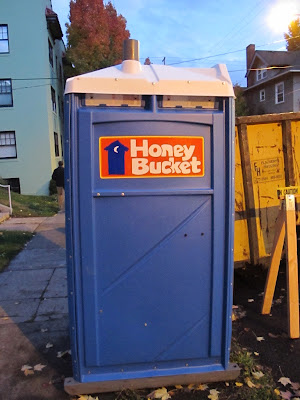
Well, you could always rent a Port-A-John, aka San-O-Let, aka Honey Bucket, for the duration of the project. I even suggested this to my wife, but she didn’t seem interested. So I figured if she can do without, why can’t I (especially since I get to pee standing up)?
Thankfully, we’re lucky enough to live just a few minutes (on foot) from a public park with a decent restroom. (See? Location, location, location!) We also found a cat-sitting gig at a neighbor’s house that included showering privileges. Obviously our project has lasted far longer than anybody could be on vacation, so before and after that magical interlude, I was just doing whore’s baths.
Is there a less vulgar term for whore’s bath?
I guess you could call it a sponge bath, but let’s be real here: you are about to be in the middle of a very tumultuous, endlessly metastasizing, and grotesquely expensive project. You’ll be using a lot worse language than that.
I am working from home during the COVID-19 pandemic. Can I still do a project of this size, or do I really need to wait until I’m back in the office?
Just bite the bullet and apologize to your colleagues, partners, and customers in advance. And during your videoconferences, try to say as little as possible. Even if your conferencing technology boasts noise cancelation, that will only go so far. I thought it was working great recently, because I could hear fine, but I was also rocking the sweet Bose noise-canceling headphones. It did not occur to me that those were only helping me. When I played back the recording later I was horrified at all the background noise that erupted every time I went off mute.
This complication could be a blessing in disguise, though: assuming you’re smart about muting as much as you possibly can, your colleagues and underlings will finally be able to get a word in edgewise. This is a great excuse to learn to delegate.
Honey Bucket? Seriously?
I kid you not. That’s actually one company’s name for these.
When I mentioned this project to a friend, he warned me about “scope creep.” What is that?
This term, borrowed from project management jargon, refers to the tendency of projects to expand, with new and expensive features getting added as you go, so the original estimate is out the window. Some of this is due to unforeseen factors like dry rot or a non-GFI electric outlet having been senselessly installed like an eighth of an inch from the floor and embedded in a tile. But it can also result from the realization that your toilet is so incredibly low you’re practically squatting above a hole in the floor, like the thing was designed for toddlers, so wouldn’t this be a great opportunity—with all these plumbers around—to buy a new, amazingly tall toilet that you can actually lower yourself onto with ease, rather than doing what’s essentially a controlled fall onto the toilet seat? But by the time you learned that this amazing toilet is like $600, and the crew only knocks off a few bucks on the basis of already being in your home and redoing all the plumbing to your old toilet anyway, your heart is set on the idea of a tall toilet and it’s too late to go back.
Scope creep is basically endless. Suddenly the tile around the tub & shower area needs to extend across another wall (which is called wainscoting) and then up past the sink (a backsplash). And since they’re removing the mirror, suddenly that needs to become a second medicine cabinet. And you didn’t expect the “trim” (i.e., tub & sink fixtures) to cost $1200. And then you remembered that the tub stopper mechanism doesn’t work, which is amazingly expensive to fix (as in, four figures, unless my wife was joking, but I just can’t tell anymore), and should have been done before the cut-out in the ceiling below the bathroom was drywalled up. So, there’s probably no point in trying to budget for a project like this. Just expect to blow through all available funds before you’re done. Or, you could put your foot down and declare discretionary scope creep (i.e., that not caused by dry rot, illegal electrical, or Indian burial grounds) strictly off-limits.
What is dry rot, exactly?
Dry Rot is a 1956 British comedy film directed by Maurice Elvey, starring Ronald Shiner, Brian Rix, Peggy Mount, and Sid James, concerning three dodgy bookies trying to rig a horse race.
That can’t be right. Earlier you described it as a house problem requiring a carpenter.
Oh, right, that dry rot. It’s when wood rots due to (I guess) getting wet when it’s supposed to be dry.
So shouldn’t it be called wet rot?
I’ve just learned that true dry rot involves fungi and mycelium and spores and whatnot. So it might be possible that it doesn’t require moisture … it’s all pretty complicated. Suffice to say, dry rot, in the homeowner vernacular, is simply when something is rotten and needs to be fixed via large expenditures of cash.
Other than having hot and cold running water in your home—which would seem like a bare necessity, not anything to spend your life savings on—is there any significant benefit to going through all of this?
Why, yes, at least from my perspective. Before this project began I was feeling pretty ambivalent about a lot of things. Somewhere along the line it felt like everything was just too much, and part of me was feeling pretty good about the inevitable extinction of the human race. But now, with this project possibly concluding in the somewhat near future, I suddenly care so much more about everything. I can’t stand the idea of all this amazing copper piping, and fresh paint, and beautiful tile and wainscoting and fixtures, being burned up in the next fire or consumed in a nuclear blast. That would just be such a waste, after I’ve suffered through—and funded—this ginormous project. So now I’m more passionate than ever that climate change has to be addressed, and Putin must be stopped. You might say I have a new lease on life.
—~—~—~—~—~—~—~—~—
Email me here. For a complete index of albertnet posts,
click here.


