Showing posts with label plumbing. Show all posts

Monday, February 28, 2022

Plumbing Upgrade Frequently Asked Questions

Introduction

Home improvement is a vast, scary subject. This post focuses on a single aspect: plumbing … not that such a finite project isn’t hugely complicated. If you are contemplating upgrading your plumbing, or if you just like to laugh at another person’s expense, read on.
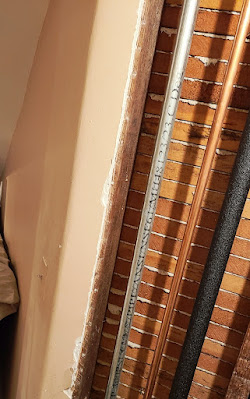

Why would I replace my plumbing?

Depending on the age of your home, there could be many reasons to upgrade your plumbing. For one thing, if your pipes are so old they’re made of lead, you are being poisoned and your pipes should be replaced immediately. (Not that I’d expect you to take my advice, because you’re probably already crazier than the Mad Hatter.) If you have that janky plastic plumbing they were doing in the ‘80s, you’re probably tired of it leaking and/or giving you cancer. And if you have galvanized steel pipes, you must be getting sick of how little flow there is due to the plumbing equivalent of arteriosclerosis, and of all the bits of metal that are sloughing off, getting carried along the flow, and clogging up your faucets until they only drool.

What would be the single hardest thing about upgrading my plumbing?

If you live in the Bay Area, there’s a great chance your home has just one bathroom, in which case it’s pretty obvious what the hardest part is: not having a bathroom for some time, possibly weeks. If you’re literally anal retentive, or one of those granola types who’s convinced bathing is bad for your skin, maybe this isn’t too big a deal. For the rest of us, it’s logistically very tough.

What? You have more than one bathroom? Clearly you broke the first three rules of buying real estate: location, location, and location. Why would you buy a home somewhere with such cheap land that your home is big enough to support a second bathroom? Don’t you care about your family?

Should I hire a general contractor?

There are many good reasons to hire a general contractor. First, this person probably knows all the potential gotchas of the project and can plan accordingly. Meanwhile, he or she can easily bring in all the various tradesmen who will be required, and keep everything running smoothly and within budget. All you have to do is make some basic choices, and of course pay the bill.

On the other hand, it’s almost impossible to find a contractor these days who will give you the time of day. Waiting around for them could stall out your project before it’s even begun. And, you could always get a bad one, who cashes your deposit and then skips town. There’s also the matter of their cost, which can be quite high. (This is especially important to consider if you’re a cheap bastard.) Finally, if you do the work without a contractor, you’ll encounter myriad problems and will learn so much. (This is particularly valuable if you’re a blogger.)

I’ve decided to go it alone, sans contractor. What gotchas should I look out for?

Well, you’re going to need more than a good plumber. Lots of a house’s plumbing is behind the walls, so the plumbers will need to cut into them, thus you’ll have to suddenly scramble and line up a drywall crew, and then painters. You’ll probably need to rip out a bunch of bathroom tile as well, which—more than likely—will expose dry rot, meaning you’ll need to get a carpenter in there pronto to replace a bunch of timbers. All these crews will need to be coordinated, and arranging their schedules efficiently may well drag out your project. And last but not least, it’s practically a given that during this convoluted project you’ll discover that your home is built on an Indian burial ground, so you’ll need to arrange some kind of dance to drive out the ghosts—and you’ll also need to ensure that your plumbers, drywallers, painters, carpenters, and tilers are blessed by the Tribal Council. And nobody is more backlogged than those guys.

How should I select my plumber, tiler, etc.? Are references important?

In a perfect world—well, in a perfect world your pipes would have been made of copper to begin with and the whole project would be unnecessary. But in a merely reasonable, fair world you’d be able to follow a logical process in selecting your tradesmen, such as reading reviews, comparing bids, checking references, etc. But in the real world, these people are in such high demand you’ll end up going with the one outfit that actually returned your call. So the question you have to ask yourself as you embark on this home repair journey is: do I feel lucky today? Well do ya, punk?

When the crew of plumbers arrived and checked out the existing plumbing in my beloved home, they actually started laughing. Is this acceptable?

Yeah, I know that must feel pretty insulting, but can you acknowledge that at least they have a point? If you live in an old home like mine (built in 1929), most of the construction is good but maybe the builders just didn’t know any better than to run your pipes outside the walls of the house. And if you live in something built after 1950, well, those builders didn’t have a soul and were just trying to cut costs wherever possible, which is why the plumbing material isn’t even sturdy enough to build a good child’s toy. The good news is, the mockery from the plumbing crew validates your decision to spend a godawful amount of money on this long-overdue upgrade.

I completely failed to anticipate that I’d need drywallers, and suddenly had all these huge sections of missing walls and ceiling in my house. I scrambled to get recommendations from friends and neighbors for a good crew, but all these companies were booked solid through 2026. The plumber said, in so many words, “Don’t worry, I know a guy” and brought in a crew of people I’d never even met, much less vetted, who gave me a verbal quote seemingly pulled out of thin air. I’m almost certain I’m being ripped off. Should I panic? Try to talk them down on price? Put the project on hold? Or what?

Go with that crew, and just pay them whatever they ask for. Try to get them to write something down, just so the price doesn’t go up every time you turn around. If you’re feeling upset about this, don’t. Instead, look at the big picture: if you can afford to own a home, and have this work done, and pay the crew, then life has been pretty kind to you overall. Or you could consider this a luxury tax, or some kind of divine punishment for not planning ahead. And besides, it’s entirely possible the crew has quoted you a fair price and you’ll get a great return on investment.

You used the term “tradesman” a bit ago. Isn’t that completely sexist? How do you live with yourself?

I thought about saying “tradespeople,” but that just sounds ridiculous, and besides, my spell-checker flagged it as wrong. And then I started thinking about how female movie stars often prefer to be called actors rather than actresses. It seems like a case could be made to consider “tradesman” a gender-neutral term. After all, my daughters (they of the woke generation) consider “guys” gender-neutral, and even call each other “dude.”

My home indeed has just one bathroom. How will I relieve myself? How will I bathe?

Well, you could always rent a Port-A-John, aka San-O-Let, aka Honey Bucket, for the duration of the project. I even suggested this to my wife, but she didn’t seem interested. So I figured if she can do without, why can’t I (especially since I get to pee standing up)?

Thankfully, we’re lucky enough to live just a few minutes (on foot) from a public park with a decent restroom. (See? Location, location, location!) We also found a cat-sitting gig at a neighbor’s house that included showering privileges. Obviously our project has lasted far longer than anybody could be on vacation, so before and after that magical interlude, I was just doing whore’s baths.

Is there a less vulgar term for whore’s bath?

I guess you could call it a sponge bath, but let’s be real here: you are about to be in the middle of a very tumultuous, endlessly metastasizing, and grotesquely expensive project. You’ll be using a lot worse language than that.

I am working from home during the COVID-19 pandemic. Can I still do a project of this size, or do I really need to wait until Im back in the office?

Just bite the bullet and apologize to your colleagues, partners, and customers in advance. And during your videoconferences, try to say as little as possible. Even if your conferencing technology boasts noise cancelation, that will only go so far. I thought it was working great recently, because I could hear fine, but I was also rocking the sweet Bose noise-canceling headphones. It did not occur to me that those were only helping me. When I played back the recording later I was horrified at all the background noise that erupted every time I went off mute.

This complication could be a blessing in disguise, though: assuming you’re smart about muting as much as you possibly can, your colleagues and underlings will finally be able to get a word in edgewise. This is a great excuse to learn to delegate.

Honey Bucket? Seriously?

I kid you not. That’s actually one company’s name for these.


When I mentioned this project to a friend, he warned me about “scope creep.” What is that?

This term, borrowed from project management jargon, refers to the tendency of projects to expand, with new and expensive features getting added as you go, so the original estimate is out the window. Some of this is due to unforeseen factors like dry rot or a non-GFI electric outlet having been senselessly installed like an eighth of an inch from the floor and embedded in a tile. But it can also result from the realization that your toilet is so incredibly low you’re practically squatting above a hole in the floor, like the thing was designed for toddlers, so wouldn’t this be a great opportunity—with all these plumbers around—to buy a new, amazingly tall toilet that you can actually lower yourself onto with ease, rather than doing what’s essentially a controlled fall onto the toilet seat? But by the time you learned that this amazing toilet is like $600, and the crew only knocks off a few bucks on the basis of already being in your home and redoing all the plumbing to your old toilet anyway, your heart is set on the idea of a tall toilet and it’s too late to go back.

Scope creep is basically endless. Suddenly the tile around the tub & shower area needs to extend across another wall (which is called wainscoting) and then up past the sink (a backsplash). And since they’re removing the mirror, suddenly that needs to become a second medicine cabinet. And you didn’t expect the “trim” (i.e., tub & sink fixtures) to cost $1200. And then you remembered that the tub stopper mechanism doesn’t work, which is amazingly expensive to fix (as in, four figures, unless my wife was joking, but I just can’t tell anymore), and should have been done before the cut-out in the ceiling below the bathroom was drywalled up. So, there’s probably no point in trying to budget for a project like this. Just expect to blow through all available funds before you’re done. Or, you could put your foot down and declare discretionary scope creep (i.e., that not caused by dry rot, illegal electrical, or Indian burial grounds) strictly off-limits.

What is dry rot, exactly?

Dry Rot is a 1956 British comedy film directed by Maurice Elvey, starring Ronald Shiner, Brian Rix, Peggy Mount, and Sid James, concerning three dodgy bookies trying to rig a horse race.

That can’t be right. Earlier you described it as a house problem requiring a carpenter.

Oh, right, that dry rot. It’s when wood rots due to (I guess) getting wet when it’s supposed to be dry.

So shouldn’t it be called wet rot?

I’ve just learned that true dry rot involves fungi and mycelium and spores and whatnot. So it might be possible that it doesn’t require moisture … it’s all pretty complicated. Suffice to say, dry rot, in the homeowner vernacular, is simply when something is rotten and needs to be fixed via large expenditures of cash.

Other than having hot and cold running water in your home—which would seem like a bare necessity, not anything to spend your life savings on—is there any significant benefit to going through all of this?

Why, yes, at least from my perspective. Before this project began I was feeling pretty ambivalent about a lot of things. Somewhere along the line it felt like everything was just too much, and part of me was feeling pretty good about the inevitable extinction of the human race. But now, with this project possibly concluding in the somewhat near future, I suddenly care so much more about everything. I can’t stand the idea of all this amazing copper piping, and fresh paint, and beautiful tile and wainscoting and fixtures, being burned up in the next fire or consumed in a nuclear blast. That would just be such a waste, after I’ve suffered through—and funded—this ginormous project. So now I’m more passionate than ever that climate change has to be addressed, and Putin must be stopped. You might say I have a new lease on life.

—~—~—~—~—~—~—~—~—
Email me here. For a complete index of albertnet posts, click here.

Sunday, April 14, 2019

More Plumbing for Dummies


Introduction

This post recounts my third foray into amateur plumbing. Are we talking “heart of darkness” territory? No, more like brain of darkness. But don’t expect a thriller involving a geyser of raw sewage like last time; my 15-year-old daughter seemed bored by today’s tale. But if you think you’re more patient than she is (hint: if you’ve made it this far, you probably are), read on.

The rules

Amateur plumbing is not for the fainthearted. Fortunately I am the beneficiary of my father’s wisdom here, as he taught me some rules I should always keep in mind before diving in. Ha. Ha ha ha ha ha. Of course that’s not true. That’s a nice Norman Rockwell sentiment: good ol’ pop teaching his kid the ropes. The truth is, my dad never had time to sit me down and explain anything.

This isn’t to say he was ignorant about plumbing; he could be quite clever. For example, he built a contraption that would detect when his hot water heater had failed, and would automatically drain it somehow without flooding his house. (This makes almost as much sense as periodically replacing your hot water heater.) But that was many years before I was born so I didn’t get to work alongside him, handing up wrenches and drinking in his tutelage. By the time I came along, my dad’s strategy had shifted to dodging plumbing issues for as long as possible. Eventually, his home’s master bathroom actually lacked a toilet. To be precise, he had bought a new toilet, but for years and years never got around to installing it, and the unfinished project ultimately outlived him.

I do have a set of rules around such undertakings, which come from my own observation and some lessons imparted by a bike shop boss decades ago. They aren’t specific to plumbing, but cover any kind of tricky repair. Here they are:
  • Don’t bite off more than you can chew. Professionals (such as plumbers) charge a lot for a reason.
  • Don’t start a project when you’re tired and stressed out.
  • Leave yourself plenty of time so you don’t end up with a half-finished project.
  • Make sure you’re always working with plenty of light.
  • Don’t start a tricky job on an empty stomach.
  • Make sure you have resources lined up in case you get stuck.
I’m sure this list isn’t complete … feel free to add your own guidelines in the comments section below.

My plumbing predicament

From the standpoint of running water, my home is a minefield. The water pressure from the municipal utility district is plenty high—in fact, it’s too high, so my drip irrigation system is prone to sudden hose failures—but virtually all the pipes within the house are original, from 1929. They’re galvanized steel rather than copper, and they’re rusting inside. This means that little bits are forever flaking off and getting carried along with the water until they reach a faucet or shower head, which traps them. This causes clogs that severely hamper the flow. To solve the problem—i.e., replace all the rotting pipes—would be a major undertaking requiring many thousands of dollars. So I put up with it.

As a result, I’m on my third bathroom sink. I’ve tried to take apart the faucets and get rid of the crap clogging them up, but to no avail. Two different plumbers have insisted that there’s nothing to be done. “There’s a cartridge in there, and once it’s clogged, the whole fixture is shot,” they claim. Excuse me, but doesn’t “cartridge” imply something that can be easily replaced? Apparently not. So recently, my fairly new kitchen faucet, which I happen to really like, started to bog down. The flow has been weakening, gradually but steadily, for months. This has driven me crazy. I cannot continue to hemorrhage money on new faucets, but neither can I bear to plunk down many thousands of dollars to replace plumbing that more or less works. Meanwhile, I refuse to get another plumber in here to tell me there’s nothing to be done but replace a bunch more hardware and pay him a bunch more money.

So, with all the aforementioned rules in mind, I finally tackled the problem myself the other night. Here’s how that went, organized by my amateur plumbing rules.

Don’t bite off more than you can chew

To recap, professional plumbers have told me you can’t fix a clogged faucet. On that basis alone, my home repair attempt was arguably foolish from the get-go. The kitchen faucet is more complicated than the bathroom ones that the plumbers threw up their hands over. It’s got the hose you can pull out, and the button that switches between fill and spray. Moreover, the lines feeding it (which are built into it and non-removable) are remarkably inflexible and scrawny. There’s all kinds of room for problems here. I was well aware of all this when contemplating my repair and deciding whether to move forward.

Don’t start a project when you’re tired or stressed out

I’m tired and stressed out most of the time these days. I have two teenage daughters, a difficult job, and too many responsibilities. Moreover, when contemplating this repair I had just finished doing my taxes (which was particularly stressful due to the major changes in the tax code and their fiscally painful repercussions). What pretty much put me over the edge was that the flow from this faucet had gotten so low it was no longer possible to wash my hands. It was like the urine output from an old man with a significantly enlarged prostate. So I was beyond tired and stress out—I was livid.

Leave yourself plenty of time

It was late evening. I was supposed to be cooking dinner for my kids, as my wife was at her night class. I was also supposed to be packing for a multi-day family road trip. We’d be leaving early in the morning the next day. In no way would I have enough time to recover from difficulties associated with this repair. I almost cannot imagine a worse time to begin.

Make sure you have plenty of light

It’s actually almost impossible for me to have good light anymore, because as I age, my vision is failing. I’m so nearsighted, an object just a few feet away is too hard to see clearly without glasses, but with my glasses anything less than two feet away is blurry. I really need bifocals, but I’m just not psychologically ready to handle that, nor am I ready to start sliding my glasses down my nose and peering over them.

I do have a great work lamp I could plug in, but I get nervous using it around water sources, for two reasons: first, the electrical outlet under my sink doesn’t have GFI, and second, the lamp might heat up my work area to where I’d start sweating too much to grip my tools. At least, these are the reasons I came up with. The reality is, I was just too impatient and lazy to set up the light.

Don’t work on an empty stomach

I hadn’t had dinner, remember? I was too impatient to have a snack before getting started, so I was good and hangry. My blood sugar was surely very low, but of course my brain doesn’t work very well in this state so I was ignoring the inner voice that warned me I was being foolish.

Have appropriate resources lined up

I had no resources lined up. The hardware store would be closing soon, and I couldn’t reach my brother Bryan, the guy I usually turn to for advice. (Click here for the transcript of my last plumbing-related chat with him.) Perhaps the most important resource would have been my wife, as she would have certainly talked me out of this ill-conceived effort from the get-go. Ironically, this was one of the main reasons I did decide to go ahead with the repair: because I knew if I waited, she’d be around to talk sense into me. And I didn’t want to be sensible. I was incensed.

So how did all this pan out?

Well, first I disconnected the faucet from the main water supply to see how the flow was without it. Wow, it was great! So great it caused a minor flood in the cabinet under the sink! That was a hassle, but I was relieved I didn’t have a bigger problem. (The rusting pipes explanation was just a theory, after all.) So then I disconnected the part of the hose that goes through the faucet from the two narrow, stiff, plastic lines feeding it. I took the faucet/hose assembly out into the garage to see if forcing compressed air through it, via my soda bottle air compressor, would help.

My younger daughter helped with this part, manning the bike pump. This gave me both my hands free to try to hold the surgical tubing against the rest of the whole mess. A lot of air leaked out, but still a fair bit of water shot out everywhere, and though I was entirely dubious that any of this would make any difference, at least it felt good to be doing something. An added bonus was that the two-liter soda bottle didn’t explode, so neither my daughter nor I came away horribly disfigured or deafened. Later, with the benefit of hindsight, I would realize how crazy this entire approach had been, but of course I wasn’t thinking straight at this point in the process.

I hooked everything back up again and if anything, the flow was even worse. I was beginning to despair, because believe me, the fact of my ignoring all six of my amateur plumbing rules was not lost on me. Moreover, I was acutely aware that I really had no idea what the hell I was doing.

So I turned my attention to the head of the faucet. There was a little plastic cylinder between the hose and the head that was intriguing. It had no little flats to accept a wrench; no little arrows indicating how to twist anything; no little screws to unscrew. But there was a tiny plastic button (visible when I took off my glasses) that seemed to do nothing, but obviously existed for a reason. I pushed it in and twisted every which way at the cylinder it was embedded in, and eventually something broke free (at first I thought, horrified, that it had actually broken, based on the sound it made). Now, I was able to take the innards of the faucet head apart.

There was a ton of crap in there, tiny bits of rust like fine gravel, little jackstones and shards and whatnot, and I scraped them out with the pointy end of a chopstick. I put it all back together, struggled a bit due to the crudely made (but it must be said, thoughtfully designed) ring assembly, turned the faucet on, and—EUREKA!—the water came gushing out like a damn hydrant! Like Niagara Falls! I let out a whoop of pure joy. After the abject, willful stupidity I’d indulged in pursuing my benighted campaign against forces far greater than I, I’d somehow managed to snatch victory from the jaws of defeat!

I immediately poured a Bear Republic Racer 5 IPA and had my younger daughter help me create this celebratory Beck’st:


(Alas, I don’t have a “before” picture showing the faucet’s pathetic trickle of water from only half its jets. It never occurred to me to photograph it.)

I struggle to convey to you just how totally stoked I was to have won out against the rust clogging my faucet. To ignore so many warning signs and yet prevail … it was like something that only happens on TV, like in the final seven minutes of a “Star Trek” episode. Never mind that the repair itself, upon reflection, wasn’t actually ingenious or anything; the point was, I’d confronted a soul-crushing problem that had been increasingly weighing on me for months, and had kicked its ass!

For a couple minutes, with my mystified (and bored and hungry) kids looking on, I just turned that faucet on and off over and over, watching the water blast out like magic. I felt like Eeyore putting his (popped) birthday balloon into his (empty) honey pot and taking it back out again delightedly, declaring, “It goes in and out like anything.’”

The next morning, my wife was predictably astonished that I’d taken on such a foolhardy project at such an inopportune time. Examining my motivation after the fact, I was able to explain: while it’s true that I’d had half a dozen good reasons to put off my repair, I’m sure my dad had, too, with that toilet he never got around to installing. Waiting for some magic opportunity to bang out a home repair can be a slippery slope. Throughout my childhood, problems continually went unsolved or un-tackled and there was nothing I could do about it. As I make my own way through adult life, I find I’d rather crash and burn than risk continuing my dad’s legacy of procrastination.

Further reading


--~--~--~--~--~--~--~---~--
For a complete index of albertnet posts, click here.

Monday, October 7, 2013

Plumbing Emergencies for Dummies


NOTE:  This post is rated PG-13 for pervasive crude humor and mild strong language.

Introduction

This post is about how to handle a simple plumbing emergency if you’re a dummy.  Actually, you could be a really smart person who just doesn’t know anything about plumbing and this might still be helpful.  Or, you could be really smart and knowledgeable about plumbing and might just enjoy surveying the hapless coping techniques that a dummy has stumbled upon.  Or, you could just be anybody with a taste for schadenfreude who would enjoy a story containing the phrase “geyser of raw sewage.”

 Rule #1:  Figure out where the unwanted water is coming from

Shortly after buying our first home, my wife and I went on vacation.  We were touring Bay Area B&Bs, and on the way from Half Moon Bay to San Francisco decided to stop at the house.  (I know, it’s not really on the way, but we were giddy new homeowners.)  I was in the garage, perhaps for no other reason than to bask in its existence, when a crazy thing happened.  There is a open-ended pipe near the far wall, where the washing machine would have been had we gotten around to buying it, and the purpose of this pipe is to carry wastewater away from a washing machine.  For no apparent reason, raw sewage suddenly began gushing out of this pipe.

(Why is it always “raw” sewage?  Isn’t sewage always raw?  Who ever heard of boiling sewage?  “Don't worry, this sewage is potable.  It’s been boiled.”  I don’t know the answer to this question.  You’d have to ask somebody more knowledgeable about plumbing.)

So, back to the garage plumbing crisis.  My first impulse was to yell “NO!” and reach toward it, but of course all of this happened in super-slow-motion so my “NO” was several octaves lower than my real voice and really slow, to match my movements, so it was more of a “NOOOOOOOOOOOO......”

Now, that water could have been coming from anywhere, but the sewage factor led me to a lucky guess that the toilet was involved.  Fortunately (in this case and this case only) we have only one bathroom, so I ran up there.  Sure enough, there was a terrible hissing noise coming from that room.  I can’t remember if it was from the toilet itself or the related plumbing—it could have been coming from my wife or even myself, I mean this was a long time ago—but the toilet-related plumbing was the culprit.  At least I was in the right room.

Rule #2:  Don’t panic

I know, “don’t panic” is easy enough to say, but something about a plumbing emergency makes it really tempting to panic.  If you were to tell somebody, “The entire house was flooded and I—I panicked!” they probably wouldn’t hold it against you.  But still, you shouldn’t panic.  Take something as simple as a toilet on its way to overflowing the rim.  If this isn’t happening in a motel room where a previous guy’s digestive output could be in play, you’re a coward if you don’t keep your wits about you and take immediate action.  One action of course would be to grab a plunger if it’s handy, but the better action is to quickly remove the toilet tank lid and lift the floating thingy in there.  (I could call it a “floater,” but in the toilet context that term has already been taken.)  Sometimes this floating thingy is a big ball, sometimes it’s a hollow cylinder, but the point is, as the water level rises in the toilet tank, the thingy floats upward until it maxes out and shuts off the flow.  So if you grab that bad boy and lift it, the toilet will instantly stop overflowing.  Then you can yell your head off for somebody to run in with a plunger, towels, etc. before anything has hit the floor.

In the case of the garage sewage spew, I looked for the line that feeds water into the toilet.  These lines have little handles on them and if you crank down the handle (clockwise) it’ll shut off the water supply.  This is what I did to stop the gushing sewage in the garage (but not before several of my bicycles were covered in putrid water with flecks of half-dissolved toilet paper and lots of other gross stuff).

Rule #3:  Get help

Getting help isn’t the first step.  It’s something that should be done concurrently with getting the water flow to stop.  Unless your next door neighbor is a plumber who telecommutes, you want to first do what you yourself can do, as soon and as fast as you can.  When the immediate crisis is averted (i.e., no more water going where it doesn’t belong) that’s when you bring in the plumber and whoever else is needed to put your life back together.

My brother Max lives in Boulder, Colorado and during their recent nightmarish flood was in the process of baling water out of his flooded basement when the next-door neighbor came running over.  This guy presumably did a great job with Rule #1 (he astutely observed that the water was coming from FRICKING EVERYWHERE), but he completely fell down on #2.  He came running into Max’s house yelling his head off.  “Oh my god, you gotta help me!” he cried.  I mean, think about this.  The entire city is flooded, roads have been demolished, creeks overflowing, cars washed away, thousands of souls are in great danger and turmoil, and “you gotta help me”?  He went on, “I got thirty gallons a second comin’ into my house!”  I can’t help but wonder, did he just make up this statistic somehow, to use as a rallying cry, or did he actually make some crude measurement of water volume and do the math?  Is that the first order of business, calculating the flow rate?  So having announced his crisis to my nonplussed brother, he whipped out his cell phone and started calling plumbers.  As if every plumber in the state isn’t already addressing a crisis, perhaps his own.  As if the National Guard hasn’t already been deployed.  This neighbor is yelling into the phone, “I’m payin’ cash!

In this particular case, however, the guy happened to stumble on the right neighbor.  Max is a great big manly man, could easily kick my ass (in fact, he has, multiple times) and he knows his way around homes and plumbing and crises.  In fact, he has an honest-to-god construction worker’s hardhat, and not only that, he’s got this big badass spelunker’s light mounted to it.  All this and he’s a helpful enough guy, or at least morbidly curious enough, that he headed right over to the guy’s house, temporarily abandoning his own crisis.  As Max gleefully related to me afterward, this guy’s toilet was doing the weirdest thing.  Every few seconds it would projectile-vomit a massive gush of raw sewage.  Like, ten gallons at a shot, with this menacing regularity.  So Max ran out to the yard and found the clean-out. 

Now, I’m not entirely sure what a clean-out even is, beyond it being related to the sewage system.  I know that “clean-out” is a term that manly men throw around when they’re describing their weekend projects.  (Sure, I could look it up in Wikipedia, but that’s cheating.  You’re supposed to learn about these things first-hand, in the field.)  Max found this clean-out because it had a big metal lid or cap on it.  Maybe they always do.  Anyway, he used some giant tool that he happened to be carrying, a big old monkey wrench or crowbar or something, and pried that lid off.  He said there was instantly this unbelievably massive—wait for it—geyser of raw sewage, going way high up there into the air, almost like Old Faithful.  And it was endless, like it was feeding right off the entire sewer system of the city, an endless foul fountain.  Max booked it back into the neighbor’s house, confirmed that nothing was coming out of the toilet anymore, and then hustled on home to work some more on his basement.  So, this neighbor?  Yeah, he got real lucky! 

(This phrase “real lucky” is one my brothers and I throw around a lot.  It hearkens to something my dad once said to me, when I was parking my car and got too close to a broken concrete curb outcropping, and it stripped the trim right off the side of my ’84 Volvo.  This freak accident made a terrible noise, like the car was shrieking, and when my dad got out he was shocked—almost disappointed, it seemed—that my comeuppance involved so little damage.  I zipped the trim right back on to the car, and my dad said, “You are real lucky you didn’t do more damage.”  For him to use the adjective “real,” where the adverb “really” is called for, is tantamount to the harshest profanity, given his normally gentle, professorial syntax.)

 Rule #5:  get that water shut down!

I guess this rule is kind of implicit in what I’ve already said, but this is a guide for dummies.  So, assuming you’re not involved in a catastrophic flash flood, or even if you are, see if you can’t get that flow shut off.  Sometimes this can be tricky even when your plumbing disaster is localized.  For example, the other day I was in the kitchen when I heard this hissing noise coming from upstairs.  I ran up there and the floor was completely flooded.  There was a strong blast of water coming from below the bathroom sink.  Remember what I said earlier, about finding the line that carries the water, and looking for the little handle that turns it off?  Well, the little handle was lying on the floor.  Dead.  The cylinder that it attaches to, that ends in a rubber plug that closes off the water, was made of plastic, and had spontaneously failed.  It broke in half, so the handle part went shooting off and there was nothing to stop the water from spraying out like a high pressure hose.


Here’s where I made my first mistake.  I paused, staring at the cheap piece of treasonous plastic, and I took a moment to marvel at the pure, unalloyed venality that caused somebody to decide to make this thing out of plastic.  I mean, what if I’d been on vacation when this thing broke?  That could be thousands and thousands of dollars in damage to my home.  How much did that company save skimping on materials?  Maybe a cent?  So I took a moment to curse whoever chose plastic as the material.  My curse was this:  May you be waterboarded to death in a campground outhouse.  (I know, that’s pretty harsh, but I was in the middle of a crisis and trying not to panic.  I’ve since rescinded my curse, though perhaps too late, who knows.)

Okay, wasting time pausing to curse persons unknown wasn’t actually my first mistake.  My first mistake was not knowing in advance how to shut down the water supply to my entire house.  Everybody should know how to do this.  In modern homes there’s usually a very large pipe in the garage with a big handle on it, so it’s really easy.  (In the state of Washington, my brother Bryan tells me, there’s a giant knob in every garage, and it’s painted red and white so it’s especially easy to find.)  In my home, built in 1929, there is no obvious way to shut off the water.  I’ve long assumed it has something to do with the pipe under a plastic lid in my yard where the water meter is.  There are weird, crude steel thingies down in there, at ninety degrees to each other, and I reckon if you could line them up, the water would stop. 

So, my bathroom still actively flooding, I raced down there to the yard, pried that lid off, and tried to budge the machinery down in there.  I did this using a weird quasi-wrench, long and totally rusted and of the cheapest imaginable quality, that my wife had suddenly handed me.  She had found it near the guts of our drip irrigation system and figured it must be the thing.  Well, I did manage to get a purchase on the weird clunky metal doohickeys down in the ground near the water meter, but I couldn’t budge them.  The crude tool was flexing so much I thought it’d break in half.  The next obvious step was to panic.

But, I didn’t panic, since I always keep Rule #2 in mind.  I asked myself, “What would Captain Kirk do?”  So I thought hard for about two seconds and then it hit me:  “Spock ... the water coming out of that sink line ... it’s hot!”  Meaning:  it came from the hot water heater!  I raced into the garage, found the pipes coming off the hot water heater, and cranked them closed.  I ran to the bathroom:  no more gushing.  Whew!  (I know what you’re thinking:  what if it had been the other cheap plastic valve that had broken, the cold water side?  I know.  You could say that I’m real lucky.)

Rule #6:  After the crisis, see what you can fix yourself

I went back downstairs.  My wife was on the phone, trying to get help.  “Who are you talking to?” I asked.  (You can tell I was still a bit frazzled because I said “who” where “whom” is called for.)  She said she was on hold.  “Hang up,” I said.  (It’s possible I said “Hang up on that fool!” but this is probably the embroidery of memory.  I know I didn’t say “Hang up ... I got this,” because that would have been pure hubris.)  I showed her what broke and announced my intention to head over to the hardware store.  She immediately shot down this idea and starting researching plumbing supply outfits online.

I initially bristled at this—I mean, browsing in a hardware store is one of life’s great joys, especially (perhaps) for men.  When my dad used to go to McGuckin’s, the totally kickass hardware store in Boulder, he’d always ask if we kids wanted to go along.  We always did.  That place was amazing.  Absolutely giant, and there was nothing they didn’t have.  It was like a hardware cathedral.  A friend of my brothers ended up working there, and let us in on a little trade secret.  Whenever a particularly gorgeous woman was spotted by an employee, he’d immediately get on the PA system and announce her location using the code name “Larry.”  For example, if she were in the Bolts section, he’d get on and say, “Larry to Bolts, Larry to Bolts.”  All the male employees would immediately head over to the Bolts section to check her out.  This went on for ages until some manager suddenly realized, “Hey, we don’t have any employees here named Larry!”  He put an end to the practice, though I’m sure they developed a work-around.

Anyway, I looked over my wife’s shoulder and saw on her screen photos of the entire valve assembly, which I’ve come to learn is called an “angle supply stop.”  They were priced at like $40 or $50, which seemed pretty high when all I really needed was the little internal cylinder doohickey.  She got on the phone to some local place and explained the issue in such a way that I was completely lost, even though I knew exactly what she was trying to say.  (Not that I’m complaining, having recently used the term “doohickey” myself.)  Eventually she handed the phone to me and I explained it in my own words.  The guy said the thing I needed was called a “nipple” and could be had in various non-plastic materials.  I don’t know how my wife chose the place she did, but when I looked at it with Google Maps Street View I realized this wasn’t exactly a boutique.


I went down there and showed them the broken piece, mentioned that the guy on the phone said it was a nipple, of which he had many, and they looked at me like I was crazy.  I showed them the handle that attached to it, and then pulled up a photo of the whole assembly that I’d taken on my smartphone.  They said I’d have to replace the entire assembly.  I couldn’t help but wonder if the fact of my flashy smartphone had led to this diagnosis.  You know, kind of a luxury tax.  If I’d flashed a gold iPhone 5S, maybe they’d have said I needed a whole new sink!


So this guy got a new angle supply stop, and I could see right off that its internal cylinder was made of plastic.  I complained about this.  “That’s the only way they make them,” the guy said.  I was about to reply that I’d rather go without a bathroom sink than to pay good money for another plumbing time bomb when another guy said, “I think that’s the wrong size.”  He stared at my photo.  I realized I should have put a ruler in the frame before snapping the photo.  This second guy went and found the right size angle supply stop, which was fancier and had no plastic in it.  It’s chrome-plated brass, and lead-free (though the box says “lead-free*,” and the asterisk might mean “sort of”).


The good news is, the angle supply stops were only $7 (apparently these things are much cheaper at the Blair Witch Plumbing Emporium than online) and a cinch to install.  (Well, the hot water side was a cinch.  I bought two of them, needless to say, so I can preemptively replace the other side, just as soon as I can figure out how to shut off the water supply to the entire house.  Still working on that.)

Rule #7:  Figure out how to shut off your water BEFORE you have a plumbing emergency

See above.  Maybe this should actually be Rule #1....

Monday, November 14, 2011

The British Faucet Conundrum

Introduction

This post concerns the silly faucets, or “taps,” that predominate in the U.K. I will explore the possible reasons why such an inferior design persists, and what it says about British vs. American culture.

Double-taps everywhere

Consider this photo, from my UK vacation last summer:

I love the sign: “Now wash your hands.” In the U.S., of course, people (and especially customers) don’t like being told what to do, even if it’s something entirely reasonable. This is called Freedom. So the sign will say something like “Employees must wash hands” or, more likely, “Employees must wash hands before returning to work,” the implication being that if your shift is over, you can skip the hand washing. But there’s something else in the photo I want you to look at. It’s the sink. Pretty fancy, and with fancy taps. Two taps per sink. Now check out this photo, from the same trip:

Another fancy sink, but still the primitive two-tap design. This time a sign warns against scalding, which is a big risk when you try to wash your hands in such a sink. Look carefully at the round thingy at the back of the sink. I think there’s supposed to be a little chain with a rubber stopper attached there, so you can mix the hot and cold water in the basin. Since there isn’t, you have to move your hands back and forth between the taps, alternately parboiling and cooling them. And now, on to Exhibit C:

Look how short that tap is. It is impossible to run your hand under it without scraping it against the back of the sink. Is this because it’s a tiny little space-saving sink? No:

It’s a giant sink, actually. The tap is so short because, well … no reason. That’s just life. But wait, there’s more. Assuming this next sink had a stopper, would you dare mix water in its basin to try to clean your hands with?

Of course not. Now, we’ve all dealt with grody public restroom sinks (that one was in a $150 a night hotel in London). But at least in the US you can get warm water without involving the basin. Basic sanitation in the case of a grody British sink requires you to either wash your hands in cold only, or to scald/relieve/rinse/repeat.

Is this just because the sinks are really old? No, this next one looks like it’s from around the ‘70s when everything (including bathroom fixtures) became ugly:

All of the photos in this post are ones I snapped myself, of sinks I used during my summer vacation in London and Glasgow. During this trip I encountered exactly one sink offering the miracle of warm water out of a single tap. (I didn’t get a photo of it because I hadn’t yet thought up this blog post.)

Why double-taps?

In an attempt to answer this question I turned to the available literature, that being what I could easily find on the Internet. I found a number of interesting and amusing explanations for double-taps, not one of them satisfactory. Here are some highlights:

“With 2 taps on a basin, it is much better to wash and rinse off your face. With a single tap which is set in the middle of the basin, you can’t do that because you can bang your head on the tap if you tried to rinse off your face.”

Red tape. Older British homes often have storage tanks in their attics that feed water heaters. Under certain conditions, those tanks could be contaminated–for instance, by the intrusion of a rat–and tainted hot water that flows into a mixer-tap might get sucked into a cold-water pipe leading back to the public water supply, endangering the whole neighborhood. So regulations forbid mixing of hot and cold water streams inside a tap unless the tank meets strict standards or protective valves are installed.”

“Having the choice of either hot or cold for washing hands is an incentive to get it over and done with and not waste water.”

“Because we find 2 taps more aesthetically pleasing as well as being able to wash your hands and brush your teeth at the same time.”

“As far as double-taps go, it is the best way to deal with zombies.”

“I’m British and some houses in our street have an indoor toilet. Though we don’t speak to them as they think they are better than the rest of us.”

Now, I’m not going to comment on all of these, but I must refute the bit about banging your head. Consider Exhibit G:

If you look closely in the upper right corner you see the bottom edge of a drinking class—what the Brits call a “toothbrush holder”—and if I’d framed the photo a little differently you’d also see a glass shelf. I bashed my head into that shelf multiple times. The shelf was a real danger, as it was clear and at head level. But hitting your head on a tap? Please. (I mean, have you ever done it?)

As for washing your hands and brushing your teeth at the same time, I don’t see how this would be done, nor how double-taps would facilitate it. Perhaps it’s as facetious as the zombie explanation.

Which brings us to the “red tape” business. I’m not buying it—I mean, this isn’t the Dark Ages. How many homes and buildings still have the hot water tank up in the attic? And how hard would it be to rat-proof the tank? It’s not like you ever hear about the unregulated American water supply being fouled in this way. Besides, the UK regulation clearly does not apply anymore because there are single-tap warm water faucets to be found there.

USA #1 Let’s Roll … right?

Are we to conclude that, as evidenced by our single-tap (aka “mixer-tap”) faucets, the US is just better than the UK? Of course not. We fall short in so many ways. Most of our cities don’t have a decent subway, and the Bay Area one I use is way louder than that of London. Amtrak, though very cool, is a cruel joke compared to the train systems in the UK which are cheaper, quieter, more reliable, and have far greater reach. For retail purchases, America still hasn’t adopted the chip card (more secure than our old-fashioned magstripe cards). Meanwhile, our broadband Internet access is both slower and more expensive than what Europe and the UK have, even though we fricking invented the Internet.

Even around here, when you call a taxi, it can take forever to arrive, or it won’t come at all. Getting a cab in Glasgow was an amazing experience. I dialed the number, and a computer system read my caller-ID digits, looked up my address, and instantly announced that a cab would arrive in x minutes, or I could press 1 for more options. About a minute later the phone rang and the computer voice said, “Your cab is here.” (Actually it probably had some charmingly quaint name for “cab.” In fact, I seem to recall that the computer voice had a charming Scottish brogue.)

Evil faucet – American edition

Of course it would be irresponsible to discuss the inconvenient double-taps of the UK without admitting that we have some pretty awful faucets in the U.S. Consider our modern public restroom with all its little electric eyes for the faucet, the toilet, the paper towel dispenser, even liquid soap dispensers. These might be okay if they actually worked right, but so often they don’t. My hands, which aren’t exactly small, somehow miss the faucet sensor. Or the water comes on for a second and then cuts out, and I’m doing a little hand jive down there trying to get more. Or I’ll walk by the paper towel dispenser on the way to the urinal, and it’ll spew out unwanted paper. At the urinal, I’ll shift my position and it’ll flush while I’m still peeing. Worse yet is the toilet in the stall: once I’ve carefully arranged the little paper doughnut on the seat and then turned around to sit, it thinks I’ve left and flushes, taking my paper doughnut with it.

And what I just described is the Brave New World of automated restroom fixtures. What preceded these (and are still found in older restrooms) were really awful. Think of those spring-loaded restroom faucet handles, where the flow would stop if you let go. This meant you had to wash one hand while holding the faucet handle with the other. Washing just one hand was pretty much impossible—“one hand washes the other” being more than a figure of speech—plus you had to choose between cold and hot water unless your hand was big enough to span both handles.

When you stop to think about it, the public restroom sink reflects how the owner of the restroom views his society. In the UK, the assumption seems to be that the restroom user either a) enjoys the methodical process of mixing warm water in the basin to wash with; b) is okay washing with only cold water; or, c) doesn’t mind the scald-and-relieve cycle, being a stoic Brit with a talent for resignation. In the US, it is apparently assumed that the restroom user can’t be bothered to turn off the damn water, and would blithely walk away while it was still running, wasting untold gallons.

Consumer demand

Of course we Americans have never suffered spring-loaded faucet handles in our homes, and throughout my life I’ve enjoyed mixer-taps (with the one exception of a really cool old apartment in Rockridge, which also had radiators instead of forced-air heating). I’ve already replaced both of the older mixer-tap faucets in my house (with new mixer-taps): the kitchen one because it was a piece of crap, and the bathroom one because it wouldn’t stop dripping. I hired a plumber to fix the bathroom sink, and he told me that the thing was obsolete, and the $0.04 washer we needed was no longer available, and we had to get a whole new faucet assembly. Worse yet, our sink (which looked no more than ten or fifteen years old) was outmoded and wouldn’t accept the new faucet, so I had to replace it, too. By the end of the ordeal I was out over a grand.

Did I mind? No way, man, I’m an American consumer! This is what I do! As everybody knows, we Americans are well steeped in the tradition of keeping up with the Joneses (actually, surpassing them) by buying the latest and greatest of everything. Planned obsolescence is not only tolerable, it’s something we’re complicit in. Not only do we want that new thing, we want to be the first to have it. Think of the people who lined up to get the iPhone, and before that the people who lined up to buy Windows 95.

I don’t get the impression that the British are like this. Recall that double-tap explanation I quoted earlier: “I’m British and some houses in our street have an indoor toilet. Though we don’t speak to them as they think they are better than the rest of us.” Of course it’s a joke, but I think there’s something to it. Solidarity seems to still have a place in the UK, in contrast to the American spirit of outdoing your fellow man whenever possible.

Can we learn from the British?

Look, I’m not going to say we should all try to be British. A lot of their self-imposed consumer restraint is fricking lame—like not having a microwave oven or a dishwasher or a clothes dryer. I went for years without a dishwasher and it didn’t make me a better person. And of course for an American to special-order an English-style double-tap sink would be an absurd affectation. (Meanwhile, washing your hands with cold water, as the double-tap arrangement tends to involve, is non-hygienic according to this article and this one.)

But there’s something to be said for the Brits’ “don’t-gimmick-me” approach. I’ve seen some really pointless innovations in the US: the electric can opener; oval-shaped chainrings for bikes; the motorized necktie rack; and most recently the Rabbit instant wine bottle opener. Why do we need to open a bottle of wine in three seconds flat? If we’re in such a rush, why not go all the way and swap out the cork for a spigot? (Oh, wait, we’ve done that, too.) And as if the original Rabbit weren’t bad enough, we now have the electronic Rabbit with an illuminated LCD screen showing how many cork pulls are left before the battery is dead. God forbid we should have the thing conk out unexpectedly, and have to open a bottle using a hand-powered corkscrew.

But wait, you might say, why should I hold people’s stupid gadgets against them? Isn’t that their business? No, because once the consumer gets used to being overly coddled, he gives up the old ways, and the market follows his lead, depriving people like me of traditional products. Too often, aesthetics suffer for it, as mere utility trumps all. For example, the modern ketchup bottle: just look at it, compared to its vastly superior ancestor:

It’s almost as though the plastic bottle is designed to reflect the stout physique of the modern American. Instead of having to master the subtle air-bubble-sliding technique, the consumer can now force the ketchup out as fast as he wants to speed along his feeding frenzy. The squeeze bottle even makes a fitting flatulent sound as it spews. Revolting. And yet the plastic bottle has become so popular it is now the norm, and you can’t even find a proper glass bottle in the supermarket anymore. Until recently, I had to talk waitresses into selling them to me. But guess what? It turns out you can still get the traditional glass bottle of Heinz ketchup in the supermarket—but only in the UK.

dana albert blog