Showing posts with label anxiety. Show all posts

Friday, July 10, 2026

Things That Could Push Me Over the Edge

Introduction

To begin, I want to assure you that I’m a pretty even-keeled sort, and although in my youth I had quite a temper—my brothers referred to my not-infrequent rages as “fire-ups”—I am very good at keeping it together these days. Still, I know that everyone has a breaking point. Probably it would take the perfect storm of annoyances to push me over the edge, not just a single irritant (such as the incessant call of the whip-poor-will in James Thurber’s eponymous story). The purpose of this post is to give anthropologists, biographers, or police detectives some good leads if somebody, someday, seeks to figure out why a calm, easygoing person like me actually went berserk. So here’s a list of the kinds of things that could, if chained together under the right circumstances, finally push me too far.


Anything involving a fitted sheet

Could it possibly be that in 2026 nobody has improved on the weirdly quasi-rectangular, never-correctly-sized, inexpertly-elasticized fitted sheet? This product’s job is just not that complicated: to stay put on a mattress. Sometimes fitted sheets actually fit, and thus recede into the background, but so often they misbehave: for example, a corner peels away, so you wake up with your sweating skin plastered against the mattress, perhaps imprinted with its weird texture. And where fitted sheets really drive me nuts is when they’re not on the bed. Unlike a top sheet, they’re impossible to fold … no matter how precisely you try to line up the edges, you just end up practically wadding the thing into a ball. And then when you try to mount it on your mattress, you can’t get it oriented—it it behaves like pizza dough you fail to stretch into a disc, only you’re trying for a rectangle. Finally you find the little seams that (if you’re lucky) delineate these edges, and then you’ve got the sheet covering most of the mattress, but that final corner is either way too tight, so you can’t tug it far enough down, or it’s too loose, and you have all this slack to fold under. Every time I deal with a fitted sheet, I almost want to just give up and go sleep on the couch with a sleeping bag.

Stuff stuck in my teeth

I should only eat nuts at home where I have a gum stimulator tool. Otherwise I have all this shrapnel in my teeth I can’t work free, and my tongue gets tired and sore. When this happens on a hike I’ll sometimes pull a thin twig off a tree to use as a toothpick, in which case my wife warns me the twig is poisonous. (The worst part of this scenario is that she actually knows what she’s talking about.) But things get really bad when some sneaky bit of food gets stuck so badly right between two teeth that that it actually hurts. In this case, a toothpick doesn’t always help. In fact, the worst case scenario is that either a toothpick actually breaks in there, compounding the problem, or a piece of dental floss shreds in between the teeth. At such moments life seems literally hopeless.

And speaking of dental floss, even it doesn’t shred, trying to throw away a strand of it can seem futile. I pop the trash can lid up, try to drop the strand in, and it clings to my fingers, or misses the can, or only half of it goes in so it dangles over the side, or—worst case—it falls on the floor and (because I’m usually so exhausted at bedtime) I have trouble even finding it. Can’t Dyson create some kind of Floss-Vac, so that when I’m done flossing I can just press a button and have the floss ripped from my fingers and sucked into a vortex where I never need to think about it again?

Janky POS at gas station

Paying at the gas pump should not be complicated. Every company designing this point of sale interface should just copy an existing design that works. And yet the Service Station Industrial Complex seems to need to innovate. Sometimes it’s loud video ads or byzantine car wash options, or else it’s half a dozen loyalty card options. If I try to use my Safeway card and don’t have any award points, it sometimes hoses the whole transaction; other times, it weirdly gives me the Chevron member discount (which is a mistake, but hey, I’ll take it!). This confusion is only slightly annoying, but what kills me is when the POS wants me to pre-select something. The other day an Arco POS display said, “Enter amount.” Amount of what? Gas, or money? I guessed and put in “6,” figuring consumers care mainly about how many gallons we need, vs. the unpleasant matter of how much we’re forced to pay. Well, I guessed wrong and the pump gave me $6 worth of gas … a little over a gallon, which is of course nearly worthless. But I was like, okay, fine, it wants a dollar figure. So I tried again and put in a generous number, which should have worked, except that after pumping for like 30 seconds the POS realized, hey, this same card was used twice at this pump—an obvious sign of fraud! Stop the fueling! So I got like another half-gallon, plus it locked up my credit card, so I had to call my bank. Amazingly, this isn’t the first time such a thing has happened. Whoever designed this interface should be force-fed gasoline through a beer bong.

Car blasting horn at cyclist

Look, I understand that when I am out bicycling, sharing the road with cars, occasionally a driver will want to make sure I’m aware of his car bearing down on me. A little toot of the horn from, say, 30 feet away is completely appropriate. But I also encounter motorists who wait until they’re five feet from me and then blast the horn. It’s not like I didn’t know they were there, but that unexpected loud blast can just about make me jump out of my skin. The horn is supposed to be for safety; why this need to weaponize it? When this happens, I generally flip the driver the bird. This response might seem strange to you: I mean, what if the driver overreacts? Well, think about it: what’s he gonna do, come after me? He’s ahead of me! If he screeches to a halt, I’ll ride right past. If he waits for me at the next intersection and wants to fight, I’m all for it. After all, I’ll be the only combatant in a helmet.

The last time this happened, a couple weeks ago, I flipped off the driver, and then my riding buddy said, “There were kids in that car.” I grasped his point immediately: I had lucked out! Consider: the driver is an asshole; his young kids know it; and now I’ve taught them an important gesture they can make to their dad on a regular basis. I only wish I could give them a better tutorial, emphasizing that the ring and index fingers don’t curl all the way in, but are positioned such that their knuckles line up with that of the bird finger. But I’m sure those kids will refine their technique over time.

Resurfacing earworm

I am cursed with the ability to remember rock songs in great detail, whether I like them or not. Obviously in the case of a band I love, like Pink Floyd, it’s natural I’d remember every word of every song, along with all the instrumentals—but also intact are all these songs I never even meant to listen to but encountered secondhand because they got a lot of radio play. This means I also know all the lyrics to, say, “Piano Man” by Billy Joel, even though I only liked the song briefly, when I was like seven. Mercifully, lots of the  music from my youth has failed to pass the test of time and, due to zero airplay, finally fades from memory.

Until it comes back. And this, alas, can happen at any time, for no reason. Some minor song like “One Step Ahead of You” by Split Enz will suddenly pop back into my head, and I’ll be like gosh, that’s strange, but then it’s kind of understandable that one would resurface because “one step ahead of you” is a household phrase. But occasionally a song I always despised, and which hasn’t been played on any Bay Area station in decades, and has no reason to be remembered, will pop into my head and then become the soundtrack to my latest anxiety dream, so I hear it all night as I sleep. Most recently the offending song was “Hair of the Dog” by Nazareth. In case you’ve forgotten, it’s the song whose chorus (which is like 90% of the song) goes, “Now you’re messing with a / Son of a bitch!” Why does my brain do this to me? Am I punishing myself for something?

Modern light bulbs

I understand the benefit of modern LED light bulbs: they use like a tenth of the energy of traditional incandescent bulbs. And I’m all for saving the planet, of course. I like to run my lights on a dimmer (which also conserves energy) … but it’s strictly hit or miss how the new bulbs will behave. The same make and model might work this week but not next. How they fail varies quite a bit. The LED bulbs designed for above my stovetop don’t do a damn thing. (I found some non-LED ones on Amazon but they refused to ship them to California due to state law; I had to have like 20 of them shipped to my mom’s place in Oregon.) Other LED bulbs seem to work on the dimmer but occasionally, spontaneously they’ll start flickering like crazy, causing seizures in my epileptic houseguests. Or they’ll just occasionally stop working until I futz with the switch a bunch of times. Completely maddening.

The other issue is, even though these modern bulbs barely use any energy, I can’t get a bright enough bulb for the bathroom. When I shave, I want that bathroom lit up like an operating theatre (and the rest of the time it’s on a dimmer, remember)? But all these LED bulbs max out at some piddly lumen number.

Does your neighborhood feature people leaving totally cool stuff out in their driveways for anyone to take? Sometimes it’s crap, like worn-out, depressingly faded or dirty toys, or waterlogged books. But more of the time it’s great stuff … we once got a beautiful drafting desk, and another time some elegant drinking glasses, and once (as celebrated here) we found a sweet toaster. But perhaps the most satisfying item ever was a box (in front of this old geezer’s house) of old-school incandescent bulbs. I couldn’t believe my luck! I mean, these you cannot buy. It’ll be a sad day when they finally burn out. Just like me I suppose.

People who can’t use calendar software

Among workplace productivity applications, perhaps the most useful is the shared calendar. How did we ever set up meetings before we could instantly see what day and time works for all six attendees? It’s great! Which makes it extra frustrating when colleagues—whom I have no option to avoid having meetings with—choose not to participate. They break the whole system. You go to set up a meeting and their schedule looks like Tetris—they’re triple- or quadruple-booked all day, every day, for the next five years. How many of these meetings are bogus? Answer: all but (possibly) one.

And if you’re attending a meeting, accept the invite! Don’t keep me waiting! I mean, what’s the problem … are you holding out for a better offer? Just keeping your options open? Look, if you don’t accept, I’m either going to have to hassle you, or reschedule, because believe me, I wouldn’t invite you in the first place if you weren’t absolutely necessary to the discussion. Chances are I don’t even like you.

If I were a manager, I would tell my employees, “If I ever see you double-booked on your calendar, you’re fired.” (You might think this would be frowned upon by leadership but actually, I’d be a hero, just for finding a novel way to get rid of more employees.)

Malfunctioning smoke alarm

Is there anything worse than being awakened in the middle of the night by a shrieking smoke alarm? Not only are you jumping out of bed, but you’re legitimately alarmed, especially because so many of these don’t only detect smoke (which at least you can smell) but carbon monoxide (which could silently kill your whole family). So you’re trying to figure out if you need to evacuate the house or just silence the damn thing. And half the time the “Silence” button doesn’t work. After all, the thing is malfunctioning.

It was bad enough when all you had to do was take out the battery—but now there are these factory-sealed models where you can’t. So you have to bury the damn thing like the telltale heart, smothering it in a clothes drawer so you don’t have to hear it anymore.

Bonus points: a certain model I seem to have a weakness for buying has a switch on it called “Deactivate.” It’s so tempting to throw this switch, except you can never go back. I mean, what’s the difference between using this switch and just smashing the alarm with a hammer?

I actually got the manufacturer to warranty a unit recently. The support rep asked what happened. I said that it wouldn’t stop alarming, no matter how many times I pressed “Silence,” and then finally it went silent but now won’t respond to the “Test” button. (I confess I left out the part where I repeatedly beat the alarm with my fist and then threw it on the floor.)

I was traveling recently and my daughter, who was visiting (or I guess technically housesitting since my wife and I weren’t there) called to report a smoke alarm wouldn’t shut up. Before I had a chance to actually advise her, she said, “Oh, wait, here’s a ‘Deactivate’ button!” Before I could stop her she’d thrown the switch. “Thanks a lot, “ I snarled. “You just bricked it.” Then I felt like a jerk, which hurt especially bad because I know it’s true.

Synthesis

I just realized what’s probably going to push me over the edge one day: I’ll be asleep, having an anxiety dream, with “Rock Me Amadeus” playing on infinite loop in my head, and then the smoke alarm will go off, and it won’t shut up, and in my frenzied attempt to smother it I’ll end up trying to wrap it in a fitted sheet!

—~—~—~—~—~—~—~—~—
Email me here. For a complete index of albertnet posts, click here.

Wednesday, June 17, 2026

Is It Wrong to Bring a Child Into This World? - Part II

Introduction

As I described in my last post, I am at the time of life when some of my friends have kids of child-rearing age, and once in a while I’ll hear one say, whether quoting their kids or expressing their own sentiment or both, “It just seems wrong to bring a child into this world.” Notwithstanding my complete respect for those who choose not to procreate, this notion riles me up.

I did some research to make sure the “just seems wrong” argument isn’t merely a fringe thing. And as I mentioned last week, it turns out that a large Pew survey found that a lot of people hold this view. In fact, 38% of respondents aged 18-49 cited “concerns about the state of the world, other than the environment” as a main reason they don’t want kids, and 26% cited “concerns about the environment.” My research also turned up, again and again, the “antinatalist” movement that holds that it’s always wrong, from an ethical perspective, to bring a child into the world, regardless of circumstance.

Last week, after providing some background on how overpopulation isn’t the bugaboo we all thought it was, I analyzed the environmental and ethical perspectives of the “is it wrong” question. In this post I will take on the “concerns about the state of the world” position, which is the one that vexes me the most.


Before we begin…

Yes, this post is a polemic, like last week’s. My ideal audience is anybody who googles “Is it wrong to bring a child into this world?” and believes, or at least suspects, that it is. But I’m not here to put down anyone who believes this, or is beginning to; after all, there’s no shortage of current events to be worried about. Meanwhile, I’m also at the age where some friends and family are starting to fantasize about grandchildren, and aren’t always subtle about pressuring their adult children to get going.

I am totally fine with those who, for personal reasons, just don’t want kids. And that’s a lot of them: it’s the number one reason given by respondents to the Pew poll, in the 18-49 age group, for opting out. Here are the top five:

  1. Just don’t want to – 57%
  2. Want to focus on other things – 44%
  3. Concerns about the state of the world – 38%
  4. Can’t afford to raise a child – 36%
  5. Concerns about the environment – 26%

If a person is being challenged about not procreating and cites the first, second, or fourth reason, he or she is opening the door to a debate about his or her priorities, which could be unpleasant—I’ve witnessed and even fielded accusations of selfishness (before I had kids, obviously). This is truly offensive, and I can appreciate the temptation to advance a more principled position—and take the fight to the other person’s turf—by citing the state of the world. And I can imagine a parent of my generation hearing this concern from his or her grown-up offspring, and accepting the negative perspective without kicking the tires very hard. But what if that offspring is advancing the idea tentatively—and maybe even hoping, on some level, to hear it refuted?

What a shame it would be succumb to anxiety, and actually conclude it’s wrong in principle to procreate right now … especially when this position is pure nonsense. In this post I will argue that a) now is not a historically bad time to bring a child into the world, and b) barring a zombie apocalypse, Terminator-style AI takeover, or nuclear winter, it’s never a bad time to bring a child into the world.

Our world is not that bad

To begin with, rumors of the demise of freedom, democracy, human rights, safety, and economic opportunity are greatly exaggerated. How can I so smugly state this? Because they’ve always been exaggerated. As I’ve described before in these pages, humans have a built-in, evolutionarily encoded impulse to focus on the negative. Hans Rosling, a Swedish physician and statistician, examined this in his excellent book Factfulness: Ten Reasons We’re Wrong About the World—and Why Things Are Better Than You Think. This book explains why a vast range of people—including scientists, executives of multinational companies, journalists, medical researchers, attendees of the Davos World Economic Forum, and others—have historically done really poorly on a multiple-choice test about the state of the world. In fact, people do worse than if they guessed at random; as Rosling explains, they’re “systematically wrong.” Out of nearly 12,000 people tested in 14 countries in 2017, “every group of people … thinks the world is more frightening, more violent, and more hopeless—in short, more dramatic—than it really is.” I myself took this quiz, years ago, and got like a 3 out of 13. I hadn’t thought I was that ignorant or that negative, but that’s kind of how cognitive bias works. But wait—don’t leave! This doesn’t mean I’m an idiot who doesn’t deserve your attention: the average score across those 12,000 people was a mere 2.

This bias toward negativity is exacerbated, Rosling explains, by “selective reporting by journalists and activists”—which accentuates the negative to create a sense of urgency. (Read this, quick! Donate now!) Meanwhile, Rosling points out, people may feel that it’s heartless to acknowledge that the world is improving when there is still so much wrong with it. Fair enough, but it’s also heartless to be complicit with the rabble-rousing algorithms designed to make people as anxious as possible.

Not only is the world not that bad, but it’s almost certainly in better shape now than when you were born. “What?!” you may ask. “How can you assert that when you don’t even know me, so you don’t even know when I was born?” The answer is: because the world has been improving all along, so my assertion is true no matter how old you are.

To support this audacious claim, I’m going to compare 2026 to three historical snapshots: the birth years of my mother-in-law, of myself, of and my first child. Three sequential generations. You’re going to laugh at how much better things are for the kid lucky enough to be born today.

1932 — The year of my mother-in-law’s birth

I chose the birth year of my mother-in-law, rather than that of my own mom, because my mother-in-law is older—in fact, she’s among the oldest 1% of living humans globally, maybe even the oldest 0.5%, so she’s among albertnet’s most elderly potential readers. And here’s the America she was born into, broken down by some of the biggest concerns people have today about our world’s fitness for bringing up children:

  • Economy: 1932 was arguably the single worst year of the Great Depression. There was 25% unemployment, and without any social safety net, unemployment generally led to immediate destitution. Over 9,000 American banks had failed.
  • Geopolitics: In Germany, unemployment had hit 30% and economic desperation was fueling the rise of the Nazi party, by now the largest in Germany. Adolph Hitler would become chancellor within a year.
  • Disease: There was no polio vaccine, no antibiotics, and no vaccine for measles, mumps, rubella, or chickenpox. Tuberculosis was still a leading killer. In the US, infant mortality was roughly 60 per 1,000 live births in 1932—compared to about 5.4 today.

Just imagine if my mother-in-law’s parents had contemplated the state of the world and were in a position to decide whether or not to have a baby. I mean, her dad had a job crushing rocks (to make gravel). Fate did me a huge favor there, as my mother-in-law went on to have a happy childhood and is still enjoying a long, satisfying adulthood after having four beautiful children, one of whom became my wife. If you were to ask my mother-in-law today if the circumstances of her birth put her in a deep existential hole she never managed to climb out of, she’d laugh in your face.

1969 — The year of my birth

I was the last of four boys born to my parents, and—birth control having been readily available—was not an accident. My mom and dad conceived me with full knowledge that their world was seriously messed up:

  • Geopolitics: 1969 was the peak year of American troops in Vietnam, with over half a million deployed. The draft was in effect, meaning virtually every young man in the country faced the possibility of being sent to fight in a war with no clear end.
  • Political dysfunction: The year before, 1968, had seen the assassination of Robert Kennedy and Martin Luther King Jr.; police attacking anti-war protesters at the Democratic National Convention; and widespread urban riots. Nixon had just taken office under a cloud of suspicion that would culminate in Watergate. The previous year’s Tet Offensive had shattered public trust in the government’s honesty about the war.
  • National safety: The Cold War was at a sustained peak. Both the US and the Soviet Union had enough nuclear warheads to destroy civilization multiple times over, and the doctrine of Mutually Assured Destruction was widely bandied about.
  • Economy: Inflation was famously bad in 1969, at 6.1%—a shocking and disheartening rate after two decades of price stability. The Federal Reserve responded by increasing interest rates sharply, which pushed America toward a long and stubborn recession. Americans had no idea they were on the cusp of one of the great bull markets in American history; they saw only inflation, a growing recession, an expensive war with no end in sight, and a deeply divided country.
  • Crime: the murder rate was heading toward what would become the worst era of American violent crime in modern history, peaking at 10.4 per 100,000 in 1980—more than double today’s rate.
  • Culture: Within a month of my birth, the TV show “Hee Haw” premiered. And my father actually watched it. These were dark times indeed.

2001 — The year of my first child’s birth

The year 2001, and those following it, were not halcyon days for America. And yet it never occurred to my wife and me not to have kids, based on then-current events. In fact, if you were to have asked us to explain our pro-procreation rationale as concisely as possible, we’d have gotten it down to a single word: “Duh.” And yet, here’s what was going on in our world:

  • Terrorism: September 11, 2001—the deadliest terrorist attack in America’s history—killed nearly 3,000 people and triggered a governmental response that fundamentally changed America’s approach to security and surveillance. The anthrax letters that followed killed 5 and infected 17 others, raising fears of biological warfare on American soil. The sense that the homeland was no longer safe was entirely new and profoundly destabilizing psychologically.
  • Economy: The dot-com bubble had burst in March of 2000, wiping out trillions in wealth, and by 2001 the US economy was in deep recession. This was worsened by 9/11, which caused the stock market to fall 7.1% on its first day of trading after the attacks.
  • Political dysfunction: The country was bitterly divided over a presidential election decided by the Supreme Court, which halted a recount in Florida. The Court’s ruling was so unusual that it explicitly stated it should not be cited as precedent—an extraordinary statement to make. Suffice to say this decision struck a great many Americans as scandalous.
  • Geopolitics: The US was on the verge of wars in Afghanistan and Iraq, but with no clear target or objective identified. The world suddenly felt dangerous in ways it hadn’t since the Cold War.

Granted, my first child was conceived before the attack on the World Trade Center. But did my wife and I regret for one moment bringing her into that world? Not at all. After all, we decided, with eyes wide open, to have another child two years later, even though by then unemployment had hit its peak and my own employer had gone bankrupt.

I hope I’ve compellingly suggested that every generation has been born into conditions that could, by the “concerns about the state of the world” logic, have argued for not procreating—and yet my mother-in-law, her daughter, your humble blogger, and my children are all glad we’re here. And since the dates of our respective births, so much about the world has improved. Here are some highlights:

  • Today, infant mortality is eleven times lower than it was in the year of my mother-in-law’s birth. If that doesn’t make this a better time to have children, what does?
  • Violent crime has fallen more than 50% since its early 1990s peak, and property crime has fallen almost the same amount, according to FBI statistics.
  • Since the year of my first daughter’s birth, the economy has boomed; despite 9/11, two wars, the worst financial crisis since the Great Depression, and a pandemic, the stock market in 2026 is worth roughly six times what it was in 2001. If we go back to 1969, parents afraid of market conditions would deprive a child of the opportunity to partake in 30-fold S&P 500 growth over the next 57 years (adjusted for inflation, with dividends reinvested).
  • The world demonstrated an unprecedented capability to respond to a crisis, that being the COVID-19 pandemic. As aptly recounted here, an amazing collaboration took place between the biotech industry and various governments. Based on groundbreaking innovation and a largely unprecedented willingness to accelerate regulatory approval, a vaccine was developed in less than 12 months. This shattered the previous record, which was the mumps vaccine in the 1960s, which took about four years. A 2025 study published in JAMA Health Forum, a publication of the American Medical Association, estimates that the COVID-19 vaccines saved 2.5 million lives. I cannot imagine what would have happened had COVID hit back in 2001.

Still worried about politics?

If you’re still rejecting my assertions about the state of the world, perhaps your position is largely political. After all, politics is probably the most divisive force informing the national mood right now. So I’m going to tackle that, but don’t worry—I won’t take a side. (As described here, I think partisan bickering is pointless and not the purpose of albertnet.) Instead, let’s imagine a political change that I think we can all agree would be disastrous: what if we lost the right to free speech? And how about another: what if we fell under tyrannical Communist rule? Would I then concede that it’s wrong to bring a child into this world?

My answer is an emphatic “No.” Because if we decided, on the basis of Communist tyranny and the lack of free speech, that it was wrong to have children, we’d also be saying it’s been wrong for anyone in China to have had a baby in the last 77 years, or anyone in Russia for most of the last 109. We’d be saying it was wrong for my college roommate to have been given a chance at life: he was born into an authoritarian monarchy in Ethiopia, one of the poorest countries on earth; lived through a Communist revolution and one of the most brutal regimes in African history; was labeled an “enemy of the state” as a teenager who dared to speak out; escaped to America; and is now thriving and raising a family. Do you want to tell couples in less privileged countries than ours that it’s immoral for them to have kids?

Which brings me to my final point: the intrinsic absurdity of basing the decision of a lifetime on a snapshot in time.

A failure of perspective

Let’s do a quick thought exercise. Let’s suppose my wife and I had been thinking about starting a family a couple years earlier, in 1999, so we did an assessment then of the state of the world. The Dow had just closed above 10,000, and then 11,000, for the first time in history. The NASDAQ produced a mind-boggling 85.6% annual return. Unemployment hit its lowest level in 30 years. The federal government posted a $125 billion budget surplus — its second consecutive surplus after 30 years of deficits. Geopolitically, the Cold War had been over for a decade, the Soviet Union was gone, and democracy was spreading globally. It might have seemed like the perfect time to bring a child into the world—and yet within just a couple of years all this had collapsed. A child born in 1999 would be less than a year old when the NASDAQ began its catastrophic slide, losing three quarters of its value over the next couple of years. My kid would have been two years old on 9/11; three years old when WorldCom became the largest bankruptcy in American history after massive accounting fraud; and four years old when the US invaded Iraq and unemployment peaked at it post-recession high. So basing the decision to procreate on favorable conditions no more guarantees a happy life for your child than rough times portend a fraught one.

This is the folly of taking a snapshot in time and assuming it will set the tone of a person’s life for the next 70, 80, maybe 90 years. A child born today will live until roughly 2100 … who could possibly say what will happen between now and then? Think back to my mother-in-law’s life … she has lived through a crazy mixed bag of good and bad, from the Great Depression, World War II, the Cold War, Vietnam, Watergate, the 1970s stagflation, the AIDS epidemic, 9/11, the 2008 financial crisis, and COVID-19—but also the defeat of Axis imperialism, the creation of the polio vaccine, the Civil Rights act and Voting Rights act, the fall of the Berlin Wall, the eradication of smallpox (which had killed millions), the previously unimaginable access to information made possible by the Internet, the development of mRNA vaccines and unprecedented speed of the COVID vaccine, and the dramatic global decline in extreme poverty—more people lifted out of poverty in her lifetime than in all the rest of human history combined.

My takeaway? Looking at current events and deciding not to have kids is simply a failure of perspective. Basing an irreversible decision on what you read on your phone or hear on your podcast is not clear-headed risk assessment—it’s an anxiety response dressed up as moral reasoning. Again, I don’t blame you for feeling anxious. I just find it unsupportable to convert that anxiety into a judgment like “it’s wrong to bring a child into this world.”

A final note

I want to reiterate that I’m not trying to promote procreation—I am completely fine with “I choose not to,” and object merely to “no one should.” I am willing to work very hard to understand another’s perspective, so long as it’s not some froot-loopy moral judgment. Let me give you an example. I’ll confess I was somewhat flippant when my daughter announced she would never be a mother. I said something like, “It’s natural that at age 22 you’re not ready for parenting,” and intimated that her biological clock may one day cause her to change her mind. She seemed inordinately irritated by this response, I felt at first, but I finally understood her perspective when I read this passage in one of her college papers (for a philosophy class, on a non-procreation topic):

If I heard my parents talking about the messiness and inhuman effort of raising a child and I said I certainly wouldn’t go the same way they would laugh, and respond, “Just you wait till those hormones kick in.” It was as if they wished destruction upon me in the form of chemicals that would override reason and change my conception of self, that iron necessity to do what I did not want, justified because I’d become someone who desired it.

I call that “owning it.” She’s not afraid to answer the question for herself, not for the world. I think we can all respect that … right?

—~—~—~—~—~—~—~—~—
Email me here. For a complete index of albertnet posts, click here.

Sunday, March 26, 2023

Firewall for the Mind

Introduction

I recently read a compelling New York Times opinion piece by David Brooks called “The Self-Destructive Effects of Progressive Sadness.” It discusses the growing darkness of the national mood, which Brooks terms “maladaptive sadness,” and which he attributes to three trends: a catastrophizing mentality; extreme sensitivity to harm; and a culture of denunciation. The result, the author contends, is a decrease in one’s sense of agency, which causes emotional duress that can eventually lead to sadness and anxiety.

I was hoping the article would suggests ways we can work to mitigate this problem, but it didn’t get into it—that’s a whole other article. This post is me taking a swing at that other article.


Pay attention … or not

I believe the solution to this maladaptive sadness begins with deciding where and how—and, crucially, if—to focus our attention.

Let’s start with the catastrophizing mentality. Humans do have a talent for focusing on the negative. The late Hans Rosling, a Swedish physician and statistician, examined this in his excellent book Factfulness: Ten Reasons We’re Wrong About the World—and Why Things Are Better Than You Think. This book explains why the vast majority of people—including scientists, executives of multinational companies, journalists, medical researchers, attendees of the Davos World Economic Forum, and others—have historically done really poorly on a multiple-choice test about the state of the world. In fact, people do worse than if they guessed at random; as Rosling explains, they’re “systematically wrong.” Out of nearly 12,000 people tested in 14 countries in 2017, “every group of people … thinks the world is more frightening, more violent, and more hopeless—in short, more dramatic—than it really is.” Rosling identified ten key reasons people err, and one of them is “the negativity instinct.” To some degree, we’re hardwired for pessimism, which is exacerbated, Rosling explains, by “selective reporting by journalists and activists”—which accentuates the negative to create a sense of urgency. (Read this, quick! Donate now!) Meanwhile, he points out, people may feel that it’s heartless to acknowledge that the world is improving when there is still so much wrong with it. But then, naysaying doesn’t help, particularly when it depresses us.

I’m not suggesting that the solution to a widespread emotional health problem is simply to decide to be more positive. I acknowledge that a lot of our vulnerability is more psychological than logical. I can remember being a little kid and only just having learned to swim, and how I would be afraid to venture toward the deep end of the pool. Of course it’s no more dangerous over there; a person can drown in six inches of water. It just seemed more dangerous. As much as I reassured myself that the deep end was no big deal, the sight of that chasm opening up below me freaked me out every time. I finally got over this fear by simply closing my eyes when I got to the deep end. Without the visual stimulus, I could swim all the way across. The point is, “eyes wide open” doesn’t always reduce risk, and can introduce nonproductive anxiety.

Fast-forward a few years to when I’d moved on to bike racing. The Junior field (ages 16-17) in those days was pretty big—50 to 60 riders, typically—and fast. I remember the first road race of the season on a cold day with a strong crosswind, which meant lots of jostling around in the pack. I was feeling really intimidated, especially when I looked back at the large swarm of riders behind me, all of whom it seemed were saving their energy (in my draft) and could come flying past me at any moment. This was a major burden, psychologically, until I decided only to look at the riders ahead of me, and never allow myself to fall back very far. Each time I finished taking a turn at the front, I would only drop back a bit, and then get back into the line at fifth or sixth position. (To worm your way in, you look only forward, at the wheel you want to take.) This way, I was able to pretend I was already in a small breakaway with no swarming peloton to worry about. I did this for about fifty miles until I realized it was always the same riders ahead of me. Finally I sneaked a look back. The pack was gone—we’d dropped them! It wasn’t the size of the pack that mattered, but the quality of the riders near the front.

Far higher achievers than I have employed similar mind tricks. In this great interview, the cycling champion Andy Hampsten talks about the psychological rigor of beginning a pro career in Europe. So often, he was tempted to quit. He describes one such occasion, racing on a terribly cold, snowy spring day in Spain. He was shivering so badly he feared he might crash, and seriously considered abandoning. But then he found a way to deal with his fear: “a silly book called The Hitchhiker’s Guide to the Galaxy that I thought of … where when the hero was in danger he had special glasses that would turn pitch black so he couldn’t see how dangerous things were. It’s best not to know … so I tried to apply that.” Instead of focusing on how frigid and dangerous this downhill was, he tried to look forward to the climb ahead, where he could warm up and the speed would be lower. His crisis of confidence hadn’t been driven by a fully reasoned assessment of the conditions; it was just negative self-talk. By choosing not to dwell on that negativity, Hampsten not only finished the race, finished the season, and made the transition to a world class professional, but grew his confidence and famously won the 1988 Giro d’Italia stage race by dominating a legendary mountain stage in a snowstorm.


Two circles

So, am I just suggesting we put our heads in the sand? That’s the whole trick, just ignore apparent threats? No, of course it’s more complicated than that. In his editorial, Brooks goes on to say, “People who provide therapy to depressive people try to break the cycle of catastrophic thinking so they can more calmly locate and deal with the problems they actually have control over” (italics mine). Societal catastrophes like climate change, systemic racism, and the vanishing middle class are all real problems, of course, but they have something in common: they are beyond the ability of most individuals to combat. They’re bigger than us, which is why we feel so powerless.

This brings me to a useful concept (which I’ve mentioned in these pages before, so bear with me if this is review): the distinction, as described in The Seven Habits of Highly Effective People, between the “circle of influence” and the “circle of concern.” Below is the author’s schematic. The idea is that we should spend most of our mental energy on what we can influence; for example, learning to manage our own stress. We should avoid spending too much energy on the circle of concern, such as the future of democracy, because that’s where most of us are largely helpless.


Did Hampsten’s team management emphasize to him how dangerous the race over the snow-covered Gavia Pass would be? Did they remind him that that no American had ever even finished on the podium of the Giro, which he now stood to do but only if he didn’t crash out in this dangerous stage? Did they show him a highlights reel of riders crashing on descents in bad weather? No, that would be pointless, and worse—and that would all be in the circle of concern. Instead, the team focused on what aspects of the race they could influence. They went around to all the sporting goods stores in the area and bought up all the cold weather gear they could find to equip their riders. They prepared Hampsten for success, and—since literally no other team had thought of this—in doing so they gave him an edge over his competition. (That stage of the Giro has become legendary; the tifosi (Italian fans) call it “the day the big men cried.”)

Why now?

Okay, so it’s best to separate what information is actionable, and what isn’t. But the Seven Habits book was published in 1989; if the matter is this simple, why is everyone’s emotional duress seeming to increase so much, and so fast, now? As reported by the National Institute of Mental Health, “more than one in five U.S. adults live with a mental illness (57.8 million in 2021).” If a growing sense of powerlessness can be linked to people spending more mental energy in the circle-of-concern space, what is causing that increase?

The Internet and social media are obviously implicated and I’m clearly not the first person to assert that. Even if we set people’s habits aside for the moment, the pace of bad news has accelerated, and it can feel like our reaction time has to be faster. Consider the meltdown of the Silicon Valley Bank: as described in this Charles Schwab article, “With the effects of rapid news flows, especially via social media, and banking that can be done quickly and via mobile devices, the bank’s collapse happened with lightning speed.” Much of the ripple effect across the economy has been due to sudden and unwarranted loss of confidence in the banking industry as a whole; as Schwab put it, “The main channel of contagion so far is more psychological than systemic.”

But where the mental health crisis is concerned, it’s not just the speed of the Internet at work; it’s how we choose to use it. Brooks cites a culture of denunciation. Sure, you can denounce others without the Internet but it’s a lot harder. I mean, unless you’re a professional whose work can get printed on paper, what are you going to do—pass out leaflets? Stand on a street corner braying? Collar your colleagues at the water cooler? No, when people are feeling fed up about vaccines, politics, or any other battle in the culture wars, they go post vitriolic comments beneath articles, or send tweets, or otherwise leverage the computer network that connects five billion people.

With all this bold negativity on display, it’s no wonder, as Brooks points out, so many people have developed extreme sensitivity to harm. In the parlance of the schoolyard bullying culture I grew up in, “they can dish it out but they can’t take it.” Well, maybe that’s not totally fair, but I think there’s something complicated going on around being a bully in one moment, and wanting to appear sensitive the next. The thickness of people’s skin, so to speak, is selective. For example, progressives criticize Jane Eyre because one of its protagonists participates (albeit “off screen”) in colonialism without the author denouncing him for it, so anybody who has experienced systematic oppression might find this triggering somehow. They say it’s best, therefore, to write the book off as “problematic” and not use it in schools. But then they go off and watch “Breaking Bad,” a show about a guy who cooks meth, or “Real Detective,” which repeatedly shows graphic footage of a young woman’s naked corpse. If challenged on whether this could possibly be healthy to take in, they’ll say, “Oh, it’s just, you know, edgy.”

I have a scheme to help you navigate these waters and fight the tide of these increasingly anxious times. But before I begin: what follows isn’t for everybody. If you feel a strong need to grow your knowledge of the precise cause and extent of the world’s problems, and feel that proper virtue signaling can’t be achieved without sharing what you’ve learned, and that your personal identity depends on upholding a culture of personal punditry, you should just stop now. Go read something else.

What? You are still with me? You want to continue? Great! Let’s get started.

Opt out of the culture war

The first thing I’d like to establish is that in the culture war that’s raging, we should all be conscientious objectors. Why? Because this is a war that can’t be won. Our strong opinions are being weaponized, but we aren’t actual soldiers and we’re not being deployed with any battlefield tactic that can actually prevail over a known enemy. Political extremists and Internet algorithms are drawing out our built-in impulse to find someone to blame for the world’s problems, just to foment our opposition and thereby increase our loyalty. (The “blame instinct” is another of the ten reasons Rosling cites for people misunderstanding the world.) Unless we’re politicians or policymakers, we aren’t changing the world when we rail against it; we’re just collateral damage in a war that will never end.

I’m not saying we have no role in the world’s problems. Of course if we’re concerned about climate change we should try to walk, bike, take mass transit, etc., and vote for programs that address the problem. And those of us who are parents have a duty to educate our children and help them become responsible adults. But when somebody who isn’t a parent and hasn’t been a student in forty years wants to collar me and go on a tirade about the “crap” that “they” are teaching in “our” schools, I think it’s perfectly reasonable to run for the hills.

Take ownership of your attention

If a chain smoker complained to you that he was chronically short of breath, or a fast food junkie groused about how hard it is to lose weight, you’d probably be biting your tongue. Where our physical health is concerned, it’s easy to tie the willing consumption of a dangerous substance to the natural consequences it produces. Some of us are outspoken about this; consider the age-old cliché, “My body is a temple.” Fair enough, but what about our minds? We’re less likely to question the growing tendency we have to be glued to our screens, scrolling through our feeds. I do hear people confessing that they probably waste too much time on social media, but this is given with the half-serious, hangdog air of somebody acknowledging something fairly harmless, like a caffeine addiction. Nobody treats overconsumption of polemic Internet content as a big problem. But I believe this content is a pollutant, and possibly as dangerous to our mental health as tobacco or junk food are to our physical health.

I think it’d be easier to get people to agree with this concept if I took the partisan angle and said either that Fox News is toxic to the brain, or that NPR is, depending on my audience. But it isn’t so much the position itself that’s the issue; as Brooks, and the Seven Habits book, point out, the despair comes from railing against what we can’t solve (and guess what: blaming one party or another doesn’t actually help). So when we use platforms that track our interests, and that have learned how to push our buttons, we’re signing up for a steady diet of emotional unease. What’s needed is the wisdom to understand the threat here, and the discipline to shelter our minds from constant provocation. It’s realizing we can choose whether or not to peer into the chasm at the deep end of the pool.

Firewall for the Mind

In the realm of computer networks, a firewall is a device (or software function) that enforces rules about what communication, or “traffic,” is permitted. It filters out threats based on where content is coming from, what type it is, and so forth. Early firewalls had an access control list with simple rules like “allow [or deny] any traffic from [source] to [destination].” Modern ones are very sophisticated; for example, the one governing my home WiFi blocks all gaming, social media, and pornography, as well as any traffic from China, Iran, Iraq, North Korea, Russia, or Syria.

I’m not suggesting you focus on creating a technical impediment to this or that Internet content. A firewall for the mind isn’t something you’d configure on any device, but rather a more general rule base you create and adhere to around how you’re going to use your brain and what you’re willing to focus it on. It’s about what information, news, entertainment, etc. you’re going to allow in, what you’re going to ration, and what you’re going to reject, whether it’s online, printed, broadcast, or spoken. I propose that instead of passively receiving what’s pushed toward us, we should each start with a general rule—“deny all”—and then make specific exceptions based on what will educate, entertain, or enlighten us without any side effects like frustration, existential angst, anxiety, or a feeling of doom and gloom. This should be highly personalized—never mind what everyone around you is focusing on. After all, that’s not working out so well lately.

As an adult I’ve never had cable TV; I was a late adopter of cell phones and smartphones; I eschew all social media. I also refuse to talk about politics with just about anybody. Those are aspects of my personal firewall, and my rule base has adapted according to what’s going on in my life. For example, when my wife was pregnant, I blacklisted the book What to Expect When You’re Expecting, which is a terrorist tract designed to terrify new parents. As I headed in to my third decade in corporate America I stopped looking at “Dilbert” because it was just too cynical. In the years following the 2016 and 2020 presidential elections, with political polarization at a fever pitch, I stopped reading the political articles in The New Yorker precisely because they took me deep into circle-of-concern territory where, like all kinds of people across the political spectrum, I felt aggrieved but helpless.

Of course your own rule base can be whatever you decide, but you might start with a few general questions:

  • Is this content making me happy?
  • Is it making me money?
  • Is it making me laugh?
  • Is it edifying or entertaining?
  • Is it satisfying my curiosity?
  • If it concerns a problem or an issue, is there some specific action I can take that will actually help?
  • Does this content dwell on bad news that occupies only my circle of concern?

Existing mental firewalls

It would be naïve for me to pretend this concept is entirely new, and in fact people have been building their own mental firewalls since the dawn of human existence. The problem is, the rules are often set up not around protecting our brains from sadness and anxiety, but around tuning out what doesn’t match up with our tastes and/or belief systems. Choosing between Fox News and NPR is part of a rule base, after all. Where things are going particularly awry is that cable TV programming, much modern print journalism, and in particular the myriad content providers on the Internet are tailoring their product to us. This seems like a favor except that the end goal is always to maximize our outrage and hang on to our attention for as long as possible. The circle of concern is their happy stomping ground—not yours. Good mental firewalls thwart these mechanisms.

In general, I go after content that primarily exists to entertain or enlighten me, not persuade me. Most fiction, for example, is free of any specific agenda (and when a work’s social conscience seems too prominent, to the point it’s just depressing, I reserve the right to withdraw). Where nonfiction is concerned I particularly enjoy topics that aren’t in the news, and which nobody is bickering about, such as (to cite a convenient example) this article on caterpillars in which I encountered all kinds of delightful, non-pressing information. For example, the “caterpillar of the silver-spotted skipper … uses an air-gun-like appendage in its anus to send its [feces] pellets soaring. This practice, known as ‘fecal firing,’ discombobulates parasitic wasps.” Stuff like this argues for a more nuanced model of attention involving a Circle of Delight.

This isn’t to say the caterpillar article was all rosy; it did explain how scientists are now seeing significant declines in insect diversity and population that could become an ecological crisis, based on how many plants depend on insects for pollination. So did I start combing the Internet for more information on this problem? Did I try to make it part of my feed? No. I don’t have a feed, I’m not a scientist, and this simply isn’t my problem to solve. That’s the kind of line that I have to draw … which I think you should draw, too.

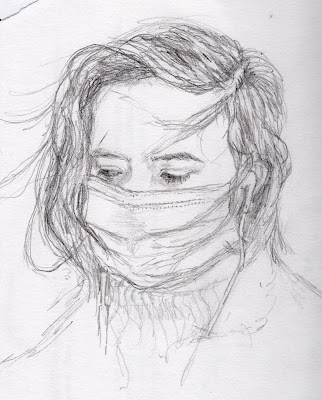
[Speaking of drawing, the art at the top of this post is by my younger daughter.]

—~—~—~—~—~—~—~—~—
Email me here. For a complete index of albertnet posts, click here.

Wednesday, November 30, 2022

From the Archives - Bits & Bobs Volume V

Introduction

This is the fifth installment in the “From the Archives – Bits & Bobs” series. Volume I is here, Volume II is here, Volume III is here, and Volume IV is here. I got the idea for this series from all the published writers who, when they run out of new material, basically print their own money by publishing old letters or diaries that had just been gathering dust. Surely they edit and polish the stuff though, and choose only the best bits, which is what I’ve also done with the following passages, from letters I wrote to my friends or brothers. I’ve provided, for each snippet, the locale I was writing from. Enjoy please enjoy.

(Below is a fairly representative photo from those days. You can tell from my grin that I either had no idea how foolish I looked, or just didn’t care.)


July 17, 1991 - Berkeley

Remember all the hoopla surrounding the solar eclipse? Well that was barely noticeable here in the Bay Area. We’ve had a dark sky for weeks: nothing but cloud cover. I have had the blahs for days, real bad. I can’t seem to focus on anything but the negative. I try to count my blessings, but when the sky is this grey for this long, nothing seems to satisfy. It’s like the Book of Ecclesiastes: “Vanity of vanities, all is vanity” (1:2) and “The eye is not satisfied with seeing,/ Nor the ear filled with hearing” (1:8). Of course, that narrator had it easy, because he was talking about all things “under the sun” and there is no sun to be had here. I just get so glum, I end up with songs like Pink Floyd’s “Dogs” in my head:

       So have a good drown
       As you go down
       All alone
       Dragged down by the stone

That was my feeling this morning when I looked outside and found another dreary day facing me. Even rain would be a nice change, but the sky outside is one of thick formless cloud cover, far too high up to break the monotony with rainfall. A day should ideally begin with a lovely dawn, breaking into a sunny yet cool morning, followed by a hot sun burning directly overhead at noon. This accomplished, the heat should taper off into a lazy sunny afternoon, ideally broken up by a short thundershower to set the scene for a slightly cooler evening and finally dusk. But for the last few days, nothing like this has transpired. Ten in the morning has been identical to noon, to 2 p.m., and to the evening. It’s been bland nothingness.

But then I looked out our sliding glass doors and was struck by something out toward the horizon. Out of a background of stony grey, I saw the island of Alcatraz, framed perfectly by the only structure that wears fog well: the Golden Gate bridge. I have seen Alcatraz countless times before, and never with so much as a second thought. But now it was the only brightly lit thing I had seen in days. Somehow the sun had found a loophole in the cloud cover and aimed itself right at the former prison, lighting it brilliantly. The scene looked like something out of The Wizard of Oz, with its emerald buildings shining as if lit from within. I grabbed the binoculars Dad gave me last Christmas and got the best look of Alcatraz I’ve ever had, as if the bridge and island were right in my backyard. That was the whole morning—only a few minutes long, and only out there on that island—but we had a morning nonetheless, and while it lasted “Dogs” evaporated and was replaced in my head with another Pink Floyd song, “A Pillow of Winds”:

        Green fields,
        A cold rain is falling
        In a golden dawn
        
        And I rise like a bird
        In the haze
        When the first rays
        Touch the sky
        And the night winds die

The appearance of this oddly localized shaft of sun was so brief, I thought I might sink all the way back down into my earlier despondency, but I didn’t. Somehow, that little taste of sunshine seems like enough to sustain me for a while. After all, this is California. The sun is bound to come out soon. Right?

August 17, 1992 - Berkeley

School starts in about a week. The realization that this is my final semester is slowly sinking in. Last night I had a dream I went to interview for a job with a former employer. I wore this light blue cotton suit with white vertical stripes that was totally inappropriate, and in fact looked pretty ridiculous. Some receptionist kept trying to turn me away because of my suit, and due to my lack of ability with the new word processing software, and the fact that I didn’t even have an appointment. I kept trying to convince her that I could learn the new software quickly, but she wouldn’t believe me. Finally the office manager recognized me from when I’d worked there, and told me someone would talk to me in a few minutes.

While I was waiting in the lobby, I realized my suit was stretched really tightly over my body. Unbuttoning the jacket (which had buttons all the way to the collar, making it even less appropriate for the business world), I was horrified to find I was wearing another suit jacket underneath it. Unbuttoning this jacket, I found not one but two dress shirts, one beneath the other. I even had two pairs of shoes: some giant white Nike Air Super Solo Magnum Team Force Court Flight basketball shoes, and underneath those, some more conservative black Reebok tennis shoes. I began to strip off all my clothing and sort it by appropriateness so that I could end up with one decent outfit. Just as I was down to my underwear behind the two piles, the president of the company walked out to meet me. Glancing at my watch, I realized I was ten minutes late for my first class, and since this was the first day of the semester, I would be disenrolled from college if I didn’t get my ass over there. I fled from the building, leaving behind all the clothes.

January 10, 1994 – San Francisco

I almost got shot. E— and I had driven all the way to Ventura to visit friends and arrived at like 2 a.m. Our friend D— lives on a little street called Bath which is in a fairly nice area, near the beach. Bath Street isn’t all that wide—parking along it is illegal—so it’s kind of like a little alley. We were parked temporarily while unloading and I was taking the bikes off the back of the car when a car drove by us really slow. D—, being new to the neighborhood, thought it was either a neighbor or somebody looking for directions, but the guy didn’t stop. He just drove on, down the dead-end street, and D— said, “Wow, that guy looked at me really funny.” I hadn’t actually looked; I was busy unhooking bungee cords (if you aren’t paying attention and one snaps you, it’s quite painful, you know). Well, after turning around the car drove by again, really slowly, and again I didn’t look. D— was curious, though, and looked in at the guy. A short distance later, the guy stopped and got out of the car.

I didn’t want any trouble, and have adopted a big-city policy of minding my own business, so I just continued with the bikes, unlocking them and juggling the Straight-Jacket and Bad Bones (which sound like handy ghetto weapons but are actually U-lock accessories). I could hear the guy saying to D—, “What’s a mattah, man, you ain’t useta seein’ dudes like me ‘round heah?” D— said no, and the guy came back, “Man, you lookin’ at me funny, man, like ya got a problem wit me or sumpin.’” At this point D— came back with a response which he will never live down: “I think you’re paranoid.”

I glared at D— at this point, but I still didn’t look at the stranger (perhaps out of fear of his thinking that I, too, was looking at him funny). Had I looked, I would have seen him pull a handgun out from his jacket as he yelled, “Paranoid? I’ll show you paranoid!” At this point, E—, who clearly possessed the most presence of mind of us all, rabbited. D— quickly backed up towards the garage door, and I continued to mess with the lock. Not having seen the gun, I simply locked the lock and tested its weight in my hand, evaluating its effectiveness in bashing in a human skull. I mean, hell, I’d never scrapped with a gun-toting lunatic before so it never occurred to me the guy was armed. I figured we had a minor altercation on our hands and we had him outnumbered. I was puzzled by D—’s obvious terror as he smeared himself up against the garage door with his arms up, saying, “No problem, man, no problem!”

I looked over, finally, at this point, and the man was bending over. Not having seen the gun, I thought he was picking up something off the ground to throw at us. I was just standing there, like a great big dopy-looking target, trying to remember if I’d packed my mace in my bag. (It’s actually this new jalapeno pepper spray, which has now been made illegal in the state of California. Ironic, isn’t it, that handguns and automatic weapons are legal here, but harmless self-defense sprays are not?) Anyway, I finally realized what was going on: the guy was bending over to get a clip out of his sock. He loaded his gun and pointed it right at D—, and by this time there was nowhere for me to go. You don’t want to move too quickly, you know, when a lunatic is pointing a loaded gun.

Oddly enough, in the moment I didn’t feel that scared. I was thinking to myself that if the guy really wanted to go out and shoot someone, he’d have loaded his gun before leaving the house. Keeping the clip in his sock and reaching down to get it seemed kind of theatrical. Of course this was probably pure rationalization—my brain’s desperate effort to keep panic at bay by pretending the situation wasn’t that dire. Meanwhile D— just kept saying, “No problem, man, no problem!” until finally the guy got back in his car, where his woman had been waiting (I now noticed), and they drove off.

At that moment, I realized the gravity of the situation, and my teeth began chattering uncontrollably. We ran into the house, where E— had scared the daylights out of D—’s wife and her friend who hadn’t recognized her and wondered why this strange woman had suddenly burst through the door. E— had looked for a phone but failed to find once since the only one in sight was a crazy transparent terminator-style phone that look like a science project. It was at least five minutes before we were able to actually think straight, fetch the phone, and dial 911. An officer arrived within minutes, and we gave him a description of the man. (Interestingly, I had somehow remembered the car as a white ‘70s boxy thing, whereas D— was saying it was a dark, modern one—but I kept my mouth shut. I mean, the man had had a gun and I didn’t even realize it: I was clearly not star witness material.)

The cop said, “You’ll be interested to know that a man of the same description robbed a Motel 6 a few blocks away from here about two minutes before you called. We had four officers in the area but nobody got him.” I guess if we’d called earlier, they might have caught him in the act. On the other hand, people might have been shot.

—~—~—~—~—~—~—~—~—
Email me here. For a complete index of albertnet posts, click here.

Monday, January 17, 2022

COVID-19: Helping Teens Cope

vlog

In case you are suffering a migraine, or your contact lenses are too strong, or you can’t find your reading glasses, or you just plain hate to read, I am offering this post as a vlog. You can even blindfold yourself and pretend it’s a podcast. On the other hand, if you can’t stand the sight of my face and/or are teaching somebody how to read, scroll past the video ... the entire text awaits. Don’t miss the artwork from my daughter Lindsay!

Introduction

Obviously the COVID-19 pandemic is a grind for everyone. It’s tempting to think teenagers have it easier since they’re invincible, invulnerable, and impervious to disease, or at least think they are—but actually, the pandemic could be especially hard on them. Why? It’s because they’re in the very flower of life as opposed to those of us who kind of gave up long ago and are just running out the clock.

If you’re a parent of a teen or young adult, perhaps this post will help you support your child. And if you’re not a parent, but have a taste for schadenfreude, you should read on, too.


The pitfalls of COVID for the young

According to this article, typical teens’ reactions to global crises like the pandemic include feeling “stressed or overwhelmed, frustrated or angry, worried or anxious, restless, agitated, … teary, sad, fatigued or tired,” and they could be “losing interest in usually enjoyable activities or finding it difficult to feel happy.” Unfortunately, these are also totally normal symptoms of being a teenager, so it’s really hard to tell how, or whether, the pandemic is affecting your teen or young adult.

Some problems are undeniable, of course. Outside of the anxiety and stress, there’s the simple matter of not getting to hang out with friends, or doing so with all kinds of restrictions. Resentment can develop when your kids’ friends have cooler, more permissive parents. On top of that, kids are understandably just sick of everything: the online schooling, the distancing, the masking, and the hand washing. Yes, we parents are sick of these things too, but at least we grasp that they’re actually important, since we don’t have delusions of invincibility.

So what is to be done? Articles like this one and this one recommend getting more exercise. This is a fine idea, except that a) it’s so eye-rolling-ly obvious, and b) the likelihood of its adoption is empirically low. According to this article a study has just found that only 1 in 10 teens is getting enough exercise right now, vs. the (already poor) figure of 16 percent who were exercising enough pre-pandemic.

Can parents help? Well, you could start by setting the right example. If you suit up and go running or biking, there’s a chance your kid will notice. Better yet, try taking an online Zumba class with your kid. That should help, I think … though I’ll admit I haven’t tried it. (I just mentioned it because I like the word “Zumba” and am hoping it’ll help this post show up in Google searches.) My wife and I did do an impromptu dance party today, which got our eighteen-year-old giggling quite a bit, while also introducing to her the novelty of actual rock music coming out of actual speakers instead of just earbuds. (I would explore this dance party concept even more, except that my wife made fun of my moves, and my kid gets gobs of exercise anyway.)

Self-care

As pointed out by this website, you should “teach self love,” starting with self-care. Unfortunately, the advice is given only via an infographic so there aren’t actual instructions, but I have a few suggestions. First off, it’s not enough to just advise self-care; you need to practice what you preach. I’m talking about that stupid COVID beard you’ve grown. It doesn’t make you hip, and there’s too much grey in it, and it lowers the effectiveness of your KN95 mask, for crying out loud. Shave it off already. And if you’re a mom, keep your legs shaved and make sure your daughter notices. (Note that leg-shaving can be a highly political matter; if you leave your legs hairy on purpose, point this out, and celebrate it. Tell your daughter, “I want my legs lush, like I’m a coed at UC Santa Cruz. And I always shampoo them when I shower.”)

Self-care isn’t limited to nice things we can do for our bodies; it’s also about the damaging behaviors we should avoid. Remind your teenager not to seek comfort in drugs or alcohol. According to the CDC, “These substances can weaken your body’s ability to fight infections, and increase the risk of certain complications associated with COVID-19.” Beyond that, it’s obviously harder to remember to wear a mask or socially distance when you’re totally tripping or drunk off your gourd.

You should also bear in mind that there’s more to self love than self-care. Self love can include a bit of good old fashioned vanity and/or self absorption. Maybe it’s time to finally give your kid that “DAMN I’M GOOD” bracelet your dad bought back in the ‘70s and passed down to you.

But don’t go overboard with self love! When people are suffering, there’s always the risk they’ll become insufferably self-absorbed. It’s important to try to remind them of the larger world around them and the unique problems others face. Start with the fiscal waste of the pandemic. If your child is in college, bemoan the already egregious cost of their tuition and dorm fees, which are basically being totally wasted. If your kid is in high school, talk about the heinous property taxes you pay to support that school, and how it’s all for naught because so little actual learning is happening. Explain how you’re being robbed blind on these KN95 masks, and how rising inflation, fueled by supply chain problems, could be the next great economic crisis. (In general you should try to work the phrase “supply chain” into conversation whenever possible, because it totally improves your cred.)

How to draw teens out about COVID

Where can teens and young adults go for advice, sympathy, or just someone to vent to? Certainly not their friends, to whom they have to present a brave, stoic front. And their teachers—overwhelmed with technical issues such as remote learning, COVID tests, and contact tracing—clearly don’t have time. Once again, the job falls to us parents, as if we asked for this. So the question becomes, how do we get our kids to open up?

Here’s one way: announce to your kid(s), “Let’s all sit down in the living room. Your father and I are creating for you a safe space to share your feelings while we listen without judgment.” It might take a moment or two before your kids open the floodgates, but as long as you just sit still, with your hands in your lap, gazing at your children with pure love and devotion spread across your face, they’ll launch right in before you can say “mindfulness training.”

Naw, I was just screwin’ with you. Of course that would never work. Let’s turn to the experts for suggestions. Dr. Lisa Damour, a psychologist and school counselor, advises here that you should “make space for relief and joy.” Sounds easier said than done, eh? I for one have no idea how such a thing could be accomplished. But remember, our kids are smarter than we think. Why not put it to them to figure this out? You can say to your son, “Brent … I know this pandemic is hard on you. You’re hurting, I get that. But the thing is: you need to make space for relief and joy.” Then just watch as he tries (or doesn’t even try) to keep a straight face. Smirking, giggling, or outright laughing at you isn’t exactly the same thing as joy, but it’s somewhat close. Obviously this is a short-lived pleasure, just a little burst, so follow it up with another: use the word “quaranteenagers” in a sentence. Then hit him with the one-two punch of “lean in” and “show up.” He’ll be in stitches.

It’s crucial to show your support by communicating with your children on their own terms. It’s tempting to hover over them dropping bits of advice here and there, like shaking bacon-bits on a salad, but remember, lots of modern kids are vegetarians, figuratively speaking. (Okay, that metaphor got kind of screwed up … sorry.) Suffice to say, words are not necessarily what our kids need. Gestures, behaviors, and actions “speak” louder. For example, my younger daughter doesn’t exactly gush when I meet her eye and say, as sympathetically and authentically as possible, “How are you doing?” But recently I bought her a totally sweet camera and she really responded well. I mean, she didn’t talk too much (other than to say thank you, having not been raised in a barn thank you very much), but weeks later, she spontaneously kissed my forehead. (I’ll confess I flubbed the moment, because as she approached I instinctively recoiled, but so long as I remain gainfully employed, I’ll surely have other opportunities like this.)

Managing our own distress

This helpful article reminds us not to snap at our teens, pointing out that “this is good advice at any time, but it’s particularly important right now.” Well, this is a simple enough concept, but what about us parents … aren’t we totally stressed too? What if venting like this is necessary for our own coping?

It’s tempting to ignore this “don’t snap” advice as wildly unpractical, but actually, there is a way forward. If you have a cat, you can berate her as a proxy for your child. “Now Fluffy,” you can say, “you’re an absolute disgrace. I’ve seen you washing, which looks life self-care, but I know where that disgusting tongue has been. And I can smell your cat box from here. Ugh.” Fluffy couldn’t care less (unless you raise your voice, which could startle her). Best of all, you’ll feel terrible after admonishing that innocent creature, so you’ll give her all kinds of love, which makes you both feel better. (Well, okay, maybe it only makes you feel better, but still.)

Note: do not try this with your dog! As tempting as it is to say, “BAD Waldo! You are a VERY BAD DOG!” you simply mustn’t. Dogs are very sensitive. At least, I think they are … I’ve never had a dog. Anyway, if your pet happens to be canine, leave the poor animal alone. Go out and buy one of those Hasbro Ugly Dolls, or even a Yoda action figure or something, and just chew its freaking head off! Tell it how awful it is, how useless, how selfish, how lame. You’ll feel a lot better, and if you don’t, then alternately abuse and comfort the doll, in kind of a lather-rinse-repeat style. Or not. I actually have no idea how/if this would work. Forget I said anything. (Man this pandemic thing is hard!)

Confronting fear

Perhaps the biggest problem for teens isn’t how to wash their hands more effectively, or how to best maintain social distance, or how to tolerate the 0.5-second-long pin-prick of being vaccinated. The real issue is their fear. This kind of global crisis has never before happened in their lifetimes, and none of them ever paid attention in History class during that unit on the Spanish flu pandemic of 1918. (If my teachers even covered that, I sure as hell wasn’t awake.)

So you need to confront this fear thing head-on. Convey to your teenager that it’s okay to be scared. Note that teens don’t want to be preached to, so it’s important to let this sentiment seem like their idea. The best way to do this is reverse-psychology. Say to them, “Oh, are you scared? Can’t handle a little stay-at-home? Totally freaked out just because your little world got shaken up a bit? Oh, is that needle gonna hurt too bad?!” (Stop short of the old “Chicken! Braaawk-brak-brak-braaawk braawk!” bit because they won’t get the reference.) When your kids push back and say, “Hey, Dad, it’s a global pandemic, I have every right to feel afraid!” then you know they’ve become true believers, because this will be coming from them. (Just don’t ruin the moment by pointing out that “global pandemic” is technically redundant.)

The tech dilemma

Remember my comment earlier, about the problems that can arise when your kids’ parents are cooler and more permissive than you? Well, you should be careful when your draconian policies extend to the virtual world, with restrictions on your kids’ Internet use. Some experts, such as the authors of this article, are actually advising parents to lighten up on “tech time” restrictions. And yet, others (like this one) warn that too much social media, and too much COVID news, can really bring your kid down. Here’s one way forward: if your WiFi equipment is sophisticated enough, consider removing the time-of-day restrictions, but implement a DNS blacklist so that the only site your child can reach is albertnet. This blog is like 99% news-free and all the hateful comments are directed at me … so it’s a safe space on the Internet for your teen.

Surely some experts would find my solution extreme, and that’s fine … but why haven’t they addressed the increase in bullying and other insensitive behavior our kids can expect as their so-called friendships go virtual? It’s much harder to be sensitive online than in person … meaning the pandemic will just compound the problem. If you’re lucky, your kid will mention to you the anguish that is gradually building through this ongoing fusillade of small-scale abuse. This is the time to “be there” for your kid, to make sure he knows you’re on his side. Tell him, for example, “Really, Ricky posted that? Well you know what? He’s an asshole.”

What about videogames? I’ve heard they’re a great way to blow off steam. Should parents be worried about violence and other thematic content? Probably not, so long as their kids don’t actually play these games. I know almost nothing about them, but a little bit of research turned up a game called Boyfriend Dungeon, which (according to this Wikipedia article) is “a role-playing game mixed with a dating simulator, in which the potential romantic interests are generally male characters that can turn into weapons that can be used within dungeons,” with “stalking and emotional manipulation of the player-character.” With games like this, who needs a deadly virus?

Now, I’m probably not being totally fair here, since my knowledge of these games isn’t firsthand. A neighbor of mine was going through a divorce some years back, and I asked how his son (aged eight or so) was doing. My neighbor replied, “Oh, he’s got his [World of] Warcraft, he’ll be fine.” I am happy to report that this kid, who’s probably in high school now, hasn’t yet opened fire on anybody. So I suppose you should go ahead and allow gaming to be your child’s pandemic panacea if that seems to be their thing.

What if the pandemic is helping your kid?

Now, is it possible your child is feeling stress or guilt because the pandemic is going just fine, and in fact has its benefits for her? Of course! This article acknowledges that some kids may have “commitments they didn’t want to keep or some people (classmates, teachers, coaches) they didn’t want to see, so this crisis might actually bring some relief,” but assures us this doesn’t need to be seen as a problem, since “it’s also OK to be happy.” The article suggests you tell your kid, “There’s no right or wrong way to feel.” I actually disagree with this (for example, it’s wrong to feel compassion for anti-vaxxers, those fricking savages) but the overall idea is a good one. You can tell your kid, “Look, the reality is, your standard of living has always been higher than that of most of the world’s population; this country was built on slavery and the eradication of the native population; and all your clothing and electronics are made in overseas sweat shops by underpaid children with no benefits. So there’s ample precedent for you to come out just fine while others across the globe are suffering. Why worry about that now? Just be happy that you’re happy!” I’m sure she will feel much better.

Your teen has COVID … now what?

If your teen gets COVID, he or she is bound to feel pretty humiliated, given all the haranguing you did about staying safe, and all the resources available that he or she obviously failed to take advantage of. In this instance you need to take an honest look at how your teen is doing overall vs. yourself. If you’re in an even worse way, then it may be time to go ahead and rub it in, saying, “I told you so!” and “You should have listened!” and maybe even “You’re getting what you deserve!” This will of course be devastating for your child, but it’ll feel so good for you, it’s probably worth it. On the other hand, if your kid has been suffering even more than you, then his or her feelings come first and you need to do whatever is necessary to prevent guilt or shame from surfacing. “Whatever is necessary” basically means saying, with utter sincerity, “Hey, don’t feel bad—it happens to the best of us.” Now, “sincerity” in this case means you speak from experience. That’s right, it’s time to go get COVID. Head down to an indoor megachurch service, replete with a full choir, preferably in Houston, and don’t you dare wear a mask!

But seriously…

Okay, I had a little fun here, but you might be thinking, “Hey, this is no laughing matter.” I would politely disagree—to me, almost everything is a laughing matter—but I will concede that we should take this issue seriously. Perhaps this post at least has you thinking about how the pandemic affects your teen, and if nothing else I’ve linked to ten perfectly sincere and potentially helpful articles.

More reading on the pandemic

—~—~—~—~—~—~—~—~—
Email me here. For a complete index of albertnet posts, click here.