Showing posts with label male insecurity. Show all posts

Tuesday, August 16, 2022

10 Reasons Keurigs Are Annoying

Introduction

When I’m staying in a motel and they have a Keurig machine, my first reaction is positive—as in, oh good, it’s not going to be one of those terrible little no-name coffee packets that’s like a giant tea bag and brews a terrible brown liquid that is barely coffee. But then when I actually use the Keurig, I’m reminded of all the ways I find it annoying … and that’s even before number nine on the following list has happened (or when it doesn’t). Here is my top-ten list of why Keurigs are annoying, followed by a little surprise!


Reason #1: the landfill problem, obviously

I just bought Melitta #2 cone filters recently, in a pack of six boxes with 100 filters each. And in doing so, I thought (with a gasp), “Didn’t I just buy 600 of these fairly recently?” Well, it’s not so bad because it was actually last October (and yes, I know this because I bought them from Amazon, so sue me). Besides, these are all non-bleached, brown (aka “whole wheat”) filters, and I composted every one of them after use. So I’m not doing so badly. But imagine what 600 spent K-Cups would look like, dotting a landfill. Pretty depressing.

As documented in this Atlantic article, the inventor of the Keurig machine and its K-Cups now regrets he ever come out with it, and doesn’t use a Keurig himself due to the waste. As of 2015, 13 billion used K-Cups went into landfills every year. As of 2020 the company claimed to finally have a fully recyclable cup, but only if you were willing to separate the plastic, paper, metal, and coffee grounds. As the Atlantic put it, “A Venn diagram would likely show little overlap between people who pay for the ultra-convenience of K-Cups and people who care enough to painstakingly disassemble said cups after use.” Keurig—and this was long overdue—has recently made this process easier but they advise to “check locally” as the cups are “not recyclable in all communities.” I kind of doubt many users bother. And even if they do, recycling still requires energy; it’s never as good as composting. And all this waste is for what? Saving the effort of brewing coffee because it’s so, so hard? Would this product be as popular if it were branded Fisher Price Baby’s First EZ-Brew Coffee Station?

Which brings me to my next reason…

Reason #2: cheesy faux-Euro branding

Keurig sounds European, and it’s supposed to. As in, the idiot-proof operation and wastefulness is okay if it’s European and sophisticated. The full name of the company is Keurig Dr. Pepper, and it was formerly known as the Dr Pepper Snapple Group. So it’s as American as sugary soft drinks and that undrinkably cloying non-tea. Further proof of its heritage is that you can “brew” blueberry, caramel vanilla, and even French-toast flavored beverages, which is as grotesquely American as Starburst “fruit” chews. The Euro name really kind of insults our intelligence, doesn’t it?

Reason #3: large, ugly, single-use appliance

A nice stovetop or electric kettle is compact, looks great, and has multiple uses beyond coffee, such as making tea, pre-heating your thermos, getting a head start soaking a pan or your stovetop … you get the idea. Here’s a picture of the kettle I use (or more specifically, of the one I bought for my brother, and his reaction to it).


Like so many kettles, it’s easy to pour from due to the perfectly designed spout (which, by the way, cools water to the perfect temperature for brewing coffee or tea). It’s a marvel of minimalist engineering.

A Keurig, on the other hand, is totally lame: it’s large, hi-tech-looking, plastic, and does exactly one thing, which is to prepare a single serving of coffee (or artificially flavored offshoot) for one person in one size. Which brings me to…

Reason #4: reinforces self-centered individualism vs. hospitality

Half the time I make coffee, it’s for two. I do pour-over drip coffee so we’re talking two mugs with two cone filters, side by side. (My wife does half-decaf, or else I’d just do a Chemex carafe.) This small act of thoughtfulness is part of why we’re still married after 28 years. And when I have houseguests, rising early and brewing a big batch of coffee for everyone gives me, and them, a simple pleasure. Now imagine you’re somebody’s houseguest and you wake up to the delicious smell of brewing coffee, only to make your way into the kitchen and discover your host only made it for himself. “Keurig’s on the counter,” he says from the next room. You dig through a basket of K-Cups looking for one that isn’t “Vanilla Skyline” or “Maple Sleigh” flavored, and get to work making yourself a cup. Sure, you’re glad to have coffee, but isn’t this so much less gezellig? Needless to say, gone are the days of having somebody come refresh your cup here and there. It’s every man for himself with the Keurig.

Reason #5: leads consumers further down the path of convenience addiction

The Keurig inventor, explaining why he no longer uses the product, concedes that “it’s not like drip coffee is tough to make.” Until about 2008, making coffee the old way was just not a big obstacle for people. But a lot of Americans are fricking lazy, which is why about one in three American homes now has a Keurig machine. Keurig is as guilty as the microwave popcorn industry in this regard. If you train consumers to believe that all manual effort is to be avoided, the Keurig is what you get. If Keurig made food it’d be Cup O’ Noodles.

Reason #6: fewer coffee purveyor options

I was disappointed when I saw that my favorite coffee roaster, Peet’s, had capitulated and started selling their product as K-Cups … but then, Peet’s is pretty mainstream at this point. But what about these smaller roasters who are fair-trade, environmentally focused, all-organic, and probably more responsible in ways I don’t even appreciate? Now they have to compete with a product whose gross waste (see above) is fundamentally incompatible with their brand and operation. I’d rather not give these smaller outfits another disadvantage in trying to survive.

Meanwhile, I’m not an expert on coffee or anything, but I’m assured by all my coffee-aficionado friends that the best cup of coffee comes from beans that were ground to order. In other words, coffee stays fresher when purchased as whole beans. Obviously this isn’t an option with Keurig. They put ground beans in the K-Cups and vacuum seal them with nitrogen, which seems like a less effective (and creepier) freshness strategy.

Reason #7: appeals to male insecurity

This is probably the toughest assertion for me to support, but did it ever seem to you like inserting the K-Cup into the Keurig’s jaws and them shoving them closed is a lot like chambering a bullet in a rifle? Does this remind you of the little magazine of blades in a Gillette Sensor razor? Isn’t it kind of sad that insecure men, when using an idiot-proof product like this, are reassured by these transparent appeals to their masculine vanity? A real man uses a proper double-edged razor and will happily disassemble and troubleshoot his coffee grinder if it ever gets jammed. (And you thought the disposable K-Cups were the only imitation of the so-called “razor and blades model” that Keurig stole from Gillette and their ilk!)

Reason #8: just one word: plastics

As described here, some years ago I searched really hard for a kettle that didn’t have any plastic, because I don’t like the idea of all that heat and all that plastic getting together for my twice-daily coffee ritual. Sure, the links between plastics and health problems are not fully understood, but why take any risk? K-Cups get really hot during brewing. On the off chance this isn’t good for you over time (e.g., over perhaps 700 cups a year), why not play it safe? (I’ll note that my current kettle, made by Chantal, is completely plastic-free. So is my mug. And my spoon.)

Reason #9: isn’t actually foolproof

When a Keurig works right, its operation is very simple: jettison the spent K-Cup (like an empty shell, per #7 above), load and chamber the new one, pour in the water, place the mug, and press the button. But have you ever had this sequence disrupted? I have, quite recently. I discarded the spent K-Cup, slapped the new one in there, poured in the water, and then discovered the Brew button wasn’t lit. The Keurig wasn’t plugged in! Because my wife and I were staying in an old motel with very few electrical outlets, she’d borrowed this outlet to charge her phone. Now what? Well, if this happens to you, here’s what to expect: ten very frustrating minutes from now, you’re going to have water all over your counter, water remaining in the Keurig machine, four wasted K-cups, and two cups of screwed-up coffee—one impossibly strong, the other impossibly weak. Um … somebody refresh my memory as to why traditional brewing is so inconvenient?

Reason #10: eliminates a pleasant ritual

I generally work from home. In the afternoon, usually around three when things have quieted down, I like to take a coffee break. I fill my kettle, start the water heating, and then set about grinding the beans, with a quiet, compact hand-powered burr grinder. This takes a few minutes, almost exactly as long as it takes for the water to boil. Then I place the filter in the pour-over cone, pour in just enough water to wet the beans, and then wait a little less than a minute before proceeding to pour water over the entire cone, slowly moving the kettle spout about in a circular motion per the established best practices of the pour-over method. It’s a calming, mildly absorbing, and pleasant ritual, and it takes some time—meaning I actually get a break from work, which is half the point. Why eliminate this? Is it always better to spend just twenty seconds with your stupid plastic machine, go back to your desk, and then fetch the coffee a couple minutes later? From the standpoint of work-life balance this strikes me as the beverage equivalent of eating a Cup O’ Noodles lunch at your desk while working on that spreadsheet some more. Lame!

And now, the surprise!

I know this has been a pretty negative post, and I also know that that in general we could all use some more positivity in our headspace. With that in mind, I’m thinking of implementing a new conversational rule with close friends and family: if somebody waxes negative, they must then shift gears and make three positive statements, such as things they’re grateful for, etc. This will keep us all from getting down and/or cynical. So, I’m now going to offer my favorite three things about coffee:

  1. It jump-starts my brain in the morning, obviously
  2. It just smells so darn good, whether you’re inhaling the aroma of the beans, the grounds, or the final product
  3. Even people who don’t particularly like coffee (e.g., my kids) enjoy the smell of it brewing, like aromatherapy

—~—~—~—~—~—~—~—~—
Email me here. For a complete index of albertnet posts, click here.


Monday, January 24, 2022

From the Archives - Bits & Bobs Volume II

Introduction

It’s another slow news day. So, taking a cue from Can’t and Won’t, a collection of very short stories, essays, letters, and recounted dreams from Lydia Davis (click here for details), I’m assembling and posting some excerpts from some old letters to my brothers. (My first set of these is here.) These bits and bobs should be better than actual diary excerpts because at least I wrote them with an audience in mind, so I had incentive to make them good. I’ve provided, for each snippet below, the locale I was writing from.


April 24, 1989 – UC Santa Barbara

I went to see this movie, required for my English class, in one of the lecture halls on campus tonight. I planned to hit Gold’s Gym afterward since it was closed at 6:00 this morning when we rode down there (they said due to “water damage,” whatever that means). Anyhow, the movie’s supposed to be at 7:30, but the bozos can’t figure out how to lower the screen. They spend twenty minutes on that. Then, they can’t figure out how to turn off the lights—another ten minutes down the drain. Then, for twenty more minutes they can’t get any sound for the movie. Meanwhile I’m sitting next to this funny looking guy and this stupid girl with him who’s staring at the ceiling and laughing at everything and reminding me of one of one of the groupies I’d have if I were a rock star. Out of the blue, the guy turns to me and says, “You want gum?” Is it okay to accept gum from strangers? It’s Extra gum so I take the risk. It’s really rubbery, really slippery, good for blowing bubbles. Finally, after forty-five minutes they get the movie going. Halfway through, I blow a bubble a bit too aggressively and the gum goes flying out of my mouth, and you know what? I never found it! I was really slouching, with my feet up on the seat in front of me, so I was sure it landed on my clothes, but it was nowhere to be found. Not on the floor, my clothes, anywhere. Gone. Vanished. Anyhow, the movie was great but needless to say I didn’t have time to lift weights afterward.

I’ve got some new music. First of all, and don’t scream, I’ve been turned on to rap music by Captain John Pelstar. So I’m getting into Kool Moe Dee, Public Enemy, and Ice-T. You can hate me if you want, but once you start listening to this shit it’ll probably grow on you too.

Jesus, what the hell am I doing? I’ve gotta read Huis Clos (aka No Exit) by Sartre, in the original French; memorize about 4.5 billion vocab words for same; and write a 6-8 page paper on a 400-page book! I’ve got a final exam on Friday, on Saturday, on Monday, on Wednesday, and the following Friday! Holy shit!

But wait, there’s one more thing I gotta tell you. I’m spreading a new rumor through the cycling team. The rumor is: we’re being sponsored by Club Tan this season! Unlimited free tanning for everybody on the team! But you didn’t hear it from me! What’s scary is we’re scraping so low now for sponsors that everybody actually believes this. I told Mike B–, who’s on the sponsorship committee, and even he believed it! Now that he knows it’s just a BS rumor, he’s been spreading it around too. By the time the season rolls around, everybody will “know” about it. Shit, I really gotta go.

October 28, 1989 – Isla Vista

So I’m riding with Brett, a really cool guy on the cycling team (aren’t they all) and we’re exiting Highway 101 toward Goleta. The exit is long and uphill, and we’re going really slow because it’s a rest day. We pass this racer type, wearing some fancy Rincon team outfit, and we say hi but she doesn’t even acknowledge our existence. So we keep riding up the hill, and at the top there’s a stop sign where we turn right. I always run it, since there’s never any cars there. In fact, I once ran it right in front of a cop and he didn’t bat an eye. It’s that much of a blow-off. So I’m behind Brett, and oddly enough he actually starts to slow down. So I decide to go around him on the right, and no sooner do I start to pass him than the Rincon girl comes surging up the right side, without warning, almost plowing into me. Stunned, but still unwilling to brake, I decide to go around Brett’s left side instead. As I’m coming around, I look again at the girl, like, “What is she thinkin’?” Then, I hear a noise behind me. I look over my left shoulder and this truck is suddenly bearing down on us. No problem, he has plenty of room, I think. So I look forward again, and to my horror, Brett has slowed down even more and I’m hopelessly hooked on him. I have nowhere to go because of the truck, and my bike seems to have locked into his somehow. My bike gets pulled out from under me, and my butt is falling towards the rear wheel. If my butt were to land on the wheel, it would drag my balls into the brake caliper and drag me along like that, ruining my chances of ever being a father. In the nick of time, I manage to pull my right foot out of the toe-clip and stand up on it, though the bike is still being dragged along, and my left foot is still in its pedal. My left hand is holding onto the top of the handlebar, and I’m sliding on my right foot now, with my right arm swung high like a cowboy on a bucking bronco. To give you a better perspective of how grave the situation is, I should perhaps mention that the right side of the handlebar is dragging on the ground, while my puny left arm is holding the bike up as I watch my brand new Dura-Ace Integrated 8 rear derailleur coming precariously close to hitting the asphalt. I also need to protect my precious Dura-Ace right brake lever so I’m yarding on that handlebar with all my might. I slide like this for some fifteen feet, before Brett’s bike finally lets go of mine and I grind slowly to a stop. Total damage: to body, none. To bike, three inches of torn Benotto tape valued at 95 cents. (I fixed it up with electrical tape; I don’t use that part of the handlebar anyway.) I can’t believe I didn’t go down; indeed, Brett said later he was just waiting for the terrible scraping sound and my blood-curdling scream. So the end result was that disaster was once again narrowly averted, making me more cocky than ever.

October 31, 1990 – Berkeley

The owner of the bike shop has got a really cute kid, like eighteen months old. The wife brings him by daily. He already seems intrigued with the bike parts, and likes to drag a floor pump around the shop with him. He’ll hold the hose up to his face and point the handle towards you, so you pump it and give him a blast of air. This makes him giggle like crazy. Every now and then he’ll wander into the shop area and look up at me and say “Papa?” Today I said, “Can you say Dana?” and he did, the little rascal. Then he took a few swipes at a bottom bracket with a screwdriver, which is about the level of proficiency of most of our mechanics, so I figure he’ll be doing spot repairs within a year and everything else before kindergarten. That’ll be good for the shop, because he’ll be free to work full time unlike us college kids who only do 10 or 12 hours a week.

September 12, 1991 – Berkeley

So I’m biking down Bancroft, a street that borders the campus to the south, and I see this young female student being heckled by a homeless dude in army fatigues. He’s in the street spitting on a car (presumably hers), and she’s across the car on the sidewalk, and in a rage she throws this jar at him. Of course it misses, and hits the ground like a foot from me, sending broken glass flying across my legs. In shocked disbelief I watch as the homeless dude runs around the car at her as if to attack her, but before I can see what happens this car behind me, totally oblivious to the mêlée, starts honking at me and I have to get out of the way. I tell you, this is a weird place.

September 22, 1993 – San Francisco

Planetary Gear is a kinda dumb name for a really cool bike shop. It’s this tiny, cramped place with a giant Simplex clock on the wall, posters of great racers of the past, and old antique bikes everywhere. All kinds of ancient celeste-green Bianchi framesets, these cool Dutch Mary Poppins bikes like Geoff’s probably riding these days, old Gazelles and Allegros and an occasional Basso. It definitely has that old, retro Euro flavor. Not a click shifter or clipless pedal in the place. The owner, Grant, is this youngish looking guy, as Euro as his shop, who coolly dangles a cigarette from his lips and looks at you with a curious, slightly judgmental look, his eyes twinkling boyishly like Mickey Rourke’s, as if he’s deciding whether to laugh at you or take your money or both. He’s an expert at maximizing the flash and panache of a tired old Italian road bike, and selling it for more than it cost when it was new and state-of-the-art. I’ve seen him really rip some people off, but I figure, heck, at least they’re not being ripped off on something lame, like one of those Allsop Softride monstrosities. Besides, he is selling the last vestige of Western Civilization; he should be well compensated for that.

I drop by every so often, but I never actually do any business. For the most part, my bikes are pretty modern. And then when I finally did go in on Saturday to do buy something—I needed a spring for the ancient Mafac cantilever brake on my commuting bike—Grant wasn’t even there. Some other guy was working who didn’t seem too with it. No shirt, no shoes, no service—and I mean the guy, not the shop policy. Anyway, he ignored me for a while, but after I stared at him long enough he finally said, “Yeah.” I asked if they had a Mafac cantilever spring, and I pointed to an old cross bike that, of course, had them. “For this brake right here.”

He smirked. “Yeah, I’ve got that, but I can’t sell it to you.” This seemed to please him and—oddly enough—me as well. “You gotta come in Wednesday or Thursday and talk to Grant about that,” he said.

          “Why,” I said.

          “Well, because … huh. Let me see your bike.”

          “It’s not here. I’ll bring it in Wednesday and show it to Grant.”

          “Yeah. Do that. Cause he’s real picky about where that stuff goes.”

December 11, 1995 – San Francisco

I started my new job today. They took me out to lunch to a really cool place. It was nice, but not exactly posh—very old-fashioned San Francisco-ey. Our booth was solid oak. There was a button on the wall that rang a buzzer to call our waiter. He was an old but spunky fellow with a mouth. Somebody asked if the lemonade was fresh squeezed; he returned with a glass of water and pointed to a bowl of fresh lemon wedges that had been on the table the whole time. “Make it yourself,” he said. Later, when somebody tried to order a chicken dish, he said, “Come back at dinner. We haven’t killed the chicken yet. It would be way underdone.”

Our discussion during lunch ranged from the industry and technology itself—which is sufficiently interesting that even non-dorks can participate—to the tale of a fellow employee who, when skydiving for pleasure, had a parachute failure. The failure, the raconteur explained, was of the “Mae West” variety: the cord somehow got flung up over the parachute, causing it to fail to fill all the way. The name derives from its looking like a bra. It is less drastic than another type of failure called the “candle,” which is almost always fatal. This colleague lived, but was in traction for a while.

September 18, 2008 – Albany/Boulder

Sorry to hear about [your daughter] Lydia’s bike crash. You can tell her the following story to cheer her up. On the day of freshman orientation [back in 1984] at Fairview High [in Boulder, Colorado], I somehow found myself in the position of getting a ride there from D—. But not in a car, of course, but on the rack of his bike. So we were flying down Greenbriar Blvd, where it drops down from Shanahan Ridge, and D—’s Dr. Who scarf was flying out behind him, and he let out a couple of whoops, for sheer joy. Suddenly, the weak part of my brain, the insecure part, the part that fixates about good First Impressions and whatnot, kind of took over, and I worried about what people would think, since I was starting at this new school that none of my junior high classmates were attending, so I had to make all new friends. What would my classmates think if they saw me on the back of D—’s bike? They’d probably think I was his bitch.

I decided I just couldn’t stay on there, on the rack of this bike piloted by Dr. Who. So I bailed off the back. The weak, insecure part of my brain is pretty stupid, of course, and neglected to notice that we were really flying. How fast? Well, it was a steep downhill, so we probably doing like 20 mph, and I’m thinking maybe even more. I mean, it was enough speed to start D— whooping, after all.

So, you can guess the rest. I didn’t exactly hit the ground running, but I sure hit the ground. I did one of those stage slides like heavy metal rockers were doing during that era, where I slid on the tops of my shoes and—more importantly—my knees. Just ripped those kneecaps right open, like you’d taken a planer or a rasp to them or something. (I was wearing shorts, unfortunately.)

So after that I was going around freshman orientation gushing blood from both knees. I considered for a moment that the girls might be impressed by my toughness and my stoicism, but of course they were just grossed out, I mean just totally disgusted. I’m amazed I don’t have scars from it. And of course I had to try to answer to D— when he asked, incredulously, “What did you do that for?”

I really didn’t know what to say. I guess I just shrugged. “Didn’t realize how fast we were going, I guess.” It was odd, though ... I felt somehow as though justice had been served. I felt like I deserved the pain and the public scorn, for thinking I was too cool for my friend.

—~—~—~—~—~—~—~—~—
Email me here. For a complete index of albertnet posts, click here.

Monday, October 27, 2014

From the Archives - Why Girls Dig Cyclists


Introduction

In my experience, there is not much overlap between the so-called “Greek system” (i.e., sororities and fraternities) and a college’s cycling team. Cyclists tend not to drink (at least during the season), and Greeks tend not to ride bikes. Thus, their paths almost never cross, except in class. This tale, which I just realized is a quarter of a century old, explores a rare exception to this rule.


Why Girls Dig Cyclists - May 4, 1989

You know that old stereotype that all sorority girls are luscious babes? Well it’s true. And you know the one about how they’re all airheads? Well . . . who am I to judge, especially when they feed me? And what are they feeding me? Spaghetti, of course. I’m a cyclist, so that’s pretty much all I eat. You may wonder how it came to pass that I’m dining at a sorority house. Well, wouldn’t you, if given the chance? My bike team pals and I are here for a benefit dinner. The sorority is raising money for a cyclist who was hit by a drunk driver and faces $1 million in hospital bills.

I suppose there are plenty of guys who would jump at this opportunity even without a spaghetti addiction, just to have a chance to chat up the sorority girls. After all, if you’re not in a frat, you may not have that many opportunities. That’s been my experience, anyway. This one girl in my French class seemed really into me until she asked what “house” I was in and I said some version of “none,” at which point her nose crinkled up like somebody had stepped in dog shit. That’s when it struck me that where sorority girls are concerned, for a guy not to be “Greek” is a real liability. (Or is it just me?)

Fortunately, I’m here with my teammate Randy, who is the right guy to hang out when you’re at a sorority house. He seems to know all the girls. I thought maybe this would lead to some introductions, but he’s too busy flirting. Myself, I’m too busy not flirting to actually flirt. I occupy myself noting the things that make this unassuming building a true sorority house. (Besides the hot chicks, of course.) For one thing, the lifestyle is really structured—look at all the charts on this bulletin board. Up top, we’ve got the “OVER 3.75 GPA” listing, and below that, the “OVER 3.00 GPA” listing. At the bottom is the voluminous “NEEDS MOTIVATION” list. Oooh, I’d hate to be on that one. Kind of like being in stocks.

Over here is a really unique list. Seems that when you’re in a sorority, they inspect your room every month and fine you if it’s not up to snuff. I’m not kidding! Here’s a sample (note that the names are approximate):

Bambi Barrette . . . . . . . . poorly dusted . . . . . . . . $ 2.50

Fifi Forbes . . . . . . . . . . not vacuumed . . . . . . . . . $ 2.50

Cindi Smith . . . . . . . . . . hole in wall . . . . . . . . . . $ 2.50

Julie Johnson . . . . . . . . . total mess . . . . . . . . . . $10.00

Why “hole in wall” doesn’t carry a heftier fine is beyond me. I figure if my room was a total mess, I’d go ahead and punch a hole in the wall to get my ten bucks worth. I wonder what it would be like if our landlord charged us fines like that? Maybe might look something like this:

S.H. Brickhouse . . . . . . . door torn from wall . . . . . . . . . . . . . . $50.00

S.H. Brickhouse . . . . . . . dirty dishes hidden behind fridge. . .  $10.00

S.H. Brickhouse . . . . . . stinky green sweats . . . . . . . . . . . . . . . $10.00

S.H. Brickhouse . . . . weird curly hairs embedded in soap . . . . .$10.00

(I used an alias in the above example. My roommate likes to go through my stuff and might find this letter. What would be the fine for snooping? And how much for a beat-down?)

There’s another chart on the wall: “WHAT’S IN/WHAT’S OUT.” The term “girls” is out, while “women” is in. The rest of the guidelines seem to concern the complicated political structure of the sorority, so I have no idea what they mean. Anyway, boys will be boys, and we’re coming up with a few really good guidelines of our own, which I can’t share with you.

The cooking is going real slow, so while we’re waiting in the hall, some of the sisters bring out Kool‑Aid and Honey Grahams. The Kool‑Aid is the standard summer camp mass-consumption recipe—one package of mix to ten gallons of water—but I’m really enjoying the graham crackers. They make me feel about ten years younger, since ten years ago is the last time I had them. I can see by the look on the girls’ faces that the sorority motherhood training is working. But as beautiful as these maidens are—and believe me, they are beautiful—nobody can serve up the graham crackers quite like a real mom.

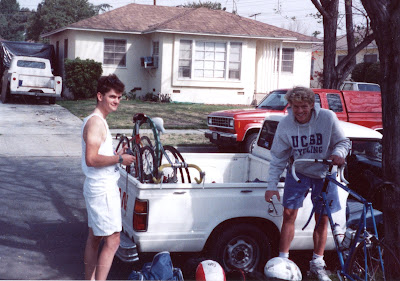
My friends and I are getting extra graham crackers. That’s because we’re wearing our “UCSB CYCLING” sweatshirts. I’ll bet you that each and every one of these girls is envisioning herself in one of these sweatshirts; that’s how cool they are. See the guy in the “Top Gun” aviator jacket? At over $200, it’s no match for what we’re wearing. These sweatshirts testify that yes, we are actual bike racers. Each day we live and breathe cycling with undiminished passion. And it is this passion that the girls want a piece of.

(Would we give these girls UCSB CYCLING sweatshirts? Naw. First of all, sweatshirts cost money. Second, though the sweatshirt’s bagginess is great for obscuring the underdeveloped upper body of a cyclist, we’d prefer that these girls—er, women—wore something more form-fitting.)

In the dining room, a girl is standing on a chair, shouting at everybody. I guess she’s the supervisor. “Sisters can’t eat!” she yells at two other girls. I think about asking, “Is that because of the sorority dieting policy?” but think better of it. Suddenly, I see a sign on the wall: “LOAD YOUR PLATE HIGH CUZ IT’S ONLY ONE TRIP THROUGH!” Oh my god, I’ve been had. I’d heard it was all you can eat!

Oh, well. I’ve gotten out of tougher spots than this. My three pals and I level the entire tray of spaghetti—and it was just put out. The people right behind us in line are griping, but those farther back (who have to wait anyway) are shouting encouragement. Suddenly, disaster strikes: plate failure. My paper plate is buckling, threatening to dump my entire haul. Without a moment to spare, the girl behind me in line gives me another plate. Then the sauce starts to run off the edge. Panicking, I bolster the leak with garlic bread, narrowly averting disaster. As I make my way to a table, I hear her say, admiringly, “What’s scary is that he’ll probably eat it all, too.”

The other diners have to stand there in line awhile longer waiting for the next batch of spaghetti, but I’m sure they’re not angry. They know my friends and I are representing the UCSB Gauchos in the West Coast Collegiate Cycling Championships this weekend. We command a lot of respect on this campus. In fact, if you look at the girls carefully (which you’ll do anyway, if you’re male), you can easily see how smitten they are. It takes a lot of guts to tackle such a big plate of spaghetti, I know. But hey, I rode today.

Does it seem like a lot of the girls have left? Yeah, they probably went out front to see if we rode our racing bikes here. Girls just dig our bikes. I saw this one eyeing my Dura-Ace eight-speed derailleur the other day, and I could tell she wanted to talk to me but was just too shy. That’s normal; we cyclists are so much bigger than life, our admirers get overwhelmed sometimes.

A couple of Randy’s lady friends at our table have finally gotten him to tell some war stories. We cyclists don’t like to brag (which is what describing our races frankly amounts to), but girls have a way with these things. “Yeah, it was so rad,” Randy says. “I’m coming around the last corner and suddenly I’m on the ground, just going, whooah, what happened. Last lap, too. Rotten luck.” The girls are obviously enraptured. “But, like, why did you crash?” one of them asks. I pick up the ball: “We crash because crashing is fun. It’s as simple as that.” The guys start laughing, but she looks concerned. “Doesn’t it hurt, though?” she asks. John takes this one. “Yeah, but we’re s’damn tough that, well....” He shrugs. John likes to flirt, but his intentions toward her are honorable. (If that sounds familiar it’s because I’m paraphrasing a fortune cookie.)
    
Speaking of cookies, that’s what we raid next. It’s really crowded up there, and I’m trying to get what’s mine when everybody starts laughing. “What happened?” I ask. This dude answers, “Some geek just ran into the sliding glass door.” Dammit! It’s Randy! I feel really bad for him ... after all, I did that once. But the door I ran into was a lot cleaner. Boy, I hope he’s okay. I guess he got caught up in all the excitement.

As we’re eating our cookies—Randy and I got enough for everybody—a girl walks by in some really interesting faux-cycling shorts. Most faux-cycling shorts look almost like the real thing but lack the chamois pad. But this girl’s shorts differ further in that they’re really short. Really, really short. One of the girls at our table says, “Oh my GOD! Look at those shorts! Those are so cute!” I know she likes them, and well, I do too. “Oh my GOD!” I echo her. Why does it sound so different when I say it? Language sure is strange. The guys are all laughing. She is not. But hey, it’s cool. I can tell she digs me. Of course she does—I’m a cyclist!

Friday, May 13, 2011

Doping Journalists, and "Un-Boosting"

NOTE: This post is rated R for mild strong language and mature themes.

Introduction

This month’s “Outside” magazine has an article written by a guy named Andrew Tillin who decided to cheat at bike races—by taking synthetic testosterone—so he could write about the experience. (Kind of like a stand-up comic going to a strip club “ironically” to “gather material.”) What perfect timing: in this post, I document my own cycling performance experiment, which is similar and yet opposite. Over the last two weeks I’ve tried a more novel approach: un-cheating.

I could call my process un-doping, but that term has been taken already, by me. What I mean by un-cheating is doing the opposite of blood-boosting. Blood-boosting is among the most popular methods by which pro bike racers cheat. It consists of taking blood out of your body during the early cycling season, letting your body replace that blood over the months, and then putting back in the original blood right before an important bike race. This gives you extra red blood cells, which means an enhanced ability to carry oxygen to the muscles. The methodology—which is both illegal and highly dangerous—is known to be highly effective.

What I have done, in contrast, is to have blood—specifically, two units of red cells—taken out of my body so that it can be given to somebody who really needs it: not a pro athlete, but an accident victim. (For details about my recent blood donation, click here.) While my body is gradually replacing the red cells, I experience a loss of strength that is the mirror opposite of what an athlete gains from blood-boosting or using EPO. Instead of measuring the performance increase of doping, I measure the performance decrease of its polar opposite. I’m really out to show the same thing as the “Outside” writer: that is, the delta between supercharged and worn-down, between doped and clean. I’m just coming at the matter from the other direction.

In this post I shall examine the existing literature on journalists doping to get their stories; describe my methodology for measuring my performance before and after giving blood; describe subjectively the experience of hard riding with two units of red cells missing; and document my performance during the two weeks prior to donating blood vs. the two weeks afterward. There are charts and graphs. Finally, I will describe the epiphany I’ve had in the process of this rather odd experiment. Surprisingly, the experience has given me hope for the sport.

A flawed journalistic approach

There is so much wrong with Andrew Tillin’s “Outside” article. The very first sentence shows how out-of-touch the guy is: “Now I know how Floyd Landis feels.” Like hell he does! Floyd Landis has lost everything. Landis dedicated his life to cycling; won (or appeared to win) the Tour de France, the greatest bike race on the planet; was the first rider in history to have his Tour title stripped for doping; went broke and suffered worldwide infamy by trying to defend himself; was humiliated all over again when he finally admitted his defense was a lie; was abandoned by his wife; has no obvious career prospects; and is being sued for defamation by the international governing body of cycling. Tillin, through cheating, has gotten himself a book deal, while only suffering the wrath of a few blogger-types, along with a slap on the wrist from USA Cycling. (They’ve banned him from competition for two years, but he was only a casual weekend racer anyway.) For Tillin to compare himself to Landis almost smacks of narcissism.

Tillin decided to dope with synthetic testosterone “in part because it was the same stuff Landis apparently used to win the 2006 Tour de France.” Tillin selected it, he says, despite the opinion he cites of some scientists who deny that synthetic testosterone would be particularly useful during a stage race. He snorts, “Could’ve fooled Landis.” What Tillin is not realizing or acknowledging is that Landis wasn’t just taking testosterone; by his own admission, he was also blood-boosting and taking EPO. The other reason Tillin chose testosterone, he says, is for “the general health effects it might bestow.” As I read, I began to think this was a guy who just liked the idea of jacking up his manliness, and used the journalistic project as an excuse.

This impression was only reinforced when I got to the part where Tillin drops a bunch of (local 45+ year old) guys in a race and thinks to himself, “Take that, you motherfuckers. There’s more.” That Tillin would even have such a thought is bad enough; to freely admit to having thought this is just bizarre. On what grounds does he deserve to call his non-doping rivals “motherfuckers”? He blames the testosterone for his outburst. Yeah, right. I highly suspect he’s just a jerk.

Then, Tillin ended up only getting seventeenth place in the race because, he says, he was “strong enough but not smart enough.” Well, isn’t smart riding the whole point of bicycle racing? In describing his motivation to do the doping experiment, Tillin cited his suspicion that many in the peloton were doping, complaining, “Scumbags. Who can hold down a job and ride like these jerks?” The answer is, people who have been racing for two or three decades and actually know what they’re doing. Ultimately, Tillin is just a wanker. He has no expert insight into the physiology of the sport and how much of his improvement was from the drugs. Perhaps his book gives a lot more detail than the handful of anecdotes in his “Outside” article, but based on what I’ve seen of this guy I’m not inclined to read it.

The other problem

The other problem with this article is that it’s not much different from another doping-journalist article that “Outside” already ran, back in 2003. Did the “Outside” editors forget about that article, or were they just counting on their readers forgetting it (like how “Cosmopolitan” runs the same “ten secret sex tips” article every other month)? In “Outside” magazine’s original doping-journalist article, a guy named Stuart Stevens spent eight months taking synthetic testosterone, synthetic human growth hormone, anabolic steroids, and EPO. His article provides a lot more detail than Tillin’s, giving us a few numbers (e.g., his hematocrit—a measure of the oxygen-carrying red cell concentration in his blood—went from a decent 43.8% to a stellar 48.3%). He also gives some nice history and background about doping.

But Stevens’ article ends up with the same problem as Tillin’s: Stevens doesn’t really quantify the benefit of all those drugs. Okay, he got all huge. He gained weight while his body fat percentage dropped. He felt fine, for once, following a double-century (i.e., 200-mile) ride. But the big race Stevens was working toward with all these drugs was a tandem race. He was sharing a bike with another guy who wasn’t doping! It’s almost like he went out of his way to make sure there could be no objective measurement of the benefit he got from the drugs. What a waste!

My approach

There are many differences between my approach and that of the “Outside” writers:

  • I did not do anything illegal;
  • I did not do anything unsafe;
  • My level of performance is not subject to the natural improvement that relative beginners can make so easily—after thirty years of competitive cycling I’m about as good as I’m going to get;
  • For many years I have been carefully documenting specific performance measurements, taken over fixed routes up some favorite climbs, and have a very solid benchmark of pre-blood-donation performance;
  • I have analyzed the two weeks before and after the blood donation very carefully;
  • I present hard data that makes the effect of my experiment very easy to quantify.

There are several facets of performance that I measured before and after giving blood. They include the following:

  • Immediate impact on power output after donating blood;
  • Impact on heart rate of having donating blood;
  • Endurance over a difficult course (i.e., power output, heart rate changes over several hours) pre- and post-donation;
  • Day-to-day recovery, pre- and post-donation (i.e., power output on second consecutive day of riding);
  • Rudimentary measurement of athletic efficiency (ratio of heart rate to power output);
  • Recovery over time from having given blood.

I should note that my power measurements are taken from a fairly rudimentary device. Rather than measuring the actual force put into my drivetrain, my bike computer measures rate of vertical gain (based on changes in barometric pressure) and calculates power using the equation f=mgh, where m is my mass (a constant I programmed into the device), g is the force of gravity, and h is the elevation gain. As a power meter it’s pretty useless on the flats, but fairly useful when comparing relative output on climbs, especially the consistently steep ones I favor. My two favorite climbs are South Park Road (just under a mile at an average grade of 11.1%) and Lomas Cantadas (just over two miles at 10.6%). (Vanity compels me to tell you that the power numbers calculated by this device are a lot lower than a real strain-gauge power meter would give).

The origin of my study

It is not the case that I gave blood in order to conduct this experiment. Rather, it was the other way around. I was giving blood simply because it’s a good thing to do, and when the technician measured my hemoglobin—which the clinic must do to make sure I’m healthy enough to give blood—my idea was born. My hemoglobin came out at 14 grams per deciliter (gm/dl), which roughly equates to a hematocrit of 42%, the low end of normal but high enough for donating double red cells. What got me thinking was that the last time I’d given blood, about six months before, my hemoglobin was only 13 gm/dl (a hematocrit of about 39%, which no athlete would want).

One’s hemoglobin/hematocrit levels are generally assumed to be God-given—a measure of talent—though they can be affected by external factors. Why the difference in my last two readings? Probably because the last time I gave blood was about two weeks after a grueling two-day stage race. It’s well established that intense endurance events can erode even a very fit cyclist’s hematocrit, which is precisely why the cheaters micro-dose themselves with EPO during a three week stage race. They don’t use enough EPO to measurably increase their hematocrit, which could get them busted, but just enough to keep it from declining as it otherwise would. Blood-boosting achieves the same effect.

After learning of my hemoglobin number, I was immediately curious what giving up two units of red cells would do to it. But it would have seemed strange to ask the lab to measure me again right after my donation, or the next day; after all, these are professionals with real work to do, and anyway they wouldn’t have understood the nature of my request. But I could always study the effect empirically. For no real reason, I am very meticulous about recording all kinds of cycling performance data anyway, so it wouldn’t be much extra work to study the performance implications of being down a few trillion red cells. It’s a great simulation, I think, of having raced a week or two in a Grand Tour.

(How long does it take to get back to normal after donating double red cells? Depends on what you mean by “normal.” The folks at the blood bank said I’d feel fine the next day. When I asked specifically about hard exercise, they shrugged, and said “Maybe a few days or a week; get plenty of food and drink, you’ll be fine.” They’re coming it at from the perspective of normal good health, not of obsessive athletic performance. How long until every last red cell has been replaced? Sixteen weeks. That’s right, 112 days; that’s when they tell me I’m eligible to donate blood again.)

First ride after donating blood

I was told to avoid strenuous exercise for twenty-four hours after giving blood. After doing a little Internet research to make sure that hard-core cycling truly was safe at this point, I mounted my bike: twenty-four hours almost to the minute after giving blood. I didn’t expect to feel good, and I didn’t. But what surprised me was my heart rate. It was a lot higher than usual, and yet I was going slower. On South Park, my main climb, my heart rate averaged 161 bpm, which is 7 bpm higher than the 154 bpm I’d averaged on the same climb two days before. That may not seem like much, but it really is—on that same climb, over the 24 trips up the hill I did between Jan 1 through April 26 of this year (that is, up until giving blood), I averaged 155 bpm. Last year, across the 86 times I did that climb, I averaged 156 bpm. You can see how consistent my heart rate normally is; to be at 161, at this lowly pace, was really weird.

I’ve studied my heart rate for years, and find that when my legs are tired, my heart rate doesn’t go as high. It’s as though my heart is stronger than my legs, so when they’re tired, the heart gets to loaf. As a rule of thumb, when I feel great one day, and my heart rate is really high, I’ll feel pretty blown the next day and the heart rate will be a lot lower. I was curious to see how my legs would feel, and how fast my heart would go, the second day after giving blood. On the one hand, I’d have generated about 200 billion more red blood cells by the next day; on the other hand, I’d probably be tired from this strange ride.

Second ride after giving blood

I took a rest day after that first post-donation ride: not because it had been a particularly hard ride (it was in fact a bit shorter than my normal loop) but because I was tired and I’m a busy person. So the following day, I figured I’d be that much more rested, and have that many more blood cells. This time, it being a weekend, I rode with my buddy Craig. We’re normally fairly evenly matched—he’s a bit better so far this season—so I figured riding with him would motivate me to dig deep.

Not that I had any choice. We decided to do the Hill Climb Extravagaaanza (HCE), a route we’ve been tinkering with over the years that tackles the toughest climbs in the area. Over about 50 miles we racked up over 7,000 feet of vertical gain. Here is the route:

My heart rate was back to normal for the first few climbs: I averaged 153 bpm on both South Park and Lomas Cantadas. I was certainly slower than usual—almost a minute slower than average on South Park, and 2-3 minutes slower on Lomas—but I was getting’ ‘er done. Then, as the ride wore on, I just started to peter out. My heart rate began to slide, along with my power output, until I was wallowing in the mid 140s heart range, putting out power in the low 200s. (You can see all this in the graph above.) Pretty pathetic. I felt bad for Craig, who after all was looking for a workout and was occasionally dropping me by accident because he forgot to hold back. Fortunately, he’s a good guy to chat with. We joked around about how I should see a doctor: “I don’t know why, I just feel kind of tired lately!”

We met up with our bike club and did one more climb, Tunnel Road. This is everybody else’s warm-up climb, so the pace normally seems tediously slow to me (since I tend to do a few climbs before meeting the group). This time, I was on the ropes, having trouble just hanging on.

You could blame my fatigue on the brutal route, but actually I often seem to get stronger as a ride goes on. (My best time of the year up Lomas, a 17:07, was when I’d already ridden than eighty miles.) Clearly, the lower red cell concentration hugely affects endurance. From now on, when I see a clean Tour rider cracking in the last week, I’ll have that much more empathy.

Day-to-day recovery after giving blood

I really didn’t feel much like riding the next day, but I was committed to my research project, and besides, it was a glorious sunny day. Wow, what a travesty. I managed to make it up South Park, but just barely. My power output for this climb, a mere 240 watts, was a whopping 20% below my pre-blood-donation average for this climb for 2011. My heart rate was also down, 9 bpm below my average. Further study was impossible: at the top of the climb I was a broken man, and just coasted on home like a dog who is ashamed of making a mess on the carpet and slinks miserably out of the room.

Again, it’s not the case that this fatigue was solely due to the brutal ride I’d done the day before. I refer you again to my best Lomas time of the year: it was on a Sunday following a Saturday HCE with Craig. Continuing to train, post-donation, felt like digging myself into a deep hole.

Measurement of efficiency

Surely you could speculate about the extent to which morale and other psychological factors might play into this. You could say I expected to go slower, so I did—a reverse-placebo effect. Could it be that I’ve just been loafing, using my blood donation as an excuse to become my laziest self?

I have three reasons to believe that my fatigue is real, not psychosomatic. First, I’ve been riding long enough (thirty years) that I don’t think my psyche is as malleable as that of a newcomer. For a veteran cyclist, suffering on the bike is just an instinct—it’s not something that only happens when the conditions are just right. (Describing a cyclist as a “robot” can be taken as praise: despite the rigor of the sport, you keep climbing on the bike, day after day, and go put in your suffering like turning on a faucet.) Second, a couple of these post-donation rides were with my pals, which pits my vanity against my laziness—who can bear to get dropped without giving it his best? Third, I’ve been tinkering, over the last five years, with an objective measurement of efficiency.

My efficiency measurement is pretty simple: over a known climb, I’ll simply compare my heart rate to my average power output and express this as a ratio. For example, if I averaged 160 bpm on a climb while putting out an average of 320 watts, my ratio would be 2.0. This number will of course vary from person to person, and all kinds of things can affect heart rate, but as a relative measurement I’ve found it’s pretty consistent. If I’m doing anything close to 2, I’ve got good form and was having a good day. If I’m out of shape, the number is closer to 1.7. For the purposes of my current study, this ratio is useful because if I were simply loafing, both my heart rate and my power would go down together and the ratio wouldn’t be hugely affected.

In this case, my power/HR ratio went from 1.88 pre-donation down to 1.71 post-donation: a drop of 9.8%. My heart rate on these climbs did drop, but not much: on South Park, for which I have the most data points, the difference was only 2 bpm average, pre- vs. post-donation. And yet the power output delta is 29 watts, or 11.2%, for this climb—a major difference. I wasn’t loafing: my body just wasn’t as efficient during the two weeks following my blood donation. Which I’d expected: more red cell means better transport of oxygen to the muscles; fewer red cells means less efficient transport of oxygen.

Data crunching

The closest thing all the data come to producing a punch line is this: my lowered hematocrit dropped my power between 9.6 and 9.8% (9.6% across all measured climbs, 9.8% across South Park rides). Imagine if instead of taking two units of red cells out of my body, I’d added two units. I’m not sure if the effect would be equivalent in either direction, but assuming it were, I could put out 9.6% more power if I blood-boosted.

Applying this power increase factor to my best time on, say, the ten-mile climb up Mount Diablo (i.e., multiplying my best time by 0.904), I could theoretically go five minutes faster and be in range of a top-ten finish in the big race they have up there. Not bad for a big heavy guy whose specialty is much longer events. Of course, this is only a hypothetical result, not nearly as convincing as empirical results gained through doping—but isn’t it better to make an educated guess, based on the blood-donating data I can gather honorably, then to cheat at sport while needlessly endangering my body?

For the real nerds out there, here are all the data I’ve crunched about my rides, presented in handy tables and charts. (Not all the pre-blood-donation rides are shown; I left out a couple of flat and indoor ones because they don't yield any power data.) Needless to say, you’ll want to click on these charts to zoom in. If you’re not into data mining, scroll past them because there’s more to my story below.

Gradual recovery

It’s not obvious from the data, but I am gradually recovering, performance-wise, from my blood donation as my red cells gradually get replaced by my bone marrow. (From a non-cycling standpoint I feel completely normal, as I had within a day or two of donating.) Last Saturday, I got up before dawn and rode up Mount Diablo. It’s about an 83-mile ride door-to-door, with 7,500 feet of cumulative gain. This ride is never easy, especially solo, and especially on a windy day, which Saturday certainly was.

What I found was that, unlike my first post-donation HCE with Craig, I felt increasingly better as the ride went on, which trend I associate with solid fitness. I didn’t feel very good on Mount Diablo itself, but that’s partly because it was so cold. Later in the ride, I (needlessly) tackled a monstrous grade on Reliez Road, and on the steepest section was putting out 286 watts at only 150 bpm, for a very solid power/HR ratio of 1.91. Not bad for 65 miles into the ride. I felt even better on the next climb, halfway up Happy Valley Road (or “Half-Happy” as we call it); on the steepest section I put out 290 watts at 152 bpm for the same power/HR ratio. Here’s the graph of my ride:

It was really heartening to feel better as I went. This was completely the opposite of what had happened on my first really hard ride after donating blood. My recovery has been gradual, but unmistakable.

On the last climb of the day, Wildcat Canyon, I went easy because I was no longer worried about getting home in time to take my daughter to her soccer game. Moreover, I was tired and wasn’t entirely sure I wouldn’t suddenly blow up. (You can only know your body so well.) But at the top, I ended up hammering. Let’s look at my training diary entry for details:

Toward the top of Wildcat I passed some novice-type and said hi. He returned the greeting but then tried to drop me! I mean, what kind of desperate ego did this guy have that he could delude himself into thinking he could best me somehow by getting to the top first, after I’d already passed him? But I wasn’t really irked or anything. Normally I wouldn’t respond at all to such a thing, maybe I’d just shake my head. But I was feeling ornery, and my legs felt good, so I figured I’d just accelerate slightly and put the guy in his place, like a powerful government quietly squashes a tiny rebellion without firing a single shot. But to my great surprise, the guy surged again, this time getting out of the saddle and trying to sprint, with this ineffectual, mincing little pedaling motion that gravely insulted my male ego. I mean, just with whom the hell did this dude think he was dealing? Without giving him the satisfaction of getting out of the saddle myself, I upshifted two gears, increased my cadence, and just obliterated him. I Cancellara’d that little poser so bad that not only did he cease to exist, but his entire ancestral line was expunged from history. I guess I was a bit grumpy from all the wind.

I include this bit because long after the ride was over I kept marveling at how inordinately ticked I’d been at this guy’s antics. They were certainly nothing new; guys do this kind of thing all the time. But then it dawned on me that the problem with this guy’s attitude is exactly the same as with the doping journalists and dopers in general. He had indulged an ugly willingness to believe a lie, in the service of his ego. He could ignore the fact that I’d passed him, just as dopers ignore the fact that they’re cheating; both manage to get an ego boost from an achievement that is an illusion. This willful delusion is, to quote Poe, the “lie thy soul hath spoken!”

Obviously the guy I dropped on Wildcat had committed only the slightest misdemeanor—a victimless crime. At the other end of the spectrum are the pro cyclists who cheat, who are essentially robbing the clean cyclists of their full earning potential, not to mention of glory. How can these cheaters actually pump their fists after winning a race? Have they managed to blot out the giant asterisk that accompanies every instance of their success?

Between these extremes fall our doping journalists. They’re making money off doping, just like the cheating cyclists. They’re also enjoying a level of strength they didn’t earn, just like the cheaters. Ultimately, they’re giving in to the temptation to know what it’s like to have an unfair advantage. Particularly in the case of Tillin, it’s an enjoyable game; he had, after all, complained about being beaten in Masters races, and in the heat of competition—“Take that, you motherfuckers, there’s more!”—savored the illusion of being better than his rivals.

Journalistic ambitions aside, these two are bullies whose meager analysis isn’t worth the risks they took with their health.

Conclusion – the upside

I had a small epiphany toward the end of my experiment. Whereas the journalists only ask “what can be achieved through doping?” my experience led me to ponder what can be achieved by not doping, or in my case putting myself at a disadvantage by hobbling my blood while my cycling pals are at full strength. As much extra suffering as I did in the two weeks following my blood donation, I couldn’t help but appreciate that I was still doing some pretty gnarly rides, and with passable grace. Whereas cheating cyclists and doping journalists are cowards, I have felt courageous. It’s not easy facing the HCE or a solo Mount Diablo when my hematocrit may well be brushing up against actual anemia, but I’ve been doing it, and enjoying it.

Perhaps this satisfaction, in the face of terrible odds, is what keeps the clean bike racers going. It cannot be easy lining up at the start of a brutal road rice alongside riders you know are doping, but the honorable riders keep on showing up. In the process, they are literally keeping their sport alive—rescuing it from the bullies. Next time I watch my heroes lose, rolling over the finish line well behind the winner, perhaps I’ll feel that I’m just a little bit closer to knowing what they’re feeling.

dana albert blog

Tuesday, January 19, 2010

From the Archives - The Sissy Syndrome

oooo
Introduction

My recent dishwasher installation project, and various other home improvement projects over the years, remind me of an essay I wrote long ago called “The Sissy Syndrome.” I wrote it because it needed to be written, but at that time I had no way to publish or otherwise propagate such essays. Thus, I’m not sure any living human has ever laid eyes on this one. As you will see, it concerns a double-standard: not a simple, well-understood one like women face, but a thornier, more complex one that torments men. I have found it and dusted it off, and present it here as a companion piece to “Dishwasher Man.

The Sissy Syndrome - February 1, 2003

No doubt women have been screwed in many ways by the process of their liberation. For example, men expect women who work full time to continue doing most of the “women’s work.” But the glory days of this double standard are behind us; it was my dad’s generation who got to skip out on most forms of housework while enjoying the fruits of a double income. I’m always eager to pile on when our wives and mothers bemoan the complete injustice of the woman’s double role, but let’s let that be their thing. I have my own bone to pick with the evolution of the sexes.

My beef is this: men have come a long way toward contributing equally to the ongoing housekeeping and child-rearing duties; have developed impressive cooking and diaper-changing and even ironing skills; have sincerely adopted the principles of gender equality; have even learned how to be emotionally sensitive in a manly, non-effete way—and yet both women and men alike are still immersed in the timeless conviction that all men should have the robust, uncomplaining, tireless physical strength and invulnerable armored flesh of the day laborer.

It’s all well and good that modern men are comfortable with abstract mental operations, delicate sociopolitical maneuverings, and ballsy professional grandstanding; that we have a real appreciation for high culture; that we possess the unflagging patience and tenacity required by, say, a mortgage refinancing transaction—but all of this is for naught if we men don’t have an intuitive understanding of, and love for, every power tool and toxic solvent known to man, along with the cheerful willingness to haul all manner of large heavy object. It’s understood that we have a natural affinity, and even enthusiasm, for any brute-force earth-moving project our women can throw at us.

Men don’t get to substitute the ability to choose a necktie for, say, the willingness to unclog a rain gutter. If for all our amateurish efforts with the belt sander we still can’t make the doors in the house close quietly, it doesn’t matter if we can go eyeball-to-eyeball with an angry executive and successfully push through a deal he’s not happy with. Modern business tools or intellectual powers alone cannot make us men, they just makes us better Smurfs. But it’s not the women applying this judgment; the self-loathing comes largely from within. If I can resolve a static IP routing problem on a frame relay interface and bring all the Jiffy Lube stores in the nation back online, but still have to pay somebody to change the oil in my own car, I still feel like a poor excuse for a man.

In fact, if I can have a heart-to-heart talk with my wife and help restore contentment after a painful emotional storm, that almost makes it worse when I get a paper cut in the tender, peach-skin flesh of my finger. On some level, I truly believe that our women would secretly jump at the chance to trade in our advanced verbal skills for the chance to watch us bore a mining tunnel into solid rock with nothing more than a pickaxe swung by graceful and powerful muscles. Beyond the show of strength—and here is the important point—there’s work to be done. And often they need a man to do it.

On some base visceral level, women must be as conflicted as modern men are about our modern refined sense of home-decorating aesthetics and our spirit of familial cooperation. So what if we do half the diaper changing around here? It’s helpful, sure, but a woman doesn’t need a man for that. Women sincerely love it that we’re affectionate with our babies: but wouldn’t it be even better if we could cuddle those babies after building a redwood deck out back?

Perhaps the modern woman would hold firm and maintain that she really, truly is above all that, and if given the choice, she’d actually trade in our ability to fix the sump pump for a willingness to read a book on ovulation. But I know all about spoken positions: they’re easy enough to have because they seldom get tested. (My dad is a feminist from way back, as fair and even-handed is they come, but—happily enough for him—this managed not to result in his doing any laundering or dishwashing when I was growing up.)

Without any behavior to study, the only way to prove or disprove one’s progressive attitudes would be to employ a polygraph machine. And I think it’s the same way with the attitudes women have toward backbreaking manual labor and the male. It’s subtle. They don’t have to say, “Hey, are you going to dig up that tree, or are you worried you’ll get a blister on your finger or throw out your back or not end up being strong enough for the job?” It’s all implied. All they need to say is “That tree needs to be dug up,” and the following chain reaction is automatically kicked off in the man’s brain:

She wants this tree dug up.

Digging up a tree is hard work, requiring strong muscles and tough hands.

She is not as strong as I am.

Her skin is not as tough as mine.

Based on my superior strength and tougher skin, I am not only the logical choice for this job, but it would be shameful for me to allow her to do this herself.

Hard though it may be to dig up a tree, this and countless other much harder jobs have been done by normal male individuals throughout time.

Based on the countless number of individuals who could dig up this tree, if my muscles are not strong enough or my skin not tough enough to do the job, I am actually a lot more like her than I am like the men who do this kind of thing routinely; that is, I am not really a man at all, but more like a modern woman who happens to own a penis.

If I do this job but complain about it, I am maybe just barely a man, since I live in a world of real, uncomplaining men, any of whom she might come to wish she had around instead of me.

Naturally, it doesn’t seem appropriate for me to complain about this state of affairs. After all, men enjoy being stronger; on average we make more money than women, for no good reason; we still dominate high offices throughout the world; we get to pee standing up; and we never have to wear panty hose. Maybe I should just keep my mouth shut. But I do feel justified in pointing out that at least on this homemaking front, the tide is turning in an unfavorable direction for us men, and not just in the reversal of past ills. Without attempting an exhaustive discussion of the equality of the sexes—after all, I don’t want to stray too far from my main thesis—let me take a minute to address the chance examples I just gave:

Without much hand-to-hand combat or many long marches through the mire with a badly injured comrade on our backs, the modern American adult, male or female, has little need for great physical strength; indeed, there’s a downside to this strength—the burden of it—that I hope to make clear in this essay.

It’s immaterial how much money the average male makes compared to the average female, since a) my wife’s and my incomes are combined anyway; b) this is just another area where I risk falling short of my male peers; and c) it makes zero sense for me to actually wish for this state of affairs, since I want my wife to make as much money as possible, ideally many times more than I do.

Men’s high office stranglehold is of no benefit to us, as these leaders are totally beholden to corporations, lobbyists, and pundits anyway; moreover, the tendency of people to elect men instead of women only benefits me if I’m a chauvinist (which I’m not) or want to run for office myself (which I don’t).

Okay, I have to admit, peeing standing up is great, but the average person only goes six times a day, and one of those times is at night when we have to sit down anyway, so it’s just not that big a deal.

Women almost never wear panty hose anymore, and women’s slacks today don’t look any less comfortable than men’s.

But these considerations are beside the main point: that there is really no female equivalent to the double-standard of the modern, sensitive male needing to have the physical attributes of the sinewy, gritty landscaper. Is there truly a female equivalent to a man’s not being manly enough? I can’t think of one. Not being feminine enough? No, guys love tomboys, and if asked any woman can put on makeup and flattering attire. A woman wearing her man’s clothing has a certain type of sexy chic that takes nothing away from her femininity and if anything enhances it when employed properly. Not being good looking enough and/or thin enough? Not a good example. There are obvious benefits to looking good, whether you’re male or female, and if women are scrutinized the most, at least their investment in their appearance is well amortized across virtually every waking moment of every day. How does it benefit a man to build up the strength, stamina, and calluses necessary to occasionally build a fence or landscape a yard? Who’s going to know he did these jobs, besides his wife? (Yet if he shirks them, he has to face himself.)

Sure, I could brag to my male buddies about how I dug up and fixed a leaking sprinkler system (if I’d actually done this), but how much mileage would I get out of that? The difficulty of the task doesn’t speak for itself. And generally the wiser tack is to avoid discussions of home improvement altogether, lest we end up admitting to something we’d rather not: “Well, actually, we paid a contractor to build the fence. I’m sure I could have done it myself, but being so busy at work and all [unspoken details: driving a desk, typing all day, making phone calls] I just didn’t have time. I did stain it myself though. Yep. Tough job. The stain really didn’t smell very good.” No, better just to field a complement by saying, “Yeah, it’s a good fence,” and then changing the subject. (Perhaps this explains the origin of the strong, silent male.)

Nor is there a female equivalent to the inability of a self-respecting man to gracefully get out of doing a man’s work. The entire notion of “a man’s work” is completely solid and inarguable. Sure, there are tasks formerly thought to be the exclusive realm of the male, that it turns out are equally achievable by a female, like doing math and programming electronic equipment and driving a car in bad weather and barbecuing. And other tasks, such as taking out the garbage, have belonged exclusively to the male for reasons involving, perhaps, the last vestige of chivalry rather than any notion of difficulty. But there are other jobs that simply demand too much strength for a woman to do. It’s obvious to anybody, progressive or not, that the man is the appropriate person to do this work.

The notion of “women’s work,” on the other hand, is a total anachronism. Name a single job that a woman can do that a man truly cannot. There isn’t one. Sure, there are skills that have traditionally been in the women’s domain, like knitting and crocheting and sewing clothing from fabric and patterns, but nobody does that stuff anymore, and no woman would ever have her womanhood challenged by refusing to do them. Lots of women don’t even cook much these days, and they practically boast of it, since it marks them as modern and liberated. (Note that this does not cast doubt on their femininity.)

Worse, if a man gets sore about the home project double standard, the woman doesn’t have to take any blame—she gets to chalk the whole thing up to a man’s hang-up. It’s unbefitting of a male to complain about the difficulty of the work, and in fact can cause big trouble. Envision this scenario: a man—okay, a male adult—does some yard work, and he gets completely pissed off because he has just developed, and in the process lanced, a large blister, and it hurts. He complains bitterly, and there is absolutely no appropriate course of action for his wife to take. If she snidely says, “Oh, poor baby, did you get a little boo-boo?” or “Get a backbone, you pathetic excuse for a man,” the effect is obvious. But if she sweetly coos, “Oh, I’m sorry, let me kiss it and make it feel better,” even if she could do this without a trace of irony, that’s even worse because it makes the husband a child and his wife a mother figure. There is no human social protocol for this scenario other than the man to grimly and silently bear it. Only if he sustains a respectable injury like the loss of a limb is there room for the woman to notice it, freak out, and let the man shrug and say, “It’s nothing.”

By complaining of a blister, the male paints both himself and his mate into a corner socially, and there is no escape. Though we can’t complain about the work itself, at some point the unfairness of the situation begins to grate on us. When I say “unfairness” I’m referring to all the progress men have made toward being more thoughtful spouses, better parents, effective housecleaners, fairer people, and yet how little these things do to relax our duty to take on all the physically strenuous jobs.

If the male decides to point out the double standard, then the female really has him over a barrel. Because she hasn’t said a thing! All she asked was for the job to be done, since she couldn’t do it, so his plaintive response takes on the aspect of some difficult male complex, his internal emotional struggle, the kind of thing that can be summed up as a man talking about his feelings, which is an acceptable thing for the modern male to do under certain circumstances, like when all his manly obligations have been met, but not right after he’s made a big fuss over having to do the kind of work that real men have done cheerfully for millennia, without sustaining even a slight soreness, much less a blister, much less a spoken grievance. No, the abuse comes from within the male himself, so women don’t even have to fess up to it. It’s an invisible button they don’t even have to push.

So what is to be done? I guess we men could maintain the role of sensitive, articulate, well-educated, fair, sweet housekeepers, and loving, doting fathers and husbands, but take careers as day laborers, to build up the strength and stamina and (let’s just say it) manliness required for the occasional home improvement project. But then we wouldn’t make enough money, which is a pity when you’re as educated and articulate and sensible as the modern man has become.

So should the women try to even out the playing field by building up the strength and firmness of flesh to do the jobs themselves? Of course not. They’d be snared in their own ideal of femininity and beauty. No good for them, and besides, no man wants his wife to be tougher and manlier than he is.

So should women relieve their men of all housekeeping and child-rearing duties to give them time to work out and toughen themselves up? Yeah, right—and recreate the wretched state of affairs my generation grew up with, the overburdened career woman/homemaker/mother, but now with both parties resenting the man for the injustice of it? Not a good solution.

Perhaps the only kind thing for women to do is to silently hire somebody to do this work, and let the husband find out only after it’s too late. Then the man can save face by pretending to be annoyed at his wife’s fiscal irresponsibility, saying “Hell, honey, I could’ve done that!” while secretly breathing a sigh of relief. (And the woman can humor him in this bluff.)

If this scenario isn’t practical, or the job is something truly within the husband’s grasp, at least the woman can let the man seem to talk her into letting him try it himself; she can exercise saintly patience while he struggles with it; and she can make sure she never, ever downplays the difficulty of the job, and never shames him into doing it by starting to do it herself. And if he complains—not about the job itself, he would never do that—but about the injustice of this double standard, she can make sure she readily agrees, and acknowledges the absurdity of it. She can concede that males have come too far in our evolution from jerks to be subjected to backbreaking slave labor, that he should be spared this work not because he’s not capable of doing it, but because it’s not interesting enough for his heightened intellect and his advanced appreciation of the higher planes of human existence to which he has ascended. And she can bring him a beer.