Sunday, July 24, 2022

Observations on the 2022 Tour de France

Introduction

The 2022 Tour de France ended today, and what an exciting Tour it was … easily the best in years. And yet, I only got to do a blow-by-blow report of one stage, since all the exciting ones were on weekdays. Thus, I’m providing a second post concerning what to me were some of the most interesting surprises of this year’s race.

(Note that some of these observations require fairly deep knowledge of the sport, but others could possibly be appreciated by anyone.)

COVID-19 in the peloton

At one point in the coverage, commenting on the hoards of fans lining the Col du Tourmalet, announcer Anthony McCrossan casually made mention of the COVID-19 pandemic being over. The fans certainly seem to think so, but we’re still seeing masked riders, an altered podium ceremony protocol, and—above all else—lots of riders forced to abandon due to COVID. How many? Take a guess.


The answer is seventeen. That’s kind of a lot, when you consider how careful riders have traditionally been about germs, etc. (Tyler Hamilton talks a lot about this in his book The Secret Race.) COVID withdrawals likely had a significant impact on this year’s race, with last year’s winner Tadej Pogacar losing two domestiques—Stake Vegard Laengen and George Bennet—to the virus. Three teams—Cofidis with Guillaume Martin, Israel Premier-Tech with Chris Froome, and Movistar with Enric Mas—lost their team leaders to COVID.

Perhaps rumors of the coronavirus’s demise have been exaggerated…


Attacking just after a summit

The turning point in this year’s Tour came on Stage 11, when Jumbo Visma’s Primoz Roglic attacked just after the summit of the Col du Télégraphe, and caught race leader Tadej Pogacar’s UAE Team Emirates teammates napping. This led to the first time in the race that Pogacar was isolated for any considerable period of time, and set up the showdown on the valley floor just before the ascent of the Col du Galibier, where Roglic and his teammate Jonas Vingegaard attacked Pogacar again and again. Responding to these attacks exhausted Pogacar, and on the final climb he lost lots of time to Vingegaard.


Look at the photo above: three Jumbo-Visma riders are in perfect position, while Pogacar (in yellow) radios his team car, presumably to say, “Where the hell is everybody?” (He’s got  one teammate in sight, but too far back … the dude didn’t catch up for many minutes, by which time the damage was done.)

I coach a high school mountain biking team, and I advise them, before any race that features a big climb, to attack right over the top, where other riders instinctively sit up, feeling (if only subconsciously) that they have earned a little break. A couple of riders have reported good results from this tactic, though the fastest kids on the team don’t generally listen to my advice because I’m just some old guy who doesn’t shred much gnar’ on the descents. But now I can just tell them all the story of 2022 Tour de France Stage 11.

(Just kidding. High school mountain bike racers have no use for the Tour, road racing in general, or hearing such stories.)

The benefit of two team leaders

Team Jumbo-Visma came into this Tour with two potential leaders: Roglic and Vingegaard. Both have finished second overall in the Tour, and both were considered favorites this year. Naturally this arrangement has its critics, who look back at infamously problematic rivalries such as LeMond vs. Hinault in 1985, Contador vs. Armstrong in 2009, and Wiggins vs. Froome in 2012. Any time a team positions two riders as leaders, you get news articles about it (such as here regarding Froome and Geraint Thomas, and here regarding Roglic and Vingegaard). Sometimes having two leaders works, and sometimes it doesn’t.

This year, it worked out really well. Fortuitously for Vingegaard, heading into Stage 11 Roglic had crashed pretty hard and was a couple minutes behind him, so their pecking order was pretty well established—but Roglic was still very much a threat to Pogacar. This meant that when the two Jumbo-Visma riders took turns attacking the race leader, he had to respond every time.


This was a pretty unique opportunity for Jumbo Visma and it was brought about by having two GC contenders in their ranks. Sure, other GC hopefuls could also participate in such a one-two-punch scenario, but generally, not being teammates, they aren’t as invested in doing so (as evidenced by Thomas’s willingness to just follow Pogacar during all this mêlée). And if a team has only one leader, only he can attack and accomplish anything. For example, it’s not like Pogacar could have his domestique Brandon McNulty attack Vingegaard and get anywhere with it. Vingegaard would be like, “Hey, fine, send your guy up the road. See if I care.” And he’d let McNulty ride uselessly off into the sunset instead of responding to the attack.

Van Aert’s great class

Coming into Stage 15, Jumbo-Visma’s Wout van Aert had already established himself as a major force in the race, having won two stages and worn the yellow jersey for four days. Stage 15 come down to a thrilling bunch sprint, with van Aert bumping elbows with Mads Pedersen before being narrowly beaten at the line by Jasper Philipsen.


Right after the finish, cameramen milled around looking for the requisite heartwarming footage of riders in tears, hugging their teammates, managers, significant others, etc. They certainly got the desired response with Philpsen, but van Aert didn’t have much reaction at all. Instead, he tended to his little daughter, trying to wash her hands off with a water bottle. Sure, a minute earlier he’d been almost crashing into another rider at 40 mph, but now his fatherly duties took precedence over having some big melodramatic “moment” after all the action. Despite being one of the most prominent riders in the biggest bike race in the world, he evidently hasn’t forgotten that he’s just a guy. A dad.


Simmons: albertnet reader?

In my coverage of Stage 14, I made good natured fun of Quinn Simmons’ beard, declaring that it makes him look a bit like the kind of scary looking spokesman for the Howard Johnson motel chain:


In the same post I also pointed out that it’s a bit irresponsible for pro cyclists to wear beards, given that they make COVID masks less effective and it would suck to get COVID have to drop out of the Tour. Well, lo and behold, Simmons showed up for Stage 16 without his beard! Look how fresh-faced he looks now, especially juxtaposed with Simon Geschke, who a mere two days earlier had practically been his doppelgänger:


What could explain this? Well, it’s possible Simmons read this blog. It wouldn’t be the first time; I actually once got an email from a Tour rider who’d read that day’s blow-by-blow report. (I also got a comment below the post itself, which said, “Dana, I want to have your love child.” The Tour rider’s message was a bit more understated.)

Obviously there are other potential reasons for Simmons to shave off his beard, but I don’t have time to chase that story down. Let’s just go with the theory that he’s an albertnet fan who took my advice to heart.

McNulty’s amazing pull

In Stage 17, when Pogacar was starting to run out of opportunities to take back the lead from Vingegaard, he put his teammate Brandon McNulty on the front toward the end of the penultimate climb, the Col de Val Louron-Azet. McNulty’s pace was so high, he dropped everyone in the race except Pogacar and Vingegaard, and the trio broke the previous record for that climb set many years before by Marco Pantani, Jan Ullrich, and Richard Virenque. Then McNulty set tempo for the entire final climb, the Peyragoudes, at a pace so blistering that his leader was able to take more than two minutes more out of Geraint Thomas, who was third on GC, by the end of the stage.


Unfortunately for Pogacar, he couldn’t shake Vingegaard, and though he outsprinted him for the stage win, he didn’t take any real time (just a few seconds for the time bonus). This was really an opportunity lost.

Nobody can deny that McNulty was amazingly strong and did a great job setting tempo … but actually, from a tactical perspective, it was a complete bust. The pace was so high, Pogacar ultimately never found a good time to attack, which was perfect for Vingegaard. Let’s put ourselves in the Dane’s shoes for a moment: what would be the perfect situation? It’d be to have one of his Jumbo-Visma teammates, like Sepp Kuss (the other American super-domestique) setting a high enough tempo to keep Pogacar from attacking. And that’s almost exactly what Vingegaard got … it’s just that the domestique happened to be wearing a UAE Team Emirates jersey. Post-race, maybe Vingegaard should have been hugging McNulty.


Riders’ gearing for mountain stages

During the Hautacam stage, the announcers chatted about gearing. McCrossan, the non-cyclist of the commentating duo, asked Roche, a former pro, “What sort of chainrings would they have on today?” (This kind of Q&A comprises about 80% of their entire commentary.) Roche replied, “Most likely some riders would have a 36, some others would have a 39 or a 38, depends on your pedaling stroke. Today, with the advantage of having up to a 32 on the rear cassette, you can manage keeping your 39 if you want.” McCrossan then asked, “Is it easier to attack on a 39 or a 36, or does it not really matter, in terms of getting the gear, the momentum going?”

Now, at this point I fully expected Roche to kind of hold back a giggle or a snort, and—reminding himself that stuff like gearing just isn’t obvious to the non-cyclist—would politely explain that it cannot make any difference. All that matters is the combination of front and rear teeth, which produces the “gear inches” figure—that is, how far the bike will go with one revolution of the pedals. (You can geek out on the details here.) I had thought all serious cyclists completely understood this, but to my surprise, Roche replied, “Well, when it's really steep like 12, 13 percent than a 36 is useful. On a gradient of 7 or 8 percent I think it would be easier with a 39.” Huh? How would a 39 be “easier” for attacking?
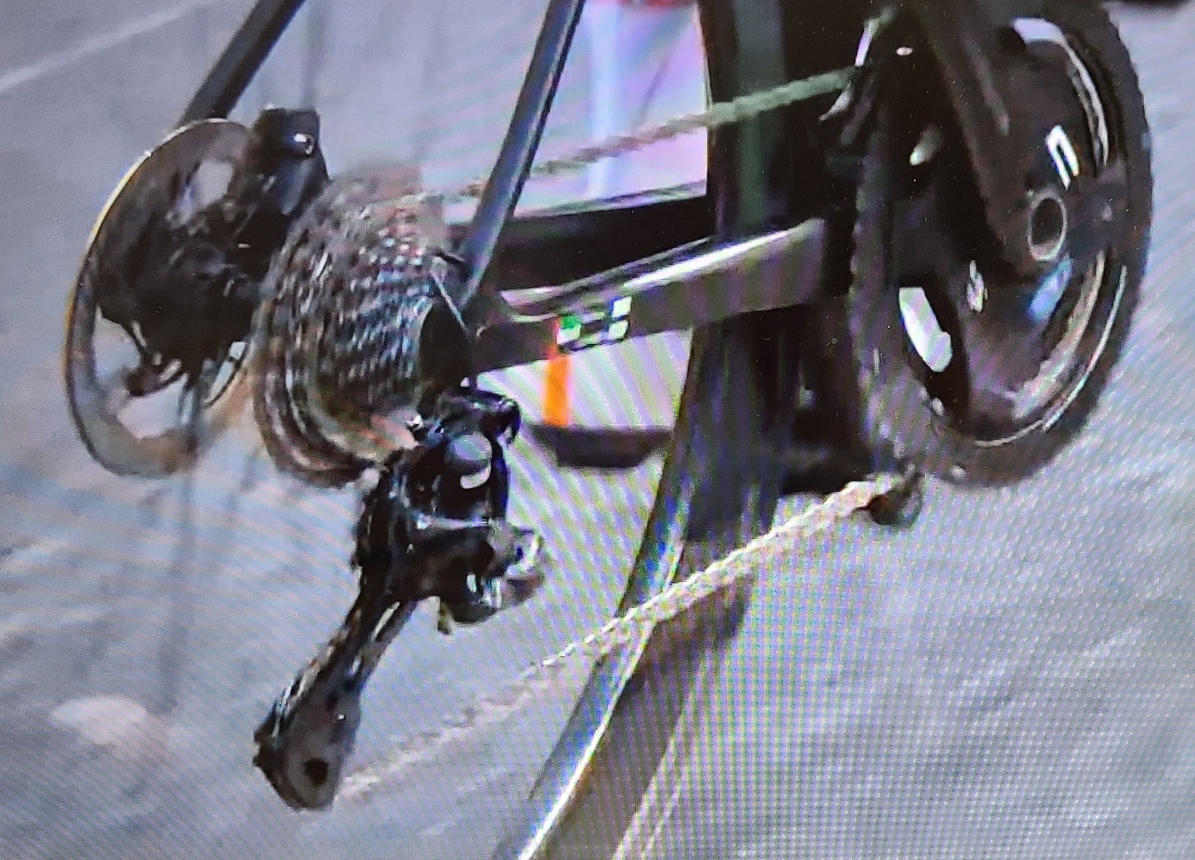

Let’s assume for the sake of argument that Pogacar was in a 39x23 at this moment (i.e., the footage I grabbed a shot of above), and he wanted to shift into a higher gear to attack. He might go for, say, the 17-tooth cog, meaning a 62-inch gear [27*39/17]. Well, if he happened to have a 36-tooth inner chainring, he could just go for the 16-tooth cog instead, which would produce an almost identical 61-inch gear. (The rider wouldn’t make this decision based on any concept of numbers, of course; it’d be instinctive.) There is absolutely no difference in how the bicycle would behave given one of these gearing scenarios or the other. There is no “momentum” involved in turning one size chainring or another. If there could be any benefit to a 36 vs. a 39, it’d be that with a 36, you could run a smaller largest cog (i.e., you wouldn’t need the 32-tooth Roche had mentioned earlier), so you could have a tighter gear ratio and thus a better selection of cogs to choose from (i.e., smaller number-of-teeth gaps between them) to dial in the perfect gear. So if anything the 36 would be better on a shallower gradient: the opposite of what Roche asserted.

This is perhaps a flaw in the two-guys-talking style of race announcing: Roche may think he only has to bullshit McCrossan, who’ll believe anything, but of course the home viewer may well know better. I guess the bigger lesson, though, is that I shouldn’t mistake retired pro racers for bike geeks. And given what passes for information on my blog, I can’t exactly get on Roche’s case for totally winging it and making shit up.

Why do riders stash their sunglasses?

Twice during this Tour, McCrossan asked Roche why some riders take their sunglasses off and stash them in their helmet vents. (Perhaps McCrossan forgot he’d asked the first time, or liked the dialogue well enough to repeat it, or wasn’t satisfied with Roche’s original answer … who knows.) Both times, Roche said it was because it was so hot out, the riders just wanted better air flow over their faces.
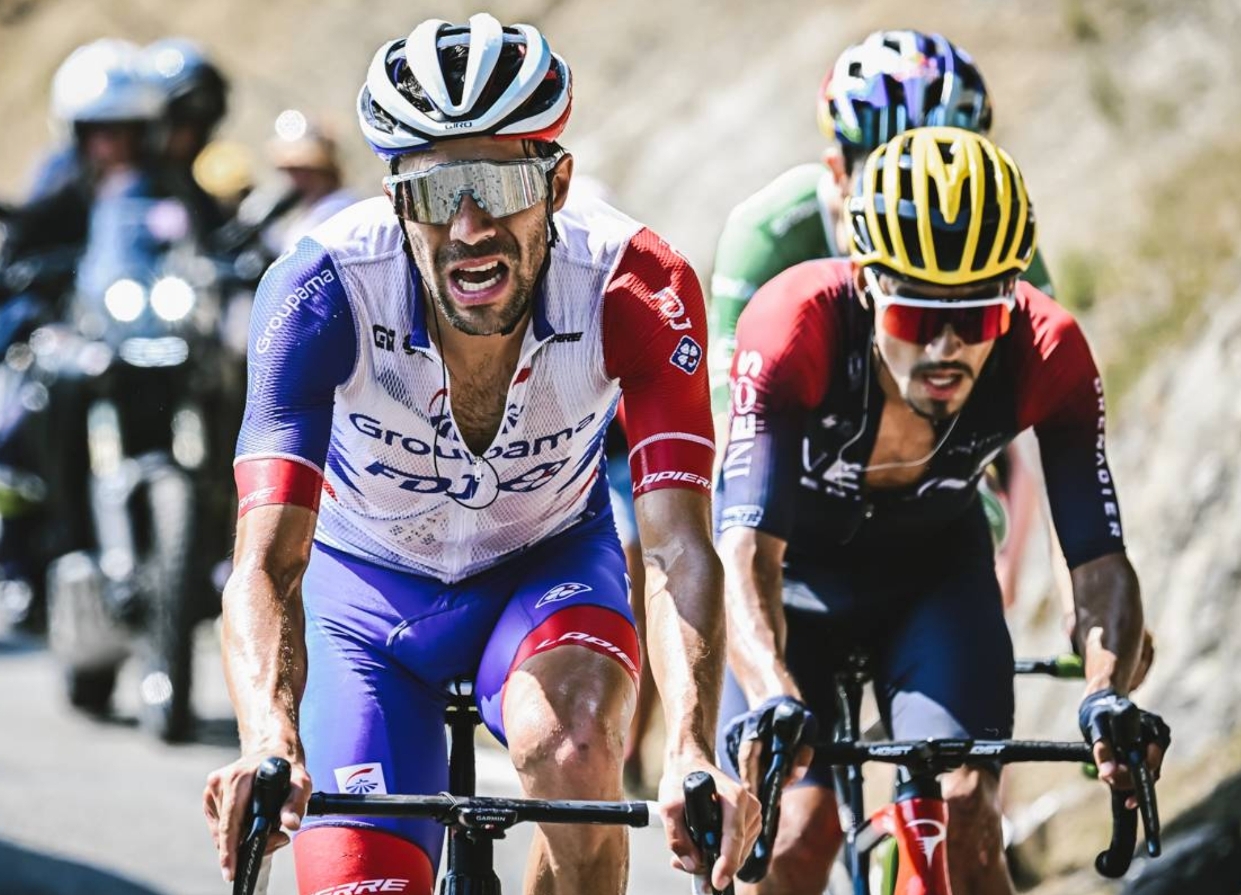

This may be partly true, but I just don’t think it’s a complete answer. For one thing, cycling sunglasses haven’t always been so stupidly oversized as to suffocate your face. Meanwhile, it seldom gets very hot where I ride, but I stash my shades all the time. It’s not to let my face breathe; it’s because sweat drips down onto the lenses to the point that I can’t see very well. So I’ll take off my sunglasses either because this has already happened, or because I’m on a long climb and I want to prevent it from happening. Obviously Roche is a far better cyclist than I’ve ever been or will be, but sweat is sweat. If you disagree I’d love to hear about it.

Vingegaard waiting on the descent

During Stage 18, Pogacar attacked over the top of the penultimate climb (and yes, I’d like to reiterate my earlier point about how smart this is), and tried to drop Vingegaard on the descent. They dropped the rest of the group and then, as the duo hammered along, balls-to-the-wall, Vingegaard slid on some gravel and almost stacked.


Not thirty seconds later, Pogacar suddenly changed his line in a curve (perhaps seeing some gravel himself), and had to hammer the brakes. As Vingegaard passed him, Pogacar went off the side of the road, lost traction, and crashed.


Pogacar wasn’t seriously hurt and got right back on his bike, and had no trouble catching Vingegaard because the race leader waited for him, coasting and looking over his shoulder. As Pogacar caught up, he even gave Vingo a little handshake of gratitude.


The commentators made a big deal about this, talking about what a great show of sportsmanship this was. Roche commented that Vingegaard would have been within his rights to push on ahead, because after all Pogacar had crashed while trying to outpace him on the descent, taking on the extra risk voluntarily. Presumably, Roche said, if the tables were turned Pogacar wouldn’t have waited for Vingegaard.

While Roche has a point—crashes are part of the sport, after all—I don’t see anything all that magnanimous in Vingegaard’s gesture. It was a long way to the end of the stage, and he wouldn’t have picked up that much time over the descent. Meanwhile, as the defending race leader, with a sizeable time advantage over Pogacar, it was in his best interest to make the descent as safe as possible—and surely Pogacar wouldn’t try to drop Vingegaard again after he’d waited up; that would be a total dick move. Moreover, Vingegaard had teammates behind him, who would surely be of benefit to him if they could catch back on; it had never been Vingegaard’s idea to leave them behind to begin with. Tactically, to wait for Pogacar would benefit Vingegaard in every way. And on top of that, he would get to look like the nice guy. To me, his decision to wait was a complete no-brainer. The only slight misstep Vingegaard made was to point out, in the post-race interview, that he’d waited. That was needless. We get it, dude. We all saw it. The announcers crowed about it. You’re a great guy.

What about doping?

You might be surprised I didn’t get into the whole doping issue with this post. To be honest, I just don’t see that there’s anything new or surprising on that topic to report on. About all I can say is that, if doping appears to still be rampant, at least no single team is so good at it as to bring back dull-as-fuck Tours like we suffered through during the Froome years. I’m grateful for that.

—~—~—~—~—~—~—~—~—
Email me here. For a complete index of albertnet posts, click here.

Saturday, July 16, 2022

Biased Blow-By-Blow - 2022 Tour de France Stage 14

Introduction

I like to give a blow-by-blow report of major bike races, but so far none of the weekend stages of this year’s Tour de France have been the exciting mountain stages I favor. Today’s isn’t a very promising course either, but with my weekdays taken by The Man, I’m down to covering either this or the final time trial, which would bore both of us to tears. Read on anyway … at some point I’ll recap what’s happened so far in the GC battle, which has been pretty awesome. And who knows, maybe all hell will break loose today.


2022 Tour de France Stage 14 – Saint Étienne to Mende

As I join the action, there is a breakaway that has about ten minutes on the GC peloton, with about 70 kilometers to go. They’re interviewing Thibaut Pinot (Groupama FDJ).

INTERVIEWER: Est-ce que la route est difficile aujord-hui?

PINOT: Je voidrai avoir du biftek-frites.

INTERVIEWER: Ah, je comprends, ce n’est pas un sujet facile, oui.

PINOT: Et une salade, bien entendu!

INTERVIEWER: Votre équipe, ils sont prête pour la chaleur?

PINOT: Et et un verre de vin, bien sûr!


Wow, things are off to a rough start. First of all, the Peacock network is blocking my ability to grab screen snapshots. That photo above? It was a lot better on my screen, believe me. You’ll just have to imagine what Pinot looks like. I’ll help sketch it out: he’s wearing the red, white, and blue colors of his team (the “livery,” these pompous announcers would call it). His COVID mask is white cloth …not nearly as effective as a KN95 (or “NC-17” as I like to call it), but then we all know that, descents notwithstanding, Pinot is a rider who likes to take risks.

The other thing making things rough is that the announcers, Nicolas Roche and Anthony somebody, made no effort to translate, from the French, anything Pinot and the interviewer were saying. Do I have to do everything myself? Here’s my best crack at it:

INTERVIEWER: Is the route difficult today?

PINOT: I would like to have the steak and fries.

INTERVIEWER: Ah, I get it, this isn’t an easy subject, sure.

PINOT: And a salad, better yet!

INTERVIEWER: Your team, are you guys ready for the heat?

PINOT: It’s been a lousy Tour for me and I’m frankly embarrassed, after all the fuss the press made over me in my early years, and then that horrible 2019 Tour when it looked like I had such a great shot at the GC, only to drop out with an injured leg, for chrissakes, and now I’m not even the team’s protected rider. I mean, it’s so frustrating: if you give a dog a good name maybe he lives up to it, but I’ve been treated like a shit domestique and have “become my job,” as they say.

Here’s a nice shot of the action.


Do you like my co-commentator, Freya? She’s good company, but even quieter than Sean Kelly.

Caleb Ewan (Lotto Soudal) is off the back with his team helping him. He’s had a really awful Tour—yesterday he crashed pretty hard, which is unfortunately the most noteworthy thing he’s done in the last week and a half.

With 66 kilometers to go, the gap to the break is up to 10:42.

Now the leaders are on a climb, the Côte de Grandrieu, 6.3 kilometers at 4.1%. Within the breakaway group, the highest-placed rider on GC is Louis Meintjes (Intermarché-Wanty Gobert), who sits 13th overall, 15:46 back. Also in the group are Neilson Powless and Rigoberto Uran (EF Education-EasyPost), Bauke Mollema and Quinn Simmons (Trek-Segafredo), Michael Woods (Israel-Premier Tech), Marc Soler (UAE Team Emirates), Danny Martinez (Ineos Granadiers), Michael Matthews (BikeExchange-Jayco), Pinot, and Simon Geschke (Cofidis), who leads the King of the Mountains competition.

Riders are getting ready for the KOM sprint. And here they go! Geschke (Cofidis) easily takes the maximum points, pulling away from Simmons. Since I can’t provide a photo, I’ll describe it. Geschke’s jersey is white with red polka-dots. Both riders were out of the saddle, grimacing. They both have big bushy beards. This is a great Tour for big beards. I can probably find a stock photo somewhere. Ah, here you go:


Now Simmons attacks! His American compatriot Powless is trying to bridge across to him! ‘Mur’ca! And now Powless has caught Simmons! Will they share the workload? Not so far, Powless is just sitting on. Maybe he and Simmons have political differences.

They’re climbing again and Simmons is just drilling it! He takes a quick look back, peering under his arm, to see what the group is doing. Either that or he’s sniffing his armpit. Maybe that’s how he gauges his effort—how much sweat he’s putting out, or how strong its smell is. Who needs a power meter? Okay, the group has got him.

Now Matthews attacks. He quickly gets a decent gap but with 52 kilometers to go he’ll obviously need at least a couple dudes to bridge up to him. Wow, he’s really flying, and already has 23 seconds.

Andreas Kron (Lotto-Soudal) attacks the break and Simmons is right on him. With his big red beard, Simmons looks a lot like that kind of scary-looking spokesman for the Howard Johnson motel chain.


The breakaway is completely shattered! At the front is Matthews, and just few seconds behind him is the trio of Patrick Konrad (Bora-Hansgrohe), Kron, and Luis Leon Sanchez (Bahrain-Victorious). And now they’ve got Matthews. Which is actually good for him, like I said.

I just had a little breakaway of my own (bio-breakaway, you might call it) and upon my return, the leaders are on the penultimate climb, the Côte de la Fage, 4.2 km at 6%. It looks like Felix Großschartner (Bora-Hansgrohe) has joined the leaders, and Konrad has fallen off.

I want to take a moment to decry something I see throughout cycling coverage: Großschartner’s name is rendered “Grossschartner.” That’s right, three S’s. How does that ß become two S’s? Of course the announcers don’t want to even try to pronounce it, it’d sound like they’re hissing, so they never mention this actually very fast rider. So unfair for him. Maybe he should take the celebrity route and change his last name to something easy and attractive, like “Strong.”

Weird: with one kilometer left in the climb, Kron takes a musette bag (or “horsey-bag” as my college girlfriend liked to call it). Maybe the bag is full of helium gas. Is that allowed?

Back in the chase group, Uran attacks! The whole group starts swarming and boiling and it looks really painful. “They’re spitting like llamas!” the announcer says. Or does he mean lamas? Do lamas spit? I’m gonna guess he means llamas. It’s impossible to know since it’s just a strange thing to say. (Note: I do tend to put words in people’s mouths, as I did with Pinot earlier. But the announcer really did say that about the spitting. I couldn’t make that up.)

Alberto Bettiol, Uran’s EF teammate, takes the front and does a long pull.

And now Soler attacks over the top of the climb! He quickly opens a pretty big gap. He’s done almost nothing this whole Tour except to chase down a Jumbo-Visma move a few days back (more on this in a moment). Then he faded back to total pack-filler anonymity again.

The scattered constellation of the breakaway is forming little clumps, like that modern kitty litter that turns feline urine into hard, snowball-sized spheres. You won’t get similes like this from professional journalists.

Whoa, Kron gets a front puncture and almost goes down! They show an instant replay so I’m able to get a photo of it with my phone! See how he’s unclipped from his left pedal? Look closely and you can see me in the photo, reflected on the laptop screen! It’s very artistic!


I guess I can start providing photos, since my phone camera is doing a better-than-nothing job here. Can you believe I pay for this coverage, that doesn’t even let me do screen grabs?

I’ve been hoping things would settle down a bit at the front of the race so I could bring you up to speed on this Tour, in case you haven’t been following it. There’s a pretty long descent before the brutal final climb, so maybe I finally have my chance.

It’s been a pretty great GC battle, actually. Pogacar initially looked too dominant, as usual, winning two stages in a row and taking the yellow jersey, but then on Wednesday during stage 11, Team Jumbo-Visma really got their act together. At the summit of the second big climb of the day, the category one Col du Télégraphe, Primoz Roglic totally attacked, and in the ensuing mêlée, Pogacar was totally isolated from his UEA Team Emirates team. On the valley floor before starting the famed Col du Galibier, Jonas Vingegaard and Roglic took turns attacking Pogacar. It was a lather-rinse-repeat scenario, and Pogacar, seeming to get frustrated, launched an attack of his own, which struck me as hubris. It’s like, dude, you’re already expending all this energy responding to these attacks … why would you do extra work? So on the final climb, Vingegaard launched a blistering attack and took almost three minutes out of Pogacar. Pogacar finished the race covered in blisters. Really? Blisters? Well, no, that was just the logical extension of “blistering attack.” Weird word, “blistering.” But that’s the kind of Tour it’s been.

And now Roglic is dropped. This is the second time today that’s happened; he lost over three minutes earlier, and only caught back on when the breakaway was well established and the peloton started really loafing. Roglic crashed hard during an early stage on the cobbles, and dislocated his shoulder. He was able to pop it back in, but that had to hurt … maybe he’s still suffering from that.

So, what else from the first half of this Tour? Oh year, Wout van Aert (Team Jumbo-Visma) has been the man, taking top three in at least three stages, wearing the yellow jersey for a few days, winning a stage, and being the most amazing super-domestique I’ve seen in years. And in other news, Pogacar’s fiancée was seen after Wednesday’s stage rocking a RUN-DMC T-shirt. I’m not sure what to make of this but it’s surely important. You’ll have to turn to a more mainstream journalistic source for the full story on that, I just don’t have the time to chase it down.

Poor Kron never got back into the front group, so it’s down to three riders. They’ve still got 37 seconds.

Back in the peloton, van Aert is setting a high tempo at the front, and the group is thinning out. Whoa, Thomas Pidcock (Ineos Granadiers) goes out the back! He was sitting like 8th on GC, after winning Thursday’s stage solo atop the famous Alpe d’Huez. But I guess the pace can’t be that high because the gap to the break is up over 13 minutes.

Here’s a nice (albeit lo-res) shot of the final climb profile. It looks like an absolute beast.


The climb’s official name is the Côte de la Croix Neuve, but it’s nicknamed the Montée Jalabert because Jalabert won there once. What’s that all about? I mean, every stage finish has had some winner, so why does Jalabert get this climb named after him? Pretty damn silly if you ask me. I’m going to try to get my own teammates to start calling Lomas Cantadas the Montée Albert (with my name pronounced “Al-BAAAYR” of course). Not because I’ve ever “won” it or anything, but because I might be the only cyclist to write a poem about it, or at least the only one to write a poem in dactylic trimeter about it.

And now the leading trio has started the Montée Jalabert.


Matthews attacks!


He’s got a really huge gap on this brutal section! It’s like 14% and he’s crushing it! But suddenly Bettiol closes up the gap with a quickness!


I gotta be honest, I don’t even remember Bettiol being in this group. He must have bridged up when I wasn’t looking. Hell, he probably bridged up when nobody was looking. That Bettiol is a sly one! And now he’s got Matthews under serious pressure! Bettiol has to drop him on the climb because there’s no way he could beat him in the sprint. And here it is, Bettiol drops Matthews, with just over a kilometer left in the climb!


Matthews hangs his head in the universal gesture for “FML.” In a second here the announcer, as if following a script, will use the expression “lights have gone out,” which metaphor is the darling of announcers these days. But wait! The announcer says no such thing! And now Matthews lifts his head up and accelerates!

He’s closing the gap! OMG! Matthews has got Bettiol!


And now Matthews attacks!


And Matthews crests the climb alone! It’s just 1.5 kilometers to the finish, mostly downhill and flat!


Matthews has got the win! He does the popular “I can’t believe it” victory salute!


Bettiol comes through looking a bit shocked. Actually, I made that up. You can’t read anyone’s expression anymore, what with the giant sunglasses.


“Pinot comes in dirt,” Roche says. I don’t know why he can’t pronounce “third.” I mean, he’s Irish. Can’t they make the “th” sound? And the “d” sound, for crying out loud?

But the real race is behind, where the GC group has just reached the Montée Jalabert. The American Sepp Kuss (Team Jumbo Visma) sets tempo for his leader.


Kuss was brilliant on the Alpe d’Huez climb, protecting Vingegaard’s yellow jersey by setting the fastest pace of anyone that day. And now Brandon McNulty (UAE Team Emirates) takes the front for Pogacar. ‘Mur’ca!

Top riders are going out the back! And now Pogacar attacks! Only Vingegaard can hang with him!


Romain Bardet (Team DSM), who sits fourth on GC, chases the Ineos duo of Geraint Thomas and Adam Yates. Thomas is third on GC, just nine seconds ahead of Bardet, and Yates sits fifth, 51 seconds behind him. Right on Bardet are David Gaudu (Groupama-FDJ) and Nairo Quintana (Arkea-Samsic).


(As usual, Yates has done absolutely nothing during this Tour except follow wheels. Thomas has attacked exactly one time, when Pogacar was in difficulty on Stage 11, and that was admittedly a perfect move that actually worked.)

Pogacar won’t turn his head to see how Vingo is doing behind him. Perhaps Pogacar realizes this craning of the neck might reduce his airflow. Kind of smart, actually.

Vingo looks cool as a cake. You thought I was gonna say cucumber, didn’t you?


The two have got over half a minute on Thomas and Yates already.

Here’s a helpful schematic labeling the riders and giving their speeds.


Curious, isn’t it, that while the riders are still together, Pogacar is going 20 km/h and yet Vingegaard is only doing 16 km/h? That’s how you know Pogacar is doping. Fortunately, that speed delta isn’t making any difference in the race (which, I know, defies the laws of physics).

And amidst the throng of unruly spectators, Gaudu has passed the Ineos duo!

The GC leaders cross the summit. As you can see, behind them Gaudu has taken six seconds out of Thomas.


And now Thomas and Quintana reach the summit. Quintana is having a pretty good Tour, sitting sixth on GC.


Nearing the finish, Pogacar launches a big-ass sprint, foolishly supposing that a) he could actually ride Vingo off his wheel, despite being if anything the weaker of the two right now, and that b) even if he got a gap, he could extend it to anything meaningful. I think he’s just like a dog with a stick … Pogacar can’t help it. He sees a finish line, he sprints. It’s automatic.


At the finish are throngs of Danish fans, singing “Vingego” over and over again in a silly singsong voice. Won’t they feel stupid when they discover later that they spelled “DENMARK” wrong on their banner…


They’re interviewing Matthews. “They” being “the media,” not the Danish fans. Just to be clear.

INTERVIEWER: It’s been years since your last Tour stage win, and now you’ve pulled one off. Tell us about it.

MATTHEWS: This win was for my daughter. She’s four years old and I wanted to show her: this is what I do it for.

INTERVIEWER: Are you sure she was even watching? She might have been at a play date or something.

MATTHEWS: No, I told my family they should probably tune in for once in their lives because our team was aiming to do something this weekend.

INTERVIEWER: How did you win it? What was going through your head?

MATTHEWS: On that last climb I was just thinking of my daughter, and how I needed to make good on all the sacrifices my family makes for me.

INTERVIEWER: Let’s be real here. What four-year-old has ever made any sacrifice for anybody? What would that even look like?

MATTHEWS: …

INTERVIEWER: That tattoo on your neck .. it says “believe”? Can you tell me about that?

MATTHEWS: I think it speaks for itself.

INTERVIEWER: Yeah, but it’s spelled wrong. It’s supposed to be “i-e-v-e” but it’s “e-i-v-e” on there.

MATTHEWS: Oh my god. You’ve got to be shitting me.

INTERVIEWER: Punked! Got you! Hahahahaha!

MATTHEWS: Tadej warned me about you. This interview is over.


Here’s Matthews on the podium. His outstretched arms, tilted back head, and closed eyes would say “apotheosis” except that his dumb baseball cap drowns that out by saying “long haul trucker.” How did American baseball caps infiltrate the European peloton? How has the UCI not banned this?!


Caleb Ewan makes it through the finish well in advance of the time cut. What a relief for him and his team.


Here’s the stage result.


And here is the new GC. The main change here is that Meintjes moves way up in the GC … he wasn’t even top-10 before and now he’s tied for 7th.


And now, the yellow jersey presentation.


Vingegaard must be stoked to get another stuffed lion. During his first yellow jersey podium ceremony, on Wednesday, he looked his new lion right in the eye, smiling, as if to say, “Hey, you!” Vingegaard has a young child who will of course want a lion, and Vingo will want one for himself; fortunately, he now has four of them.

Wout van Aert gets his green jersey. He’s so far ahead in this competition, all he has to do is finish the Tour and he’ll keep it. There’s a lot to like about van Aert, including the fact that he’s the only rider in this Tour who remembers to throw his flowers to the crowd. And he’s got a hell of an arm, especially for a cyclist!


They’re interviewing Vingegaard.

INTERVIEWER: You looked pretty comfortable out there today.

VINGEGAARD: Yes, I ride a superb Fizik saddle, and of course the chamois in my Agu shorts is pretty plush.

INTERVIEWER: No, I mean comfortable with the pace.

VINGEGAARD: Oh yeah, that. Yes, it was good.

INTERVIEWER: There were a lot of Danish fans at the finish. That must have been really special for you.

VINGEGAARD: Honestly, what do you expect me to say? That they’re a bunch of dorks or something? That they can’t even spell?

INTERVIEWER: Whoa, easy there big fella.

VINGEGAARD: Sorry, that was out of line. There’s a bit of pressure that comes with this yellow jersey, you know.

INTERVIEWER: And it’s probably not made any easier by bloggers totally making shit up and putting words in your mouth.

VINGEGAARD: Don’t even get me started.


Now Geschke mounts the podium, having successfully defended his KOM jersey. He looks a bit like a hipster with that beard. However you may feel about this from a sartorial perspective, I think we can all agree it’s unprofessional, given the COVID risk. It’s well established that COVID masks don’t work well on bearded men (or women, come to think of it), and no fewer than seven riders have dropped out of this Tour due to COVID. Geschke should shave that beard, as a precaution.


Meintjes takes the podium for the Combatif (i.e., most aggressive) award.


He’s the only rider who bothered to get himself cleaned up and changed for the awards ceremony. I guess he didn’t realize it’s actually important to wear your team cycling costume for this presentation. I have the same struggle with the high school mountain bike racers I coach, who always want to wear some cool skateboarding t-shirt or whatever instead of the Cougars jersey.

It has just been brought to my attention that a) Matthews won the Combatif award today, not Meintjes, and b) this guy on the podium can’t be Meintjes, as he looks too old and soft to be a bike racer. I have no idea who he is, what he’s doing here, or where he got that medal. I guess security is really light at the Tour and he’s just some rando, clowning around.

Well, that’s about it for today. There are several hard mountain stages left, including the Col d’Aubisque and Hautacam on Thursday, but I’ll be working my day job and can’t report. Check back next month when I (hope to) cover the Vuelta a España!

—~—~—~—~—~—~—~—~—
Email me here. For a complete index of albertnet posts, click here.