Showing posts with label bike racing tactics. Show all posts

Wednesday, July 10, 2024

Tour de France FAQ - A Guide for Newbies

Introduction

The 2024 Tour de France bike race is about half over, and presumably the most exciting stuff is still ahead. It’s been really good so far—at least, to me, a bicycle road racing afficionado. But what about the typical American sports fan, who doesn’t know a white jersey from an albino cow? That’s what this guide is for. Now, even if you already know all about the Tour, you should still read on, because the real point of this post is, “What’s funny about this race?”


2024 Tour de France Frequently Asked Questions

How do I watch the Tour de France live?

In America, you have to either subscribe to Peacock Premium ($6/month) or Flobikes (which literally doesn’t post any pricing—if you have to ask, you can’t afford it). Otherwise, you can use a VPN to pretend you’re in Europe and watch Eurosport. If none of these options appeals to you, you can watch highlights on YouTube, or (best of all) move to Europe. Then you won’t have to get up so early.

What does “GC” mean?

It stands for “good climber.” Kidding! It’s actually General Classification, meaning the overall race. The GC leader is the guy whose cumulative time, across all days of the race, is the lowest. Whoever leads the GC at the end of the final (i.e., 21st) day has won the Tour de France. For all those who aren’t in contention for the GC, the there’s the prospect of winning a single day’s event (aka stage) of the race … that’s also a pretty big deal.

What is a time trial?

In the time trial event, each racer rides by himself and his time is taken. It’s basically the same format as downhill skiing. The time trial is called “the race of truth” because tactics, psychological gamesmanship, and drafting don’t come into play. Frankly, I think these more complicated aspects of cycling are the best things about it; by that measure, time trials aren’t the true test at all. Moreover, I think mass-start downhill ski races would be awesome.

The Tour de France sometimes features team time trials. They are totally badass, featuring each nine-man team going alone against the clock. I wish TTTs figured in every Tour.

What are the special jerseys about?

There are basically three categories of jersey: standard, leader’s, and what I’ll call “other.”

The standard jersey is what almost everyone on a team wears (i.e., if he’s not wearing a leader’s or “other” jersey). It’s basically a billboard for the team’s sponsors. This is how this sport gets its money: through advertising, like with NASCAR. Otherwise there’d be no feasible way to pay all the salaries, since nobody has to buy a ticket to watch the Tour. If you’re lucky enough to live in France, you can just stumble out your door and wander out to the road to see them all go by.

Then we have the leader’s jerseys, for those leading one of the overall categories of the Tour. The yellow jersey, or “maillot jaune,” is what the GC leader wears. Then you have the white jersey with red polka-dots which is worn by the King of the Mountains (aka KOM) leader. You’d think this would indicate the best climber of the race, but often it’s actually not. It’s the guy who wins the most sprints to the tops of climbs and is awarded points for doing so. Obviously this guy needs to be consistent, but not perfectly; if he lost 20 or 30 minutes on a mountain day he’d miss the opportunity for more points on that stage, but could hang on to his overall KOM lead. Why is this jersey polka-dotted? Beats me.

Next is the Points jersey, which is green, and identifies the guy who’s most consistent in the races that end in a sprint finish, and for extra (“intermediate”) sprint opportunities along the way. This jersey is green because … money? I have no idea. Doesn’t matter. Finally, we have the plain white Best Young Rider jersey, for the highest-placed GC rider under age 26. This jersey is white because this rider is also required to be a virgin. (No he’s not.)

The “other” jerseys exist because of distinctions riders have earned beyond the Tour. For example, the winner of the previous season’s World Championship road race gets to wear a white jersey with rainbow stripes for the entire season, including the Tour. Also, many countries have their National Championship road race before the Tour, and the winner of each gets to wear his champion jersey, which often resembles the country’s flag. This can be confusing, of course.

Has a rider ever won more than one jersey?

Yes, it happens sometimes. For example, Eddy Merckx won all the jerseys on offer back in 1969. More recently, in both the 2020 and the 2021 Tours, Tadej Pogacar won the yellow, white, and polka-dot jerseys. Note that if a rider is leading in more than one category, he wears the jersey for the most prestigious one, and the next highest rider in the lesser category wears that jersey. For example, right now in the Tour, Pogacar is leading the KOM category but also the GC, so he’s in yellow while the second place rider in the KOM, Jonas Abrahamsen, is in polka dots. There are cases of one jersey trumping another as well; for example, in this year’s Tour, Remco Evenepoel wore his white jersey (for best young rider) during the time trial, despite being the current time trial World Champion. (No, nobody else wore the rainbow stripe jersey for that stage.)

I’ve heard announcers call the Tour a “chess game on wheels.” Is it?

Well, not exactly. In chess, only half a player’s pieces (the pawns) match one another in terms of what they do and how, while you’ve got all these other pieces that move in unique ways. Imagine a cyclists who could only go in an L-shaped direction, like a knight. It’d be ridiculous. Cycling is really more like checkers.

But in terms of the more general question about tactics and strategy, this is a team sport where most teams have a single leader (occasionally two), and the rest of team members are trying to help him (or them). And some teams aren’t even trying for the GC victory but only want stage wins, based on what they can realistically hope to accomplish. So they might have one guy who goes for sprint wins and another for mountaintop wins, and the rest of the team supports that day’s leader.

What makes cycling so tactical is that you can save gobs of energy by riding right behind another rider, or ideally a bunch of them. (If you wondered what I meant by “drafting” earlier, that’s what it’s called.) So a team’s job is to a) keep their star rider out of the wind, and b) force other teams’ star riders out into the wind. This is why riders “attack,” which means to sprint off to try to “break away” (i.e., get ahead of the rest and build up enough of a gap not to get caught by the end). In cycling, “attack” rarely means to hit, kick, or bludgeon. When that does happen, it’s usually hilarious.

What is a domestique?

A “domestique” is literally a servant. Per the teamwork discussion above, sometimes a domestique’s job is to attack other riders to “put them into difficulty” (to use a favorite term of the sportscasters’), but at other times their job is to ride back to the team car to pick up water bottles and then carry them forward to the star riders. They’re also around to offer up their bike if a leader’s is broken, or to pace him back up to the group if he goes off the back for any reason.

There is a documentary about cycling domestiques called “Wonderful Losers: A Different World.” It suggests that a domestique’s main job is to crash his bicycle. I’m not sure how this movie got to be so warped; perhaps they just had gobs of crash and first aid footage they couldn’t resist using. I don’t recommend this one if you are a cyclist with a significant other who worries about your safety.

The riders all seem to have hearing aids, or maybe earbuds. Are they music lovers, or deaf?

Those are the race radios, which keep the riders in constant contact with their team directors. The directors give them instructions, warnings about road hazards, encouragement, and sometimes recite poetry.

Do the directors really recite poetry to the riders?

No. Of course not. What gave you that idea?

It seems like the helmets are just getting out of hand. Is this some kind of joke?

I assume you’re talking about the time trial helmets, like this one:


These helmets, designed to confer an aerodynamic advantage, are no joke, mainly because they’re not funny. They’re proof that people will do just about anything to gain an edge, when their careers are on the line. I think goofy helmets should be banned, for the good of the sport. And yet, for some reason, the Union Cycliste Internationale (aka UCI, the governing body of cycling) has not asked my opinion on this. Shoot, I’d be the arbiter for free, just to be nice.

By the way, if the helmet above doesn’t look like it would even cut through the wind very well, bear in mind it’s designed for a rider who’s got his head down. With any luck, said rider would run into something and learn his lesson.

I guess the silver lining is that cycling helmets seem to work pretty well … maybe the NFL should try them.

Why are pro bike racers so dang skinny?

It turns out that humans can be pretty close to starving and still perform at a very high athletic level, if their nutritional needs are being met (e.g., balanced diet). The Tour de France features gobs of brutal mountain passes, and to be competitive every rider needs to have a very high power-to-weight ratio. So Tour riders eat as little as possible in training, so they come to the race extremely lean. They do eat a lot during the race but then they’re burning probably 5,000 calories a day.

Of course not all the riders are that skinny (except by the standards of other sports like baseball and curling). The sprint specialists, who go for victories in the flatter stages, are pretty muscle-bound. But they still have to get over the mountain passes, and within a time limit based on when the leaders finish. So, they can’t be as ‘roided out as, say, an American football player.

Speaking of which, do the Tour riders use performance-enhancing drugs?

Short answer: probably. Surely not all of them, and maybe not even most of them, but the sport will never be rid of doping no matter how much it claims to have cleaned up. I base this on current race leader Tadej Pogacar’s absolute domination of this year’s Giro d’Italia (aka Tour of Italy, similar to the Tour de France), where he won by an extraordinary margin while setting a new record for the highest average speed ever in that race. Higher, even, then in the years where infamous dopers like Marco Pantani and Ivan Basso were winning it.

Couldn’t this mean only Pogacar is doping? No, because he lost the last two Tours de France, and there are plenty of other riders who, on a given day, manage to beat him. Too many riders are putting up overly impressive numbers (that is, data points like average speed, power output, and the ratio of rider’s power to his weight, which many consider to be the smoking gun). Even the domestiques are turning out unrealistically strong performances.

All that being said, cycling is probably no dirtier than most pro sports. At least the footage isn’t embellished with CGI like in the movies, and all the riders do their own stunts. As long as the doping arms race doesn’t get too unbalanced, it’s still a fun sport to watch.

In the context of bike racing, what does “stack” mean?

It means to crash. All the road cyclists I know use this term (e.g., “Dude, I hit some gravel and almost stacked!”) but, oddly, none of the commentators ever say it.

Speaking of commentators, they keep talking about this or that rider “getting back on terms.” What does this mean?

I think only the Peacock commentators, Bob Roll and Phil Liggett, say this. It means “catch back up” or “get back into favorable position,” but nobody else on the planet uses this term. I think those two are trying to start a thing.

Is there an official anthem of the Tour de France?

No, but in 1983 Kraftwerk recorded a song called “Tour de France” and you can watch the video here. Although Kraftwerk is German, the lyrics are all in French. They’re not all that interesting, but if you croon along or sing this in shower, you can substitute this line: “An American will never win/ Tour de France, Tour de France.” That’s what I was doing in the mid-‘80s before Greg LeMond surprised everyone. Actually, I still do this. Force of habit.

What has been the highlight of this year’s Tour so far?

I would say the highlight so far was Mark Cavendish breaking the record for most career Tour de France stage wins, with 35 of them, at age 39. What makes this so special, at least to me, is that it came after a long dry spell. Cavendish failed to win a single Tour stage between 2017 and 2020, and many thought he was all washed up. Perhaps he’d become a bit jaded, kind of lost the hunger. I think a lot of us can relate, especially as we age. For example, another middle-aged superstar, Eminem, has rapped eloquently about this:

Man, in my younger days
That dream was so much fun to chase
It’s like I’d run in place
While this shit dangled in front of my face
But how do you keep up the pace
And the hunger pangs once you’ve won the race?
When that dual exhaust is coolin’ off
‘Cause you don’t got nothin’ left to prove at all
‘Cause you done already hit ‘em with the coup de grace

Miraculously, in 2021, Cavendish suddenly regained his form, and perhaps his mojo, and won a remarkable four stages of the Tour, picking up the green jersey in the process and matching Eddy Merckx’s record for most career stage wins. It looked like Cav was back on track and positioned to break the record the next year. Amazingly, though, his Deceuninck Quick-Step team director, Patrick Lefevere, didn’t put him on the team for the 2022 Tour de France, and in fact terminated Cav’s contract at the end of the year. While Lefevere didn’t really explain himself, it’s widely acknowledged in cycling circles that he’s is a vainglorious, narcissistic, power-crazed douchebag. (Note: by “widely acknowledged” I mean it’s my personal opinion.) I can imagine this was very inspirational for Cav, to come back and show the world what an idiot Lefevere is for not believing in him.

So Cav changed teams for what he thought would be his final Tour in 2023, only to crash out early before winning anything. I think all us cycling fans thought that would be it, but Cav decided to go one more year and take a final crack at Merckx’s record. Clearly, he put in all the work required—which is a lot, for a 39-year-old trying to beat the young bucks in pure speed—and his sprint victory in Stage 5 of this Tour was glorious. He lived up to the rest of Eminem’s rap:

Still you feel the need to go full tilt
That Bruce Willis, that blue steel, that true skill
When that wheel’s loose, I won’t lose will
Do you still believe?

(Does Eminem have any idea who Mark Cavendish is? Surely not. But Eminem doesn’t read albertnet either, so it’s all good.)

Belief came up in the post-race interview after Cav’s amazing win. The journalist asked, “But that makes you the best? That mindset—that mental strength that you have?” Cav replied, “It’s definitely a benefit, you know, especially when you’re not physically as good as everybody else.”

Do exploits like Cav’s—coming back from the doldrums, persevering, and achieving great triumph—cut across all sports, inspiring all of us whether we’re cycling fans or not?

Why, yes. Yes they do. And thanks for asking!

—~—~—~—~—~—~—~—~—
Email me here. For a complete index of albertnet posts, click here.

Friday, September 15, 2023

2023 Vuelta - Jumbo Visma & the Kuss Conundrum

Introduction

It’s been a hell of a Vuelta a España. Not since Vuelta del Taco Truck have I been so enthralled. Not that it’s a particularly close race lately—Team Jumbo Visma is dominating—but there’s some intrigue within the team. As I write this, the American Sepp Kuss is still leading the GC, but with just a handful of seconds over his teammate, recent Tour de France winner Jonas Vingegaard. Kuss is only another minute ahead of another teammate, recent Giro d’Italia winner Primoz Roglic.

The really weird thing is, Kuss’s lead has been dropping a bit, stage after stage, because his own teammates have been attacking. A member of my bike club emailed the group, “Can one of you armchair directors sportif explain today’s stage of the Vuelta in which 2 guys on the GC leader’s team attack him on the final climb? I’m struggling to find a charitable explanation.” By the time you read this, things may have changed, but I want to follow my pal’s prompt and investigate this weirdness from this particular moment in time, right after the Angliru stage, when the team still has the opportunity to decide how to conduct itself, with Kuss still in the red jersey. I have developed some theories.


Theory #1: it’s just the hierarchy

It could be that Team Jumbo Visma is simply too risk-averse to shake up the established hierarchy for no good reason. Not that they don’t have good reason, from my perspective as a fan. I mean, I think rewarding a very loyal domestique, who some commentators are saying may be the best mountain domestique in the history of the sport, is actually a good reason to challenge the established pecking order. But this team is about winning races, not just being cool. Roglic has won the Vuelta three times, Vingegaard has won two Tours de France, and the team can be confident these guys won’t falter in the final week, or buckle under the responsibility of finishing out the job. As a GC leader, Kuss is an unknown entity.

Beyond tactics, this hierarchy could extend into the messier realm of unconscious bias, like an unofficial caste system in the sport. Consider the label domestique. It wasn’t until I was talking about bike racing with some recovering journalists recently that I thought much about this term. I was just trying to tell the story of Kuss pounding champagne after his brilliant stage win (more on this later), but—with the curiosity befitting journalists—my friends backed me up and said wait, wait, wait. … support riders are actually called domestiques? It really is an ungenerous term, like calling your teammates “the help.” In this light, the sport really does promote elitism. Meanwhile, it surely takes a massive ego to be a Grand Tour winner and perhaps guys like Vingegaard and Roglic take it as an article of faith that they’re simply superior to their staff, occupying a more rarified realm. (“Kuss?! That motherscratcher? He’s never even made the final podium!”) If that’s their feeling, the idea of this (albeit strong) domestique becoming a GC winner is just preposterous and cannot be allowed.

From this hierarchical viewpoint, even letting Kuss ride hard in the Stage 10 time trial was actually charitable.  Don’t forget that Floyd Landis, while in his last year of service to Lance Armstrong, was severely punished for riding too fast in a Tour time trial (instead of saving his energy for his support role in the later stages). Although Floyd professed his innocence—“I was going easy, I’m just really strong!”—Lance threw a fit and flushed Floyd’s blood bag down the toilet, right in front of him, to remind him who was boss. (No, I did not make that up. It really happened. It’s in Tyler Hamilton’s book.)

By the way, Kuss was a good sport after the Angliru stage, congratulating his two teammates on, well, beating him.


Theory #2: no gifts

During one of his Tour “victories,” Lance let Marco Pantani win the Mount Ventoux stage, which was an unpopular move with everyone. In the press conference post-race, Lance casually mentioned he’d only cared about the GC, basically announcing the gift, and Pantani was offended and said so. There was more backlash because Lance could have just been making an excuse instead of admitting Pantani was stronger, and for this reason Lance himself came to regret his professed generosity. Many Pantani fans felt ripped off, too, like there was an unnecessary asterisk next to their hero’s win. Well, the next time Lance had the opportunity to win a stage, when he already had the GC in the bag, he took that opportunity, and during the podium celebration the former five-time Tour champ Bernard Hinault said to him, “That’s right: no gifts.”

Hinault lived by this ethos himself. Prior to the 1986 Tour de France, he announced that he would be working for his teammate, Greg LeMond, to reward him for his past support. It would be like passing the baton. But in the actual race, Hinault totally attacked LeMond, several times, leading to a big dustup in the media, a real soap opera. When questioned about breaking his word, Hinault shrugged and said something like, “I wanted to make him earn it.” And wasn’t it a better story in the end, that LeMond had to beat everyone, even his friend and teammate, to prove he deserved the Tour title?

Applying this to the current Vuelta is admittedly a bit of a stretch, but perhaps this “make him earn it” notion is a clever story Vingegaard and Roglic are telling themselves because it’s more palatable to them than, say, theory #1.


Theory #3: Plan B

It’s also possible that according to some convoluted tactical logic, to have Vingegaard and Roglic attack is just a way to make sure Jumbo Visma has a plan B for winning the GC if Kuss should happen to falter. Since the time Kuss took the red jersey, Vingegaard has soloed twice. The first time, at least, the Dane wasn’t in great position on GC, having had a poor stage or two. His attack bought him some needed time on his rivals, and after all nothing was preventing Kuss from also attacking and defending his own position (which he did). Such tactics aren’t very nice, of course, but if the overall team directive is to win the GC at all costs, and if Vingegaard and Roglic have the legs, why not?

This wouldn’t be the first time a team put a GC leader’s bid at risk to support a Plan B. In one of the Tours that Lance “won,” his teammate Víctor Hugo Peña crashed in the team time trial, and the team waited for him. I was astonished … Lance was not known for his dedication to the team, to put it lightly. A pal explained to me that Peña was the team leadership’s Plan B for the GC if something happened to Lance, so they needed to keep him from losing time in the TTT.

Jumbo Visma themselves have some experience with Plan B: last year, when Roglic crashed in the Tour and couldn’t perform at his normal level, his support rider Vingegaard had been kept close enough on GC to take over and get the win.

Theory #4: envy

It could be that Vingegaard and Roglic are nursing petty jealousies when it comes to Kuss. I mean, let’s not kid ourselves: Kuss is better looking, has more charisma, is more of a crowd favorite, and as the tireless, loyal domestique is more relatable than these past heroes … and now he gets to lead the Vuelta on top of it all. A real Cinderella story.

In case you don’t take all these claims for granted, let’s look at a couple of Kuss’s endearing exploits. When he won his first Vuelta stage a few years back (and again when he won a stage this year), he did something that American mountain bike racers have done for years: as he headed for the finish line he rode near the fencing at the side of the road and held out his hand to high-five scores of fans. I don’t think these European fans had ever seen anything like it. To see him doing that, a big shit-eating grin on his face … I had tears in my eyes.

And then let’s consider Kuss’s podium celebration after this year’s stage win. He took the standard jumbo-sized bottle of champagne and sprayed the crowd with it, as is customary, but the he went completely off-script. Most cyclists, especially climbers, can barely lift that magnum to their lips, and take a prim little sip. Kuss hefted that bad boy above his head and started just pounding it. Check this out:


It’s kind of amazing how long he went and how much he drank … that would be impressive even for a non-bike-racer. The commentator Christian Vande Velde said admiringly, “You go, boy!”

It’s not just any cyclist who could do this to such good effect. Roglic, who to me looks like a bit of a thug with his swarthiness and amateurish tattoos, might have looked kind of scary pounding the booze. And Vingegaard … God forgive me, but everything about that guy seems a bit weird, so to see him guzzling the champagne might have just seemed, I dunno, a little creepy. But Kuss, with his apple-pie face and boyish charm, and his unassuming persona, and that little surprised, half-suppressed burp at the end, all wrapped up with an exuberant grin ... well, it’s the very epitome of charisma.

Roglic in particular might envy Kuss’s situation enough to want to spoil it. In the 2020 Vuelta, during the last mountain stage, Roglic had a narrow GC lead that was challenged when Richard Carapaz made a sweet solo move. Carapaz needed only like 40 or 45 seconds to unseat Roglic, and things looked dicey for a bit. Uncharacteristically, Kuss was dropped, and another Jumbo Visma domestique had to make his way up and slay himself for Roglic. In this situation, Kuss—though he’d let down his leader in a key moment—didn’t get a lot of attention; his lapse wasn’t that visible because the cameras weren’t on him. Compare this to the one Tour de France that Roglic probably felt he had in the bag, only to spectacularly lose it in the final time trial to the upstart Tadej Pogacar. Roglic will never live that down. And now Kuss, who is leading the Vuelta seemingly by accident, could go on to lose it without any particular disgrace because after all, he didn’t come into the race with any ambition other than to do his normal job of domestique. To Roglic, that might rankle enough to incite an attack or two.

Theory #5: the business people

It’s possible that Vingegaard and Roglic didn’t launch those attacks on their own initiative. The big brass of the team might have ordered them to do it, for financial reasons. After all, if Kuss were to win the Vuelta, he’d be in high demand from other teams and Jumbo Visma might have to raise his salary. If all they care about is one of their members winning the GC, why not make it one of the guys who’s already at the top of the salary scale?

Theory #6: the business people, continued

It’s also possible that the team’s business leaders didn’t like Kuss’s champagne-swilling antics. Perhaps, they feel, this sent the wrong message about the Jumbo Visma team culture. They may have decided his behavior was unprofessional and glamorized the uninhibited consumption of an alcoholic beverage. “Think of the kids! Those poor impressionable youth!” they might be thinking. Perhaps they determined that the less attention Kuss gets from here on out, the better … so he shouldn’t be allowed to win the Vuelta. So they deploy their henchman, Vingegaard and Roglic, to stop him.

Theory #7: nationalism

Ever since the Dubya years, and particularly since the Trump years, the United States hasn’t exactly been the darling of Europe. It also doesn’t help our cause when American tourists like me go around saying things like, “World War II: you’re welcome.” (No, of course I don’t actually say this, but you get the point.) It also didn’t help that Lance took his don’t-mess-with-Texas ethos over there and messed with Europe, handing the Tour (and the sport) its biggest scandal in history. For Vingegaard and Roglic, as helpful as Kuss has been to his team, maybe they’re nursing some unconscious anti-American grudge such that they can’t bring themselves to promote him to the protected rider.

If you’re skeptical about this theory, and haven’t felt like Kuss wears his nationality on his sleeve, consider Exhibit A, his bike travel case:


That really does smack of unbridled patriotism, doesn’t it? I mean, would you use such a loud, brazen product? I sure wouldn’t. With all this in mind, you’ll surely be relieved to learn that (at least to my knowledge) Kuss’s bike case actually looks nothing like this.  I was just messing with you.

Theory #8: it’s not about Kuss

It could be that these attacks actually have nothing to do with Kuss. For all I know, Roglic and Vingegaard are bitter rivals, and their attacks are simply on one another, with Kuss and the rest of the peloton being collateral damage. Or even if the two get along, Roglic could be lashing out at having been kept off the Tour team this year, and wants to show everyone he was wronged, and/or Vingegaard wants to demonstrate that only he could have won the last two Tours.

Theory #9: irrational exuberance

Maybe these riders have been trying to do the right thing and work for Kuss, but they just can’t help themselves. When you’ve got the legs, it’s hard to resist using them. Look at LeMond in the 1985 Tour, attacking Hinault, his team leader. I already mentioned Hinault returning the favor in the 1986 Tour. Then there was Marc Soler up in the breakaway throwing a tantrum during the 2019 Vuelta when his Movistar team called him back to help his leader (i.e., do his fricking job). Sport in general is riddled with reckless, impulsive behavior. Chalk it up to testosterone poisoning.

Theory #10: none of the above

Of course it’s entirely possible there’s a perfectly good reason for these attacks that just isn’t apparent to an armchair directeur sportif like me. For example, Roglic and Vingegaard could be space aliens driven by forces utterly foreign to us humans. That would explain a lot, actually.

—~—~—~—~—~—~—~—~—
Email me here. For a complete index of albertnet posts, click here.

Sunday, July 24, 2022

Observations on the 2022 Tour de France

Introduction

The 2022 Tour de France ended today, and what an exciting Tour it was … easily the best in years. And yet, I only got to do a blow-by-blow report of one stage, since all the exciting ones were on weekdays. Thus, I’m providing a second post concerning what to me were some of the most interesting surprises of this year’s race.

(Note that some of these observations require fairly deep knowledge of the sport, but others could possibly be appreciated by anyone.)

COVID-19 in the peloton

At one point in the coverage, commenting on the hoards of fans lining the Col du Tourmalet, announcer Anthony McCrossan casually made mention of the COVID-19 pandemic being over. The fans certainly seem to think so, but we’re still seeing masked riders, an altered podium ceremony protocol, and—above all else—lots of riders forced to abandon due to COVID. How many? Take a guess.


The answer is seventeen. That’s kind of a lot, when you consider how careful riders have traditionally been about germs, etc. (Tyler Hamilton talks a lot about this in his book The Secret Race.) COVID withdrawals likely had a significant impact on this year’s race, with last year’s winner Tadej Pogacar losing two domestiques—Stake Vegard Laengen and George Bennet—to the virus. Three teams—Cofidis with Guillaume Martin, Israel Premier-Tech with Chris Froome, and Movistar with Enric Mas—lost their team leaders to COVID.

Perhaps rumors of the coronavirus’s demise have been exaggerated…


Attacking just after a summit

The turning point in this year’s Tour came on Stage 11, when Jumbo Visma’s Primoz Roglic attacked just after the summit of the Col du Télégraphe, and caught race leader Tadej Pogacar’s UAE Team Emirates teammates napping. This led to the first time in the race that Pogacar was isolated for any considerable period of time, and set up the showdown on the valley floor just before the ascent of the Col du Galibier, where Roglic and his teammate Jonas Vingegaard attacked Pogacar again and again. Responding to these attacks exhausted Pogacar, and on the final climb he lost lots of time to Vingegaard.


Look at the photo above: three Jumbo-Visma riders are in perfect position, while Pogacar (in yellow) radios his team car, presumably to say, “Where the hell is everybody?” (He’s got  one teammate in sight, but too far back … the dude didn’t catch up for many minutes, by which time the damage was done.)

I coach a high school mountain biking team, and I advise them, before any race that features a big climb, to attack right over the top, where other riders instinctively sit up, feeling (if only subconsciously) that they have earned a little break. A couple of riders have reported good results from this tactic, though the fastest kids on the team don’t generally listen to my advice because I’m just some old guy who doesn’t shred much gnar’ on the descents. But now I can just tell them all the story of 2022 Tour de France Stage 11.

(Just kidding. High school mountain bike racers have no use for the Tour, road racing in general, or hearing such stories.)

The benefit of two team leaders

Team Jumbo-Visma came into this Tour with two potential leaders: Roglic and Vingegaard. Both have finished second overall in the Tour, and both were considered favorites this year. Naturally this arrangement has its critics, who look back at infamously problematic rivalries such as LeMond vs. Hinault in 1985, Contador vs. Armstrong in 2009, and Wiggins vs. Froome in 2012. Any time a team positions two riders as leaders, you get news articles about it (such as here regarding Froome and Geraint Thomas, and here regarding Roglic and Vingegaard). Sometimes having two leaders works, and sometimes it doesn’t.

This year, it worked out really well. Fortuitously for Vingegaard, heading into Stage 11 Roglic had crashed pretty hard and was a couple minutes behind him, so their pecking order was pretty well established—but Roglic was still very much a threat to Pogacar. This meant that when the two Jumbo-Visma riders took turns attacking the race leader, he had to respond every time.


This was a pretty unique opportunity for Jumbo Visma and it was brought about by having two GC contenders in their ranks. Sure, other GC hopefuls could also participate in such a one-two-punch scenario, but generally, not being teammates, they aren’t as invested in doing so (as evidenced by Thomas’s willingness to just follow Pogacar during all this mêlée). And if a team has only one leader, only he can attack and accomplish anything. For example, it’s not like Pogacar could have his domestique Brandon McNulty attack Vingegaard and get anywhere with it. Vingegaard would be like, “Hey, fine, send your guy up the road. See if I care.” And he’d let McNulty ride uselessly off into the sunset instead of responding to the attack.

Van Aert’s great class

Coming into Stage 15, Jumbo-Visma’s Wout van Aert had already established himself as a major force in the race, having won two stages and worn the yellow jersey for four days. Stage 15 come down to a thrilling bunch sprint, with van Aert bumping elbows with Mads Pedersen before being narrowly beaten at the line by Jasper Philipsen.


Right after the finish, cameramen milled around looking for the requisite heartwarming footage of riders in tears, hugging their teammates, managers, significant others, etc. They certainly got the desired response with Philpsen, but van Aert didn’t have much reaction at all. Instead, he tended to his little daughter, trying to wash her hands off with a water bottle. Sure, a minute earlier he’d been almost crashing into another rider at 40 mph, but now his fatherly duties took precedence over having some big melodramatic “moment” after all the action. Despite being one of the most prominent riders in the biggest bike race in the world, he evidently hasn’t forgotten that he’s just a guy. A dad.


Simmons: albertnet reader?

In my coverage of Stage 14, I made good natured fun of Quinn Simmons’ beard, declaring that it makes him look a bit like the kind of scary looking spokesman for the Howard Johnson motel chain:


In the same post I also pointed out that it’s a bit irresponsible for pro cyclists to wear beards, given that they make COVID masks less effective and it would suck to get COVID have to drop out of the Tour. Well, lo and behold, Simmons showed up for Stage 16 without his beard! Look how fresh-faced he looks now, especially juxtaposed with Simon Geschke, who a mere two days earlier had practically been his doppelgänger:


What could explain this? Well, it’s possible Simmons read this blog. It wouldn’t be the first time; I actually once got an email from a Tour rider who’d read that day’s blow-by-blow report. (I also got a comment below the post itself, which said, “Dana, I want to have your love child.” The Tour rider’s message was a bit more understated.)

Obviously there are other potential reasons for Simmons to shave off his beard, but I don’t have time to chase that story down. Let’s just go with the theory that he’s an albertnet fan who took my advice to heart.

McNulty’s amazing pull

In Stage 17, when Pogacar was starting to run out of opportunities to take back the lead from Vingegaard, he put his teammate Brandon McNulty on the front toward the end of the penultimate climb, the Col de Val Louron-Azet. McNulty’s pace was so high, he dropped everyone in the race except Pogacar and Vingegaard, and the trio broke the previous record for that climb set many years before by Marco Pantani, Jan Ullrich, and Richard Virenque. Then McNulty set tempo for the entire final climb, the Peyragoudes, at a pace so blistering that his leader was able to take more than two minutes more out of Geraint Thomas, who was third on GC, by the end of the stage.


Unfortunately for Pogacar, he couldn’t shake Vingegaard, and though he outsprinted him for the stage win, he didn’t take any real time (just a few seconds for the time bonus). This was really an opportunity lost.

Nobody can deny that McNulty was amazingly strong and did a great job setting tempo … but actually, from a tactical perspective, it was a complete bust. The pace was so high, Pogacar ultimately never found a good time to attack, which was perfect for Vingegaard. Let’s put ourselves in the Dane’s shoes for a moment: what would be the perfect situation? It’d be to have one of his Jumbo-Visma teammates, like Sepp Kuss (the other American super-domestique) setting a high enough tempo to keep Pogacar from attacking. And that’s almost exactly what Vingegaard got … it’s just that the domestique happened to be wearing a UAE Team Emirates jersey. Post-race, maybe Vingegaard should have been hugging McNulty.


Riders’ gearing for mountain stages

During the Hautacam stage, the announcers chatted about gearing. McCrossan, the non-cyclist of the commentating duo, asked Roche, a former pro, “What sort of chainrings would they have on today?” (This kind of Q&A comprises about 80% of their entire commentary.) Roche replied, “Most likely some riders would have a 36, some others would have a 39 or a 38, depends on your pedaling stroke. Today, with the advantage of having up to a 32 on the rear cassette, you can manage keeping your 39 if you want.” McCrossan then asked, “Is it easier to attack on a 39 or a 36, or does it not really matter, in terms of getting the gear, the momentum going?”

Now, at this point I fully expected Roche to kind of hold back a giggle or a snort, and—reminding himself that stuff like gearing just isn’t obvious to the non-cyclist—would politely explain that it cannot make any difference. All that matters is the combination of front and rear teeth, which produces the “gear inches” figure—that is, how far the bike will go with one revolution of the pedals. (You can geek out on the details here.) I had thought all serious cyclists completely understood this, but to my surprise, Roche replied, “Well, when it's really steep like 12, 13 percent than a 36 is useful. On a gradient of 7 or 8 percent I think it would be easier with a 39.” Huh? How would a 39 be “easier” for attacking?


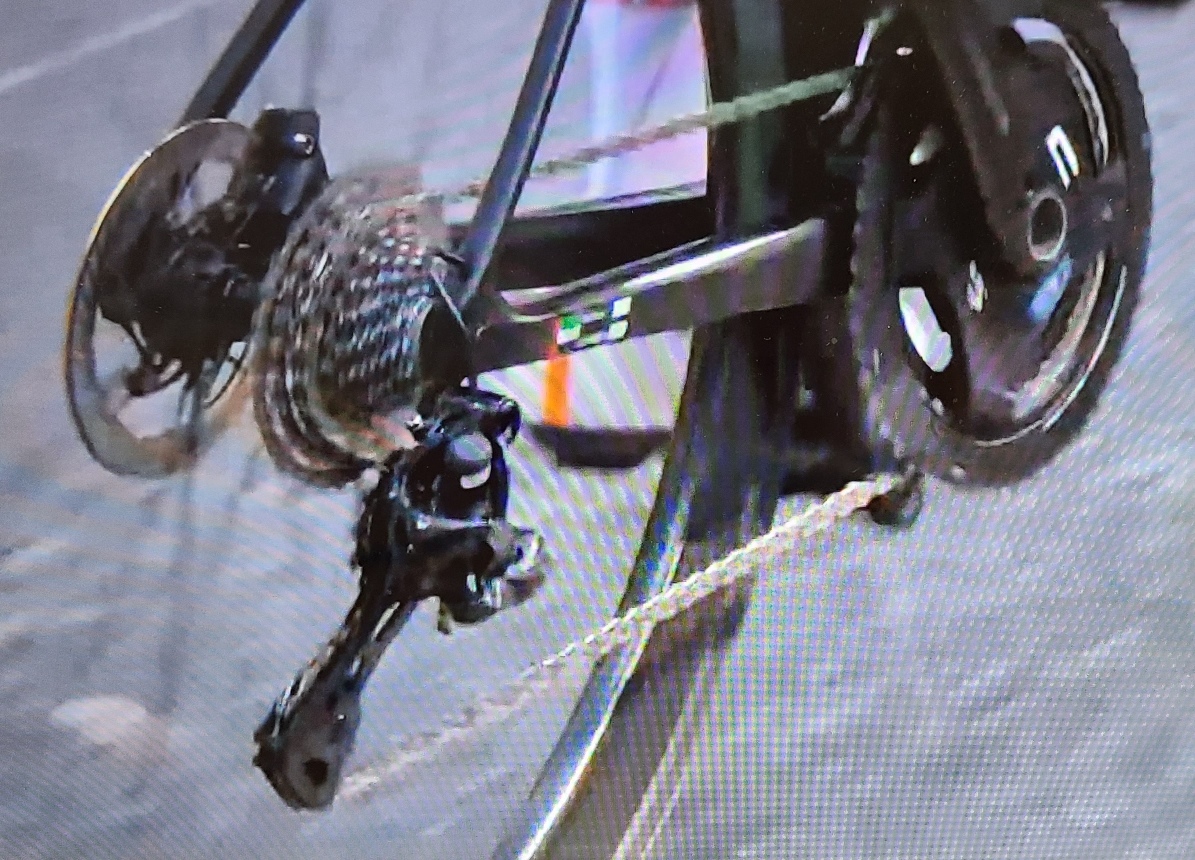
Let’s assume for the sake of argument that Pogacar was in a 39x23 at this moment (i.e., the footage I grabbed a shot of above), and he wanted to shift into a higher gear to attack. He might go for, say, the 17-tooth cog, meaning a 62-inch gear [27*39/17]. Well, if he happened to have a 36-tooth inner chainring, he could just go for the 16-tooth cog instead, which would produce an almost identical 61-inch gear. (The rider wouldn’t make this decision based on any concept of numbers, of course; it’d be instinctive.) There is absolutely no difference in how the bicycle would behave given one of these gearing scenarios or the other. There is no “momentum” involved in turning one size chainring or another. If there could be any benefit to a 36 vs. a 39, it’d be that with a 36, you could run a smaller largest cog (i.e., you wouldn’t need the 32-tooth Roche had mentioned earlier), so you could have a tighter gear ratio and thus a better selection of cogs to choose from (i.e., smaller number-of-teeth gaps between them) to dial in the perfect gear. So if anything the 36 would be better on a shallower gradient: the opposite of what Roche asserted.

This is perhaps a flaw in the two-guys-talking style of race announcing: Roche may think he only has to bullshit McCrossan, who’ll believe anything, but of course the home viewer may well know better. I guess the bigger lesson, though, is that I shouldn’t mistake retired pro racers for bike geeks. And given what passes for information on my blog, I can’t exactly get on Roche’s case for totally winging it and making shit up.

Why do riders stash their sunglasses?

Twice during this Tour, McCrossan asked Roche why some riders take their sunglasses off and stash them in their helmet vents. (Perhaps McCrossan forgot he’d asked the first time, or liked the dialogue well enough to repeat it, or wasn’t satisfied with Roche’s original answer … who knows.) Both times, Roche said it was because it was so hot out, the riders just wanted better air flow over their faces.


This may be partly true, but I just don’t think it’s a complete answer. For one thing, cycling sunglasses haven’t always been so stupidly oversized as to suffocate your face. Meanwhile, it seldom gets very hot where I ride, but I stash my shades all the time. It’s not to let my face breathe; it’s because sweat drips down onto the lenses to the point that I can’t see very well. So I’ll take off my sunglasses either because this has already happened, or because I’m on a long climb and I want to prevent it from happening. Obviously Roche is a far better cyclist than I’ve ever been or will be, but sweat is sweat. If you disagree I’d love to hear about it.

Vingegaard waiting on the descent

During Stage 18, Pogacar attacked over the top of the penultimate climb (and yes, I’d like to reiterate my earlier point about how smart this is), and tried to drop Vingegaard on the descent. They dropped the rest of the group and then, as the duo hammered along, balls-to-the-wall, Vingegaard slid on some gravel and almost stacked.


Not thirty seconds later, Pogacar suddenly changed his line in a curve (perhaps seeing some gravel himself), and had to hammer the brakes. As Vingegaard passed him, Pogacar went off the side of the road, lost traction, and crashed.


Pogacar wasn’t seriously hurt and got right back on his bike, and had no trouble catching Vingegaard because the race leader waited for him, coasting and looking over his shoulder. As Pogacar caught up, he even gave Vingo a little handshake of gratitude.


The commentators made a big deal about this, talking about what a great show of sportsmanship this was. Roche commented that Vingegaard would have been within his rights to push on ahead, because after all Pogacar had crashed while trying to outpace him on the descent, taking on the extra risk voluntarily. Presumably, Roche said, if the tables were turned Pogacar wouldn’t have waited for Vingegaard.

While Roche has a point—crashes are part of the sport, after all—I don’t see anything all that magnanimous in Vingegaard’s gesture. It was a long way to the end of the stage, and he wouldn’t have picked up that much time over the descent. Meanwhile, as the defending race leader, with a sizeable time advantage over Pogacar, it was in his best interest to make the descent as safe as possible—and surely Pogacar wouldn’t try to drop Vingegaard again after he’d waited up; that would be a total dick move. Moreover, Vingegaard had teammates behind him, who would surely be of benefit to him if they could catch back on; it had never been Vingegaard’s idea to leave them behind to begin with. Tactically, to wait for Pogacar would benefit Vingegaard in every way. And on top of that, he would get to look like the nice guy. To me, his decision to wait was a complete no-brainer. The only slight misstep Vingegaard made was to point out, in the post-race interview, that he’d waited. That was needless. We get it, dude. We all saw it. The announcers crowed about it. You’re a great guy.

What about doping?

You might be surprised I didn’t get into the whole doping issue with this post. To be honest, I just don’t see that there’s anything new or surprising on that topic to report on. About all I can say is that, if doping appears to still be rampant, at least no single team is so good at it as to bring back dull-as-fuck Tours like we suffered through during the Froome years. I’m grateful for that.

—~—~—~—~—~—~—~—~—
Email me here. For a complete index of albertnet posts, click here.

Friday, February 7, 2020

Big Ring Tale - Cycling “Hail Mary”


Introduction

I am old. Fifty, and that’s mighty old, especially to try to be an athlete. But to paraphrase Faulkner, age “might have kilt me but it ain’t whupped me yit.” I still try to duke it out from time to time with the high school kids whom I coach mountain biking. These kids, if they did nothing, would continually improve just by getting older (and thus bigger and stronger). When they train regularly, their progress is stunning. Thus we coaches enjoy watching kid after kid go from learning the ropes to whupping us, often within the span of a single season.

This tale concerns a quixotic effort to beat L—, my team’s star rider, in a drag-out sprint recently on Wildcat Canyon Road toward the end of a team practice. If the outcome was “He kicked my ass and I never had a chance,” there wouldn’t be a story. Trust me, it’s a bit more complicated than that. My tale involves verve, poor fitness, equipment, tactics, politics, shame, equipment, tactics, suffering, equipment, luck, tactics, and luck. In that order.


Verve

Who am I to be going up against our fastest rider in a slightly downhill sprint? This kid has been on the podium in every race he’s done, except the State Championships and Nationals (where he was top ten in both). When he first joined the team I was expecting a very stocky kid because we inherited him from the football team (which had such a weak bench, they had to cancel their season when concussions claimed too many players to continue fielding a team). Instead, his physique is perfect for bike racing. He could have been a transfer from Team Ineos.

So yeah, why would I even try? Well, I always try. This is because cycling is such a complicated sport … crazy things happen that can suddenly put an otherwise non-competitive rider into contention (say, a giant crash in the final corner of a criterium that squirts a single lucky rider through). Moreover, I like taking on ridiculous odds just for the lunatic thrill of it. In a sprint you always end up going fast, and if you’re on the right wheel you go really fast, and speed feels great even when you lose.

But that’s still not the source of my foolish verve. Ultimately, if I don’t always try, no matter how doomed I am, I’ll become one of those guys who doesn’t try. That leads eventually to the being guy who never goes hard at all, and then to the guy who only rides to the bakery, and finally to being the guy who stops riding altogether.

Poor fitness

Am I going to say my opponent lacked fitness, this being February? Ha. Ha ha ha. Ha ha ha ha ha. He’s young—he never lacks fitness. Aware of his own talent, L— always has ample motivation to train, and even his light off-season training has a dramatic result, meaning that the normal sine curve of seasonal fitness doesn’t apply to him. His graph is a constant upward trajectory, albeit with a steeper slope during the racing season.

Of course it is I who had the poor fitness. This is actually a strength for me when it comes to sprinting. Because my training is almost all in the hills, getting fit means climbing (marginally) better at the expense of my (already spotty) sprinting ability. If I’m ever going to finish fast on a flat road, it’s going to be in the early season.

Equipment

I was late to the party, about halfway through the group when I saw the contenders boiling at the front. This might seem like poor tactics on my part, to be caught napping like that. Actually, it was a timeworn strategy to protect my ego: I had an excuse, I was out of position! Of course, this is a bad strategy because the relief I feel at having an excuse is itself shameful, so my ego comes out the worse for wear.

Fortunately, even as L— began to pull away from the other riders, like a running back shrugging off defenders, he suffered an equipment problem—his chain wouldn’t go into the highest gear. This slowed him slightly, giving me hope of making it onto his wheel. Suddenly he had one foot out of the pedal and was swiping at his rear derailleur with his foot. By the time he kicked it just right and got into his highest gear, I was halfway across to him with a good head of steam.

Tactics, politics, and shame

So, the perfect tactic might seem to suck L—’s wheel until the very last second, and then sprint around him. But this would be problematic. It’s long run-up to the finish, along the twisty, slightly downhill road, and that’s a long time to suck anybody’s wheel. If we were professionals and the sprint actually mattered in the slightest, we might get into one of those deadlocks like you see on the velodrome, where riders slow to a crawl, neither willing to lead out the sprint. But this was just for glory, and there’s nothing glorious about sitting in your opponent’s draft for such a long stretch.

So, to work things right politically, I’d need to take a turn at the front, and the sooner I started, the better. The smart move is to pull good and hard and long so that the stronger rider will eventually see you dying up there and decide it would be equally shabby to suck your wheel the rest of the way … so he finds himself taking the final pull, essentially leading out the sprint. He won’t like it, but he’ll be honor-bound to do it.  That was my plan, anyway. I went to the front and started slaying myself. I drilled it for a good while, and then started to slow down, very gradually, as if running out of steam—but I was faking it. Sure enough, L— eventually went to the front and I tucked in behind him. NOOICE!

Equipment

My mountain bike, though it sports a carbon fiber frame and modern brakes etc., is old-school in that it has a triple chainwheel. In the realm of mountain bike culture, this is as lame as, well, being fifty years old. A double chainwheel is much more current, and all the best cross country bikes have just one chainwheel (a “one-by”). I’ve often mused that if the one-by came first, and then the industry added a second and later a third chainwheel, that would be considered rad. Yeah, my drivetrain doesn’t look as clean, and there’s more room for shifting failures, but that third chainwheel gives me a higher gear. At the speed we were going, L— was fairly wound out in his highest gear and spinning really fast, which wasn’t as efficient as my cadence. Plus, knowing my top gear was higher than his stoked my mojo.

Tactics – Part II

As much as I longed to shelter myself in L—’s draft for as long as possible, I realized the chief problem with this strategy: I don’t have a lot of fast-twitch muscles, and it’s possible that at the very end, once I swung out to the side out of L—’s draft, he might have enough punch to hold me off. It’s never a good idea to underestimate the sheer power of a young, faster rider and I’ve been burned this way before. It’s also the saddest way to go out: you suck the guy’s wheel to the very end but still lose. So I decided I had to use the element of surprise and launch my sprint far sooner than he would ever expect. If I gave it everything, I figured it was just barely possible he’d fail to get my wheel. So, marveling at how stupid it felt to try this, I attacked L— as hard as I could, well before the end.

Suffering

Well, it worked … sort of. Truly caught out by my seemingly suicidal move, L— failed to catch my wheel. Now I was fully committed and just hammered my brains out. This is where experience can really help: part of what holds a rider back is fear of acute pain, but I’ve suffered too badly, too many times, to succumb. Resignation is a skill that can be refined and polished. I’ve learned how to distract myself slightly from the agony by stepping back to look at it, to marvel at it. Wow, it’s just searing pain! It’s amazing! The legs don’t want to turn anymore, but they do! Look at ‘em go! What a bizarre behavior, all this self-abuse just for the chance at a tiny dollop of glory I’ll almost certainly be denied in the end anyway! What a fool! Let’s see how far we can extend this!

Equipment

Every second L— failed to get my wheel increased my chances of success, so I was pedaling harder than ever and my chain started skipping. I guess I kind of knew my 11-tooth cog was worn out, but had forgotten because honestly, how often do I pedal this hard in that gear? The skipping reduced my efficiency, of course; not a lot, but I needed all the planets to line up here. This. Was. Not. Good. I looked over my shoulder and L— was not far behind. I still had a long way to go. It didn’t seem possible for me to hold him off. Ah, well … there were a dozen ways to fail at this, and going too early was one of them.

Luck
                                      
Suddenly I came around a bend and saw a car up the road, not so far ahead, that had passed us earlier when we weren’t going so fast. It was going just a tiny bit slower than I, and I figured if I could close the gap to it, I’d benefit from the large slipstream a car produces. If I got into that draft, and not L—, maybe I could maintain my lead.

Tactics – Part III

The problem with giving it everything to catch the car is that if I did, but it wasn’t going fast enough to keep me ahead of L—, I’d have expended all that energy for nothing … I’d be stuck behind it as L— caught up. Then, when the road flattened and straightened out, and the car pulled away, L— would leave me in the dust. What I really needed was for the car to speed up a bit once I caught its draft. I figured the chances of this scenario were 50/50 … a lot better than just holding my own. So I went all-in, going almost anaerobic to close the gap. (Don’t worry, I’m not an idiot … I kept plenty of distance between me and the car, so I could react in time if it did something erratic ... about as far back as another  motorist would stay.)

Luck – Part II

As I approached the car, I was close enough to see, through the rear window, that the driver was male. Ka-ching! If you wondered earlier how I’d reckoned my odds were 50/50, here’s your answer: a male, observing any kind of challenge from another male, will generally be provoked to take action. Sure enough, this guy’s ego couldn’t handle the idea that a bicyclist—that is, a nerdy person using a child’s toy as though it were a vehicle—could match his speed. Naturally, he accelerated. Even at the higher speed, my workload was much reduced. I had a free ride, and unless L— had also closed the gap (I dared not look back to see), I was home free. In the event, he hadn’t … he never got my wheel.

So … yeah, man! I took the sprint! I fricking won!

Epilogue … so what?

Needless to say, though his tiny victory meant something to me (at least in the moment), it meant nothing to L—. It was just another day, another ride, another sprint. “That was fun,” was all he said later. And he was right.

So … is there anything to take away from this little tale? I think so. When I decided to rise to the occasion and contest the sprint, I figured my chances of prevailing were very, very small. And yet I took my shot anyway, because you just never know. Moreover, there would be no downside to losing, as that was practically inevitable to begin with. To succeed was a nice reminder that throwing everything you have at a challenge is actually sometimes enough.

And when we compare cycling to life, that’s where the real lesson is. Life is often (usually?) harder than sport, and in so much human endeavor we face terrible odds. I don’t know about you, but I seem to be blocked continually by obstacles that, in aggregate, can produce an overarching feeling of futility. But by continuing to show up, by continuing to dig deep into our personal grab bag of parlor tricks, lessons learned, and arcane capabilities, we can sometimes prevail. You never know when you might have a breakthrough … all you need is the right chain reaction of verve, tools, tactics, politics, shame, suffering, and a little luck.

--~--~--~--~--~--~--~---~--
For a complete index of albertnet posts, click here.