
Introduction
This post is not about e-bikes (i.e., battery-assisted bicycles). I have a lot to say on that topic, actually, but that’s for another day. This also isn’t about electronic shifting; I cover that here and here. This post is about bike computers.
More than twelve years ago in these pages, I posted Biketronics, a survey of these handlebar-mounted computers (and related technologies like heart rate monitors, power meters, etc.). That was a surprisingly popular post. So, having recently purchased the fanciest (and perhaps wackiest) of these devices I’ve ever had, a Sigma Sport Rox 4.0 with GPS capabilities, I figured we could go another round. My every instinct tells me this is a terrible topic and that nobody could possibly be interested, but then I’ve been wrong before. (For example, my post on the spelling of “kindergartner” is now one of my most popular of all time.) So here we go. I’ll throw some totally unrelated gags in here and there just in case your interest flags.
By the way, a lot has changed since my original Biketronics post. Back then, of the fifty-two cycling pals I surveyed, only five were using GPS-equipped devices. Now virtually all my friends have GPS. So I’ll devote some focus to that.
Who even uses Sigma Sport?
Nobody uses Sigma Sport bike computers, at least in this country. I literally don’t know a soul who has one, except one guy in Germany. I had to order mine from some outfit in Spain. So why did I choose Sigma Sport? Well, Garmins are too popular, same with Wagoo or Wayco or Woohoo or whatever that other popular brand is. I don’t want to be like everyone else. Besides, I’m a cheap bastard, and all the modern GPS-enabled models are at least a couple hundred bucks. No thanks.
Besides, look at the loads of features you get with the Rox 4.0:

Sure, lots of modern bike computers have power meters built in, but how many have pierced earrings? You might say “plenty,” but you’re not paying attention: pierced ears are popular, but pierced earrings? Those are hard to come by. And I love the existential air of “protective seals removed and cannot be.” These seals, these seals … they cannot be!
I also wanted a Sigma Sport because my old one served me well. It looked outdated the day I bought it, and certainly had its quirks, but it featured a groovy lap timer that would enable me to easily see the time, distance, and heart rate of my favorite climbs after the fact. Alas, the plastic bits enabling that computer to snap into the handlebar mount started to wear out to the point that I had to rubber-band it in place.

That wasn’t foolproof either so eventually I epoxied it to the mount, meaning once the battery dies I’m probably screwed—plus I can’t move it from bike to bike. So I wasn’t in a hurry to replace the computer, but it needed to be done.
I sense your interest waning—I know mine is—so here are a few good names for a rock band:
Duck Husband
Loofa Harvest
Good thing I wasn’t in a rush, because the new computer took forever to arrive. Tracking the shipment online was like trying to measure continental drift. It made its way across Europe in not much more than a week, but then was stuck in the Netherlands for twelve days. I emailed support and the retailer wrote, in an incredibly long, mostly boilerplate email, “Your parcel is currently on its way and it is due to be delivered to you very soon… Based on our experience, Customs can take between 15-60 days to unblock your parcel and proceed with delivery.”
Rox 4.0 documentation
I never did manage to find a complete list of specifications for this computer, even on the Sigma Sport website, so I guess I can’t complain that it didn’t come with a complete owner’s manual either. There was a nice thick booklet, but it’s only thick because it’s in ten languages, including Czechoslovakian and Polish. (I guess I should be grateful English is even among them.) The manual is actually just a “quick guide,” with a QR code for the “detailed instructions” web page which is mostly just little videos that cover only what is in the quick guide. There are no instructions anywhere, for example, on how to sync the computer to the heart rate monitor strap.
Here’s an example of the quick guide quirkiness:

“Active” and “Auto-Pause” aren’t actually defined. You start a workout by pressing the big button, and stop it the same way, and there’s actually a way to tell the state (running vs. stopped) on the screen—but the instructions don’t tell you what it is! And why are these “most important settings” anything you’d want to mess with during training? Think about it: you’re in the middle of a workout, hopefully not in the middle of a fast descent, and suddenly you think, “I need to calibrate the altimeter!” Why would you think this? And, if you wanted to manually set the altitude, how would you even know what altitude you’re at, other than to check the altimeter that’s right in front of you? Okay, maybe you’ve reached an elevation sign, but a) are those really common enough to make this among the most important settings, and b) why would you trust the sign, which is after all placed wherever it’s convenient to dig a hole, over a device that auto-calibrates itself via GPS, with an easy way to true itself up? It makes no sense.
First ride
I set out on the first ride with the new computer without having messed with the display settings. The display is highly configurable, which is pretty cool, but of the thirty touted functions, not all can be included in your configuration. That is, you have to choose your favorites. I figured while I was getting my feet wet, I’d just go with the factory configuration. I didn’t have any heart rate data because I searched too long in vain to learn how to set that up and was running out of daylight.
The first thing I noticed was a compass, which is nifty but totally needless because I seldom journey anywhere. There was also this weird directional arrow that seemed to point around randomly. Descending Wildcat Canyon Road, I noticed my speed fluctuating quite a bit, which you’d expect with GPS due to the satellite signal being blocked by tree cover, etc., but I had paid extra for the wheel sensor, so this shouldn’t have happened. Kind of annoying, but whatever … I was enjoying the big bold letters on the display, anyway.
But then, about ten miles into my ride, I noticed the mileage only read five miles. WTF?! Was this thing a total piece of crap, unable to actually measure distance? But the duration looked correct, and the speed (other than the occasional fluctuations) also looked about right, so it wasn’t totally whacked. But then things got even weirder. My confusion became outright bewilderment when the mileage number actually started dropping.
You’re probably just dying to learn the solution to this paradox, but I’m going to interrupt this post with a proposed title for a country & western song:
No one wears a mullet anymore
Two-thirds of my way through the ride, the mileage number was lower than ever, and it just dropped the whole rest of the way. By now you’ve surely figured this out, as I finally did too. The hypothesis I formed a few miles from home proved correct as I rolled down my street and the numbers went from fractions of a mile to matter of feet, and reached almost zero when I hit the driveway. That’s right, the device was showing my distance from home (presumably as the crow flies). So the accuracy was not an issue … but what a weird thing to want to display on your computer. I’m still scratching my head on that one.
The phone app & sharing
My old Sigma Sport uploaded its ride files to my phone over NFC (near-field communication) which was kind of a manual process and took a little while. The new one uses BLE (Bluetooth low-energy) and is swift and automatic. Look at the pretty display of my ride today:

I can share the ride, in Strava-like detail, via a URL to a (presumably) private website, with a much larger map, and I can drag my mouse along the graphs and such. (The units shown here are, alas, metric but I’ve already figured out how to fix that.)
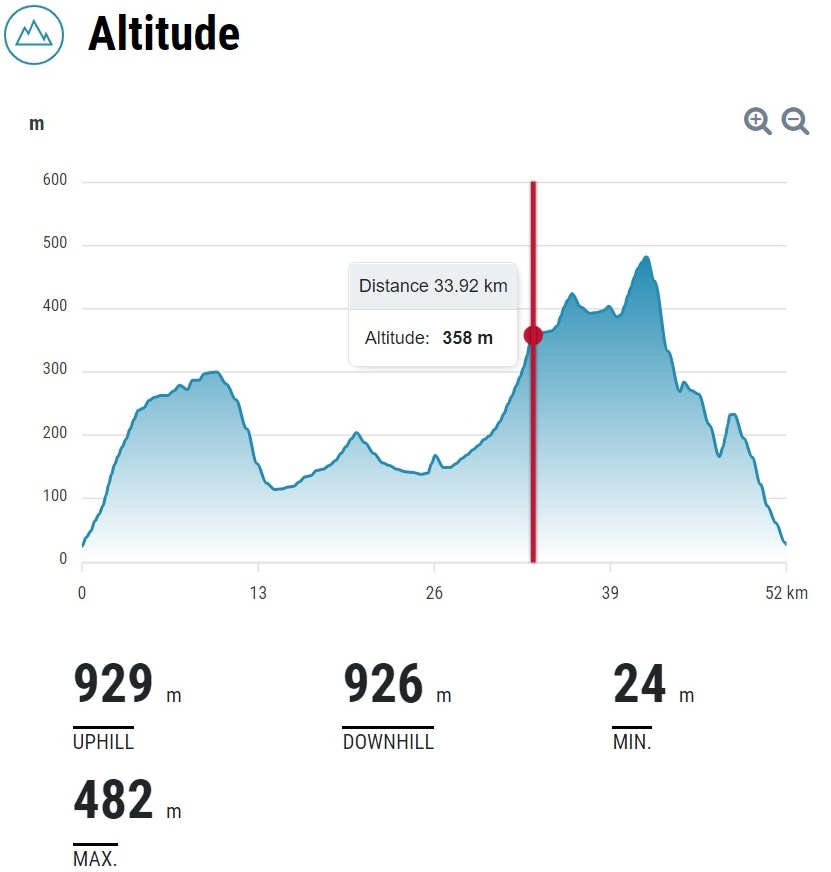

I even figured out how to export these rides into a format that my old Sigma Data Center software can import, so I can still have an unbroken record of my rides going back years. And I think I’ve mastered the various features of this thing (other than integration with komoot, which I may never need).
And now it’s time for a few more rock band names:
Now that the Android app and PC software are dialed in, and I know how to operate the computer, the only remaining problem is…
The speed & mileage mystery
I’ve got this fancy sensor mounted on my hub to provide “even greater accuracy,” so why do all the totals for my standard loop come out low? And why does my reported speed suddenly drop from 28 to 14 mph and then pop up to 32? I decided to query my bike team, to see if they have this issue, and if it’s even worth having that sensor on there (since it’s kind of ugly).
Right away, I received replies from six teammates. Two of them actually answered the question (short answer: no difference between GPS and sensor measurement), and the others provided a variety of interesting tidbits:
- The mph display often lags (jumps) while under tree cover, as does the elevation gain/loss. Piece of shit
- The device connects with a satellite. The choice of satellite affects the data. The device usually has a Satellite setting. Galileo is US satellites. GLANOSS is Russian satellites. If you set your device to choose both then supposedly you’ll get more accurate data. (There may be a third set of satellites available now, too.) If you ride a lot in one location, then travel (like if you ride from Oakland every day then one day start in Sacramento or France) this can confuse the device. The solution is to find the necessary obscure setting and leave it outside for a specified length of time. (Read the instructions. You’re on your own.) The device works better facing certain directions, like north, I think. Something to do with astronomy.
- Dana if you get on Strava all your problems will disappear Do it! Do it! Do it!
- GPS based measurements aren’t perfect. Absolute GPS accuracy is typically in the 5-10 meter range for consumer devices, so the GPS measurement is typically combined with an inertial measurement unit (IMU), which gives accelerations and rate of rotations that are then integrated to get linear and angular velocities using a Kalman filter. This also means that if the GPS signal is degraded due to building or tree, your velocity doesn’t suddenly read zero. Since the IMU in consumer devices generally sucks, it’s not going to be perfect.
Wow, that’s a lot to digest. I for one am not interested in having the Russian government tracking my movements, and I’m not sure which device (the bike computer or my phone) is doing the actual GPS work and would have the necessary obscure calibration setting to true it up. I’m sure I don’t want to start doing northbound-only rides and coming back on a bus or something. Above all else, I think it’s time for some more cool rock band names:
Getting back to my teammates’ feedback, I reckon that the hub-mounted sensor I’m using is indeed the highly sophisticated IMU described, and it’s just not engineered well enough to be that accurate … which is a bit of a shame, since the old-school ones, which had a magnet attached to a spoke that passed by a sensor that counted the wheel rotations, was utterly simple and infallible. Perhaps part of my problem is that I’ve mounted this IMU on the rear hub (so I don’t have to look at it). I have just discovered (via a video buried within its website) that Sigma Sport recommends front hub mounting for “optimum reception.” Is it worth moving it, or do I ditch it entirely? That brings me to my next question.
Does any of this matter?
My friend Craig, who wrote about the IMU, went on to say:
Of course, you never precisely defined what you’re trying to measure. Do you want to know how far the tire patch of your front tire travelled? Or, do you care more about your rear tire patch? Even a rider trying to go in a straight line makes micro adjustments while pedaling, so the front tire travels ~0.25% farther! The more you turn, the greater the difference between the front and rear tire path will be. Or, perhaps you care more about your center of gravity? In that case, every time you rail a corner, your center of gravity takes a route that might be ~1% less (depending on the radius of the turn and your lean) than your rear tire patch. Of course, does it matter? Did you do less work because your new device showed that your ride was 2% shorter?
I think he’s being diplomatic here; the more direct version of his question might be, “Who cares what your mileage and speed are when the bigger question is, when are you going to start training harder so you don’t fall off my wheel when I’m trying to be nice and drag you through a headwind?” And he would have a point.
The answer is, at least in the short term, I want credit for every last foot of my rides because I’m doing a friendly competition called Cycle Around the Globe to raise awareness around the problem of suicide, and to engage in the collaborative effort to help prevent it. (My personal fundraising page is here.) Currently I’m sitting in 15th place with 540 kilometers ridden, though the leader has 14,000 kilometers, which he achieved in a single ride … so I’m guessing he’s not using a consumer-grade IMU. In fact, I think he’s even worse than those mopeds and e-bikes on Strava … he’s just making shit up. But for a good cause!
Lap timer
Alas, there is no lap timer on the Rox 4.0 (even though this very basic feature is available on a $14 Casio watch). I think I know why: the vast majority of cyclists are on Strava, which tells them their time on any segment they could want, automatically. But no, I won’t join Strava. That kind of thing’s not my bag.
—~—~—~—~—~—~—~—~—
Email me here. For a complete index of albertnet posts,
click here.


