Showing posts with label literature. Show all posts

Tuesday, June 30, 2026

Ask A Book Club Veteran


Dear Book Club Veteran,

I am a relative newcomer to my book club, but the others have been going strong for years.  I’m not about to rock the boat, but what do you do when nobody seems to want to spend much time actually talking about the book? I mean, we touch on it, but most of the time we’re sidetracked on a seemingly limitless range of topics. Any hints on how to tighten this up a bit?

Mandy S, Portland, OR

Dear Mandy,

This is a known phenomenon, and it’s called “book club.” In other words, par for the course. If members really wanted to knuckle down and focus on the book, they’d go to college. The reality is, people need an excuse to get together and this is one of them. As for your desire to keep things on track, just watch for opportunities to drag the book back into the discussion. For example, when someone is talking about her dog, you can say something like, “Did anybody else think it strange that all the dogs in this book are male?”

Dear Book Club Veteran,

I am thinking about starting a book club, and even have five or six members lined up. But I’ve never done this before. Can you suggest a few rules that have served you well in your years at this? I don’t want to be draconian but there are probably pitfalls you’ve learned the hard way…

Rhonda V, San Antonio, TX

Dear Rhonda,

My book club has just two rules, and we generally follow at least one of them. The first rule is: every book we choose must be available in paperback. This obviously makes it cheaper for those buying it, and also increases the chances we can get it from the library, vs. newer releases that have like fifty people ahead of you on the hold list. The second rule is: nobody has to finish the book if they don’t like it, but we’re supposed to hang on for at least 70 pages. (Why 70? I can’t remember.) Once in a while I dislike a book so much I break this rule, as do others, but at least most of us try. (There’s also an unspoken rule that spoilers are totally allowed during our discussion, even if it’s a mystery novel and a member is only 20 pages from the end. I mean, that’s their problem for not finishing, right?) 

Dear Book Club Veteran,

Help! We had a guy join our book club about six months ago who totally dominates the discussion. He wasn’t so bad at first but now that he’s comfortable in the group, he acts like he’s like a professor or something. Nobody knows him well enough to confront him; ironically, the person who invited him has since quit (coincidentally or not). Is there some accepted protocol for kicking a member out?

Sarah V, Denver, CO

Dear Sarah,

I don’t know of any tactful way to ask a member to leave, and the question of who should tell him would be really tough. Plus, if you saw the guy around town afterward it would be super awkward. But I do know a workaround, which my mom’s book club resorted to: though it had been around for over 15 years, its founding members announced that the book club had run its course and would disband. This they did, or pretended to do; once the loudmouth was gone, they quietly reassembled (coordinating via clandestine emails) except for the one unwanted member. You could give that a try!

Dear Book Club Veteran,

How do you hold up a heavy hardback with those limp wrists of yours?

Clint B, Topeka, KS

Dear Clint,

Since you presumably know nothing about my wrists, I’m guessing you’re trying to be funny, insinuating that there’s something gay about a man being in a book club. Maybe you’re some kind of Manosphere cretin. If so, this isn’t the first time my masculinity has been impugned based on my book club. I was once playing poker with a bunch of men (as part of a fundraiser for my kids’ school) and was betting low and folding a lot, so I wouldn’t have to ante up a second time. Finally I got a great hand and bet big, and someone said, “He must have a good hand to bet that high.” Another said, “Maybe he’s just got balls.” A third said, “No, he’s in my wife’s book club, so I know he doesn’t have any balls.” The difference between what that guy said and what you wrote me is that he was actually funny.

I don’t know why book clubs tend to be female, other than the fact that many book clubs only allow women. Here’s an idea: as your first step in rehabilitating yourself, you should start an all-male book club … if you’re man enough to risk it.

Dear Book Club Veteran,

We’re all pretty busy people in my book club, so we only meet for an hour and a half. Of this short time, it seems like we always spend at least half an hour picking the next book. The host selects five, and prints out synopses and reviews and such, and we pass them around and then vote on little slips of paper and it’s just so inefficient. Any suggestions on streamlining this?

Angie W, New York City

Dear Angie,

My book club used to pick our books that way, but then during COVID, perhaps because so much else in our lives was going digital, we switched to everybody submitting a suggestion and then voting on them via SurveyMonkey. This gives everyone time to peruse the options at their leisure, and nobody has to print anything out. The only issue is that it’s a lot of work for whoever gathers the suggestions and produces the survey, not to mention tabulating the results. Chances are you can’t all take turns running the survey because not everyone would have the patience or math chops to get it done. (I award three points if somebody votes for a book as his or her first choice; two points for second choice; one point for third. It’s simple arithmetic but requires  a very methodological approach.)

There are benefits to taking on the work, though, if somebody wants to a) be helpful, b) save money, and c) never have to read a book he or she really doesn’t like. How? Well, as the survey master you can game the system a bit. For one thing, you’ll be the first to know which book won, so if there aren’t many copies at the library you’re first in line. Second, you can vote last, and if there’s a book you really detest, you can figure out what other book has the best chance of beating it, and throw your first-choice vote at that one instead of your own. It’s worked so far: I’ve never had to read the amateurish sci-book about the young, misunderstood video gamer who gains extraordinary power, saves the world, and gets the girl.

Dear Book Club Veteran,

My book club isn’t doing it for me anymore. How do I gracefully resign? I don’t really want to lie; for example, I’m not going to claim I don’t have time because honestly I totally do. But I also don’t want to hurt anyone’s feelings. Any ideas?

Megan A, Ventura, CA

Dear Megan,

I’ve only ever been in one book club (for something like 20 years now!) so I don’t have any experience resigning. One of our members was very candid when leaving, saying something like, “I’ve come to dread these meetings.” I thought that was a bit harsh—so I totally get your point. So here is one idea, that worked great for my wife. She was in a book club that hadn’t announced itself as being feminist-themed, but every single book the members chose were in this category. (She once asked me to buy the book for her, since I’d walk by a bookstore on the way home from work, and I couldn’t remember the author. So I asked the staff if they had Eight Bald Chicks. The bookseller hadn’t heard of it and asked, “Do you have any idea what it’s about?” I replied, “It’s probably some feminist thing.” At his he laughed and said, “Oh, you must mean 8 Ball Chicks!” Which turned out to be correct.)

Eventually my wife wanted out of the club but didn’t want to look unsympathetic to the cause. At the same time, since the club had never said they wanted to focus on feminist literature, she was free to choose any book when it was her turn. She chose Remembrance of Things Past by Proust, and wouldn’t back down when they protested its length. For this she was summarily kicked out of the club on the basis of it “being a poor fit” for her. Fair enough, and at least they made that judgment.

Dear Book Club Veteran,

My book club is mostly great but there’s this one member who’s always sneaking smut into our reading list. She’ll describe something as, say, a historical romance so we’ll go ahead with it, and then fifty pages in there’s this jump scare smutty bit and we’re all like whoa, enough! 

Alicia C, Los Angeles, CA

Dear Alicia,

Evidently you’re not getting anywhere letting this person be the judge of smuttiness; you’ll need to rely on a wider, crowdsourced reading community to help police this. Platforms like BookStagram and BookTok employ an informal rating system based on chili pepper emoticons (🌶️). Decide as a group whether two peppers (i.e., explicit scenes being relatively brief, infrequent, and not very graphic) or three (steamy, highly detailed) should be the cutoff. Leave it to the offending party to delve into all this, as one reader’s three could be another’s five and you don’t want to be guinea pigs.

Dear Book Club Veteran,

My book club’s members take turns hosting. Whenever I host, my husband wants to participate. I wish I could tell him it’s a women-only book club, but it’s not—we do have men. The fact is, I love my husband but get plenty of him every day without him being a part of book club, too. What can I do to, frankly, exclude him without making him feel, well, excluded?

Francine B, Boston, MA

Dear Francine,

That’s a real tough one, but I do have one idea based on my wife’s writing group meetings. They invite spouses to come—not to all of the meetings, but to some—and the spouses form a “splinter group” and watch a movie or go bowling together. With this arrangement your husband wouldn’t feel singled out, and it would keep him from sulking in his room and/or making little trips to the living room on one pretense or other. Talk to your club’s members and see if they like the idea!

Dear Book Club Veteran,

What do you do when your book club is meeting and the talk turns political? This happens occasionally in my club—especially around election time—and though we all basically agree on our politics, I find it really tedious nonetheless. It’s usually one or two troublemakers initially, but then the blathering catches fire and is hard to snuff out. Recommendations?

Mark T, Boulder, CO

Dear Mark,

I’m really sorry to hear that … political talk could ruin a book club (not to mention a friendship or a family, in this day and age). And you’re right, even when people have similar views, it’s still a drag, because it’s usually a stupid little game of one-upmanship. Besides, what point is there sitting around agreeing about something, particularly when it probably has nothing to do with books and reading? 

Once again, my book club hasn’t had this problem to any great degree (and when it has, quick-thinking members led the discussion in a gonzo direction that made sincere political discourse impossible). For your group and others caught in this situation, I recommend something a Berkeley area breakfast club implemented decades ago: a formal prohibition against talking about politics, punishable by a $2 fine (which could go toward refreshments or something). See if enough members support this idea to make it an official rule!

Dear Book Club Veteran,

One of our longtime members had a history of neglecting to read the book, but in the last year or two he has always seemed prepared—but his insights seem pretty simplistic and a little too pat. I strongly suspect he’s resorting to AI summaries just so he can (try to) sound smart. How can I “out” this person?

Kate R, Seattle, WA

Dear Kate,

I admire your fighting spirit … if you’re right about this guy, he needs to go down, hard! I think you can test your theory and expose his fraudulent ways at the same time through a two-step approach. First, respond to one of his insights by delving deeper and bringing something really arcane into the dialogue; for example, “I’m interested in what you said about Pnin being a spiritually complex character, revering life, memory, and beauty rather than any specific deity. But what would you  say about the ‘dazzling Greek-Catholic cross’ he wears when sunbathing?” If this kind of specificity doesn’t cause an incriminating level of visible discomfort, employ the second step: ask about something that categorically is not in the book to see if he fakes having noted it. For example, you could say, “Good point about Clarice’s anxiety. Do you think it was realistic, though, that she ended up fearing her neighbor was  a vampire?” If this member says anything other than, “Honestly, I have no recollection of that,” you can prove (at least to yourself, or publicly if you’re feeling feisty) that he’s an AI-synopsis-reading fraud!

Dear Book Club Veteran,

I don’t know how else to say it, but my book club is pretty nerdy … nobody ever suggests anything lighthearted or fun, it’s always serious stuff like a presidential biography, nonfiction like Guns, Germs, and Steel, or some socially responsible novel about wretched oppressed people. How can I inject something exciting and novel (no pun intended)?

Jill M, Omaha, NE

Dear Jill,

I’m going to reach out to another reader, Alicia in Los Angeles, to see if she’ll put you in touch with the member of her book club who is always sneaking smut into their reading list, disguised as mainstream literature. That person might just become your book club mentor!

A Book Club Veteran is a syndicated journalist whose advice column, “Ask a Book Club Veteran,” appears in over 0 blogs worldwide.

—~—~—~—~—~—~—~—~—
Email me here. For a complete index of albertnet posts, click here.

Tuesday, February 28, 2023

From the Archives - Bits & Bobs Volume VI

Introduction

This is the sixth installment in the “From the Archives – Bits & Bobs” series. Volume I is here, Volume II is here, Volume III is here, Volume IV is here, and Volume V is here. But the different volumes have nothing to do with one another.

Yes, it’s another slow news day. So, taking a cue from writers like David Sedaris and Lydia Davis, I’m assembling and posting some excerpts from some old letters. If I too were a famous writer, these micro-dispatches could be gathered into a handsome printed volume sold in bookstores everywhere (i.e., I could basically print my own money). Instead, since I’m an unsung blogger, you can read them for free!

These ones were all written while I was a student at Berkeley.


October 26, 1990

My schedule is so weird, I have to do my cycling indoors sometimes, even when the weather is great. I don’t ride my rollers in the basement laundry room anymore, though. Here’s why. They have this timer knob hooked up to the overhead light, to keep it from being left on. I was riding my rollers in there in the pre-dawn hours before work, and gave no thought to the timer. So I was riding along and suddenly there was this loud “DING!” and the lights went out. I crashed instantaneously. My Walkman went sailing across the room and broke into like three pieces. So now I’m keeping the rollers in the apartment and riding them there. I have this headwind accessory that makes them harder than actual riding. Good complement to all the hills around here.

February 12, 1991

I suddenly find myself in the terrifying position of going head-to-head with the most depraved, cruel band of thugs the free world has ever known. These miscreants have no regard for peace of mind; they loot solace and tranquility like a roadside gas station or liquor store. Meet Mr. First‑and‑Last‑Month Rent: wanted in six states for Financial Burden with Intent to Ruin. Mr. Damage Deposit: known to be armed and dangerous, wanted by federal authorities for Monetary Assault on a College Student. A recent stakeout found that these two are operating with an accomplice: Kid Tuition and his gang, the Three Installments. What could all this mean? Only one thing: I’m laying it all on the line by finding a new apartment. Which means raising a lot of cash in a hurry. Got any quasi-legal, or (what the hell) totally illegal hustles you can bring me in on?

July 16, 1991

Our local sales tax has been raised to 8.25%, and extended to cover snack foods. This is interesting: candy bars and potato chips are taxed, while fresh produce and wheat flour are not. It gets complicated: all crackers are taxed, except Saltines. Popped popcorn is taxed, but not un-popped. (Do you get a rebate on the un-popped “old maids” in the popped popcorn?) At the bike shop [where I work] these items present some complications. Powerbars, for example, contain 100% of the U.S. R.D.A. of most vitamins and minerals, and have only a gram of fat: hardly typical snack food. Yet, they still don’t really qualify as grocery. So today, in my capacity as shop manager, I put the following notice on the Powerbar display:

DEAR CUSTOMERS:

Recently enacted tax legislation requires us to charge the new tax rate (8.25%) on all snack foods. Since Powerbars and XL 40 bars are “great anytime as a snack” they are now taxable items. But since Exceed High Carbohydrate Source “supplies as much carbohydrate as 6 cups enriched spaghetti, 8 medium sized baked potatoes, or 11 slices of white bread,” it qualifies as a grocery item and is therefore not taxed.

September 19, 1991

Here is the opening passage of the article I was supposed to have read for today for my Honors English seminar: 

Perhaps something has occurred in the history of the concept of structure that could be called an “event,” if this loaded word did not entail a meaning which it is precisely the function of structural or structuralist thought to reduce or to suspect.

Keeping in mind that the opening sentence is supposed to lure the reader into further study, I find this beginning atrocious. But amazingly, it gets worse:

It would be easy enough to show that the concept of structure and even the word “structure” itself are as old as the episteme—that is to say, as old as western science and western philosophy—and that their roots thrust deep into the soil of ordinary language, into whose deepest recesses the episteme plunges to gather them together once more, making them part of itself in a metaphorical displacement.

For me to be reading this might suggest that I’m some kind of elite student who can grasp really complex ideas. But the sad truth of the matter is that I am no better equipped to handle this than you are. Probably less equipped, actually, given my youth and naiveté. This essay rages on for twenty-six pages, getting increasingly obtuse, and I never made it past the first five pages, with zero percent comprehension. Thus in one day I have fallen hopelessly behind, since the rest of the reading for this course (one such essay per class day) is doubtless based on this foundational essay.

So I walked into class this morning very ill prepared, and thought to myself, “Self, don’t despair, the rest of the class is probably as overwhelmed as I am.” This day I happened to be early, for—having given up my attempt to read the essay—I had nothing better to do than to make a big breakfast and leave for school well ahead of time. I ask the first fellow student I saw what he thought of the essay. “I really enjoyed it, how about you?” he said, apparently with perfect sincerity. I told him that to be perfectly honest, I had found it somewhat difficult. He frowned, as if surprised to hear that, and said, “I found it similar to Beckett, didn’t you?” I vaguely remember a Sir Thomas Becket who wrote some religious thing, maybe about people flogging themselves or something, but couldn’t make a connection. [I realized weeks after writing this my classmate meant Samuel Beckett.]

I spent the class period realizing that for perhaps the first time, I’m hopelessly outclassed by my peers. I start to fret and sweat, it gets hot, I can’t get away, the prof rolls, I’m popped. How’d I get into this spot? I played myself. But why am I facing off against this fierce foe? The faculty’s fault? No. Nobody signed me up for the course; nobody enrolled me by force. I thought I that I could excel at this big school? Fool. I played myself. [Apologies to Ice-T.]

February 27, 1992

I was studying yesterday in Sproul plaza, sitting on a bench, and an old man came and sat down by me, with nothing to occupy him but people watching. Eventually we had some conversation: he’s 85 years old (didn’t look it!) and from Russia. He didn’t seem to recognize Lolita, which I was reading, and was surprised at my choice of the English major, having studied engineering himself. He says in Russia, those with a college degree are admitted to a special grocery store that those without a degree are not. Same prices in the alumni-only store, but much vaster variety and availability of goods. He didn’t say how the store vets these people, and I didn’t ask.

During the big rains we had a week or so ago, I parked my bike under the bridge between LeConte Hall and Birge Hall, just east of Sather Tower, before going into Doe Library (through the back entrance, as a construction project has blocked the front and snarled most paths through campus). It wasn’t raining that afternoon but my precaution was well taken: when I finally left the library in the late evening, the rain had started up again. Groggy from my scholastic haze, I was shocked to find that nature and weather and the out-of-doors had all continued without me. Riding down Bancroft, I was impressed by the electrifying effect the rain had: extra-shiny reflections on the cars, and extra-black asphalt with a neon-like red reflections of taillights.

In five minutes I’ll leave go to tutor at Malcolm X school. My student, “Eddie,” is trying to imitate my out-loud reading by going as fast as he can. This means the words come out at the same pace as before, but with a tone of frantic urgency and almost no pause between words. I sometimes worry that he isn’t retaining what he has read, but last week we worked together on a book report and I found he’s getting most of it. His dopey teacher had acted like he’s a hopeless case, totally checked out, etc. but I find he works pretty hard if someone’s around to help him focus.

May 25, 1992

Doesn’t it piss you off when you get a defective band-aid? At the bike shop we have Curad. As you know, these are not the band-aids we grew up with, and I find myself somewhat hostile to them. Their lack of quality control is one of the small but nagging travesties that plague my employment at the shop. I would say about one in three Curad band-aids is defective. The little sanitary cotton pad is skewed, and sometimes has missed the center of the adhesive portion, so you get just a little triangle of pad, and the rest is free to stick to the wound. I really can’t believe the bandaging public tolerates Curads at all. At home I use Johnson & Johnson Band-Aid brand. This becomes expensive since I’m constantly washing dishes or taking my contact lenses out or something. I’m tempted to just leave the wet band-aids on and let them dry out, but I called Johnson & Johnson on their toll free number and asked about this. “You know how the box says they’re waterproof?” I asked. “Oh, yes, they certainly are,” said the lady earnestly, in her charming southern accent. “Well, does that mean I don’t need to change them once they’re wet?” I asked. “Oh, no, you should always replace them—that’s the only way to prevent bacteria from infecting the wound,” she replied. Puzzled, I asked, “Then what’s the benefit of their being waterproof?” A long pause. Finally she said, “Well, if you’re swimming you won’t lose them in the pool. And, they won’t go down the drain.”

September 12, 1992

I have purchased Lila - An Inquiry into Morals by Robert Pirsig, author of the classic Zen & the Art of Motorcycle Maintenance. I hope this second book is good, but I have little faith that it’ll live up to its predecessor. I really loved the Motorcycle book, but the really lame Epilogue, which Pirsig attached to it like a decade later, irritated me so much that I tore it out of the book. This act was, I’ll confess, tantamount to destroying knowledge and human thought itself. Even worse, it loosened the cheap glue binding on the whole book, so that eventually all the pages started falling out—a disaster, especially since this is the one book I really wanted to pass around among my friends. It’s a really shoddy paperback to begin with, from the imprint “BANTAM NEW AGE BOOKS: A Search for Meaning, Growth, and Change.” Other Bantam New Age editions include Ecotopia, Shambhala: The Sacred Path of the Warrior, and The Complete Crystal Guidebook. What bothers me isn’t so much the nature of these books by themselves—although that alone is annoying—but rather the very idea that Bantam could integrate so many conflicting and discrete books into a single group, as if they could all be united as life philosophies. Like somebody is going to just go right on down the list, finding Meaning, Growth, and Change in every one of these. It’s tempting to think that when Pirsig wrote Zen and the Art of Motorcycle Maintenance, he would have winced at having his work co-opted into the Bantam New Age menagerie. But actually, the epilogue that he added later totally smacked of the easy, wildly speculative, faux-spiritual sentimentalism that the “NEW AGE BOOKS” line can be presumed to have. Who knows, maybe Pirsig got cocky; after all, his book sold like crazy and impressed a lot of people, many for perhaps the wrong reasons. Anyway, I still have the decrepit Motorcycle paperback, and without the Epilogue it is a work of pure genius. I’ll let you know how Lila ends up going.

—~—~—~—~—~—~—~—~—
Email me here. For a complete index of albertnet posts, click here.

Monday, January 16, 2023

More Beer Pix - the Milestone Beck’sts

Introduction

I’m reaching that age when the milestones start to pile up: a kid graduates from high school, then another, then it’s an empty nest, a niece’s wedding, a kid turns 21 and can legally drink beer … hey, did somebody say beer? That’s more interesting than all these sentimental milestones! And guess what: this post attempts to knit the two topics together via a series of Beck’sts.

What? You haven’t heard of Beck’sting? What rock have you been teetotaling under? Get thee to a brewery! Or, click here.

Note: as with previous posts about Beck’sts, I’ve grouped these thematically. I’ve included captions and commentary, and the initials of the Beck’ster. Where you see one letter only (e.g., “E—”) that’s generally somebody’s spouse or other family member. These are roughly chronological, beginning with where my last such post, about the COVID-era Beck’sts, left off.

Celebratory Beck’st

DA: Well, L— graduated from high school. This isn’t the most exciting thing in the world, though one always worries there’s some missing class or something. For her celebratory dinner, she wanted pho, so we went to this giant place that used to be a Sizzler, only to learn that it is take-out only. WTF?! It’s the size of an aircraft hangar! So we went to some other random place. We were literally the only customers. The waitress, a downtrodden-looking, bent-over old woman in peasant attire, was really dour and acted super put-upon. E— asked about this soup with a fermented broth, and the waitress said, “It has a smell.” E— asked “What does it smell like?” to which the waitress replied, “Feet.” E— asked if it tastes good. “It’s good,” the waitress said noncommittally. E— ordered something else.


DA (continued): So, one of the cooler things about this restaurant was that they listed Elysian Brewing Space Dust IPA as one of their draft beers. You don’t see that one very often. On the chalkboard it was listed as Space Dust, but on the menu it was called Dust Space IPA. I tried to order it but the waitress said, “Out.” I asked what the Big Wave beer was. “It’s the new one,” she growled. I tried it, hence this Beck’st. Sure enough, it ended up being one of those watery lagers from Kona Brewing. It’s like Hawaii’s version of Pacifico and I mean that in the worst possible way. Anyway, it was a liquid, and cold, and went fine with the food, which was fine. Oddly, the waitress never did take away any of the plates and serving dishes, even when she brought dessert. It was all still piled up when we left. You don’t get much for $125 anymore...

Summer break Beck’st

DA: A— is visiting for a couple weeks! (Since she started college, she never comes home for summers.) Alongside some pretty good guacamole, I’m enjoying this Deschutes Fresh Haze, an old favorite. It broke 90 degrees here today!


DA (continued): OMG. I just realized there is something seriously, seriously wrong with that photo. These stupid modern phones and their convoluted camera software!

BA: That is freaky... Was it a panorama or something? The beer looks wonderful, though!

Monday Beck’st

DA: Monday is a disease. Meet the cure.


DA (continued): Regarding the text of my Beck’st a minute ago: in case you missed my cinematic reference and just thought I was a dork, see below. (Not that I’m not a dork...)


Moving Beck’st

DA: After a long day of moving stuff and building furniture in our mom’s new home, BA and I are relaxing with these fun sized beers. They are only 4 oz! Of course we would prefer a whole beer, but we’re worried about our weight.


DA (continued): Actually, that last text suffered the fate of so many photos taken with phone cameras with absurdly wide-angled lenses. These are actually 12 oz beers, and they are a new variety from New Belgium called Juice Force Imperial IPA. They are freaking GOOD, especially for summer when a refreshingly fruity beer is welcome. (By the way, I understand that we are incorrectly drinking these out of wine glasses. No other glasses have been unpacked and we wanted to see how hazy this beer is, and to spleen DW about the stemware.)


Nephew from Netherlands Beck’st

My nephew M— (name rhymes with “Ox”) and his girlfriend D—are visiting from the Netherlands. They’re enjoying 6-oz. Easy Rider IPAs and I’ve got a proper pint of the Henhouse IPA. Not shown: the Little Star pizza and Fieldworks IPA we enjoyed later! Life is good…


PCS: Wait, I thought your kids HATE Little Star pizza. I recall getting that pizza one night at your place and your kids mercilessly hazing you over the decision of getting Little Star instead of Zach’s. How could you!? Anyhow, your beers look great. Why are the Dutch youngsters drinking only 6 oz beers?

DA: Yeah, my kids always bitch & moan about Little Star, but at the end of the day they’d always prefer it over nothing, which they know is always a possibility if they push me too far. In this case we couldn’t get take-out because E— was taking a final exam online and we wanted to stay out of her hair, but we couldn’t eat at Zach’s because they don’t have outdoor seating. As far as the Dutch youngsters splitting a beer, I’m not really sure what that was about because they each had a full pint of Fieldworks with dinner. Maybe they shared the first beer just to be romantic?

JL: This is a great Beck’st. It is what all Beck’st’s should aspire to be. And I can’t help but notice that your nephew M— (rhymes with “Ox”) looks like a younger version of your brother M— (rhymes with “Axe”). The smile in particular. Nice photo and it’s great that the couple shared a beer early in the night to be “romantic” (or whatever), and then each had their own stronger beer later in the night to be badass and individual. That’s a couple that can last.

DW: The young couple must still be trying to determine who is the taker and who is the giver in the relationship. They’re halfway there, apparently. Speaking of Beck’sts, check out this Georgetown Bodhizafa IPA - Very good! I was hoping for Barley Brown’s. The place we were at usually carries it, but this was a nice substitute. Nice way to celebrate a tough week.


DA: JL, that is a very insightful insight about the couples romantic-shared-beer + individual-solo-beer. Would that all insights could be so insightful. And DW, that is a tasty looking beer and the photo, showing the toast, captures a conviviality that is a tonic after so much isolation.

Empty nest Beck’sts

DA: L—’s last dinner “at home” (i.e., in her hometown) with us before leaving for college tomorrow. This restaurant has Racer 5 on tap ... SCORE!


DA (later): This Beck’st is commemorating my magnum opus (well, opus #2). I have been keeping this journal for most of L—’s life. During the last couple weeks I spent >35 hours editing it so I could give it as a going-away present (as I did with my first daughter). Kind of poignant as tomorrow we’ll drive L— off to college and become Empty Beck’sters. (You didn’t think I was gonna say empty nesters, did ya??) Alas, this beer is kind of meh.


JL: This is truly astounding. My PhD dissertation was much shorter than this. Magnum opus (#2 no less) indeed! My man. Well earned Beck’st, so it sucks that the beer was meh.

DA (5 days later): Our final meal with L— before dropping her at her dorm and saying our goodbyes. This beer, from the very local Lost Coast Brewery (visible from this marina restaurant patio), is a hazy IPA, quite tasty, and only $4.25! (E—’s wine was $9 and she reports it’s as meh as every glass of wine she’s ever had, but she won’t give up trying to learn to like wine. But I am not bitter.) Anyway, we are officially empty Beck’sters now. Be sure to submit your questions for my Ask an Empty Nester column, coming soon to albertnet! (PS: L—’s beverage is an Italian soda. Why they put whipped cream on it is beyond me.)


Legal-age Beck’st

DA: A— is officially legal to drink! She is in town celebrating her birthday, among other things, as her college term starts much later than her sister’s. This is at the Biergarten and these are Fieldwork East Motel IIPAs. Frickin’ brilliant.


AA: So proud to be a part of a Beck’st! I’ve been awaiting this moment for years :)

DW: Welcome AA! I want to congratulate you on your fine choice of beer (first beer? Probably not…) and proper pint glass. I was afraid you may have been corrupted somehow about what a proper vessel for beer is.

DA: Actually, we were on our way walking to Fieldwork when I saw that the Biergarten didn’t look terribly packed, and I was thinking that it might be better to go there simply because they serve all their beer in proper pint glasses, and I was actually dreading these new glasses that Fieldwork has that are so absolutely hideous that they would have you PUKING FOR DECADES. I snapped a photo of one of them at one point, but I couldn’t bring myself to Beck’st it to anybody, despite the morbid curiosity you might have about it.

JL: Congratulations to AA on your induction into the Beck’sting club! May you have many happy Beck’sts to come! (But not too many…)

DA: Indeed, it’s good to have AA in the loop but only, apparently, in a receive-only mode. What this means, AA, is that you can (and should) Beck’st us but we (or at least I) cannot Beck’st you. This is a directive from your mother who seeks to avoid any improper behavioral modeling on my part.

In-law Beck’st

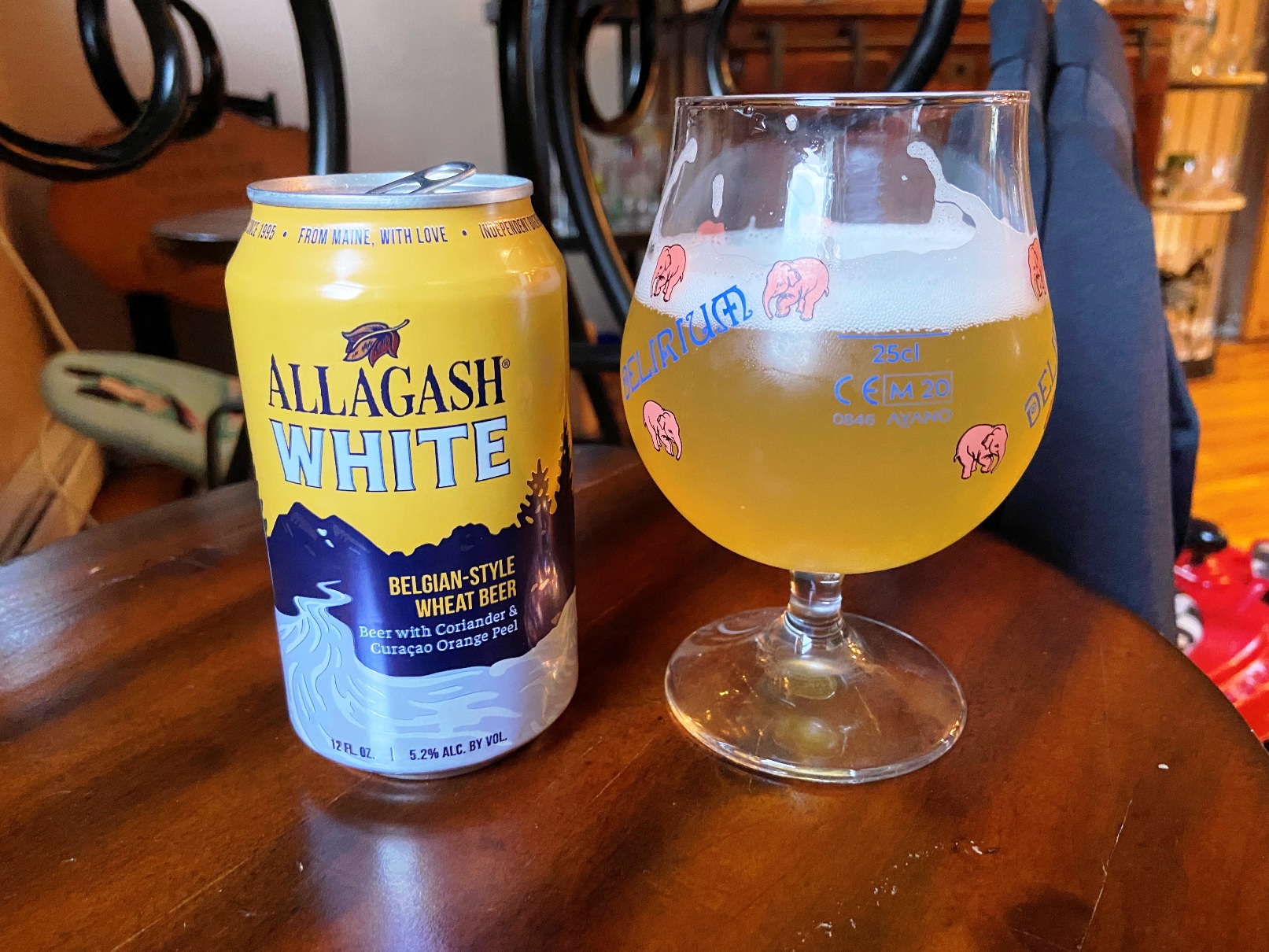
DW: [My son’s new father-in-law] gave me this Belgian White Beer when we were back in NY last week. I’m usually not a big fan of Belgian White beers, but this one was really good, even in that glass. I pleaded with him to let me drink it from the can but he wasn’t having it. “Oh no, I have the perfect glass for this beer. It’s my favorite Belgian,” said he. So it goes.


DA: DW, looking closely at that glass, I see it has the Delirium Tremens logo on it. I’d recognize that pink elephant anywhere. The DT is an astonishingly good beer. I feel your son has married into a great family, stemware notwithstanding! (Full disclosure: I have a full set of Duvel stemware. Stemware is arguably appropriate for Belgian beers.)

DW: Since we’re apparently being all sophisticated, I am thinking about getting “The Master and Margarita” audiobook, but just not sure if I’m up to it. “The Death of Ivan Ilyich” was one of my favorite novellas, so maybe I’m ready to make the leap; however, Russian authors to me are analogous to Bob Dylan. I wish I was intellectual enough to understand the significance of Bob Dylan.

DA: I don’t really get Dylan either though I know I should. And while I haven’t read “The Master and Margarita,” E— has heard good things about it, and AA’s friend M— absolutely loves it, and she is a wunderkind who read it in the original Russian, being fluent. So that’s a pretty good recommendation I think. In fact, I would starting reading it right now, but I don’t know where our copy is. It’s not all that long by Russian novel standards; only about 400 pages, which is an 8 hour 22 minute audiobook. If you’re still not feeling up to that, you might consider “Master and Man” by Tolstoy. E— loved it, and in length it falls in between a short story and a novella, at a brisk 2 hours 9 minutes on audiobook. I’m definitely going to check that one out. Just be careful when you’re browsing Hoopa or Libby or whatever for that title … it’s not to be confused with “A Masterful Man”:


DW: Thanks for the feedback on Russian authors and novels. I do know you know KNOB-Ah-Cov really well, so, you’re sorta my go-to. I’ve seen “Anna Karenina” around, maybe even at my own house. I think T— has read that..back in her reading days. Just the mere sight of that book scares me! No book should be that tall, sitting on its side, on a shelf. Or that heavy.

Kids catching up Beck’st

PCS: I’m cruising Italy with S— and the kiddos. We spent a couple of days in Florence doing the museums and cathedrals. Now, we’re in the Tuscan countryside for 6 days of riding from town to town. I’ve got to say, it is truly gorgeous riding here. It’s hot as hell but the heat sure makes the beer taste great! S—’s Aperol Spritz is next to my Peroni.


DA: Dude, you’re livin’ large as possible, posse unstoppable! Nothing like a nice, refreshing, watery Italian beer after a day in the heat, eh? So are the kiddies riding bikes, too? Be sure to Cancellara them here and there, just to remind them who’s boss. (That is, if you still can…)

PCS: Yeah, the kiddos are riding. I don’t think I could put too big of a hurt on H— except he’s getting up early and running before we go ride. M— had a colossal meltdown today on the ride into town which was at the top of a 5 km climb. I figure, they have to earn their keeps somehow!

Stealth Beck’st

DA: Normally the kids make 100% sure we have plenty of Halloween candy well before the big day, and are even known to test it for quality. But this year, without their guidance, our pumpkin went un-carved and we didn’t get to Safeway for candy until the afternoon of Halloween, and they were completely sold out! Thus, we’re hiding from the would-be trick-or-treaters this evening by having the lights out. We ate dinner (easily heated leftovers) by candlelight, and just to be extra safe, I chose this stealth beer, a Guinness. It went down real nice, though I couldn’t fully appreciate the nice head on it (courtesy of the widget in the can).


Kids home Beck’st

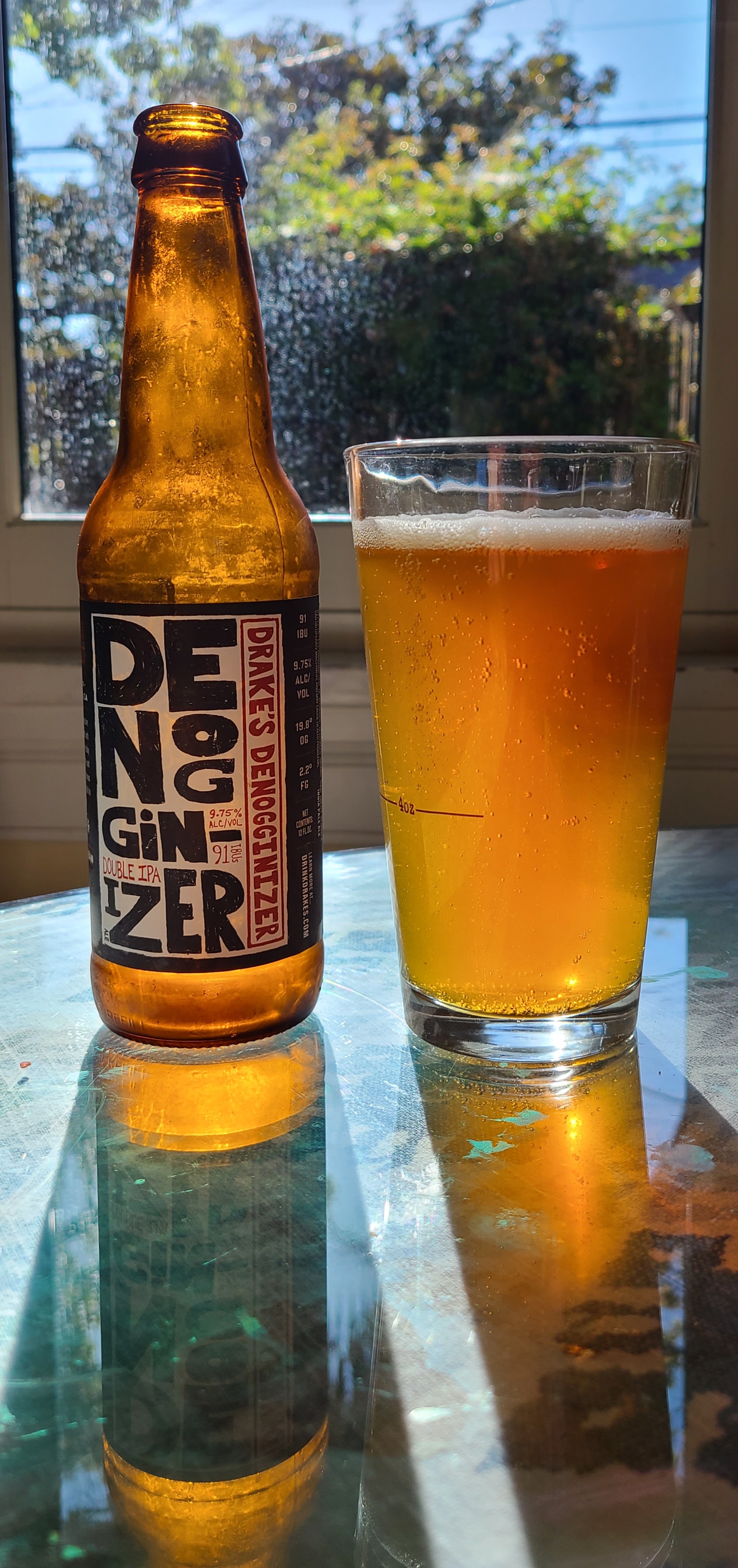
DA: Both kids are home for winter break and tonight I’ve taken them out to the movies. We’re about to watch “Avatar - Way of Wankers.” This Denogginizer Double IPA is here to help. Wish me luck!


PCS: You’ll definitely need two drinks for that movie!

DA (3+ hours later): Au contraire, they’re almost $10/pop! I split one with AA. The movie was better than I expected. Lots of folderol but also some great action.

DW: Maybe the ABV% was much higher than you realized. Awesome mini theatre. In other news, we were in Eugene and they happened to have a brewery there.


JL: I’m probably alone on this, but I like a lot of folderol in my big budget Hollywood dreck. “Bring on the folderol!” I’m always shouting at the screen. Good looking beer. DW’s too.

DA: DW, that’s a nice looking brew you have there, and I like the “distressed” table as well - looks like a legit place. JL, now I finally know who it was yelling “More folderol!” at the screen when I watched “Fast & Furious XVII - Big Fat & Sassy” a couple weeks back.

Wedding after-party Beck’st

DA: I am not drinking during January. At least, not officially … but I wasn’t going to miss out on the after-party, at a cool bar with lots of pinball machines, after my niece’s wedding. I don’t know what this IPA is, some local thing. BA has the Guinness on nitro.


DW: Nooice! I love your attempt at a dry January. The same thing happened to me on Friday. We happened to go back to Deschutes Brewery and I ordered another one of their killer pilsners. N— and L— showed up and had water and a Diet Coke or something. They steadfastly reminded me about Dry January. So ... I’m in. Looking forward to it actually.

—~—~—~—~—~—~—~—~—
Email me here. For a complete index of albertnet posts, click here.

Sunday, December 6, 2015

From the Archives - The Great TA Smackdown


Introduction

When somebody disses me, I usually retaliate. I’m not talking about revenge, which attempts to fix one wrong with another, but about pursuing justice in a responsible, productive fashion. I had a highly satisfactory come-to-Jesus with a dickwad grad student Teaching Assistant back in ‘92. Back then, we didn’t have surveillance cameras everywhere, or bystanders with smartphones capturing video of every single human activity, so there’s no footage of the heated meeting this TA and I had in his office—which is a shame. This guy was totally outgunned. It was like he brought a toothpick to a knife fight, and I had a chainsaw. What I mean is, I came prepared.

The gist of my grievance was that I’d put extra work into my paper, which he quite literally ignored. See, in addition to analyzing Ernest Hemingway’s literary technique of “omission,” I wrote a short story of my own showcasing the technique. The TA couldn’t be bothered to read the story, and even though the analytical part of my paper stood on its own (focusing on Hemingway’s work, not on my story), the TA seemed to want to punish me for my originality by judging my paper very harshly. (You can read the story itself here, along with a brief explanation of the “omission” literary technique.)

So, how did I prepare for this confrontation? I imagined what I would write to this arrogant bastard if I were denied the chance to meet with him. This worked out very well; knowing he’d never see this written testimony meant I could blow off a little steam in the process. By the time I finished writing out my talking points, I’d dealt so harshly with this guy I almost felt sorry for him. I knew, going in to the meeting, that he’d be caught completely off guard, being a lazy and hapless little douchebag with an oddly underdeveloped intellect, and I wasn’t wrong. Boy I wish you could have seen me walk him through his sad menagerie of lameness. Perhaps reading this essay will help you imagine the stricken look on his face. (No, I didn’t terrorize him or anything ... I was just very, very firm. Perhaps I cut a more menacing figure than I would today; after all, I was a young college kid, full of the bluster and bravado of that species, and my pugnacious attitude hadn’t yet been sanded smooth by experience, perspective, and a fully formed prefrontal cortex.)

(Note: this wasn’t actually a TA per se, but a reader. The difference is that a reader only grades papers and isn’t burdened with providing any instruction sessions.)


March 31, 1992: To the TA who gave me a B-minus

In analyzing your text, which might as well be called “Notes to a lowly undergraduate on his paper,” I will spoon‑feed you in the typical college “thesis statement” style you evidently prefer. My thesis is: YOU SUCK. I will support this assertion by citing directly from your text.

You start by saying, “I appreciate weariness at having to write another critical paper . . .” (p. 1). This statement demonstrates that you have only skimmed over my paper. A closer reader would have noticed that I’d written, “I’m as weary of writing standard papers as I expect you are of reading them” (analysis, p. 9). I was trying to spare us both, and your statement of appreciation is obviously disingenuous.

The second part of your first sentence reads, “you should have consulted with a reader before deviating so far from that standard” (p. 1). The automatic question is, “What standard?” There is no antecedent to your use of “that.” Is there some standard you assume we are both operating from? In an attempt to discern what “standard” you are requiring of me, I have reread the three-page description of the assignment from the professor, and refer you to the following “Subject Matter Requirements and Suggestions”:
  • “You may write on a topic you invent” (handout, p. 1). This is exactly what I did.
  • “Your paper must have a thesis” (handout, p. 2). Mine does. I stated it on the first page of the analysis, and developed it in the first paragraph. You should have been able to find it because I preceded it immediately with, “despite my [two-part illustrative and analytical] approach, this paper has a thesis:” (note that my thesis statement directly followed the colon). I certainly didn’t deviate from this standard.
  • “Originality of thought is crucial to genuine learning” (handout, p. 2). Careful examination of my text (which, incidentally, includes actually reading it) will show that I embraced this requirement by writing a two‑part paper in order to offer true originality while also satisfying the other requirements.
Let us assume that these requirements and suggestions do not allow a two‑part paper: even in the second part of my paper alone, I did, in fact, “analyze the function of a particular stylistic device” (handout, p. 3) in complete adherence to the “Suggested Paper Topics.” That you feel I was “deviating so far from that standard” demonstrates your lack of understanding of even the second half of my project. In other words: YOU SUCK.

Next, you state, “Unfortunately, as we each have over 60 papers to read in a very short time, I was unable to read your story, so I must restrict my evaluation to your analysis of Hemingway” (p. 1). The ineffectiveness of this statement is remarkable. Consider: an undergraduate, busy with a college workload of his own, has committed far more time than required in order to make a more powerful paper, but his extra effort is completely ignored—and yet he is invited to feel sympathy for the one who has blown him off. The implicit suggestion here is that your time is worth more than mine. You are contemptuously implying here that I’m just a bored schmuck with too much time on his hands. This ties in neatly with my thesis: YOU SUCK.

In the next paragraph, you acknowledge that my examples are “representative” but conclude, “the analysis seems superficial” (p. 1). Look, it’s either superficial or it’s not—there’s no “seems.” Moreover, it’s actually your skimming of my analysis that’s superficial. You offer three “probing questions” which, you suggest, I should have addressed in my essay. Number one: “What is the point of forcing the reader into this sort of relationship with the omitted language?” (p. 1). I refer you to my opening paragraph: “Omission helps to develop characters realistically, to avoid sentimentality, and to draw the reader into the story” (analysis, p. 9). Had I not developed this assertion, you could have attacked me for that; instead, you wrongly state that I didn’t even ask the question.

The next “probing question” that you suggest I should have asked is, “Why does Hemingway omit certain kinds of information and not others?” (p. 1). I refer you again to the actual text of my analysis: “While commonly leaving out certain details, Hemingway’s technique of omission also requires adding certain other details to alert the reader that the character is evading his emotions” (analysis, p. 11). The examples I cite in explaining this earned two comments of “good” from you, written in the margin of my paper. How could you have appreciated my response to this “probing question” without noticing that I had addressed the question to begin with? Did you forget what you had read? Maybe under a little grad-student stress? Awwww.

The final “probing question” you claim I failed to ask is, “What are the limitations of omission?” (p. 1). Once again (and I am becoming annoyed at having to do this), I refer you to my text: “The reader can sense Jake’s feelings only because Hemingway has so thoroughly developed Jake as a character. One must consider the extent to which omission [in a short story] would need to be employed differently than in a novel . . . [given] the short story genre’s more limited development of its characters” (analysis, pp. 12‑13). Does this not address the question? Sure, maybe I could have gone on at greater length about this, but can you really claim I never even considered the question? Clearly, your assertion that I did not “ask more probing questions” is shortsighted; rather, you needed to probe my paper more deeply. Or, to put it more succinctly: YOU SUCK.

If you pause to think (just try it, for once!) you may realize that for any student to coincidentally pose, and address, the very “probing questions” you accuse him of failing to think of is a highly unlikely scenario. Could it be that you actually formulated these probing questions based on ideas you got from my paper itself? Might you actually be confusing your own intellectual output for mine? If you like my ideas enough to subconsciously attribute them to yourself, couldn’t you at least give me a better grade than a B-minus?

Amazingly, the final paragraph of your feedback is even worse than the first two. You state, “In short, your analysis, as it stands, could be condensed into a few paragraphs” (p. 1). I have tabulated the paragraphs of my analysis for you:

Introduction/thesis statement                             1 paragraph
Explanation of 2-fold project                             1 paragraph
Definition of “omission”                                    1 paragraph
Example from first Hemingway text                 1 paragraph
Examination of 1st “probing question”             3 paragraphs
Examination of 2nd “probing question”           1 paragraph
Examination of 3rd “probing question”            2 paragraphs
Example from second Hemingway text            1 paragraph
Evaluation of first half of paper                       1 paragraph
__________________
TOTAL                                                             12 paragraphs

Assuming that the two paragraphs devoted to tying the analysis into my story are totally worthless—a false assumption designed to cater to your laziness—we are still left with ten paragraphs. Both the Oxford and Webster’s dictionaries I have consulted define “few” as “not many but more than one.” Given your obvious impatience with quantities of written text, I’m sure you’ll agree that ten paragraphs qualifies as “many.”

Is it possible you’re accusing me of padding my paragraphs with useless text, such that most of my sentences could be removed without losing anything? That would be an absurd accusation indeed, considering that I bothered to write eight extra pages (i.e., the short story) in addition to the standard essay. Those who pad their paragraphs to meet the minimum page requirement don’t then blow past that minimum by eight pages. Moreover, my top ranking in the English major attests to the quality control—ergo, the concision—of my writing.

Your penultimate sentence reads, “From there you could have a started a truly interesting paper” (p. 1). The extraneous “a” in your sentence is not surprising, given your lack of scholastic precision. What is surprising is your brazen suggestion that I have not written an interesting paper. In light of the incredibly poor job you’ve done in evaluating my paper, your snobbery demonstrates my thesis beyond a shadow of a doubt: YOU SUCK.

One more thing. It wouldn’t be right to put forth a thesis of “YOU SUCK” without mounting a rude ad hominem attack. This comes very easily to me in your case; I can simply quote from my lecture notes of March 30:
Let’s have a look at R——, the TA who has incurred my wrath. Sitting up front, he wears a prim cotton pant-and-blouse getup, all black and without a trace of color save the chance lint that, even now, he brushes off vigorously. His hair has all the perfect arrangement of the molded plastic hairdo of Malibu Ken—but R——’s is real hair, artistically blown-dry and spiked, so it looks somewhat like a pruned hedge. His face and forehead are scrubbed shiny, so that he looks a bit like a doll. In short, his appearance suggests the obsessed grooming regimen of a true narcissist.
If you were to point out that an ad hominem attack shouldn’t be delivered in the third person, you’d actually be making sense, perhaps for the first time ever. This brings me to the last sentence of your critique: “Please consult me before your next paper” (p. 1). Acknowledging the limitations of the essay form, I will save my most vicious foul‑mouthed insults, along with a brutal, bare-knuckled beat-down, for your office hours tomorrow.

~--~--~--~--~--~--~---~--
For a complete index of albertnet posts, click here.

Monday, February 28, 2011

Death of a Bookstore

Introduction

Recently I went to a Borders Bookstore in San Francisco for its going-out-of-business sale. I thought I would feel sorry for the place, but ultimately I didn’t. I’d expected to see Borders as the good guy in a Amazon-vs.-bookstore battle, but instead left the store thinking “good riddance.”

Amazon has always been a threat to traditional bookstores, and their Kindle e-reader has increased this threat. In this post I’ll start off explaining why I want to hate the Kindle. Then I’ll discuss my trip to Borders and why I think the chain deserves to die. If I have any energy left I’ll offer up some hopeful denial that bookstores—that is, true bookstores—will go extinct.

Why I want to hate the Kindle

I don’t hate the Kindle. I can’t hate it as a product, as I’ve never actually used one. You could argue that I should really try one out—not just play with the demo model at Target, which I have done, but should read an entire e-book—before I develop my opinion. Giving it a good try seems logical enough, but then, you could say the same thing for cigarettes.

I’m sure there are scores of happy Kindle users who would love to give me a demo. I don’t want a demo. There’s something evangelical about how people tout modern electronic devices (not just e-readers but smartphones, the iPad, etc.), and where the Kindle is concerned people can be downright apocalyptic. Consider this reader comment attached to a “Wall Street Journal” article about the demise of Borders: “Any prediction on when will Amazon only offer e-pub and drop the entire dead tree format from its lineup?” (That guy must feel really cool throwing around terms like “e-pub” and “dead tree format.”) In response, another commenter predicted that paper books would be dropped within ten years, to which the first guy replied, “10 years. That’s pretty pessimistic. How about one to two years.”

And why is ten years “pessimistic”—what does this guy have against paper books? Is it a desire to preserve our forests? I doubt it. I think the guy somehow associates himself with a sweeping societal change, and takes pride in his contribution to the success of a disruptive technology. (It’s a bit like feeling really proud when your local sports team wins a game, even though you yourself have nothing to do with the team or its victory.)

No, I’m not going to do battle with those who gleefully predict the Kindle’s eventual dominance. But in case you’re on the fence, here’s my top ten list of Why I Want to Hate the Kindle:

  1. Nobody on the Bart train is going to ogle my book.
  2. I can loan out my book and not have to worry about getting it back.
  3. I can leave my book in the bathroom and not worry about it being ruined.
  4. I have nice bookshelves full of handsome books that don’t deserve to be upstaged by a high-tech gizmo that pollutes my reading experience with the gaudy culture of PCs, cell phones, and the Internet.
  5. If I end up loving the Kindle, embracing its format, and becoming addicted to its convenience and cool features, my literary world will shrink from “anything any library or bookstore anywhere has” down to “anything that’s available on the Kindle.”
  6. I can’t buy used titles at great discount for a Kindle.
  7. Reading in bed is somehow not antisocial. Bringing an electronic device to bed is.
  8. My books don’t become obsolete, leading me to regret that I don’t have 50% better contrast, a 21% smaller form factor, double the storage, crisper and darker fonts, and better battery life, all available on a newer device than my primitive early version.
  9. I fight with PCs and other electronic devices all day, and books are my respite. I don’t care how foolproof the Kindle claims to be: it has an OS that can have bugs, and it has WiFi of which I can be out of range, and it has a battery that can die … all potential headaches.
  10. The name ... Kindle. Shades of Fahrenheit 451. Creepy.

My trip to Borders

So: back to books, and bookstores. I started off going to the wrong Borders, along the Embarcadero, which had already folded. It’s always a bit startling, and then disquieting, to see a business all boarded up like that. I have to say, I felt a little guilty for my role in the store’s demise; after all, I buy a fair number of books from Amazon. I headed over to the other Borders, in the San Francisco Shopping Centre. It was still open, and had its huge sale signs everywhere. As soon as I got in there my guilt evaporated. I’ve actually never liked this place, and the sale wasn’t changing my mind.

I guess I’d expected to see a certain amount of disarray and the sad signs of a business in turmoil. But the sale itself was marketed and packaged with a certain slickness; giant placards had been printed declaring “HUGE SAVINGS! ENTIRE STORE! LIMITED EXCEPTIONS APPLY. Always the fine print. And the “huge savings” amounted to 20% off, making the place merely overpriced rather than hugely overpriced. They seemed well dug-in to enjoy a very long sale with healthy margins. They’re probably continuing to restock at this point. Who knows, maybe if the sale is successful enough, they’ll take the signs down and stay in business.

Meanwhile, I couldn’t find anything I really wanted to buy. I was hoping to get some books for my kids, but there was actually no children’s section. They had a “Young Adult” section (which should be called the “dumb adult” section because so many shameless grown-ups read such books due to lack of intellectual mettle), and they had a Manga section, and they had a section for toddlers that was mostly toys—but no actual children’s books.

My family is pondering a trip to the UK this summer, so I checked out the travel section. More than half of this section was for “local travel,” and they had some cutesy name for this. (To try to recall the cutesy name, I looked for the equivalent section at Borders online—but in vain. Borders has no online travel section online at all, and I think it’s worth pointing out that when I searched on “travel” on their site, the top three hits were a WWII history book; Eat, Pray, Love; and The CalorieKing Calorie, Fat & Carbohydrate Counter 2011.) The Borders in-store travel collection did have a California section, a small travel memoir section, and then little corner devoted to England & Ireland. Italy was half a shelf at the bottom.

The Literature section was towards the back. More prominent was the Romance section, with a poster announcing “A romance for every mood!” I had to wonder what this was about. Could I collar an employee and say, “Look, I’m just royally pissed off right now, like I just want to punch something, and I’m wondering if you could recommend a particular romance for me to read while the feeling lasts.”

There was also a big Games section. I did find a game I was interested in (“You’ve Been Sentenced”) but at 20% off it was still pretty expensive. I decided if it was only somewhat more expensive here than on Amazon, I’d buy it. So I fired up the browser in my smartphone to check Amazon’s price, only to find I had no signal, despite Borders offering free Wi-Fi at this location. (I’m sure they jam the signal in the stacks. Borders wasn’t born yesterday, you know.)

There was a huge magazine section, a sizeable music section, and a large cookbook section (reasonable to find at a newsstand, a record store, and a cooking store, respectively). There was a giant display of vampire books. They also sold “gifts,” which I would describe as “something of dubious worth which you wouldn’t buy for yourself, but which you might buy as a gift for somebody you don’t know very well.” Then, up by the front, they were selling candy, just like at the grocery store or Office Depot. In short, this wasn’t really a bookstore as I’d like to define it. It was more like what Amazon would be if it were a brick-and-mortar store instead of an online entity.

Could you get good advice from a staffer at Borders? I understand that the original Borders bookstore was a small used-book operation in Ann Arbor run by a couple of brothers, and known for having a very helpful staff. But I’ve never felt like asking for advice in a books-et-cetera superstore like this. (When I have asked for help in such places, the response was like when you ask a waiter for a suggestion and he says, “Oh, I don’t eat the food here.”) I should point out that as I stood in line at checkout, the teenaged cashier did take some time to give another customer detailed directions on how to get to the Stonestown Galleria mall.

Ultimately, I don’t think Borders failed because electronic publishing and online retail leviathans like Amazon replaced brick-and-mortar stores; I think Borders failed because it tried to be a leviathan but its executives didn’t really know what they were doing. If the chain had succeeded instead of failed, it probably would have crushed out more independent bookstores in the process of continuing to change bookstores into something I barely recognize.

What is a bookstore?

What is a bookstore? Of course it’s not really for me to say, but I know what I like. To me, a physical bookstore shouldn’t be like Amazon, offering everything under the sun. In a way a bookstore should be more like the original Google—that is, a search engine whose primary purpose is weeding out all the crap I’m not looking for, to give me a manageable browsing experience. Actually, a good bookstore is more like a search engine with the best searches already keyed in: that is, a place where people who love literature have stocked the place with only the good stuff.

In the mid-‘90s when I lived in San Francisco, I frequented a North Beach bookstore called Columbus Books, on Broadway near the strip joints. This was an unlikely location for a small independent bookstore, as it was just around the corner from the famous City Lights Books and a few doors down from Big Al’s Adult Book Store. Thus, it had to face high rents along with serious competition from both ends of the literary spectrum. I don’t know when it folded (sometime after I moved to the East Bay), but its demise doesn’t worry me particularly, as there was something quixotic about its existence to begin with.

That bookstore was just chock-full of great books, many (if not most) of them used. Sometimes the used books were in eerily good condition. I found a used but pristine copy of a George Saunders book that had just come out, and had to ask the clerk if there was a mistake. “We probably bought it from a paid reviewer,” he explained. “The jerk probably never even read it.” It may be that Columbus Books wouldn’t pay anything for a used book they didn’t want to sell it in their store, and they took evident care in picking out what new books to carry. The staff would put their favorites up on the top of the bookshelves, cover facing out. Once, as a stunt, I decided to pluck a book absolutely at random from a shelf, give it only the most cursory glance, and then buy it. The book I snagged was a hardback, used but in great shape, and cheap. I liked the title, and I liked the cover:

I’d never heard of the author, but he passed the first-page test with flying colors and the book went on to be a glorious one. Just like that, I was turned on to a great writer.

Was the staff at Columbus Books helpful? Yes. One particular instance comes to mind. My wife sent me to find a book called Eight Bald Chicks that her book club had chosen. I had no idea who wrote it, and this was before Amazon or Google had really gotten going, so I the bookstore staff was my only hope. The clerk had never heard of it, but—and this is the important thing—it obviously bothered him that he hadn’t heard of it. He asked what it was about, and I said, “I dunno, I think it’s some feminist thing.” He scratched his head and said, “Ah! I know! You’re looking for 8 Ball Chicks! (They did have it.)

You wouldn’t want the waiters at your steakhouse to be vegans, would you? Why shouldn’t bookstore clerks be bibliophiles? I’ve talked to clerks at two different Berkeley bookstores who knew Jonathan Lethem personally. Knew him from where? They worked with him, of course. At the bookstore.

It’s the network

Amazon makes a pretty big deal (and a good deal of money) from its ability to mine the data it accumulates as customers buy stuff. Their algorithm looks at what’s in my shopping cart or my recent search history, and recommends other things I might like. For example, if I’m looking at a Radiohead album, it’ll see that other customers who bought Radiohead also bought Coldplay, and will recommend Coldplay. The system sometimes works pretty well (I did in fact get turned on to Coldplay this way, though they’re no Radiohead). The algorithm has its glitches, though. When I looked up the rock band Cake in Amazon’s Music section, their algorithm reasonably recommended Cake’s new album “Showroom of Compassion” but also recommended a book, Rose’s Heavenly Cakes, and a Wilton 13 Inch Angled Spatula with Black Handle.

What isn’t widely acknowledged, at least by the gadget freaks, is that a good bookstore—and especially a good used bookstore—offers something better than Amazon’s algorithm: a community of diehard readers of actual literature. When a bookstore caters to the kind of people who actually read books, thick ones, even ones by old dead writers, it creates the perfect environment for somebody like me. If you got to a top-notch bookstore like Moe’s Books in Berkeley, you’ll find all kinds of good new books, without having to push aside folderol like The CalorieKing Calorie, Fat & Carbohydrate Counter 2011, and you’ll find all kinds of good used books sold back to Moe’s by customers like yourself who have finished reading them. At a chain store, you’re offered what the corporate folks think will sell to a wide audience, but at Moe’s the used section is stocked, in effect, by Berkeley people who love literature.

When I was an English major in college, I went for over a year mindlessly buying my books from the student bookstore, which meant paying three times the cover price for a hammered old paperback edition of, say, Portrait of a Lady—a book that Moe’s probably has a dozen copies of. Then I realized, hey, wait a second, I’m not trying to find a relatively obscure physics textbook written by my professor; I could find any of these books at Moe’s! Once I started buying all my books there, I realized how deep Moe’s selection went. Looking for, say, Crime and Punishment, I had my choice of new vs. used, hardback vs. paperback, and three different translations. I could choose between really cheap for a tattered copy, cheap for a decent one, and full price for a pristine one. One of my favorite books is an old hardback copy of The Scarlet Letter, printed in 1935, that I bought at Moe’s for $7 twenty years ago.

Am I elitist? Not really—after all, I shop at places like Target, too. I just can’t mourn a bookstore chain that becomes too much like Target by trying to attract people who don’t much like to read.

Conclusion

I believe that the demise of independent bookstores, and of books in general, is greatly exaggerated. After all, just when MP3-loving Internet bloviators declared the CD dead, vinyl made a comeback. The Internet is a great tool for prognosticators, but I’m sure a lot of bookworm-types can’t be bothered to make their dissenting voices heard. Lots of traditional English-major types like me will always prefer paper books. And all the books already out there aren’t going to just cease to exist (unless there’s a giant bonfire or something) and will continue making their happy rounds of the used bookstores. I’m sure Moe’s will never be the next Amazon, but I think small bookstores will always be around to serve their niche.

dana albert blog