Showing posts with label smartphone cameras. Show all posts

Monday, January 16, 2023

More Beer Pix - the Milestone Beck’sts

Introduction

I’m reaching that age when the milestones start to pile up: a kid graduates from high school, then another, then it’s an empty nest, a niece’s wedding, a kid turns 21 and can legally drink beer … hey, did somebody say beer? That’s more interesting than all these sentimental milestones! And guess what: this post attempts to knit the two topics together via a series of Beck’sts.

What? You haven’t heard of Beck’sting? What rock have you been teetotaling under? Get thee to a brewery! Or, click here.

Note: as with previous posts about Beck’sts, I’ve grouped these thematically. I’ve included captions and commentary, and the initials of the Beck’ster. Where you see one letter only (e.g., “E—”) that’s generally somebody’s spouse or other family member. These are roughly chronological, beginning with where my last such post, about the COVID-era Beck’sts, left off.

Celebratory Beck’st

DA: Well, L— graduated from high school. This isn’t the most exciting thing in the world, though one always worries there’s some missing class or something. For her celebratory dinner, she wanted pho, so we went to this giant place that used to be a Sizzler, only to learn that it is take-out only. WTF?! It’s the size of an aircraft hangar! So we went to some other random place. We were literally the only customers. The waitress, a downtrodden-looking, bent-over old woman in peasant attire, was really dour and acted super put-upon. E— asked about this soup with a fermented broth, and the waitress said, “It has a smell.” E— asked “What does it smell like?” to which the waitress replied, “Feet.” E— asked if it tastes good. “It’s good,” the waitress said noncommittally. E— ordered something else.


DA (continued): So, one of the cooler things about this restaurant was that they listed Elysian Brewing Space Dust IPA as one of their draft beers. You don’t see that one very often. On the chalkboard it was listed as Space Dust, but on the menu it was called Dust Space IPA. I tried to order it but the waitress said, “Out.” I asked what the Big Wave beer was. “It’s the new one,” she growled. I tried it, hence this Beck’st. Sure enough, it ended up being one of those watery lagers from Kona Brewing. It’s like Hawaii’s version of Pacifico and I mean that in the worst possible way. Anyway, it was a liquid, and cold, and went fine with the food, which was fine. Oddly, the waitress never did take away any of the plates and serving dishes, even when she brought dessert. It was all still piled up when we left. You don’t get much for $125 anymore...

Summer break Beck’st

DA: A— is visiting for a couple weeks! (Since she started college, she never comes home for summers.) Alongside some pretty good guacamole, I’m enjoying this Deschutes Fresh Haze, an old favorite. It broke 90 degrees here today!


DA (continued): OMG. I just realized there is something seriously, seriously wrong with that photo. These stupid modern phones and their convoluted camera software!

BA: That is freaky... Was it a panorama or something? The beer looks wonderful, though!

Monday Beck’st

DA: Monday is a disease. Meet the cure.

DA (continued): Regarding the text of my Beck’st a minute ago: in case you missed my cinematic reference and just thought I was a dork, see below. (Not that I’m not a dork...)


Moving Beck’st

DA: After a long day of moving stuff and building furniture in our mom’s new home, BA and I are relaxing with these fun sized beers. They are only 4 oz! Of course we would prefer a whole beer, but we’re worried about our weight.


DA (continued): Actually, that last text suffered the fate of so many photos taken with phone cameras with absurdly wide-angled lenses. These are actually 12 oz beers, and they are a new variety from New Belgium called Juice Force Imperial IPA. They are freaking GOOD, especially for summer when a refreshingly fruity beer is welcome. (By the way, I understand that we are incorrectly drinking these out of wine glasses. No other glasses have been unpacked and we wanted to see how hazy this beer is, and to spleen DW about the stemware.)


Nephew from Netherlands Beck’st

My nephew M— (name rhymes with “Ox”) and his girlfriend D—are visiting from the Netherlands. They’re enjoying 6-oz. Easy Rider IPAs and I’ve got a proper pint of the Henhouse IPA. Not shown: the Little Star pizza and Fieldworks IPA we enjoyed later! Life is good…


PCS: Wait, I thought your kids HATE Little Star pizza. I recall getting that pizza one night at your place and your kids mercilessly hazing you over the decision of getting Little Star instead of Zach’s. How could you!? Anyhow, your beers look great. Why are the Dutch youngsters drinking only 6 oz beers?

DA: Yeah, my kids always bitch & moan about Little Star, but at the end of the day they’d always prefer it over nothing, which they know is always a possibility if they push me too far. In this case we couldn’t get take-out because E— was taking a final exam online and we wanted to stay out of her hair, but we couldn’t eat at Zach’s because they don’t have outdoor seating. As far as the Dutch youngsters splitting a beer, I’m not really sure what that was about because they each had a full pint of Fieldworks with dinner. Maybe they shared the first beer just to be romantic?

JL: This is a great Beck’st. It is what all Beck’st’s should aspire to be. And I can’t help but notice that your nephew M— (rhymes with “Ox”) looks like a younger version of your brother M— (rhymes with “Axe”). The smile in particular. Nice photo and it’s great that the couple shared a beer early in the night to be “romantic” (or whatever), and then each had their own stronger beer later in the night to be badass and individual. That’s a couple that can last.

DW: The young couple must still be trying to determine who is the taker and who is the giver in the relationship. They’re halfway there, apparently. Speaking of Beck’sts, check out this Georgetown Bodhizafa IPA - Very good! I was hoping for Barley Brown’s. The place we were at usually carries it, but this was a nice substitute. Nice way to celebrate a tough week.


DA: JL, that is a very insightful insight about the couples romantic-shared-beer + individual-solo-beer. Would that all insights could be so insightful. And DW, that is a tasty looking beer and the photo, showing the toast, captures a conviviality that is a tonic after so much isolation.

Empty nest Beck’sts

DA: L—’s last dinner “at home” (i.e., in her hometown) with us before leaving for college tomorrow. This restaurant has Racer 5 on tap ... SCORE!


DA (later): This Beck’st is commemorating my magnum opus (well, opus #2). I have been keeping this journal for most of L—’s life. During the last couple weeks I spent >35 hours editing it so I could give it as a going-away present (as I did with my first daughter). Kind of poignant as tomorrow we’ll drive L— off to college and become Empty Beck’sters. (You didn’t think I was gonna say empty nesters, did ya??) Alas, this beer is kind of meh.


JL: This is truly astounding. My PhD dissertation was much shorter than this. Magnum opus (#2 no less) indeed! My man. Well earned Beck’st, so it sucks that the beer was meh.

DA (5 days later): Our final meal with L— before dropping her at her dorm and saying our goodbyes. This beer, from the very local Lost Coast Brewery (visible from this marina restaurant patio), is a hazy IPA, quite tasty, and only $4.25! (E—’s wine was $9 and she reports it’s as meh as every glass of wine she’s ever had, but she won’t give up trying to learn to like wine. But I am not bitter.) Anyway, we are officially empty Beck’sters now. Be sure to submit your questions for my Ask an Empty Nester column, coming soon to albertnet! (PS: L—’s beverage is an Italian soda. Why they put whipped cream on it is beyond me.)


Legal-age Beck’st

DA: A— is officially legal to drink! She is in town celebrating her birthday, among other things, as her college term starts much later than her sister’s. This is at the Biergarten and these are Fieldwork East Motel IIPAs. Frickin’ brilliant.


AA: So proud to be a part of a Beck’st! I’ve been awaiting this moment for years :)

DW: Welcome AA! I want to congratulate you on your fine choice of beer (first beer? Probably not…) and proper pint glass. I was afraid you may have been corrupted somehow about what a proper vessel for beer is.

DA: Actually, we were on our way walking to Fieldwork when I saw that the Biergarten didn’t look terribly packed, and I was thinking that it might be better to go there simply because they serve all their beer in proper pint glasses, and I was actually dreading these new glasses that Fieldwork has that are so absolutely hideous that they would have you PUKING FOR DECADES. I snapped a photo of one of them at one point, but I couldn’t bring myself to Beck’st it to anybody, despite the morbid curiosity you might have about it.

JL: Congratulations to AA on your induction into the Beck’sting club! May you have many happy Beck’sts to come! (But not too many…)

DA: Indeed, it’s good to have AA in the loop but only, apparently, in a receive-only mode. What this means, AA, is that you can (and should) Beck’st us but we (or at least I) cannot Beck’st you. This is a directive from your mother who seeks to avoid any improper behavioral modeling on my part.

In-law Beck’st

DW: [My son’s new father-in-law] gave me this Belgian White Beer when we were back in NY last week. I’m usually not a big fan of Belgian White beers, but this one was really good, even in that glass. I pleaded with him to let me drink it from the can but he wasn’t having it. “Oh no, I have the perfect glass for this beer. It’s my favorite Belgian,” said he. So it goes.


DA: DW, looking closely at that glass, I see it has the Delirium Tremens logo on it. I’d recognize that pink elephant anywhere. The DT is an astonishingly good beer. I feel your son has married into a great family, stemware notwithstanding! (Full disclosure: I have a full set of Duvel stemware. Stemware is arguably appropriate for Belgian beers.)

DW: Since we’re apparently being all sophisticated, I am thinking about getting “The Master and Margarita” audiobook, but just not sure if I’m up to it. “The Death of Ivan Ilyich” was one of my favorite novellas, so maybe I’m ready to make the leap; however, Russian authors to me are analogous to Bob Dylan. I wish I was intellectual enough to understand the significance of Bob Dylan.

DA: I don’t really get Dylan either though I know I should. And while I haven’t read “The Master and Margarita,” E— has heard good things about it, and AA’s friend M— absolutely loves it, and she is a wunderkind who read it in the original Russian, being fluent. So that’s a pretty good recommendation I think. In fact, I would starting reading it right now, but I don’t know where our copy is. It’s not all that long by Russian novel standards; only about 400 pages, which is an 8 hour 22 minute audiobook. If you’re still not feeling up to that, you might consider “Master and Man” by Tolstoy. E— loved it, and in length it falls in between a short story and a novella, at a brisk 2 hours 9 minutes on audiobook. I’m definitely going to check that one out. Just be careful when you’re browsing Hoopa or Libby or whatever for that title … it’s not to be confused with “A Masterful Man”:


DW: Thanks for the feedback on Russian authors and novels. I do know you know KNOB-Ah-Cov really well, so, you’re sorta my go-to. I’ve seen “Anna Karenina” around, maybe even at my own house. I think T— has read that..back in her reading days. Just the mere sight of that book scares me! No book should be that tall, sitting on its side, on a shelf. Or that heavy.

Kids catching up Beck’st

PCS: I’m cruising Italy with S— and the kiddos. We spent a couple of days in Florence doing the museums and cathedrals. Now, we’re in the Tuscan countryside for 6 days of riding from town to town. I’ve got to say, it is truly gorgeous riding here. It’s hot as hell but the heat sure makes the beer taste great! S—’s Aperol Spritz is next to my Peroni.


DA: Dude, you’re livin’ large as possible, posse unstoppable! Nothing like a nice, refreshing, watery Italian beer after a day in the heat, eh? So are the kiddies riding bikes, too? Be sure to Cancellara them here and there, just to remind them who’s boss. (That is, if you still can…)

PCS: Yeah, the kiddos are riding. I don’t think I could put too big of a hurt on H— except he’s getting up early and running before we go ride. M— had a colossal meltdown today on the ride into town which was at the top of a 5 km climb. I figure, they have to earn their keeps somehow!

Stealth Beck’st

DA: Normally the kids make 100% sure we have plenty of Halloween candy well before the big day, and are even known to test it for quality. But this year, without their guidance, our pumpkin went un-carved and we didn’t get to Safeway for candy until the afternoon of Halloween, and they were completely sold out! Thus, we’re hiding from the would-be trick-or-treaters this evening by having the lights out. We ate dinner (easily heated leftovers) by candlelight, and just to be extra safe, I chose this stealth beer, a Guinness. It went down real nice, though I couldn’t fully appreciate the nice head on it (courtesy of the widget in the can).


Kids home Beck’st

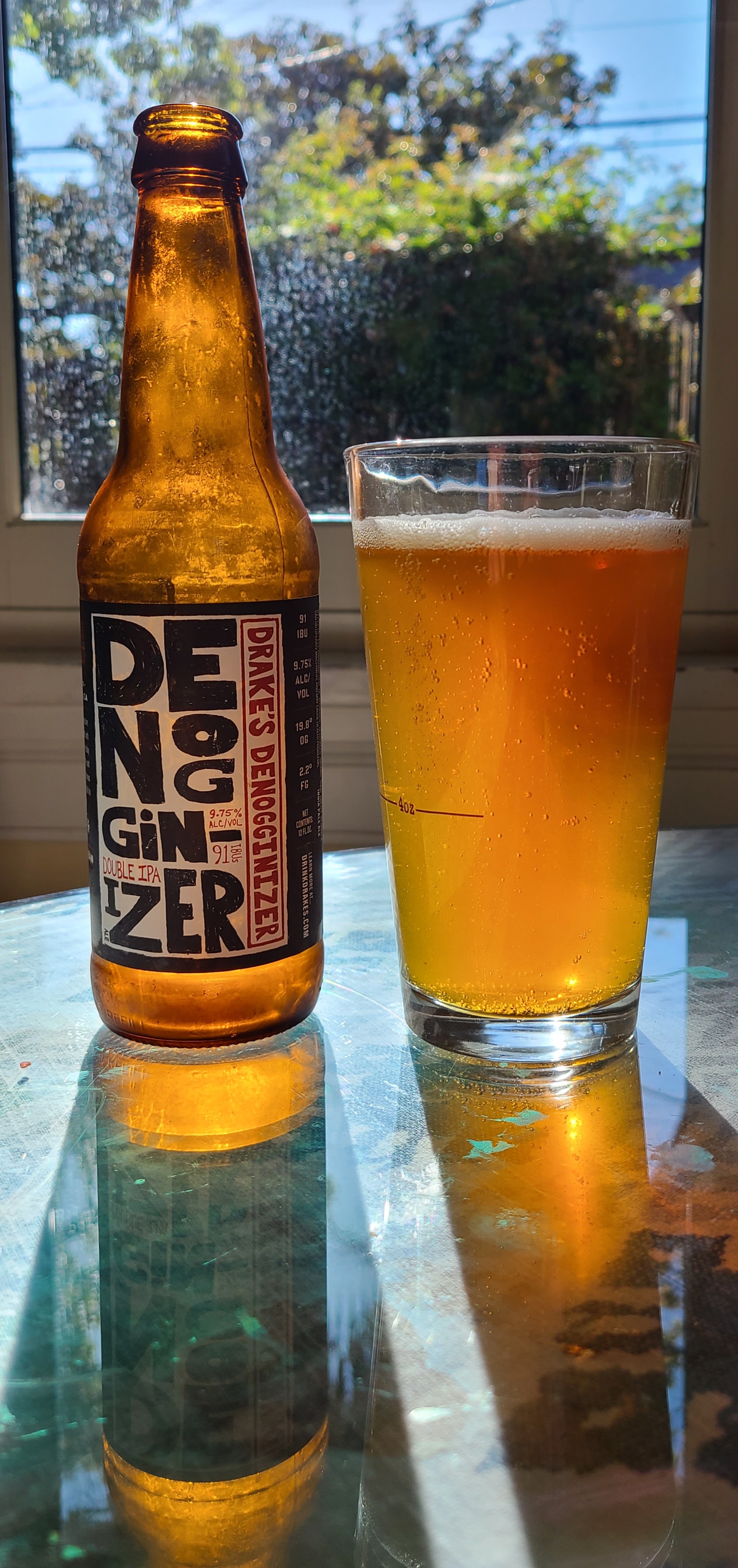
DA: Both kids are home for winter break and tonight I’ve taken them out to the movies. We’re about to watch “Avatar - Way of Wankers.” This Denogginizer Double IPA is here to help. Wish me luck!


PCS: You’ll definitely need two drinks for that movie!

DA (3+ hours later): Au contraire, they’re almost $10/pop! I split one with AA. The movie was better than I expected. Lots of folderol but also some great action.

DW: Maybe the ABV% was much higher than you realized. Awesome mini theatre. In other news, we were in Eugene and they happened to have a brewery there.


JL: I’m probably alone on this, but I like a lot of folderol in my big budget Hollywood dreck. “Bring on the folderol!” I’m always shouting at the screen. Good looking beer. DW’s too.

DA: DW, that’s a nice looking brew you have there, and I like the “distressed” table as well - looks like a legit place. JL, now I finally know who it was yelling “More folderol!” at the screen when I watched “Fast & Furious XVII - Big Fat & Sassy” a couple weeks back.

Wedding after-party Beck’st

DA: I am not drinking during January. At least, not officially … but I wasn’t going to miss out on the after-party, at a cool bar with lots of pinball machines, after my niece’s wedding. I don’t know what this IPA is, some local thing. BA has the Guinness on nitro.


DW: Nooice! I love your attempt at a dry January. The same thing happened to me on Friday. We happened to go back to Deschutes Brewery and I ordered another one of their killer pilsners. N— and L— showed up and had water and a Diet Coke or something. They steadfastly reminded me about Dry January. So ... I’m in. Looking forward to it actually.

—~—~—~—~—~—~—~—~—
Email me here. For a complete index of albertnet posts, click here.

Friday, October 29, 2021

How to Select a Camera - Part 2

Introduction

In my last post I explained why it still makes sense to buy a real camera, notwithstanding (and partly because of) the sophistication of smartphone cameras. I described the main types of modern models—the point-and-shoot, mirrorless, and DSLR (aka “sand-filled”) cameras, and concluded that most (hypothetical) albertnet readers should probably go with mirrorless. In this second and final installment I’ll quote two experts in describing the technical differences in features among two models, and what these differences mean.


Advice from the mavens

My friend John and my brother Bryan take great photos (but I won’t be sharing their albums here so you’ll just have to trust me). Bryan got a lot of photography lessons from our dad (perhaps using up our dad’s patience since I never even got a real camera, much less a lesson, but I’m not bitter). I emailed John and Bryan links to my two front-runners, the Olympus PEN E-PL10 and the Olympus OM-D E-M10 Mark IV, and this handy link to a comparison page on the B&H Photo website.

John advised, “I think for Lindsay, finding a camera that ‘speaks to her’ rather one with the best specs on paper is the thing. I’ll admit that I bought Sony cameras because I thought they looked cool. And I think the PEN cameras are super cool looking too (and they are well regarded).”

This is a good point, and freed me somewhat from worrying too much about the specs … though I’ll admit I can’t resist sifting through the minutiae.

My brother Bryan took some time to walk through some of the more salient feature differences. Here are his observations, with my reactions and some other commentary.

Bulb mode

Bryan explains:

Bulb mode is where the camera keeps the shutter open as long as you hold the shutter button down (or perhaps by some other mechanism?). One uses it for making long exposures, so if that’s something Lindsay would like to play with, this might be a benefit of the OM-D E-M10 Mark IV. When might she play with such a feature? One thing that comes to mind is that young people these days love to take pictures of star trails because they’re so cool.

I don’t know about this one. Bryan might overestimate how much kids, or other people, are into astronomy. (Or perhaps he’s being facetious?)

Sensor size (resolution)

Bryan expounds:

Sensor Resolution of 16.1 MP versus 23 MP – Obviously, the OMG camera [his jocular nickname for the Mark IV] has the bigger sensor, which means higher resolution pictures, which means better zooming and cropping possibilities. It also means that if you want to make prints of your photos, they will look much better. It’s like comparing your old VGA monitor to your modern tablet with its retinal display. On the down side, these bigger pictures take up more space on your computer’s hard drive and so on.

I have read in various places that simply looking for high megapixel count won’t help much. That number can be high due to pixel density, but sensor size is more important. Assuming these cameras have the same pixel density, the more expensive one really does have the superior sensor. I guess it comes down to the old adage: size does matter.

Image Stabilization

More analysis from Bryan:

3-Axis Sensor-Shift verses 5-Axis – When it comes to making sharp photos, it’s all about holding the sensor still while the light is exposing it. You can do this with a tripod, by holding really still like a sniper, by buying lenses with active elements that move to absorb some of your shaking, or, like Pentax did years ago and other companies are apparently doing now, actively moving the sensor around to compensate for your shaking. The more axes the better... I’m not sure which axes the PEN camera operate on, probably x, y and rotate? The irony of course is that it’s the PEN camera that needs more stabilization, since it’s the one you’ll be waving around at arm’s length while taking pictures.

This is one of the main reasons I kind of think the bigger, clunkier camera might be worth it. Lindsay holds the camera fairly still but not perfectly … I kind of cringe at how much the camera is still twitching. Maybe that’s just me being a dad, though…

Electronic Front Curtain Shutter

Bryan writes,

I had to research this... apparently there’s a phenomenon called “shutter shock” where the mechanical clanking of the shutter mechanism (the mechanical curtains that hide the sensor until it’s time to expose it to the light) can shake the camera enough to blur the image at certain camera settings. It can cause what would otherwise be a perfectly sharp picture to be blurry when zoomed in, even when the camera is otherwise stable, even on a tripod. There are actually two curtains involved in covering the sensor, the front curtain and the rear curtain. The front curtain slides out of the way at the beginning of the exposure, exposing the sensor. After the set amount of time has elapsed, the rear curtain slides over the sensor, hiding it from the light, and the exposure is complete. Only the front curtain can cause the blurring, since the rear curtain’s movement comes after the exposure is complete. The solution, then, is to move the front curtain out of the way early and begin the exposure electronically, by starting the sensor read at the beginning of the exposure. (There are things I don’t understand about this, but that’s for another time.) Here is a good article, with a link to a cool movie that shows the curtain in action. All this to say, if she ends up really pushing the envelope, this might be a cool feature to have and learn about.

Wow, this is kind of amazing! You know what it reminds me of? That second set of eyelids that Vulcans have, that saved Spock’s vision in the “Operation – Annihilate!” episode of Star Trek!

Diopter Adjustment

Bryan writes,

This is the adjustment on the viewfinder to correct the image so that you don’t have to wear your glasses while looking through the view finder. Obviously, this applies only to the camera with a view finder ... more on this later. If you weren’t wearing your glasses, you might not make as good pictures because you can’t see what you’re doing, either on the screen or the viewfinder.

I have this on my Lumix point-and-shoot camera and I totally dig it. At this point, though, Lindsay is not very keen on the viewfinder … when she borrows my camera, which is frequent these days, she always uses the big LCD. Man, kids these days…

Media/Memory Card Slot

Per Bryan:

I didn’t research it, but the PEN camera only supports UHS-I, whereas the OMG supports UHS-II. Obviously UHS-II has two I’s instead of one, so it must be better. Seriously, though, the higher standard probably means that you could buy a faster card to handle the higher data transfer rates of the fancier features. Maybe it just makes the camera faster overall.

Bryan’s synopsis

Bryan completes his comparison of the two cameras:

The more expensive, bigger OMG camera [shown at the top of this post] is better in every regard except for one: it looks kind of like a big DSLR camera, and some people just don’t want to look like a tourist. I think that Dad got to that point, which is strange when you think about it. It looks like the cameras are actually similar in dimensions, the OMG is just five millimeters wider, but 16 mm taller and 10mm thicker. But the PEN camera is designed to look very stylish, and I believe that it does, and that could be very important to a young lady. I agree with John on this one: if she is embarrassed about the looks of the camera, she may never bond with it properly and it may just end up in a drawer, and she will have lost the opportunity to learn all about photography and make beautiful art.


If, on the other hand, she doesn’t care about the stylish nature of the PEN camera and is more moved by the sexy pretend pentaprism hump on the top of the OMG camera and all that it represents, then by all means, it is the better way to go. I happen to be a firm believer in the viewfinder for many reasons, some of which I shall enumerate. First of all, if you hold the camera properly while peering through the viewfinder, you will get superior pictures because they won’t be blurry from motion-blur. A professional photographer taught me this. I frankly can’t understand how phone cameras manage to get such sharp pictures when their owners are waving them about like pom-poms while taking photos. There must be some incredible processing going on there... in any case, holding the camera up to your face allows you to pin your arms against your body, which, being quite large, doesn’t shake around as much as your extended arms. This effect will be less with Lindsay, but the principle is sound.

I agree 100% with this, and by the way the phrase “pretend pentaprism hump” does more to sway me toward the smaller camera than anything else I’ve read, because it’s just so cheesy to build a cosmetic hump there, and while I’m on the subject, wouldn’t “Pretend Pentaprism Hump” be a great name for a rock band?

More on the viewfinder

Bryan continues,

Another reason that the viewfinder is superior is that you can see better. With your eye up against the camera, it’s dark in there and you can see the screen clearly. This allows you to frame things better, focus better (if you’re into the manual focus thing or are telling the camera where to focus), set the exposure better, check out your depth of field better, and so on. Though I haven’t really used one, I understand that the modern EVF (Electronic View Finder) allows for all sorts of extra data to be displayed in interesting ways. Some of these data can be displayed on the screen, but probably in less detail.

Finally, when it comes to serious photography, you just don’t see real photographers waving their cameras around, shooting photos like an action hero shoots a gun, holding one in each hand, with the barrels pointing away from each other, alternating bullets from left to right. Boy, that sure looks cool, especially if they’ve just flown through a glass wall of a skyscraper and they’re shooting and shooting as they fall, but real gun people don’t shoot that way, they hold the gun very carefully with both hands, arms extended, and they sight down the barrel so that their bullet has a chance of actually hitting the bad guy. Photography is kind of like that. If you want crappy, blurry shots, go ahead, wave the camera around. John and Erin [his son and daughter-in-law] take a whole lot of photos, and really good ones at that, and they use the huge, sand-filled DLSR cameras and they almost always use the viewfinder. There are probably other reasons for using a viewfinder that I haven’t thought about, but this has gone on long enough.

OMG, I can totally picture that movie poster of Chuck Norris shooting in two different directions at once, with his eyes looking at you, the viewer of the poster, rather than at either of his ostensible targets.


I have to admit, when I take a photo, I mean a real photo and not just a snapshot of my cat (for which I emphasize quick set up, kind of stealing the shot so the cat doesn’t see what I’m up to and stop being so cute), I do like to pretend I’m a sniper actually shooting somebody, and not like the bullet-spewing action hero but like a real freaking sniper, and I happen to know a bit about this because I have two friends who are super talented sharpshooters, both ex-military and one of whom had a job sitting up in the guard tower and shooting would-be prison escape artists at the California Men’s Colony prison. (He was never presented with the opportunity to shoot anybody, but the stress of knowing he might have to eventually got to him and he quit.) Both sharpshooters assured me that you almost never fire more than one shot, because a) the guns are so accurate you don’t need to, and b) if you actually sprayed bullets like in the movies the heat would warp the barrel. Anyhow, I guess with modern cameras and the capacity of these memory cards it’s reasonable to just flail the camera around like you’re a human semaphore or something, clicking away all the time, knowing that among the several hundred shots you’ve taken, one or two will be amazing, but man, I just hate wading thru all of those unsuitable photos, giving myself arthritis deleting them, since it’s always my phone or camera that the flailer (i.e., my wife or daughter) used and they leave all that photographic detritus around like so many plates and forks after a dinner party. Heck, maybe I like the viewfinder simply because I’d rather be a sniper than a dishwasher. Maybe it’s an ego thing.

The camera mavens’ conclusions

Bryan summed up his analysis with this:

All that being said, buy the camera that she will actually use. If she really likes the PEN camera, good on her; if she really gets into it but finds that she’s being hampered by the camera, because it doesn’t have a viewfinder or is missing features or whatever, she can always sell that camera (or hand it up to someone) and buy something fancier. If she goes all in, she’ll probably want to buy a full sized DSLR or whatever anyway. You never know!

John agreed and added:

The more I look at photos, the more I think that the tech is less important. I have two Sony APS-C cameras: one is old and has less resolution and no image stabilization and usually has my older, slower, crappier lenses on it. But sometimes that is the camera that is in my hand, and I tell you: I am still impressed at the good images I can get with it. Sure, the newer one gives me better assurance that I will get a good image in one setting or another, but a good photograph rarely has much to do with how awesome your camera is.

My ultimate choice

Obviously I favor a camera with a viewfinder for myself, but after all these emails I was leaning toward the PEN. After all, Lindsay doesn’t use the viewfinder on my camera anyway, and this camera is for her, not me. And getting back to that (probably hollow) pretend pentaprism hump … it just turns me off. Is this a camera, or a prop?

What clinched the deal is that I was on the B&H website, grabbing links for this very post, and noticed that the price for the PEN E-PL10 body bundled with a M.Zuiko ED 14-42mm lens had somehow dropped by $100 since the last time I visited it. This was (oddly enough) $50 less than the camera body by itself, $100 less than the price on Amazon, and now a full $250 less than the E-M10 Mark IV, which is enough to put a stake in its heart.

Surprised by the price drop on the B&H site, and thinking the price might go back up, I spontaneously snapped up the PEN E-PL10. After going through the checkout process I tried to get back to the original product page for it, and discovered—to my great surprise—that B&H has now discontinued this model entirely. I got the very last one!

I hope my daughter likes it. If so, perhaps I’ll paste some of her photos into this post. And if she doesn’t like it … well, I may just keep it for myself. My point-and-shoot is looking pretty humble right about now…

—~—~—~—~—~—~—~—~—
Email me here. For a complete index of albertnet posts, click here.

Wednesday, October 20, 2021

How to Select a Camera - and Why

Introduction

I have a perfectly good point-and-shoot camera but I’m in the market for a new one anyway—not because I’m a consumerist sucker, but for my kid. For her eighteenth birthday, she is very clear that she doesn’t want a smartphone (like her sister finally got), but a proper camera. Now that I’m up to speed on modern cameras, I’m ready to help you get there too.

“But wait,” you’re thinking. “Cameras are obsolete!” No they’re not. In this post I’ll explain:

  • Why you want a camera (or should)
  • The main types of camera (point-and-shoot, mirrorless, and DSLR) and how to choose among them
  • Other arcana around viewfinders, sensor resolution, shutter speed, image stabilization, bulb mode, front curtain shutter, and why the most expensive cameras are filled with sand

Don’t worry, it’s not as boring as it sounds. Also, my typical ignorance won’t be infectious … I’ve consulted two actual experts and will quote them as necessary.


Why buy a camera?

It’s certainly true that modern smartphones take really great photos, and they’re always at hand when that perfect subject presents itself. Factually, most of the pictures and videos I get nowadays are from my phone. In particular phones do a great job with low light … they somehow make do without needing a flash.

The problem is, their tiny lenses tend to be very wide-angle, and often produce startlingly warped results. Case in point: I was having a beer with my boss a couple months back and he suddenly said, “Smile!” and snapped my photo with his iPhone. As I discovered later, he emailed the pic to our whole team … which would be fine except, being caught off guard, I was wearing a huge shit-eating grin. Okay, that’s on me, but even worse, the photo was totally warped so my head looked like Charlie Brown’s. My ears looked almost as far apart as my shoulder blades. I looked like a damn bobblehead. I’d totally post the photo here to prove my point, but it’s so awful I’m actually too vain. It’s bad enough for my colleagues to get a good laugh at my expense—I’m not letting you as well.

But here’s an example I’m not afraid to post, of my nephew and his grandma. Look at this, it’s like something out of Alice in Wonderland:


I’ve got lots of examples of these, from various modern phones.

I also have an issue with how phone cameras reproduce color. It’s not that they’re bad at it; it’s that the colors often seem “enhanced” by the software. I feel like we’ve reached the point where you can’t really trust these cameras—it’s like when you see a photo of a Big Mac and the tomato looks properly red, like the kind of vine-ripened tomato you’d never get at McDonald’s, and the cheese looks like plastic (which it probably is). Smartphone cameras and their associated apps seem more keen to please narcissistic Instagrammers than they are to produce accurate photos faithful to their subjects.

Here is Exhibit B, showcasing this software impulse toward brazen tampering:

I snapped that shot accidentally while cycling, and in the process I somehow invoked this automatic retouching feature where the camera suggested an enhanced version. It gave me a little slider so I could preview the “improved” photo, which as you can see fixes a number of flaws. The app evidently decided my skin was too pale and my razor stubble too unsightly, my skin too gooseflesh-y … in short, that I’m not attractive enough to warrant all the selfie-photo sharing I was surely about to do. So it showed me what my face is supposed to look like, if I were someone else … someone good. What the hell is wrong with modern society, other than everything?! And (more to the point), how much are these camera apps doing without asking us? I prefer a device that reproduces reality as faithfully as it can—you know, like an old film camera would do, and which modern cameras still do.

My daughter, who has the critical eye of an artist, has been borrowing my smartphone for years to capture priceless moments “on film,” and lately she’s grown more and more frustrated with it, and increasingly borrows my (albeit nine-year-old) proper camera instead. I can’t wait until she has her own, vastly superior to mine, so I won’t have to hunt for mine anymore. Plus, I’m excited to see what shots she will get with a truly fine instrument.

So what kind of camera should you get? Let’s walk through the types, in ascending order of price.

Point-and-shoot

In reality, almost all modern cameras could be described as point-and-shoot, in the sense that you don’t have to set the aperture, f-stop, shutter speed, or anything else, nor do you have to focus. Several times (pre-pandemic) I’ve been in a group of friends and somebody has handed me a super fancy Nikon DSLR camera and asked me to snap a group shot, and I’ve learned I don’t need to ask how to use it. “Just press this button” is all the instruction I’ve ever needed—or gotten.

So what point-and-shoot really means is “basic, cheap camera that doesn’t allow you to swap out lenses.” Point-and-shoots can be pretty sophisticated and/or expensive and can even be fairly bulky, with telescoping zoom lenses. My Panasonic has a 16X zoom, which is way better than the zoom on any smartphone including the so-called 30X zoom on my Samsung. (Phone cameras have so-called “optical zoom” which is more like cropping a picture than actually seeing farther.)

Since these point-and-shoot cameras have bigger lenses than a smartphone and (in my experience) don’t tend to warp photos as much, I suppose they’re worth buying … but then, if you’re going to carry around a whole extra device, why not step up to something even better, that solidly trounces a phone camera? Let’s look at the next category.

Mirrorless

I’ll bet you never knew your point-and-shoot camera had a mirror in it! Well, guess what: it doesn’t. So this second type of camera should perhaps be called “also-mirrorless” or “the other mirrorless.” Pretty weird, isn’t it, to define something by what it isn’t, or hasn’t got? Imagine if boxer shorts were called “strapless underpants.”

The mirrorless camera gets its name from the fact that the next step up, DSLR cameras, do have a mirror in them, like the (film) SLR cameras of old. (As if we all knew that, or cared.) The actual difference between mirrorless and point-and-shoot cameras is that the former generally have bigger sensors (more on this in a second), and you can switch around among variety of different lenses, which gives you something else to buy (in a good way).

So what’s all this about the sensor? Well, since cameras don’t have film to expose to light anymore, they have sensors, and the bigger the better. (You can spend $10K on a mirrorless camera, and its giant sensor is the main selling point.) The sensor isn’t the only important thing, though; you also want a lens big enough to let in more light. Mirrorless cameras have these traits, and thus are what the cool kids are using, I’m told. They take really good pictures (as my friend John’s photo albums would attest if I saw fit to violate his privacy by linking to them here).

DSLR

The digital single-lens reflex camera is the really expensive version that some people—that is, the ones who look down on us—simply have to have. (Single-lens reflex probably started out “single-lens reflects” but “reflex,” like all words with an “X” in them, seems cooler somehow.) All SLR cameras have a mirror and a pentaprism in them, so that whatever image the lens “sees” is reflected right into the viewfinder, aka eyepiece. Here’s how it works:


Does that looks fancy and sophisticated? Damn right it does. And that comes at a cost.

But what is the practical advantage of this? Well, two things. One, what you see through the viewfinder is exactly what the photo will capture. Thus, you avoid the “parallax error,” and though I don’t understand exactly what that is, it just sounds bad, doesn’t it? Next time you look at a photo and think, “Damn, that dude’s head looks like it’s about four feet in circumference,” you might be encountering a parallax error (unless it’s actually encephalitis). I’m not saying you are seeing parallax, since I’m not some kind of scientist or optics expert or anything, but I’m just sayin. 

Now, the other advantage of the SLR camera is quite simply that it costs more, and discerning people will not skimp. I mean, why the hell should they? Do you think James Bond would use a mirrorless camera? Hell no. He’d use a Leica. In fact he did. A real one, not just the Leica lens built into a point-and-shoot camera like mine, which is a sellout if there ever was one. (Could you even fit a mirror and pentaprism into a camera that looks like a bow-tie? Of course not, but then a wristwatch that shoots laser beams isn’t very realistic, either.)

So, if you’re the kind of person who must have a DSLR, the rest of the hairs I’ll split in this post probably don’t apply to you. You should just throw as much money as you can at a camera, preferably on a top brand like Nikon, and you can’t go wrong. Your photos will  be better due to the automatically superior features you’ll be getting, and higher-end materials, and because you’ll be surrounded by beautiful people who feel themselves automatically drawn to you … unless you’re on safari. Then you’ll get great shots because you’ll have a lackey supporting the four-foot-long telephoto lens you’ll be using, which enables you to peer right down the throats of mighty lions. You DSLR people can stop reading right here … get yourself over to B&H Photo and start shopping!

A final note on DSLRs: you might hear these referred to as “sand-filled” cameras. Believe it or not, this moniker was coined by my brothers and me. The origin is something famously said by our dad, who was a great photographer (though he had the annoying habit of using only slide film, so you could never see his pictures unless he did a slide show, but he was too cheap to buy multiple carousels so he would have to load each set sequentially so the shows took hours, thus he almost never did them, and I have thousands of slides we’ve never seen before, which I only discovered after his death and which are now in my garage waiting to be digitized). He was all into the classic old-school SLR cameras that take different lenses, etc., and teaching my brothers how to use them (but not teaching me, as he was too disgusted by my brothers’ stupidity and/or was insufficiently confident I could learn and/or simply got bored of parenting). Oddly enough, at some point during his retirement he suddenly turned his back on the classic technology and took to poo-pooing DSLRs. He was talking to Bryan and me once (as I recall, Bryan had his pride and joy, a Pentax DSLR, hanging around his neck at the time, and if our dad had been better read he’d have compared it to an albatross, à la “Rime of the Ancient Mariner”) and he (Dad) scoffed, “There’s no reason these fancy DSLR cameras need to be so big and heavy. It’s obvious that the marketing people got involved and influenced the design teams, just to fool all these consumers into thinking there’s something special about these giant cameras. They’re probably full of sand.”

How to choose among mirrorless cameras

O gosh, you could go crazy researching this stuff. When purchasing anything, I have a tendency to narrow down my investigation to just a couple of brands, right off the bat. And how do I filter out the others? Well, there are luxury brands (e.g., Leica, Nikon) that probably aren’t a good value. And then there are obscure ones (e.g., Paper Shoot, HamiltonBuhl) that seem like a gamble. Then there are brands known for other products (e.g., Vivitar, HP) which would be like buying Ralph Lauren housewares or Porsche sunglasses (lame!). So if you have any brand loyalties, like to an old school camera you had in the past, start there. And if some friend you trust has a recommendation, don’t ignore it.

My first digital camera was an Olympus, which I bought back in 2001, when digital cameras were fairly new technology—new enough, in fact, that I bought mine at The Sharper Image. It was $750, and the memory card (which might hold up to one modern photo) was probably at least another $50. It would be easy to take shots at that camera (sorry, pun intended) based on how primitive it seems by modern standards, but it actually took some really great photos, like this one:


When it was time to replace it I had gobs of choices and a friend recommended a Panasonic Lumix, with the Leica lens I mentioned earlier. I took his advice and since then I had several of these; between me and my kids we have tended to drop (and thus break) them.

Her ageing father’s brand loyalty aside, my daughter had her eye on an Olympus PEN mirrorless like her friend has, and when I started looking I realized that, while most mirrorless camera brands will only take their own lenses, there’s one exception: Olympus and Panasonic lenses are interoperable. That seems pretty cool to me, given my luck with both brands. Plus, I was looking for an excuse to settle on a single brand, so Olympus it is.

Of course, you have to choose among the models available, and that’s where the B&H Photo website is pretty handy, with their Compare feature. (Yes, other websites have this too, but they don’t do a very good job with it.) Poring over the differences is a fun rabbit hole to go down—almost as fun as Alice’s descent into Wonderland (“curiouser and curiouser!”). Consider this comparison of the Olympus PEN E-PL10 vs. the Olympus OM-D E-M10 Mark IV. There, side by side, are all the technical specifications so you can totally geek out.

But what if you’re not a camera geek? That’s when you have to call on a friend or two … and surely you have at least one friend who’s a camera maven? This is what I did, with my friend John and my brother Bryan offering great advice.

Ah, but I see I’ve run a bit long here. I’ll save the rest of this post for next week. Check back because I’ll go into bulb mode, sensor size/resolution, image stabilization, front curtain shutter, and the all-important viewfinder…

—~—~—~—~—~—~—~—~—
Email me here. For a complete index of albertnet posts, click here.

Friday, August 20, 2021

Pretty Good Guacamole

Introduction

It’s still summer, which means it’s time for guacamole. If you’re interested in learning how to make it, you’ve come to the right place. Don’t bother with any of the recipes you’ll find online. My instructions are better, more complete, and best of all aren’t infested with annoying ads. Recipe websites are the worst, with nefarious pop-ups, videos suddenly springing to life, requests to access your location, invitations to mailing lists … just keep all that crap out of your life.

Following the structural tradition of my posts on homemade pasta, fettuccine Alfredo, Bolognese Ragu, and homemade macaroni and cheese, I’ll give you this guide in the (perhaps mythic) who-what-where-when-why-how format of the newspaper reporter.


Who, where, and when

The first time I had guacamole I was a little kid. It was a bad batch made with really awful avocados that were not only basically rotten, but also really stringy. (I’ve never understood why, but that occasionally happens.) I was revolted, and decided I didn’t like guacamole or even avocados. My evil brothers encouraged my utter failure of judgment because hey, more guac for them. (I should have been more skeptical when they didn’t ridicule my taste. They pretended that their love of guac was a bizarre idiosyncrasy and it was only natural I didn’t share it.) When I finally gave guac another try, many years later, and realized the error of my ways, I was livid—at myself, of course, but also at my brothers. On some level I still haven’t forgiven them.

I didn’t learn how to make proper guac until about 1990, when I was a student at UC Santa Barbara. A Chicana friend of mine named Tina showed me the ropes, and I have zero reason to doubt her ethnic and culinary cred. (For some reason I’m more nervous about presenting myself as an authority on this Mexican dish than I am with regard to Italian food. Perhaps it’s because I once recommended a Mexican restaurant to a friend of mine who rinsed the piss out of me for its not having been authentic enough for his more sophisticated palate.)

What

Guacamole is something made right before you eat it, whether you serve it with chips or as a topping or both. Guac is not that homogenous over-smooth green stuff you buy in a tub, and I don’t care where you buy that. (Just because Whole Foods charges like six bucks for a paltry inch-tall tub doesn’t make it good, and scarcely makes it guac). You cannot cut corners with this food, even if the store-bought stuff is arguably better than nothing. They should have a different name for that stuff, like Avocado-Whiz.

Why

Obviously you should make guacamole because it’s delicious. It’s also good for you, because avocados themselves are nutritious as is everything else that goes into it. And if you have a bunch of avocados that are perfectly ripe and will be rotten tomorrow, you practically have to make it. (Back when I commuted to San Francisco for work, I once called my boss and told him I had to work from home because my avocados would be perfect at lunchtime and rotten by dinnertime. As a fellow foodie, he was fully supportive.)

How

The best thing about guacamole is that it’s pretty easy to make. So long as your ingredients are good, all you have to do is basically get out of Mother Nature’s way. By this I mean you need to refrain from doing all the things people do to ruin their innocent produce and turn out an inferior product. Here is a list of what not to do:

  • Don’t put sour cream in your guac. I cannot fathom why people do this. It simply doesn’t belong. I mean, would you put sour cream in your beer?
  • Don’t mix your guac in a blender. It’s not supposed to have the texture of mayonnaise. I was once at a dinner party and the hostess set out a bowl of this strange white-green substance. Since there were chips nearby, I grasped that it was a dip of some kind. It tasted like nothing. I asked what it was and was shocked when the hostess said, “It’s guacamole!” I was struck dumb. I’d had no idea that’s what it was trying to be.
  • Don’t put garlic in your guac. Yes, some recipes call for this, but garlic is not authentic, it doesn’t greatly enhance your guac, and it gives you bad breath.
  • Don’t roughly hack up the onions. If you get big hunks of onion in your guac, that drowns out the other flavors, plus you (again) end up with dragon breath.
  • Don’t just mix avocados with commercial salsa and pretend that’s guac. It won’t work. The only exception is if the salsa is from Mario’s La Fiesta, but this is sadly impossible as they folded a decade ago.
  • Don’t make it right at the table in front of your guests like some silly overpriced Mexican restaurants do. That’s just a gimmick. This takes a little more work than your guests would have the patience for.
  • Don’t start with inferior ingredients. If the avocados and tomatoes aren’t in season, it’s just not going to work out that well. This is a summer food, unless you live in California and your local produce market has connections in South America (though really, shouldn’t you source your produce locally, blah blah blah?).
  • Don’t add peyote. That’s totally not the point. I don’t care if the characters in Oscar Zeta Acosta’s Autobiography of a Brown Buffalo spiked their guacamole … you shouldn’t. (Note that Acosta himself just said no to that spiked guac.)

So here are all the ingredients you’ll need:

  • Avocados (preferably Hass)
  • Onion (red is best, or white)
  • Cilantro
  • Lime
  • Tomatoes (preferably dry-farmed Early Girl, though cherry tomatoes work too)
  • Salt
  • Crystal sauce (or Tabasco)
  • Rice vinegar (optional)

I won’t bother with the quantities of each ingredient because how much you use has simply to do with the number of avocados you have, and (to a lesser extent) the number of people who’ll share it. Everything else is up to your judgment: what looks right, like what you’d see in a good restaurant? What tastes right? You can always taste as you go (chips being easier than a dozen little tasting spoons) and add more of whatever it seems to need. Experimentation is necessary and fun. If you avoid the don’ts listed above, it’ll turn out fine.

OK. To start, sink a sharp chef’s knife or paring knife into the avocado, across the middle horizontally, until you hit the pit. Rotate the avocado so that you cut all the way around, then twist the two halves apart. Thwack the knife into the pit so you can pull it out. Now slice the flesh of the avocado into rows, then go across those like a grid so it’s kind of cubed. Scoop that out into a big bowl. You’re not really going to mash this per se. By the time everything is mixed, it’ll be mashed enough. Again, you want it chunky.

It would be a shame to use mealy, pink tomatoes like what the giant supermarkets have. I suppose really good commercial pico de gallo would work in a pinch, but really you want those Early Girl tomatoes, in season. They should be bright red and so flavorful that you actually curse under your breath that you spent so much of your life eating terrible tomatoes before discovering these. Dice them into pieces roughly a centimeter on a side (though of course they shouldn’t be perfect cubes—what kind of nutjob are you?). Throw them in the bowl without the juices. (If they’re really watery you might question their quality. The non-flesh part with the seeds should be fairly gelatinous.) Can’t get good tomatoes when you need them? Not to worry. The photo at the top of this post was of a batch that didn’t even have tomatoes … it was still pretty good.

Now dice up those onions. If they’re strong, use less. And like I said before, don’t just hack them up willy-nilly. Use a razor-sharp knife and make very thin slices, like you could read through, almost all the way through the onion but not quite. Then shift it 90 degrees and slice the other way. Now turn this on its side and slice down again to create tiny cubes. Once you have a nice pile, hack it all up further, pivoting the knife around. There’s no such thing as too fine … your patience will ultimately limit you. Throw those in the bowl.

Next comes the cilantro (which is the only ingredient Tina didn’t teach me to use, probably because we couldn’t get it). Tear the leaves off the stems, wash them, and hack them up nice and fine and throw them on the pile. How much you use is a matter of taste. If you don’t put any in, your guac will still be just fine, but cilantro really does make it better.

Squeeze in some lime, and shake in some salt, and then glug in some Crystal sauce. How much of each you add is, again, all up to taste. (As explained here you should not skimp on salt in the name of good health.) If you have very young children you might go light on the Crystal sauce. (Why wouldn’t you just use cayenne pepper? Well, you could, but the Crystal sauce includes vinegar which makes your guac tastier. If you don’t have Crystal or Tabasco sauce, or are going light on that so the guac isn’t too spicy, add a tiny bit of rice vinegar for a bit of zip.)

Now, if you’ve started with beautiful ingredients, take a moment to gaze at your bowl of goodness before you mix it up. It should look about like this:


Note the fresh red and green peppers in the background of the above photo. Did those go into my guac? Nope. They’re just for show. I’m not sure what that salsa is doing there either … I was probably just eating it with chips while I made the guac, out of sheer gluttonous hedonism. By the way, I’ve noticed how modern smartphone cameras take liberties with the color, trying to make everything look better than it is. I really don’t like this about the camera software. But rest assured, my tomatoes really were that red. Just gorgeous. Note the size and shape of the Early Girl on the cutting board there. It’s not a beefsteak tomato, and it’s not a Roma, okay? If you can’t get Early Girl, get cherry tomatoes, like I said earlier. (Weren’t you paying attention?)

Now you stir everything together … not with a whisk, not with a hand blender, and not with any force. Just mix it gently with a big spoon until the ingredients are combined. Then stir it more only as needed to re-mix as you adjust the flavor. The great thing about making guac is that you can just go crazy fine-tuning it by adding more of this or that ingredient, tasting all the while by dipping in chips. If half of it’s gone by the time you declare it officially done, that’s not such a bad problem to have, innit? I mean, you’ve just had this blissful kitchen time…

Here’s what the finished product ought to look like:


If you’re serving this at the table, you’ll want to move it into a nice clean bowl that’s just large enough to hold it all. (This provides the added benefit of giving you, the deserving chef, the opportunity to clean out the mixing bowl with a rubber spatula like a cat licking her paws.) I took a final photo of my latest batch in a nice white bowl, but I won’t post it here. The phone software went nuts and enhanced the color to the point it almost looked like the guac had M&Ms in it. This was a ridiculously brazen act of auto-retouching and I cannot deceive you like that. Maybe next time I make guac I’ll get out my real camera and snap some more photos to post here. Sheesh.

Now, one of my favorite things about making guac is the way you get people to eat it. If your household is anything like mine, all you have to do at this point is say, in voice only slightly louder than normal conversation, “There’s guac.” You’ll witness a stampede as your family members descend on the bowl from every corner of the house.

Oh, one more thing: don’t serve your guacamole with lame national-brand chips like Tostitos—it deserves better. You don’t need to go full-yuppie with chichi brands like Late July either. Get that weird brand whose label is in both English and Spanish, if you’re lucky enough to live somewhere that offers such a thing. (I have no idea what people do in, like, Vermont.) My favorite brand is a local one, Casa Sanchez, that offers both thick and thin varieties. Find the chips that look like what you’d get at an authentic taqueria, not what you’d get at a Super Bowl party in Cincinnati or Green Bay.


A final note

If you follow these directions, don’t be surprised if your friends and family gush about how great your guacamole is, like you’re some kind of legit chef. It would be deceitful to accept the credit, though, given that all you did was cut up and combine some basic ingredients. Reply modestly, like, “Oh, I didn’t make this. God did. I just assembled some stuff without screwing up.”

—~—~—~—~—~—~—~—~—
Email me here. For a complete index of albertnet posts, click here.