Showing posts with label newts. Show all posts

Thursday, March 9, 2023

Welcome to Albany, California

Introduction

I live in Albany, California. If you’re not from around here, you probably haven’t heard of it. When I talk to people in other states who ask where I live, I usually just say “Berkeley area.” Well, perhaps it’s about time you learned about your blogger’s town.

This post is inspired by a great travel book I picked up recently: Roz Chast’s Going into Town: A Love Letter to New York. Of course there’s been more than enough written about that famous city, but Chast is a very funny writer and cartoonist. Not so much has been written about Albany and I’ll do my best to give you a chuckle or two.

(I’ve laid out this post according to Chast’s chapters, but that’s about where the similarities will end. I cannot do cartoons, but I did get some nice sketches from a budding local landscape architect on condition of anonymity.)


Let’s start here

Over a century ago, Albany was an unincorporated area where Berkeley people came to dump their garbage. One day in 1908 an angry band of shotgun-toting local women turned them away. This triumph inspired the residents to incorporate as the City of Ocean View, which (thanks to people’s good taste) was changed to Albany (after the city’s first mayor, who came from Albany, NY). The story of the armed women is acted out every year by students at our local elementary school. I suppose it wouldn’t be so charming if it had been men wielding the guns. Nobody knows where the men were on that day, as this was before video gaming and televised sports.

When I was in college I was aware of Albany, but only vaguely. I thought maybe Albany was the name of a district of Berkeley, like Westbrae or Elmwood. After living in San Francisco for about five years, my wife and I decided to head back to the East Bay where we could more realistically afford a house. “How about Albany?” my wife asked. “I hear they have good schools.” I shrugged and was like, “Yeah, sure, okay.” After a mere nine months of open houses every weekend and having more than forty offers rejected, we finally got a place and became Albanians. I’m not sure that’s what we’re called, actually … makes it sound like we’re from Albania. So … Albanites? Albanyites? Albanyans? Albanyone?

Basic layout

You don’t need to know that much about getting around Albany because it’s not very big—less than two square miles. You could cover it on foot in a day, but why would you, when it’s a great place to bike? Here’s a bike path map.


That green north-south route is the Ohlone Greenway, a bike path well off the street with a separate walking path. That east-west thoroughfare shown in white, Solano Ave, is where the cute shops are. There’s a busier, wider thoroughfare called San Pablo Ave that runs north-south and is more industrial, where you’ll find some solid restaurants, garages, and the Hotsy-Totsy Club (more on this later). Another bike path goes all the way out to the ocean.

Walking around

Albany, like its surrounding community, is a great for walking because it was built up before the Second World War, so it wasn’t designed around cars. This means it has wide sidewalks separated from the street by a median, so you can really enjoy a stroll without feeling like you’re always about to get run over. A lot of these sidewalks still have the imprint from the construction company that built them, showing the date:


Good sidewalks may not strike you as such a big deal, but not all communities have them. In this regard Albany is the polar opposite of Irvine, California, which caters to cars so completely it’s essentially illegal to walk there. (I think the city planners down in Irvine have given up and are just waiting for the kind of natural disaster that would require the whole city to be evacuated, so they can blast off, nuke the entire site from orbit, and just start over.) In Albany, by contrast, city planners are forever thinking of new ways to be cool, like installing bike lanes, allowing restaurants to build patios out into the street, and putting button-activated flashing lights up at our zebra crossings to help distracted motorists understand that “Hey, I’m walkin’ heah!” Nobody seems to mind that our houses have tiny garages built for Model-T Fords.


The subway

Okay, we don’t have a subway exactly, not like NYC. But we do have the Bay Area Rapid Transit line running through town. The stations and tracks are underground in Berkeley, because those guys wisely insisted on that, but in Albany it’s elevated. When you take the Ohlone Greenway you’re pretty much right under the tracks, so occasionally a train goes by overhead and your fillings rattle. 


The North Berkeley station is just a twelve-minute walk from the southern border of Albany. BART can take you to useful destinations like San Francisco and San Jose, and to the Oakland and San Francisco airports (and I mean all the way—no stupid shuttle bus required).


Stuff to do

Look, I’m not going to try to go toe-to-toe with Roz Chast’s list of goings-on in NYC. Obviously that’s your place if you just dig museums and live theater and such. That said, there’s a lot of culture in this region, such as the Aftel Archive of Curious Scents in Berkeley, the Museum of Paleontology on the UC Berkeley campus, the Oakland Museum of California, and the Lawrence Hall of Science in the Berkeley hills. Needless to say San Francisco has all kinds of world class museums and stuff. (Don’t expect to see King Tut, though, even if they claim to have built an exhibit around him.)

Among most residents, the most popular pastime in Albany is ghost whips. This is where you head out to a large, empty parking lot, get your car going in a straight line, and then jump out and walk next to it. Okay, I confess, we don’t actually do this—our parking lots aren’t that big. I have it on good authority that for ghost whips, you need to head to Turlock, about 100 miles east.

Albany does have a couple of unique attractions, such as Golden Gate Fields, the only racetrack (horses, not dogs) in the Bay Area, and the Albany Sauna, one of the oldest Finnish-style saunas in the country (dating from 1934). According to Wikipedia, its “original furnace and rooms have been maintained to produce one of the most authentic sauna experiences outside of Finland.” I guess I should mention I’ve never actually been; saunas are not really my thing. But here’s a tip: if you want to sound impressive, pronounce it “SOW-na” (first syllable rhymes with “now”).

I’m a cheap bastard so I have a lot to recommend here that’s free. First off, our regional parks are phenomenal. Just head toward the hills and your options are endless (Wildcat Canyon, Tilden, Sibley, Huckleberry, Chabot, Briones), or head toward the water to the Albany Bulb, Berkeley Marina, or Point Isabel. 


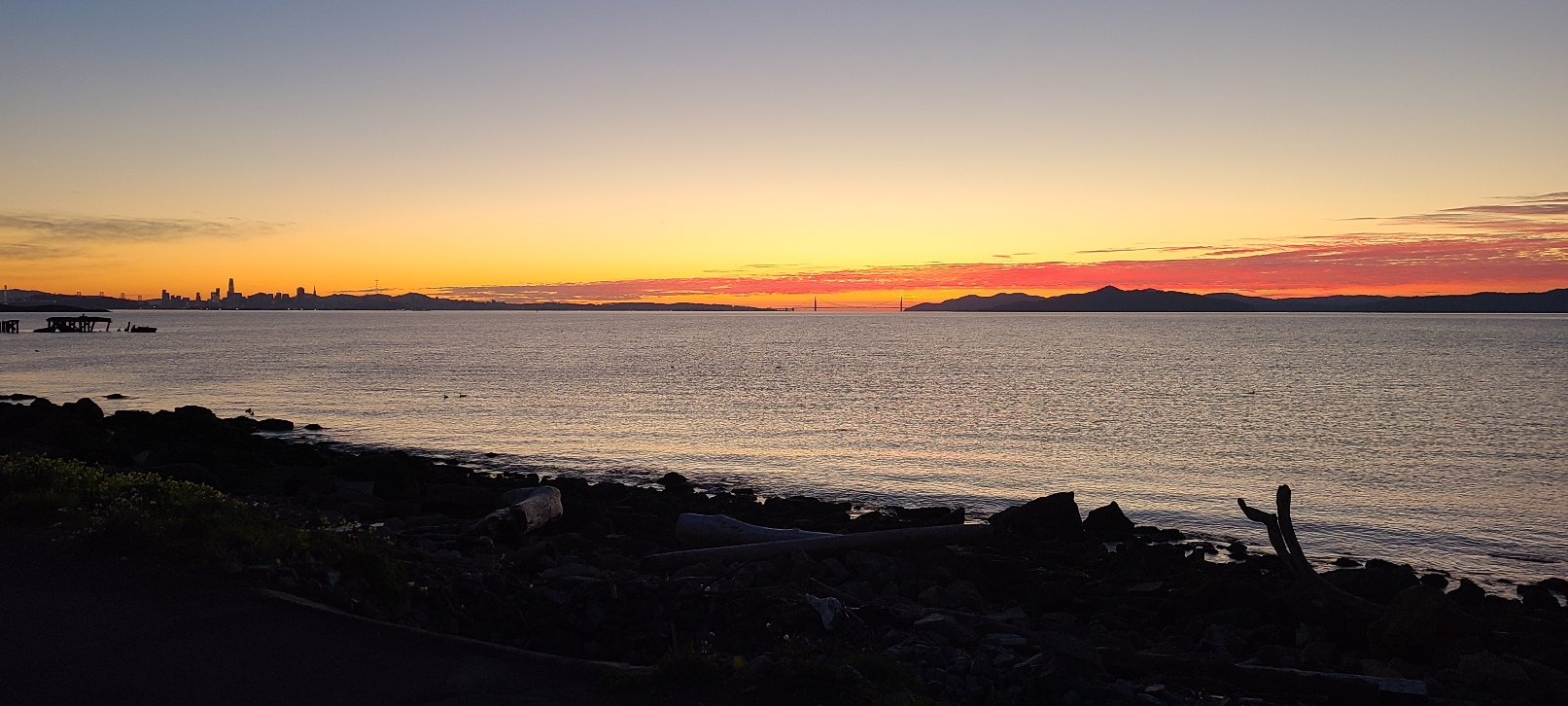
Hiking, road cycling, mountain biking, they’re all great in these parts. We even have the fully paved Nimitz Trail running along the ridge of the Berkeley hills with spectacular views of the bay, so even a dweeb on a Segway could have a good time. Here is some eye candy.

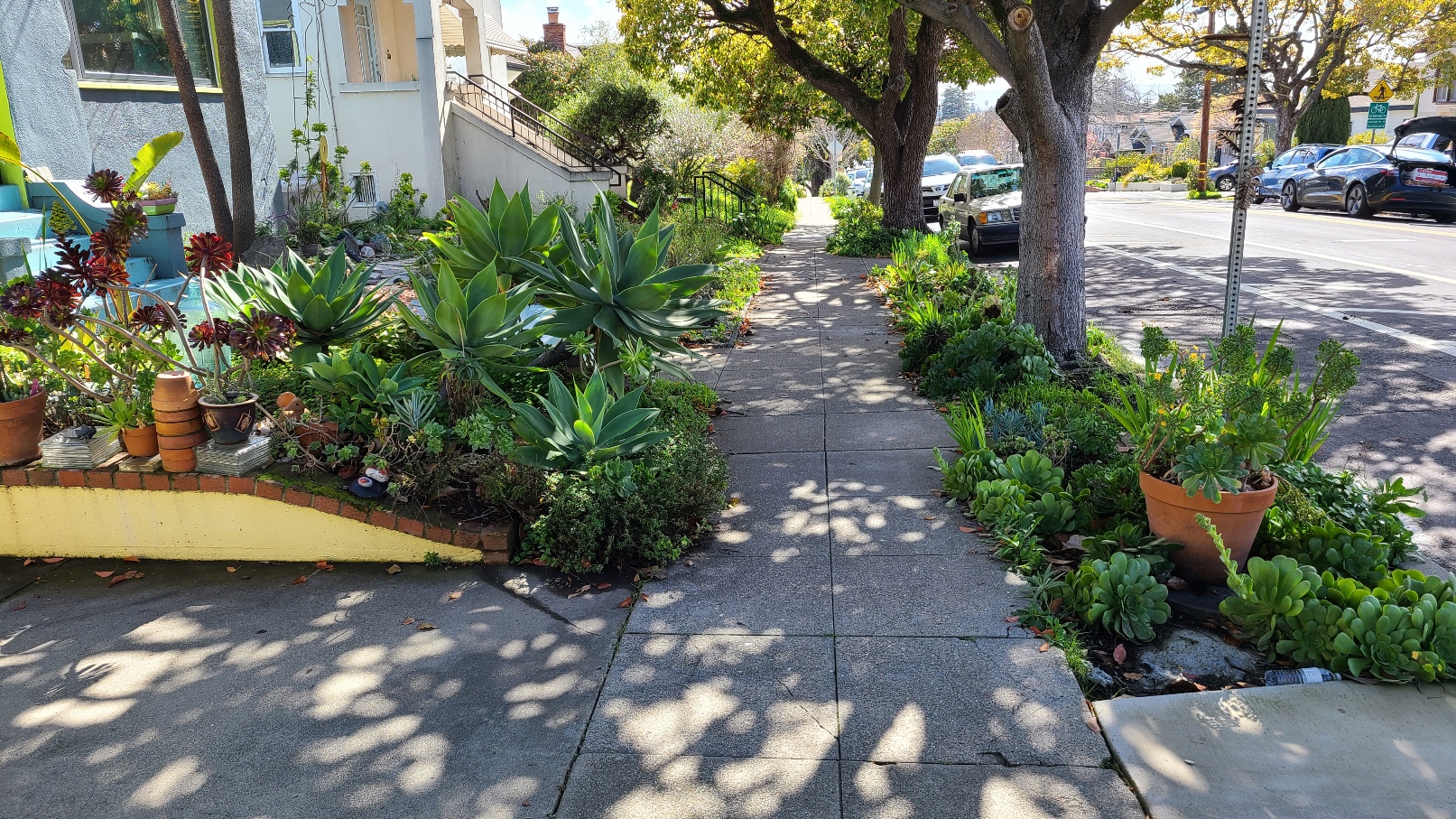
Walking around in town is fun too, because we have great weather. Winter is not depressing here, like in places where the cold is biting and/or everything is brown and grey. Winter is our green season and all kinds of trees are blossoming right now. And plants grow so well in this area, most homeowners become part-time gardeners.


If you favor walking with a  purpose, this is a great community for a pub crawl. Start at the Westbrae Biergarten (in Berkeley, just five minutes on foot from Albany), where you can enjoy some choice local draft beer and greasy snacks.


Then proceed down the road ten minutes to Gilman Brewing (delicious Belgian style brews), then stroll another four minutes to Fieldwork Brewing Company, which in my opinion makes the best IPAs on the planet. After all this you’ll need some exercise, so fortunately it’s over a mile to an old standby, the Hotsy Totsy Club (slogan: “Keeping Albany tipsy since 1939”). The best thing about the Hotsy Totsy is that it has an awesome taco truck next door.


On the way home, swing by Schmidt’s Pub, an Albany fixture since 1978 that kind of feels like a house (because it is) and always has great beers on draft, plus some nice original art.


Nerdy stuff

If you decide to live here, let me dangle this nice bonus in front of you: Albany residents get to use both the Alameda County library system and the City of Berkeley library system. That’s fifteen locations! Not that you’d visit all of them, of course, but it means a ton of inventory, and you can have books or movies sent to your local branch for free. The main Berkeley library is a beautiful old building with five floors of goodness. And the gorgeous North Branch, which is the closest to Albany, is a designated historical landmark, having been built by the famous architect James Plachek and funded by the Federal Works Progress Administration.

Now, if you’re sneering at that last paragraph thinking I’m some kind of total nerd, well of course I am! But this area might rub off on you in a good (i.e., intellectual) way. After all, lots of UC Berkeley faculty live in Albany (particularly if they want to raise children in a good school district), and Albany is also home to the University Village, which houses Cal grad students and their families. According to US Census data , Albany has a highly educated population: about 87% of our adult residents have at least some college education; 5% have an Associate degree; 32% have up to a Bachelor’s degree; and 40% also have a Graduate degree.

What does this mean? Well, if you want expert guidance in literature or film, look at what videos were recently returned to the library and not yet re-shelved, or what’s on the hold shelf. You can also get advice from bookstore employees, such as at Pegasus Books (which is technically in Berkeley but a stone’s throw away), who are as stoked on great books as you are. And if you’re looking for free books, we have scores of those little libraries along the sidewalks—I mean, they’re everywhere, and the books in them are top-notch (not just the crap you see in airport newsstands).


What’s more, your book club can occasionally invite, as a guest, the writer of the book you’re reading. We also get pretty good lectures; I’ve attended readings by Tobias Wolff, George Saunders, and David Sedaris. And when chatting over your back fence with your neighbor, you can switch seamlessly among English, French, and Latin. (Okay, now I’m exaggerating.)

Flora and fauna

I know I already talked about the flora but let me add that it’s a true Mediterranean climate, which is one of the rarest climates on earth. According to the Atlas of the Biodiversity of California, the only other places on Earth with this climate are the Mediterranean Sea region (duh!), Australia, South Africa, and Chile. In this climate, everything grows amazingly well. Spit out a sunflower seed and you’ll have a giant yellow flower in what seems like mere seconds. Okay, I’m exaggerating a bit, but really, all kinds of groovy stuff grows in abundance here. The only thing we don’t have a lot of is lawns, because we refuse. They’re so vulgar.


In terms of fauna, the Albany area is great for bird watching because it’s along the Pacific Flyway, so we get all kinds of cool birds: ospreys, great blue herons, terns, and all manner of shorebirds. Up in the hills I see hawks and falcons and even the occasional owl. Check out this great horned owl that perched one day in our neighbor’s tree.


In town here we get lots of songbirds and a surprising number of wild turkeys, which fearlessly stand down cars, sometimes at major intersections.


We don’t get the alligators in our sewers like in NYC, but I have seen plenty of coyotes up in the hills, and a couple of bobcats. I haven’t seen a mountain lion but we do have them, and I’ve seen the remains of their kills. Twice during bike rides, at dusk, I’ve been hit by a bat. (Their echolocation actually isn’t all that good and they dart around crazily, like moths.) We also get cute little newts, and in fact one of my favorite cycling roads, South Park Drive, is closed to cars five months out of the year for the annual newt crossing.


And, of course, we get deer wandering the streets with oddly little fear of anything. The expression “deer in the headlights” doesn’t apply because they never seem to even look up.


Food

Suffice to say there is all kinds of good food either in Albany or a short walk or bike ride away. The dim sum in Albany is very good; the dim sum in Oakland’s Chinatown is great; the dim sum in San Francisco (a BART ride away) is surely on par with anything in NYC. We have an embarrassment of Sushi places, great taquerias (even Calvin Trillin, writing in The New Yorker, admits San Francisco bests NYC in this regard), and top-notch pizza. (I’ve had both Giordano’s and the original Uno, arguably the most famous pizza places in Chicago, and find them identical to Zachary’s and Little Star, respectively, which are competing places on either end of Solano Ave.) Of course restaurants come and go so I can’t go down a huge list other than to say dining out here is legit. And in terms of famous restaurants that aren’t going anywhere, Albany is walking distance from Chez Panisse, where California Cuisine was invented.

We also have a number of top-notch bakeries. Not far away is Grace Baking, a well-loved place, and in Berkeley there’s Cheese Board, which has lots of tasty baked doodads but is particularly known for pizza. They’ll sell you the dough so your pies can come out great at home, too. Albany’s newest place, Pâtisserie Rotha, has such great pastries, people will stand in line for hours for them (or so I’m told). A friend brought us some of Rotha’s stuff and it was darn good. (Had I waited hours for it, I’m sure I’d have liked it even more.) 


There’s also Semifreddi’s, which I always thought was the best in the business for baguettes and such until I tried Acme Bread Company and realized it was vastly superior. Technically Acme is in Berkeley but it’s a short walk from my house.


I grew up in Boulder, Colorado which is at too high an altitude for baking, so I am just blown away at the great baked goods here. When I’ve traveled on business I’ve tried in vain to get good bread, pastries, etc. Of course I’ve had great stuff in France (though no better than here, honestly). I will concede that for bagels, there is absolutely no substitute for NYC. And, having racked my brain, I realize also that the Vogel’s sandwich bread my family had in Glasgow is better than what we get in the grocery store here. But still: Albany is a great place for foodies.

Apartments & housing

Housing is really expensive here. I could go on about this, but it would be boring.

Final stop

You may be wondering why I chose this topic. Well, I figured if you live in a place where winter is harsh, you might like a little escapist travelogue. On the other hand, if you live near Albany—i.e., anywhere in Alameda County—property tax is due in about a month. This is a good time to count the many blessings we have here!


—~—~—~—~—~—~—~—~—
Email me here. For a complete index of albertnet posts, click here.


Wednesday, April 7, 2021

From the Archives - Punish Me, Young Man!

Introduction

Today’s post is a story I originally wrote for Daily Peloton. (Their servers crashed a couple years ago and all their content was lost, so I’m gradually re-posting my dp articles here.) Enjoy please enjoy.

Punish Me, Young Man – October 14, 2007

On my ride today I got crushed by a guy whose bike had a front reflector. And yet, it was a glorious ride. (If that grabs your attention, read on, but if you’re looking for pro race results, you won’t find them in this story.)

I got off to a late start on my ride this morning, tired and feeling vaguely demoralized. I’d been caught in the rain on the previous day’s ride and was having that standard existential crisis of “Why do I train so much, and so hard, in October no less, when I don’t even race anymore?” So I was dragging to begin with, and then on my second climb, South Park Road, I really started to bog down. I was not feeling any of those “positive sensations” the pro racers are always talking about. And I kept seeing these squashed newts on the road.


These endangered newts are protected half the year by a road closure, but it doesn’t begin until November and I guess they got a head start on their seasonal migration because of the early rain. It was depressing: I saw like two dozen of them, smashed completely flat. Okay, this really shouldn’t have affected my morale, but that’s the kind of morning I was having. I almost turned around and went home.

Fortunately, the night before I’d watched the violent Western “3:10 to Yuma” and was still feeling the effects of second-hand testosterone on the baser part of my nature—the lizard brain that doesn’t make excuses. I decided to push on, taking the steep, long descent of Claremont Road so I could drag myself back up it. Toward the bottom I saw this guy coming up. He waved, and I gave a little nod before realizing, wait, that was a really big wave, maybe he needs some help. I sat up, looked back, and (being basically at the bottom already) turned around and rode toward him. He slowed down so I could ride up alongside him. “Hi, I’m new here and don’t know any rides,” he said.

Now, before I commit to sharing my ride with a stranger, especially if I’m grumpy, I’ll usually try to figure out what kind of rider he is. You can’t really go by how nice his bike is, at least in the Bay Area, where a newcomer to the sport will happily drop three or four grand on a bike. But you can get clues: how well does the bike fit him? Double or triple crankset? And does his gear look suspiciously new, or well used?

This guy was on a spanking new ride, an Ultegra-equipped LeMond, with not only a triple crankset but a front reflector. I think I first recognized the stigma of a front reflector when I was about eleven. In all the shops I’ve worked at, that was the one reflector we always left off on new bikes, even the cheap ones. Getting the risk-averse shop management to approve this was never hard: front reflectors only serve those who ride on the wrong side of the road at night without a light.

And yet, this guy somehow didn’t seem like a novice. (I used to hear the term “Fred” applied to beginners, but one of our local heroes, Fred Rodriguez, has pretty much put that name to rest.) This guy’s position was good—he didn’t have his handlebars jacked up Mary Poppins style, which seems an epidemic among novice cyclists. And he was lean. He also had this European accent, which I couldn’t place. He was medium height, with very dark skin. His clothing looked great (but of course this is something money can buy). I asked him how long he was looking to go, and he said four hours. Four hours!

I told him I wasn’t going that long, but if he wanted I’d take him up the steepest climb in the area. I’m always trying get my friends to do this climb, called Lomas Cantadas, which gains 1,240 feet in about 2½ miles at an average grade of 11%. My friends’ responses usually range from “Yeah, right” to “I did that once and I’ll never do it again as long as I live.” How refreshing that this guy was so willing. Of course, he not only had no idea where else to ride, but didn’t know what he was getting into.

But first there was Claremont to get over. We began the climb—about 1.5 miles averaging 10%—and he started half-wheeling me right away. That can be annoying, but then I know how instinctive this is when you’re riding with someone you don’t know and want to make a good impression. But man, the harder I went, the faster he went, without ever seeming to strain. “New bike?” I asked him. He told me he was borrowing it from a local shop: he’d just moved here from Austria and would be trying out for the Health Net team on Monday. Had I heard of Health Net? Uh … yeah. Wow. Suddenly I realized that, as ambassador for Bay Area cycling to a serious European racer, I was going to have to dig deep to make sure this ride wasn’t a total waste of his time.

Dang, he was strong. Had this climb gotten steeper? I’m known on my bike club for having the strange (and annoying) ability to chatter away merrily right up to my anaerobic threshold, but here I found myself gasping for breath. I asked him how old he was: twenty. I’d been thinking we were more or less the same age, but only because I always forget how damn old I am. He asked, and I admitted I’m thirty-eight. (Going on fifty, I didn’t add.) I asked what his specialty was, and he said he’s an all-rounder. Yeah, he looked it, but he could sure climb. Toward the top of Claremont, he said, “Hey, you ride good.” He paused, then continued, “For thirty-eight.”

I rested a bit descending to Orinda and along the flat section before the dreaded Lomas Cantadas. As soon as we hit the climb I felt its wrath. (At least there’s no traffic—the narrow road winds around through a sparse residential area that eventually gives way to ranchland at the summit.) Within a quarter mile I was in my lowest gear and bogging down, but the Austrian never slowed. I dug deeper and deeper, looking for some sign that he was feeling anything. No sign. I asked him if he raced pro or amateur. “Professional,” said, and quickly added, “but only on a Continental team.” He pointed at his jersey: this past season he raced for Swiag Pro Cycling Team, and for the Austrian national team. I asked if he got to ride Worlds, and he said that the federation screwed up and didn’t submit their results to the UCI, and ended up only getting to send one rider instead of three. He’d been among the original three, but wasn’t the one guy who got to go.

So here I was, riding with an honest-to-God European pro! I wished I’d had better legs, though the difference between my best and worst day probably wouldn’t have been perceptible to him. Boy did I suffer. Somewhere along the line I hit my highest heart rate of the year, 181. I asked him at one point what his was: 150. 150! When I was his age, I would hit 150 riding to class … he must have really been loafing. This, ladies and gentlemen, is the difference between a local boy and a real pro. He’s basically a different species.

On the hardest part of the climb, a couple miles in, I came completely apart. I was fricking rendered. The center could not hold. The infrastructure was crumbling. The fountains no longer worked in my plazas. Goats grazed in the shell of my capitol building. I weaved, my form was shot, my legs howled (albeit silently) like spoiled children, I wheezed like a leaf stuck in the blower. And yet, it was fun! I was taking on all comers: Man Against Man, Man Against Nature, Man Against Himself. I way dying, yes, but I had that wimp in my brain up against the turnbuckles at last. Oh yeah? Feeling lousy? Feeling weak and worthless? Well, let’s head out with this guy, lets offer him up my skinny legs to snap like twigs, let’s let my male ego trounce the rational mind once and for all, let’s see just how low I can go, how much pain I can pile on. I doubted the pro even noticed what I was going through, as he always stayed half a bike length ahead.

Ages ago, when my brother Geoff was an up-and-coming eighteen-year-old racer, he often rode with a thirty-something ex-racer named Bob, a crusty old veteran who’d been pretty good in his day. One day, as they duked it out on an epic Colorado climb, Geoff tried to keep a poker-face despite terrible, terrible suffering. Finally, he sneaked a glance at his opponent. Bob turned to him, grinned, and said, “Punish me, young man!” Ever since I heard that story, I’ve longed to use that line, and this here was almost the perfect opportunity. But the Austrian pro’s English wasn’t perfect, and I’d hate for the language barrier to distort the joke into something embarrassing. I was sure thinking it, though.

My motor control gone, I fumbled and dropped my water bottle. “Oh, I’ll get it,” the pro said. Normally I’d have tried to impress him by circling back and snatching it up without stopping, but I was in no condition to do it, and welcomed a brief respite. Besides, I wanted to see how long it took him to catch back up. He took his time circling back, stopped, stashed the bottle in his jersey pocket, and then smoothly but unhurriedly cruised back up as I kept myself redlined. I was reminded of the time I watched piranhas hunting goldfish in an aquarium: they’re so much faster than their prey, they simply don’t have to hurry. “No rush, I’ll take out the fish whenever I feel like it … okay—now.”

Finally the awful, beautiful climb was over, and we cruised the rest of my ride (he still had two and a half hours to go), chatting. He told me his name, Robel Tedros, and I figured out how to remember the name of his team, Swiag (“I will get lots of swag”). I gave him the URL of the bike club I’m on, and he said he might look me up. He described his plan: if his audition with Health Net goes well and he gets a good offer, he’ll race in the U.S.; otherwise he’ll move to Italy and race there. (I’m not sure why he’s leaving Austria, though he did mention the weather is lousy there.) I described some other roads he could check out, wished him luck on Monday, and we parted ways. I can’t imagine he won’t shred the Health Net boys, but who am I to say?

When I got home I googled his name and found him all over the race results websites, lots of top twenties. His profile on his team’s website, roughly translated by my browser (I don’t speak a word of German), reads thus: “Successes: winner total valuation of the UNIQA junior Trophy 2006, 6 victories in the junior class 2006, 6 further Top three placements in the junior class 2006, Viennese master in the junior class/road 2006, summoning into the Austrian junior national team 2006, 1 victory in the junior class 2005, 3 further Top three placements in the junior class 2005. Qualities: very good mountain driver, good individual time driver, good Sprinter, very good Allrounder, my nerve strength, openness, tolerance, loyalty, ambition.”

[Here’s a photo of Robel from around the time I encountered him.]


So, next time you see a guy with a front reflector on his bike, don’t jump to any hasty conclusions. He might be one of those mountain drivers!

—~—~—~—~—~—~—~—~—
Email me here. For a complete index of albertnet posts, click here.

Tuesday, April 10, 2012

Ode to South Park


Introduction

This post does not concern the TV cartoon “South Park.”  If you were looking for something about that show, you won’t find it here, but wait!  Don’t leave just yet.  I really like that show (though I’ve only seen one episode, the one with the babysitter and the cat and Cartman pretending he’s protecting Salma Hayek), so your sensibilities and mine might be compatible.

The following sonnet is an ode not to a TV show but to one of my favorite roads for bike riding, in Berkeley’s Tilden Park.  Obviously my ode will have special resonance for those who have ridden this road, but should also strike a chord with anybody who has a favorite climb, or anybody who seeks out a challenging course precisely because he knows it will kick his ass.

Poem

Ode to South Park

Of course I like this road—what’s not to like?
It’s quiet here and  green, and lush, and there’soooooooooo2
A grade of 10.5 percent:  to bike
Up here’s like running flights of stairs.

When young and strong, obsessed with going fast,
 I feared this road and thus avoided it. Ooooooooooooiooo6
Then age, though slowing, helped me to amass
The muster to be humble and submit.

Until last fall I liked this climb the best,
With pals or not, it was a battleground. Oooooooooooooo10
And then cruel fate decided to divest
Me of my strength.  Can I rebound?

This South Park climb will force the turning worm:
I slowly beat myself back into form. Oooooooooooooooo14

Footnotes & Commentary

Line 1:  like this road

The perspective here is of the poet in real-time as he pedals up the road.  I had the oxygen-starved inspiration for this sonnet while riding South Park the other day.

Line 2:  quiet

South Park Drive is particularly quiet from November through March when it’s closed to cars due to the mating season for newts, which has them crossing the road en masse.  One year, at the end of October, the newts got started a little early and I saw just how important the road closure is.  It was depressing:  I saw like two dozen of them, smashed completely flat.  As it happened, I had bad legs that day and the dead newts were such a blow to my morale, I almost turned around and went home.  South Park is that kind of climb:  the kind that has you searching for excuses not to go on.


Line 2:  green, and lush

I’m not botanist, but I can tell you the trees and plants along South Park Drive are the kind that are green and lush year-round.  It’s never dead and grey and brown like you get in places with real winters.  Sometimes fog gives the landscape a bleak, blasted look, but even that’s pleasurable; I always associate such conditions with the play “King Lear,” where the dethroned king is blind and groping and miserable on some vast wind-swept tundra.

Once, we had snow on South Park.  It’s close to 1,700 feet above sea level and very likely the only place in Berkeley that ever gets snow.


Line 3:  10.5 percent

A grade of 10.5 percent is pretty serious.  The steepest 0.9 miles of the road are particularly steep, climbing about 600 feet per mile for a grade of 11.4%:

Line 3:  to bike

You might think I used the word “bike” instead of “cycle” or “bicycle” simply to fit the meter of the poem.  No, I would never do that.  The word “bike” is a challenge to relative newcomers to the sport who, ever obsessed with image, insist on “cycling” over “biking.”  As I’ve documented elsewhere, crusty old veterans like me prefer “biking,” to show how little we care for semantic flourishes.

Line 5:  young and strong

As I have gloomily pondered before, I am no longer young and strong.  This is a bit different from saying I’m no longer young or strong.  Forty-somethings can still be strong, but it’s more of a battle.  When you’re young, the strength is something fresh and new and renewable.  Most importantly, you’re still growing it—your best fitness is still ahead of you.  As you age, strength becomes something you cling to:  the residue of your youth.  This strength is still a satisfaction, of course, but there’s also something slightly pathetic about it.  (Not, however, as pathetic as just letting it go.)

Line 5:  going fast

In cycling—er, biking—parlance, “fast” and “strong” aren’t quite the same thing.  Fast is more impressive.  First you get “in shape,” and then you get “fit,” and then you get “strong,” and then, if you train just right, you get “fast.”  The twenty-something racer takes little satisfaction in the century-ride goal of just finishing.  He must finish fast.  If he can’t do this—and only on a good day could a fit racer-type make it up a grade like South Park with anything that feels like speed—he can be surprisingly cowardly.  At least, I could, when I was young and strong.

Line 7:  amass

I believe it is possible to age without acquiring wisdom.  I don’t think you can chase wisdom.  I hope that my life experience, and all the great stuff I read, will gradually cause wisdom to accumulate.  So it is with muster in the next line of the poem.

Line 8:  the muster to be humble and submit

This is really what it takes to routinely attack a climb like South Park.  When I first started riding South Park with any regularity at all, I’d only do it when I was rested and fresh.  But as I got more disciplined about my training, those days grew scarce.  Something finally shifted in my attitude:  I realized it was okay for a climb to kick my ass.  I couldn’t keep pretending I could lick any road in my midst.  I learned to blow myself out completely without feeling a sense of loss.  I made South Park my go-to climb, that I would do almost every time I rode.  This didn’t make me any faster, but it made me tougher.  Gradually, this humility shaded into something more complex, involving the pride of hardened character.

Line 9:  until last fall

Both senses of “fall” are intended here:  autumn and crash.

Line 10:  with pals or not, a battleground

Riding with pals is a great way to stay motivated and ride jolly hard.  When I ride alone, which is most of the time, I’m often tempted to slack off.  The beauty of a steep climb is that you can’t choose to loaf:  like it or not, you’re trapped in the struggle of Man vs. Nature.  Often, the battle against nature turns into a battle against yourself:  naturally, “can I make it?” becomes “how fast can I make it?”

On a brutal climb, Man vs. Man becomes a fearsome endeavor.  At high speeds, savvy and tactical know-how can shelter you from your physical shortcomings.  On a climb, there’s nowhere to hide.  When I think back to the epic showdowns I’ve had with pals, the best ones always involve climbs.  So it was with South Park.  Here’s a excerpt from my training diary, dated March 27, 2008: 
We started off pretty mellow, but three minutes in Kromer unexpectedly threw down.  Suddenly he had a huge gap.  I started chasing him down.  Man, it was absurd how gradually I was gaining on him.  He’s a big, strong guy , a rolleur, a sprinter, and a fair bit older than I:  surely he couldn’t dispatch me this swiftly!  I finally caught on and, pretending I wasn’t redlined, nonchalantly asked him what his power was.  He said 460 watts.  I took his wheel.  On this steep pitch we were only going 8 mph so it’s not like I was getting a sweet draft or anything, but I stayed close so as not to give psychological comfort to the enemy.  Towards the top there’s a very short downhill section before the final wall.  I’ve found in the past that dudes instinctively let up a bit on that downhill.  This comes naturally, I think, when you’re suffering so badly.  Approaching this section, while still climbing, Kromer seemed to speed up even more, and the weak part of my brain took this as a sign that I was about to get dropped.  Meanwhile, the strong part of my brain, or at least the stubborn part, wondered if perhaps this meant he was cagily trying to finish me off before the really steep part at the very end.  I figured that no matter how bad I felt, I would attack on the little downhill and see what I could do.  Kind of like the dying general whose last words were a request to his men to turn him back around to face the enemy, so he wouldn’t die in shame.  I punched it over the top before the little downhill, and Kromer fell back:  no doubt to rest for a second or two on my wheel before slingshotting around and trouncing me.  Up until the moment I crested the climb, I was sure he had me, but amazingly my little ruse worked.  I crushed out the climb in 7:15, my best time of the year!  My agony, of course, was absolute.
Here’s a graph of that effort.  You can see here  the kind of elevated heart rate, and power output, involved.  (Why the disparity between Kromer’s 460-watt output and mine?  Two reasons.  One, he’s heavier.  Two, what you see below are “dog watts,” measured by a bike computer calculation involving barometric pressure, altitude gain, gravity, and my mass, and not factoring in wind resistance, rolling resistance, etc.)


You may wonder if my training diary also contains tales of battles lost.  Of course not:  why would it?  Being crushed by my pals isn’t news.  It isn’t salient.  The exceptions to the status quo, when all the planets align and I snatch a bit of glory, are what I bother to note.

Line 11:  cruel fate

Like line 9, this refers to a crash I had in November, sustaining a broken femur.  For months, the prospect of merely riding a bike again, much less climbing South Park, seemed sadly absurd.  In the poem I almost didn’t use “cruel fate,” because I’m not a particularly fatalistic person and am tormented by the idea that my crash could have been avoided.  But “cruel fate” is a nice Shakespearean reference, and in a vague, metaphorical sense I suppose we can acknowledge the role of fate in our lives.

Line 12:  can I rebound?

That is the question.  The doctors who treated me were wary about assuring me I’d be as good as new one day.  Over the last few weeks I’ve been able to ride my bike again, but with greatly reduced ambitions.  A tough ride for me now is Wildcat Canyon Road, a climb I’ve never thought difficult (and which in fact I used to call Pussycat).  Well, the other day I didn’t have time to ride all of Wildcat, but thought it would demoralize me to only ride part of it (I demoralize easily these days).  So I decided just to try South Park, which is closer to home.  I doubted I was quite ready, but remembered my long history with this road:  how I’d gone from only riding it when I was fresh to riding it no matter what.  This gave me the confidence, bordering I suppose on foolishness, for the attempt.  I barely made it to the end.  On the final steep pitch, I really wondered if my pedals would actually slow to a stop.  Would I clip out in time?  Would I fall over?  At the top I had to stop and rest (something I almost never do).  I didn’t have the energy to turn around and coast back down the hill.  Had there been a bench, I’d have sat down, or stretched out, on it.  My stopwatch time for the climb—more than a minute slower than my slowest trip up South Park of all last year—will give me something to improve on.

Line 13:  the turning worm

It is impossible to ride my bike and feel a pure gladness at my gradual progress, because I cannot help but compare my current self to my six-month-ago self.  These days I feel small and vulnerable and spineless.  The phrase “turning worm” is a reference to Shakespeare’s “Henry VI, Part 3”:

To whom do lions cast their gentle looks?
Not to the beast that would usurp their den.
The smallest worm will turn being trodden on
And doves will peck in safeguard of their brood.

In my small, wormlike, dovelike way I’m turning against the injury encroaching on my body.  South Park Drive is a perfect surface against which to beat myself back into shape.  It is the opponent that may yet be my salvation.