Showing posts with label California. Show all posts

Thursday, March 9, 2023

Welcome to Albany, California

Introduction

I live in Albany, California. If you’re not from around here, you probably haven’t heard of it. When I talk to people in other states who ask where I live, I usually just say “Berkeley area.” Well, perhaps it’s about time you learned about your blogger’s town.

This post is inspired by a great travel book I picked up recently: Roz Chast’s Going into Town: A Love Letter to New York. Of course there’s been more than enough written about that famous city, but Chast is a very funny writer and cartoonist. Not so much has been written about Albany and I’ll do my best to give you a chuckle or two.

(I’ve laid out this post according to Chast’s chapters, but that’s about where the similarities will end. I cannot do cartoons, but I did get some nice sketches from a budding local landscape architect on condition of anonymity.)


Let’s start here

Over a century ago, Albany was an unincorporated area where Berkeley people came to dump their garbage. One day in 1908 an angry band of shotgun-toting local women turned them away. This triumph inspired the residents to incorporate as the City of Ocean View, which (thanks to people’s good taste) was changed to Albany (after the city’s first mayor, who came from Albany, NY). The story of the armed women is acted out every year by students at our local elementary school. I suppose it wouldn’t be so charming if it had been men wielding the guns. Nobody knows where the men were on that day, as this was before video gaming and televised sports.

When I was in college I was aware of Albany, but only vaguely. I thought maybe Albany was the name of a district of Berkeley, like Westbrae or Elmwood. After living in San Francisco for about five years, my wife and I decided to head back to the East Bay where we could more realistically afford a house. “How about Albany?” my wife asked. “I hear they have good schools.” I shrugged and was like, “Yeah, sure, okay.” After a mere nine months of open houses every weekend and having more than forty offers rejected, we finally got a place and became Albanians. I’m not sure that’s what we’re called, actually … makes it sound like we’re from Albania. So … Albanites? Albanyites? Albanyans? Albanyone?

Basic layout

You don’t need to know that much about getting around Albany because it’s not very big—less than two square miles. You could cover it on foot in a day, but why would you, when it’s a great place to bike? Here’s a bike path map.


That green north-south route is the Ohlone Greenway, a bike path well off the street with a separate walking path. That east-west thoroughfare shown in white, Solano Ave, is where the cute shops are. There’s a busier, wider thoroughfare called San Pablo Ave that runs north-south and is more industrial, where you’ll find some solid restaurants, garages, and the Hotsy-Totsy Club (more on this later). Another bike path goes all the way out to the ocean.

Walking around

Albany, like its surrounding community, is a great for walking because it was built up before the Second World War, so it wasn’t designed around cars. This means it has wide sidewalks separated from the street by a median, so you can really enjoy a stroll without feeling like you’re always about to get run over. A lot of these sidewalks still have the imprint from the construction company that built them, showing the date:


Good sidewalks may not strike you as such a big deal, but not all communities have them. In this regard Albany is the polar opposite of Irvine, California, which caters to cars so completely it’s essentially illegal to walk there. (I think the city planners down in Irvine have given up and are just waiting for the kind of natural disaster that would require the whole city to be evacuated, so they can blast off, nuke the entire site from orbit, and just start over.) In Albany, by contrast, city planners are forever thinking of new ways to be cool, like installing bike lanes, allowing restaurants to build patios out into the street, and putting button-activated flashing lights up at our zebra crossings to help distracted motorists understand that “Hey, I’m walkin’ heah!” Nobody seems to mind that our houses have tiny garages built for Model-T Fords.


The subway

Okay, we don’t have a subway exactly, not like NYC. But we do have the Bay Area Rapid Transit line running through town. The stations and tracks are underground in Berkeley, because those guys wisely insisted on that, but in Albany it’s elevated. When you take the Ohlone Greenway you’re pretty much right under the tracks, so occasionally a train goes by overhead and your fillings rattle. 


The North Berkeley station is just a twelve-minute walk from the southern border of Albany. BART can take you to useful destinations like San Francisco and San Jose, and to the Oakland and San Francisco airports (and I mean all the way—no stupid shuttle bus required).


Stuff to do

Look, I’m not going to try to go toe-to-toe with Roz Chast’s list of goings-on in NYC. Obviously that’s your place if you just dig museums and live theater and such. That said, there’s a lot of culture in this region, such as the Aftel Archive of Curious Scents in Berkeley, the Museum of Paleontology on the UC Berkeley campus, the Oakland Museum of California, and the Lawrence Hall of Science in the Berkeley hills. Needless to say San Francisco has all kinds of world class museums and stuff. (Don’t expect to see King Tut, though, even if they claim to have built an exhibit around him.)

Among most residents, the most popular pastime in Albany is ghost whips. This is where you head out to a large, empty parking lot, get your car going in a straight line, and then jump out and walk next to it. Okay, I confess, we don’t actually do this—our parking lots aren’t that big. I have it on good authority that for ghost whips, you need to head to Turlock, about 100 miles east.

Albany does have a couple of unique attractions, such as Golden Gate Fields, the only racetrack (horses, not dogs) in the Bay Area, and the Albany Sauna, one of the oldest Finnish-style saunas in the country (dating from 1934). According to Wikipedia, its “original furnace and rooms have been maintained to produce one of the most authentic sauna experiences outside of Finland.” I guess I should mention I’ve never actually been; saunas are not really my thing. But here’s a tip: if you want to sound impressive, pronounce it “SOW-na” (first syllable rhymes with “now”).

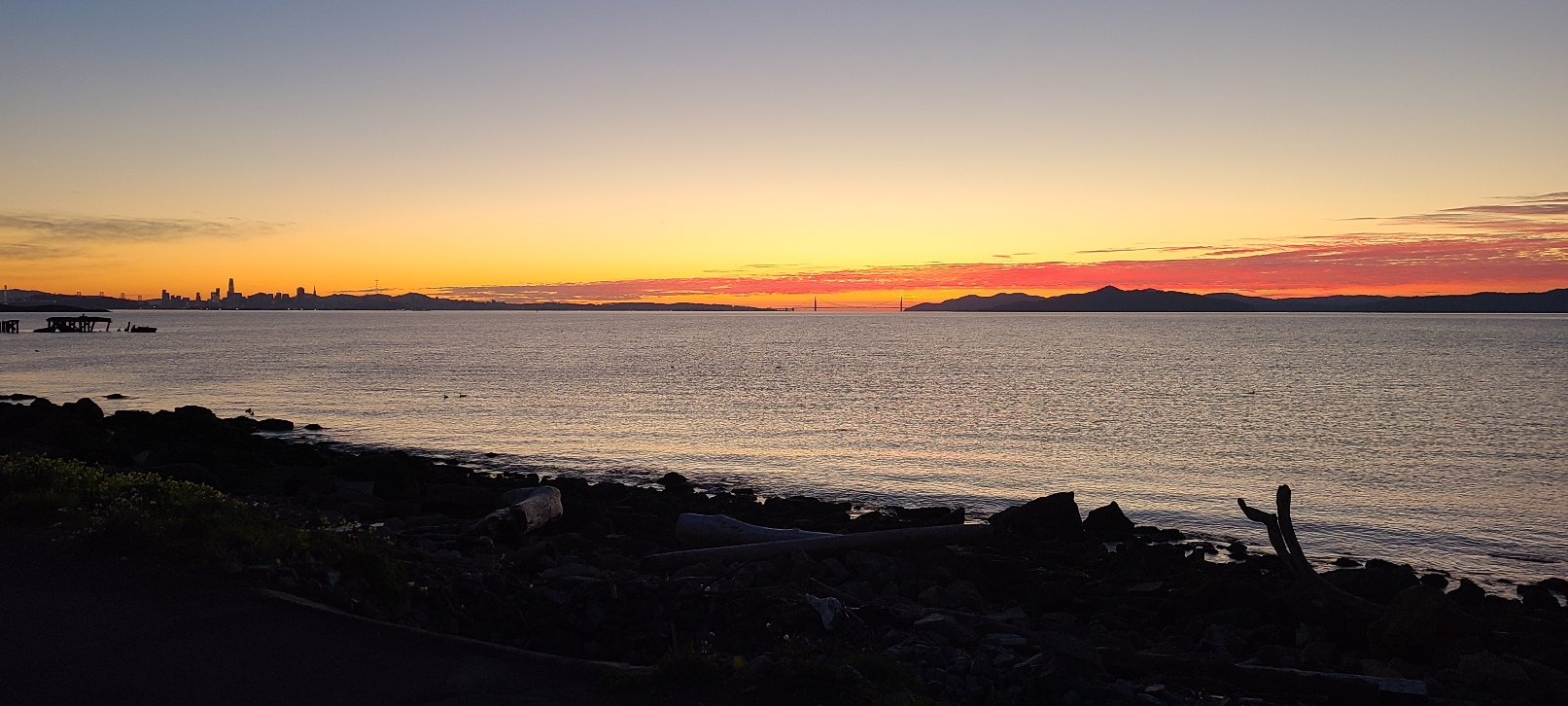
I’m a cheap bastard so I have a lot to recommend here that’s free. First off, our regional parks are phenomenal. Just head toward the hills and your options are endless (Wildcat Canyon, Tilden, Sibley, Huckleberry, Chabot, Briones), or head toward the water to the Albany Bulb, Berkeley Marina, or Point Isabel. 


Hiking, road cycling, mountain biking, they’re all great in these parts. We even have the fully paved Nimitz Trail running along the ridge of the Berkeley hills with spectacular views of the bay, so even a dweeb on a Segway could have a good time. Here is some eye candy.

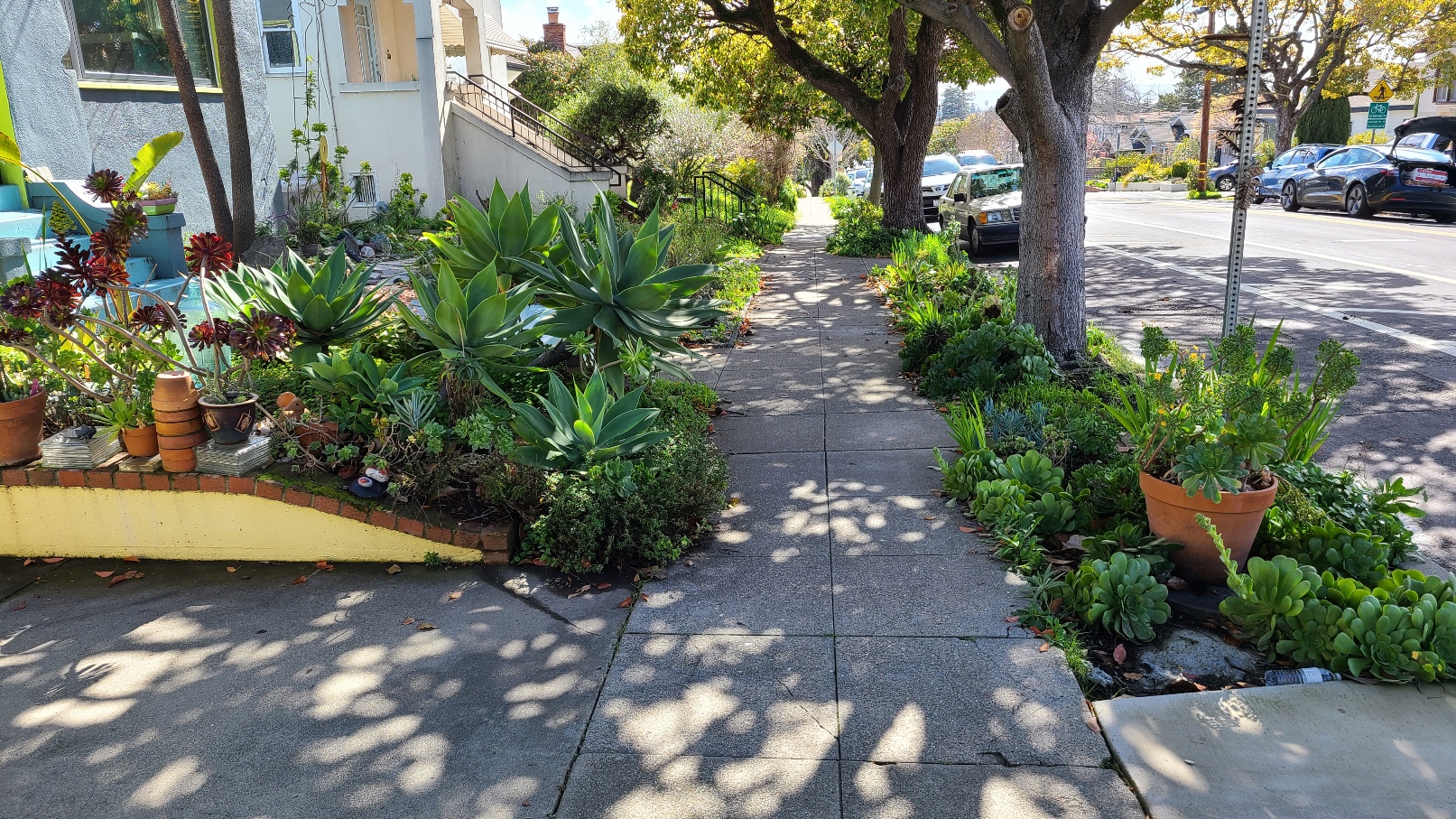
Walking around in town is fun too, because we have great weather. Winter is not depressing here, like in places where the cold is biting and/or everything is brown and grey. Winter is our green season and all kinds of trees are blossoming right now. And plants grow so well in this area, most homeowners become part-time gardeners.


If you favor walking with a  purpose, this is a great community for a pub crawl. Start at the Westbrae Biergarten (in Berkeley, just five minutes on foot from Albany), where you can enjoy some choice local draft beer and greasy snacks.


Then proceed down the road ten minutes to Gilman Brewing (delicious Belgian style brews), then stroll another four minutes to Fieldwork Brewing Company, which in my opinion makes the best IPAs on the planet. After all this you’ll need some exercise, so fortunately it’s over a mile to an old standby, the Hotsy Totsy Club (slogan: “Keeping Albany tipsy since 1939”). The best thing about the Hotsy Totsy is that it has an awesome taco truck next door.


On the way home, swing by Schmidt’s Pub, an Albany fixture since 1978 that kind of feels like a house (because it is) and always has great beers on draft, plus some nice original art.


Nerdy stuff

If you decide to live here, let me dangle this nice bonus in front of you: Albany residents get to use both the Alameda County library system and the City of Berkeley library system. That’s fifteen locations! Not that you’d visit all of them, of course, but it means a ton of inventory, and you can have books or movies sent to your local branch for free. The main Berkeley library is a beautiful old building with five floors of goodness. And the gorgeous North Branch, which is the closest to Albany, is a designated historical landmark, having been built by the famous architect James Plachek and funded by the Federal Works Progress Administration.

Now, if you’re sneering at that last paragraph thinking I’m some kind of total nerd, well of course I am! But this area might rub off on you in a good (i.e., intellectual) way. After all, lots of UC Berkeley faculty live in Albany (particularly if they want to raise children in a good school district), and Albany is also home to the University Village, which houses Cal grad students and their families. According to US Census data , Albany has a highly educated population: about 87% of our adult residents have at least some college education; 5% have an Associate degree; 32% have up to a Bachelor’s degree; and 40% also have a Graduate degree.

What does this mean? Well, if you want expert guidance in literature or film, look at what videos were recently returned to the library and not yet re-shelved, or what’s on the hold shelf. You can also get advice from bookstore employees, such as at Pegasus Books (which is technically in Berkeley but a stone’s throw away), who are as stoked on great books as you are. And if you’re looking for free books, we have scores of those little libraries along the sidewalks—I mean, they’re everywhere, and the books in them are top-notch (not just the crap you see in airport newsstands).


What’s more, your book club can occasionally invite, as a guest, the writer of the book you’re reading. We also get pretty good lectures; I’ve attended readings by Tobias Wolff, George Saunders, and David Sedaris. And when chatting over your back fence with your neighbor, you can switch seamlessly among English, French, and Latin. (Okay, now I’m exaggerating.)

Flora and fauna

I know I already talked about the flora but let me add that it’s a true Mediterranean climate, which is one of the rarest climates on earth. According to the Atlas of the Biodiversity of California, the only other places on Earth with this climate are the Mediterranean Sea region (duh!), Australia, South Africa, and Chile. In this climate, everything grows amazingly well. Spit out a sunflower seed and you’ll have a giant yellow flower in what seems like mere seconds. Okay, I’m exaggerating a bit, but really, all kinds of groovy stuff grows in abundance here. The only thing we don’t have a lot of is lawns, because we refuse. They’re so vulgar.


In terms of fauna, the Albany area is great for bird watching because it’s along the Pacific Flyway, so we get all kinds of cool birds: ospreys, great blue herons, terns, and all manner of shorebirds. Up in the hills I see hawks and falcons and even the occasional owl. Check out this great horned owl that perched one day in our neighbor’s tree.


In town here we get lots of songbirds and a surprising number of wild turkeys, which fearlessly stand down cars, sometimes at major intersections.


We don’t get the alligators in our sewers like in NYC, but I have seen plenty of coyotes up in the hills, and a couple of bobcats. I haven’t seen a mountain lion but we do have them, and I’ve seen the remains of their kills. Twice during bike rides, at dusk, I’ve been hit by a bat. (Their echolocation actually isn’t all that good and they dart around crazily, like moths.) We also get cute little newts, and in fact one of my favorite cycling roads, South Park Drive, is closed to cars five months out of the year for the annual newt crossing.


And, of course, we get deer wandering the streets with oddly little fear of anything. The expression “deer in the headlights” doesn’t apply because they never seem to even look up.


Food

Suffice to say there is all kinds of good food either in Albany or a short walk or bike ride away. The dim sum in Albany is very good; the dim sum in Oakland’s Chinatown is great; the dim sum in San Francisco (a BART ride away) is surely on par with anything in NYC. We have an embarrassment of Sushi places, great taquerias (even Calvin Trillin, writing in The New Yorker, admits San Francisco bests NYC in this regard), and top-notch pizza. (I’ve had both Giordano’s and the original Uno, arguably the most famous pizza places in Chicago, and find them identical to Zachary’s and Little Star, respectively, which are competing places on either end of Solano Ave.) Of course restaurants come and go so I can’t go down a huge list other than to say dining out here is legit. And in terms of famous restaurants that aren’t going anywhere, Albany is walking distance from Chez Panisse, where California Cuisine was invented.

We also have a number of top-notch bakeries. Not far away is Grace Baking, a well-loved place, and in Berkeley there’s Cheese Board, which has lots of tasty baked doodads but is particularly known for pizza. They’ll sell you the dough so your pies can come out great at home, too. Albany’s newest place, Pâtisserie Rotha, has such great pastries, people will stand in line for hours for them (or so I’m told). A friend brought us some of Rotha’s stuff and it was darn good. (Had I waited hours for it, I’m sure I’d have liked it even more.) 


There’s also Semifreddi’s, which I always thought was the best in the business for baguettes and such until I tried Acme Bread Company and realized it was vastly superior. Technically Acme is in Berkeley but it’s a short walk from my house.


I grew up in Boulder, Colorado which is at too high an altitude for baking, so I am just blown away at the great baked goods here. When I’ve traveled on business I’ve tried in vain to get good bread, pastries, etc. Of course I’ve had great stuff in France (though no better than here, honestly). I will concede that for bagels, there is absolutely no substitute for NYC. And, having racked my brain, I realize also that the Vogel’s sandwich bread my family had in Glasgow is better than what we get in the grocery store here. But still: Albany is a great place for foodies.

Apartments & housing

Housing is really expensive here. I could go on about this, but it would be boring.

Final stop

You may be wondering why I chose this topic. Well, I figured if you live in a place where winter is harsh, you might like a little escapist travelogue. On the other hand, if you live near Albany—i.e., anywhere in Alameda County—property tax is due in about a month. This is a good time to count the many blessings we have here!


—~—~—~—~—~—~—~—~—
Email me here. For a complete index of albertnet posts, click here.


Friday, August 20, 2021

Pretty Good Guacamole

Introduction

It’s still summer, which means it’s time for guacamole. If you’re interested in learning how to make it, you’ve come to the right place. Don’t bother with any of the recipes you’ll find online. My instructions are better, more complete, and best of all aren’t infested with annoying ads. Recipe websites are the worst, with nefarious pop-ups, videos suddenly springing to life, requests to access your location, invitations to mailing lists … just keep all that crap out of your life.

Following the structural tradition of my posts on homemade pasta, fettuccine Alfredo, Bolognese Ragu, and homemade macaroni and cheese, I’ll give you this guide in the (perhaps mythic) who-what-where-when-why-how format of the newspaper reporter.


Who, where, and when

The first time I had guacamole I was a little kid. It was a bad batch made with really awful avocados that were not only basically rotten, but also really stringy. (I’ve never understood why, but that occasionally happens.) I was revolted, and decided I didn’t like guacamole or even avocados. My evil brothers encouraged my utter failure of judgment because hey, more guac for them. (I should have been more skeptical when they didn’t ridicule my taste. They pretended that their love of guac was a bizarre idiosyncrasy and it was only natural I didn’t share it.) When I finally gave guac another try, many years later, and realized the error of my ways, I was livid—at myself, of course, but also at my brothers. On some level I still haven’t forgiven them.

I didn’t learn how to make proper guac until about 1990, when I was a student at UC Santa Barbara. A Chicana friend of mine named Tina showed me the ropes, and I have zero reason to doubt her ethnic and culinary cred. (For some reason I’m more nervous about presenting myself as an authority on this Mexican dish than I am with regard to Italian food. Perhaps it’s because I once recommended a Mexican restaurant to a friend of mine who rinsed the piss out of me for its not having been authentic enough for his more sophisticated palate.)

What

Guacamole is something made right before you eat it, whether you serve it with chips or as a topping or both. Guac is not that homogenous over-smooth green stuff you buy in a tub, and I don’t care where you buy that. (Just because Whole Foods charges like six bucks for a paltry inch-tall tub doesn’t make it good, and scarcely makes it guac). You cannot cut corners with this food, even if the store-bought stuff is arguably better than nothing. They should have a different name for that stuff, like Avocado-Whiz.

Why

Obviously you should make guacamole because it’s delicious. It’s also good for you, because avocados themselves are nutritious as is everything else that goes into it. And if you have a bunch of avocados that are perfectly ripe and will be rotten tomorrow, you practically have to make it. (Back when I commuted to San Francisco for work, I once called my boss and told him I had to work from home because my avocados would be perfect at lunchtime and rotten by dinnertime. As a fellow foodie, he was fully supportive.)

How

The best thing about guacamole is that it’s pretty easy to make. So long as your ingredients are good, all you have to do is basically get out of Mother Nature’s way. By this I mean you need to refrain from doing all the things people do to ruin their innocent produce and turn out an inferior product. Here is a list of what not to do:

  • Don’t put sour cream in your guac. I cannot fathom why people do this. It simply doesn’t belong. I mean, would you put sour cream in your beer?
  • Don’t mix your guac in a blender. It’s not supposed to have the texture of mayonnaise. I was once at a dinner party and the hostess set out a bowl of this strange white-green substance. Since there were chips nearby, I grasped that it was a dip of some kind. It tasted like nothing. I asked what it was and was shocked when the hostess said, “It’s guacamole!” I was struck dumb. I’d had no idea that’s what it was trying to be.
  • Don’t put garlic in your guac. Yes, some recipes call for this, but garlic is not authentic, it doesn’t greatly enhance your guac, and it gives you bad breath.
  • Don’t roughly hack up the onions. If you get big hunks of onion in your guac, that drowns out the other flavors, plus you (again) end up with dragon breath.
  • Don’t just mix avocados with commercial salsa and pretend that’s guac. It won’t work. The only exception is if the salsa is from Mario’s La Fiesta, but this is sadly impossible as they folded a decade ago.
  • Don’t make it right at the table in front of your guests like some silly overpriced Mexican restaurants do. That’s just a gimmick. This takes a little more work than your guests would have the patience for.
  • Don’t start with inferior ingredients. If the avocados and tomatoes aren’t in season, it’s just not going to work out that well. This is a summer food, unless you live in California and your local produce market has connections in South America (though really, shouldn’t you source your produce locally, blah blah blah?).
  • Don’t add peyote. That’s totally not the point. I don’t care if the characters in Oscar Zeta Acosta’s Autobiography of a Brown Buffalo spiked their guacamole … you shouldn’t. (Note that Acosta himself just said no to that spiked guac.)

So here are all the ingredients you’ll need:

  • Avocados (preferably Hass)
  • Onion (red is best, or white)
  • Cilantro
  • Lime
  • Tomatoes (preferably dry-farmed Early Girl, though cherry tomatoes work too)
  • Salt
  • Crystal sauce (or Tabasco)
  • Rice vinegar (optional)

I won’t bother with the quantities of each ingredient because how much you use has simply to do with the number of avocados you have, and (to a lesser extent) the number of people who’ll share it. Everything else is up to your judgment: what looks right, like what you’d see in a good restaurant? What tastes right? You can always taste as you go (chips being easier than a dozen little tasting spoons) and add more of whatever it seems to need. Experimentation is necessary and fun. If you avoid the don’ts listed above, it’ll turn out fine.

OK. To start, sink a sharp chef’s knife or paring knife into the avocado, across the middle horizontally, until you hit the pit. Rotate the avocado so that you cut all the way around, then twist the two halves apart. Thwack the knife into the pit so you can pull it out. Now slice the flesh of the avocado into rows, then go across those like a grid so it’s kind of cubed. Scoop that out into a big bowl. You’re not really going to mash this per se. By the time everything is mixed, it’ll be mashed enough. Again, you want it chunky.

It would be a shame to use mealy, pink tomatoes like what the giant supermarkets have. I suppose really good commercial pico de gallo would work in a pinch, but really you want those Early Girl tomatoes, in season. They should be bright red and so flavorful that you actually curse under your breath that you spent so much of your life eating terrible tomatoes before discovering these. Dice them into pieces roughly a centimeter on a side (though of course they shouldn’t be perfect cubes—what kind of nutjob are you?). Throw them in the bowl without the juices. (If they’re really watery you might question their quality. The non-flesh part with the seeds should be fairly gelatinous.) Can’t get good tomatoes when you need them? Not to worry. The photo at the top of this post was of a batch that didn’t even have tomatoes … it was still pretty good.

Now dice up those onions. If they’re strong, use less. And like I said before, don’t just hack them up willy-nilly. Use a razor-sharp knife and make very thin slices, like you could read through, almost all the way through the onion but not quite. Then shift it 90 degrees and slice the other way. Now turn this on its side and slice down again to create tiny cubes. Once you have a nice pile, hack it all up further, pivoting the knife around. There’s no such thing as too fine … your patience will ultimately limit you. Throw those in the bowl.

Next comes the cilantro (which is the only ingredient Tina didn’t teach me to use, probably because we couldn’t get it). Tear the leaves off the stems, wash them, and hack them up nice and fine and throw them on the pile. How much you use is a matter of taste. If you don’t put any in, your guac will still be just fine, but cilantro really does make it better.

Squeeze in some lime, and shake in some salt, and then glug in some Crystal sauce. How much of each you add is, again, all up to taste. (As explained here you should not skimp on salt in the name of good health.) If you have very young children you might go light on the Crystal sauce. (Why wouldn’t you just use cayenne pepper? Well, you could, but the Crystal sauce includes vinegar which makes your guac tastier. If you don’t have Crystal or Tabasco sauce, or are going light on that so the guac isn’t too spicy, add a tiny bit of rice vinegar for a bit of zip.)

Now, if you’ve started with beautiful ingredients, take a moment to gaze at your bowl of goodness before you mix it up. It should look about like this:


Note the fresh red and green peppers in the background of the above photo. Did those go into my guac? Nope. They’re just for show. I’m not sure what that salsa is doing there either … I was probably just eating it with chips while I made the guac, out of sheer gluttonous hedonism. By the way, I’ve noticed how modern smartphone cameras take liberties with the color, trying to make everything look better than it is. I really don’t like this about the camera software. But rest assured, my tomatoes really were that red. Just gorgeous. Note the size and shape of the Early Girl on the cutting board there. It’s not a beefsteak tomato, and it’s not a Roma, okay? If you can’t get Early Girl, get cherry tomatoes, like I said earlier. (Weren’t you paying attention?)

Now you stir everything together … not with a whisk, not with a hand blender, and not with any force. Just mix it gently with a big spoon until the ingredients are combined. Then stir it more only as needed to re-mix as you adjust the flavor. The great thing about making guac is that you can just go crazy fine-tuning it by adding more of this or that ingredient, tasting all the while by dipping in chips. If half of it’s gone by the time you declare it officially done, that’s not such a bad problem to have, innit? I mean, you’ve just had this blissful kitchen time…

Here’s what the finished product ought to look like:


If you’re serving this at the table, you’ll want to move it into a nice clean bowl that’s just large enough to hold it all. (This provides the added benefit of giving you, the deserving chef, the opportunity to clean out the mixing bowl with a rubber spatula like a cat licking her paws.) I took a final photo of my latest batch in a nice white bowl, but I won’t post it here. The phone software went nuts and enhanced the color to the point it almost looked like the guac had M&Ms in it. This was a ridiculously brazen act of auto-retouching and I cannot deceive you like that. Maybe next time I make guac I’ll get out my real camera and snap some more photos to post here. Sheesh.

Now, one of my favorite things about making guac is the way you get people to eat it. If your household is anything like mine, all you have to do at this point is say, in voice only slightly louder than normal conversation, “There’s guac.” You’ll witness a stampede as your family members descend on the bowl from every corner of the house.

Oh, one more thing: don’t serve your guacamole with lame national-brand chips like Tostitos—it deserves better. You don’t need to go full-yuppie with chichi brands like Late July either. Get that weird brand whose label is in both English and Spanish, if you’re lucky enough to live somewhere that offers such a thing. (I have no idea what people do in, like, Vermont.) My favorite brand is a local one, Casa Sanchez, that offers both thick and thin varieties. Find the chips that look like what you’d get at an authentic taqueria, not what you’d get at a Super Bowl party in Cincinnati or Green Bay.


A final note

If you follow these directions, don’t be surprised if your friends and family gush about how great your guacamole is, like you’re some kind of legit chef. It would be deceitful to accept the credit, though, given that all you did was cut up and combine some basic ingredients. Reply modestly, like, “Oh, I didn’t make this. God did. I just assembled some stuff without screwing up.”

—~—~—~—~—~—~—~—~—
Email me here. For a complete index of albertnet posts, click here.

Friday, November 15, 2019

Election Follies II Part II - The Spawning


Introduction

Right off the bat, I love sequels: not the ones Hollywood cranks out, but the opportunities I sometimes get, with this blog, to piggyback on a previous topic. If you even remotely enjoyed my last post, or enjoyed hating it, my second installment of Prop 7, One Year Later should grab you even more forcefully. Perhaps it’ll even shake you around, like a dog with a rag doll!


In this post I explore in some detail the complete and total clusterfuck Prop 7 would create, if it were actually approved by Congress.

First, a correction

In a response to the survey I sent around about Prop 7, one respondent wrote, “Hawaii and Arizona don't observe daylight savings time, so I didn't think Congress would care if California opted out of it.” I commented in my post, “Ah, this is a confused voter (or abstainer). Prop 7 isn’t about staying on standard time—it’s about staying on DST year-round.”

Well, I misconstrued the respondent’s meaning. He replied (via email) that by “it” he meant “opting out of the Uniform Time Act of 1966,” not “opting out of DST.” He did understand that Prop 7 was about year-round DST, and his point is that if Congress already lets two states choose not to conform to the Uniform Time Act, they should tolerate California opting out as well (even if it’s a different flavor of opting out).

Can technology help?

This same respondent opined that modern technology platforms such as Google Calendar and smartphones should make it feasible to handle the complexity of three concurrent flavors of time observance—those being a) the status quo; b) never observing DST; and c) observing DST year-round. He described his exceedingly complicated workday routine and how it’s exacerbated by his kids’ byzantine schedules, but how it’s all manageable because he and his wife can rely their electronic calendars.

I have to disagree with this albertnet reader. You might imagine that my dissent is based on the fact of not everybody using smartphones or calendar software. Actually, that doesn’t bother me so much … if these outliers complain, we can just tell them to get with the program. (I know, terrible pun—I couldn’t resist.) It’s also possible to fault technology in general where DST is concerned. For example, my modern car clock has a setting for automatically adjusting to DST but it quite simply doesn’t work. Meanwhile, my microwave oven has a setting to automatically switch to DST, but it couldn’t work because there’s no way to program the oven with the date. But this is also just static. I have a much bigger issue with my friend’s assertion. The fact is, where deviance from the Uniform Time Act is concerned, computer calendars are absolutely no help.

These electronic tools work great for a complicated family schedule because everyone is in the same time zone, so whatever tweaks are made to DST will affect all family members the same. But interstate business, when DST outliers are involved, is another story entirely. As I wrote in my first Prop 7 post, “Today, Monday, was rough. At work, an 11:00 a.m. conference call threw people into a tailspin because the recurring appointment had been set up by somebody in the Arizona time zone, where DST is not observed. For those outside Arizona, the call automatically jumped forward by an hour on our electronic calendars.”

To make this clearer: at the beginning of March, before DST started, the 11:00 a.m. PST call was at noon MST (or to be more precise, noon Arizona time because Arizona is given its own time zone in Microsoft Outlook and Google Calendar). A week later when DST kicked in for CA, AZ hadn’t changed, so the call was still at noon Arizona time. But since CA was now synced with AZ (because PDT is the same as MST), the call suddenly moved to noon for the Californians. This presented conflicts with other noon calls already set up with other non-Arizonians. Despite everybody’s groovy electronic calendar technology, these humans have to bicker about this situation twice a year … and that’s all because one state is doing one type of Uniform Time Act exception.

If states could switch to year-round DST…

If California were allowed to switch to year-round DST, of course that would set precedent for other states to do the same. Suppose New Mexico copied Arizona and stopped observing DST, while Colorado stayed as-is, and then Wyoming went to year-round DST to be like the cool kids in California. Clocks in this case would cease to reliably align with geography. The weekly call for the Mountain/Desert Sales Region that covers these states would get unbelievably screwed up twice a year when the time changed, as you shall see.

Let’s say the calendar event was created by the Regional Director who works in Colorado. And let’s say it’s a 2:00 p.m. call: on November 1, this would be 2:00 p.m. Mountain Daylight Time (MDT), which equates to 1:00 p.m. Mountain Standard Time (MST) in New Mexico (due south of Colorado, in case your sense of geography is worse than The Donald’s) and 2:00 p.m. MDT in Wyoming (due north). So that’s your status quo. But a week later, on November 8 when CO falls back, all hell breaks loose. For the CO folks, nothing changes except the call goes from 2:00 p.m. MDT to 2:00 p.m. MST; their calendars aren’t really affected. But the call moves from 1:00 p.m. to 2:00 p.m. for the NM folks (because NM is now synced with CO) so the NM folks would have to reschedule their other 2:00 calls. On top of that, this same call would become a 3:00 p.m. Wyoming call (because they’d still be on MDT, so they’re now an hour ahead of CA). So Wyoming would also have to move their other calls to accommodate this!

How is this simpler than everybody changing their clocks twice a year? It’s a complete debacle! You’ve got a call that, depending on the state and the time of year, can take place at 1 p.m., 2 p.m., or 3 p.m., despite all these states being at basically the same longitude!

And that’s just one state opting out of DST and one state going to year-round DST. Imagine if even just a handful of other states started exercising their freedom to deviate from the Uniform Time Act in this way. Electronic calendars notwithstanding, millions of Americans would be totally confused. Time zones would become so variable, and so disconnected from geography, people would go nuts.

Slippery slope?

Now, you might accuse me of a slippery slope fallacy—that is, of overstating the downstream consequences of California getting its way. But if you think about it, it’s highly likely other states would adopt year-round DST if California was doing it. Imagine Washington state, with all the tech companies headquartered there (e.g., Microsoft, Amazon, SAP Concur). Surely they’re on conference calls with Silicon Valley companies all the time, and would get tired of the rigmarole every time the clocks changed. Supposing Washington state followed California’s lead, what do you think Oregon would do, sandwiched as it is between the two? It would probably fall in line and adopt year-round DST. With the entire west coast on year-round DST, other states with west coast vendors, customers, and partners—like New York and Virginia—might be tempted, too.

Many states wouldn’t, though. Montana isn’t exactly a hive of interstate corporate activity, and if they went to year-round DST, the sun wouldn’t rise in their northernmost city until 9:21 a.m. at the end of December. It could be that northern states in general would tend to frown on year-round DST due to such impractically late mornings. Southern states would probably stay away from year-round DST too, because they have such hot weather. (Arizona’s earlier sunrise gives its denizens a chance to exercise before it gets hotter than balls out, and their earlier sunset means they don’t have to run their air conditioning so late.) If anything, with this new shift away from the Uniform Time Act, southern states might take the opportunity to copy Arizona and give up DST completely.

With all this in mind it’s not hard to imagine a hopelessly unmanageable situation with mass confusion every March and November, if Congress decided to allow states to observe year-round DST. I highly doubt the authors of CA Prop 7 ever considered any of this. Hopefully Congress has, and will hold their ground when California comes around asking to do their own thing.

Who cares?

If you’re still reading this, I’d guess you’re in the minority of people who will bother to ponder such stuff. As I was trying to discuss this with my wife (and already approaching the outer limits of her attention), our daughter chimed in, “Why do we have to change the clocks at all?!” I replied, “Well, if that’s not just a rhetorical question, I’m happy to answer it.” Before she could even reply, my wife cut in: “No, no, she didn’t mean it!” My wife might as well have added, “For God’s sake spare her … she’s just a child!” My daughter was quick to pile on: “Please don’t explain. I really don’t want to know.” (If you do want to know, click here and search the page for “Should we have DST?”)

Prop 7, especially given that it passed, is a great example of the limitations of democracy. Most voters don’t want to wade very deep into complicated matters of policy, but they still want to have their say. They demand simple answers, but sometimes simple answers just don’t exist.

Consider this: seven out of ten Americans want to stop changing their clocks, according to an Associated Press poll, as described here. The problem is, four in ten want to get rid of DST, and three in ten want to adopt it year-round. Factoring in the three out of ten who are fine with the status quo (i.e., changing the clocks twice a year), putting this matter to a simple vote creates, essentially, a three-way tie. (Handing victory to the slightly larger group, the four in ten who oppose DST completely, would disappoint six in ten Americans … hardly a good solution.)

In the case of Prop 7, the Federal government needs to ignore the California voters and do what’s right for the country. I know that sounds brash, but I’m serious. Imagine if our government decided that states should decide everything for themselves. Texas, for example, could decide airport security was a pain in the ass, and that they didn’t need metal detectors. I can envision a Texan politician arguing, “Why shouldn’t an American carry a gun on a plane? How better to stop terrorists?!” Voters in Texas would love this because they’re tired of standing in lines at airports, taking off their wristwatches and belts and shoes and so forth, and might vote for the change as breezily as Californians voted for Prop 7. If Congress honored the wishes of these voters, you’d have armed Texans flying everywhere, and the burden of disarming them would fall to airports around the world, who would need metal detectors at the egress points of each terminal. Why doesn’t this happen? Because, so far, the lawmakers in Washington have the good sense to maintain the FAA as a nationwide body applying the same rules in every state (and Texas hasn’t thought to propose such a thing … that I’m aware of, anyway).

I’m optimistic, then, that Congress is thinking harder about DST (or will, when the time comes) than the voters in California did, and the simple-minded knobs that introduced Prop 7. If Americans across all fifty states were to agree that changing the clocks twice a year wasn’t worth doing, then Congress could come to some consensus about the best way forward: we could all either abandon DST nationwide, or all adopt it year-round. Until and unless that happens, I sincerely hope Washington tells California, “Go away, kid … ya bother me.”

--~--~--~--~--~--~--~---~--
For a complete index of albertnet posts, click here.

Wednesday, November 6, 2019

Election Follies II - California Prop 7, One Year Later


Introduction

Well, yesterday’s election was sure dull. My city and county didn’t have anything on the ballot so it was a non-event. But that’s how I like it … I detest politics. I’m not one to discuss such matters, nor—usually—to write about them. But I did take an interest, a year ago, in California’s Proposition 7, which was titled “CONFORMS CALIFORNIA DAYLIGHT SAVING TIME TO FEDERAL LAW. ALLOWS LEGISLATURE TO CHANGE DAYLIGHT SAVING TIME PERIOD.”

All the summary stuff in that proposal suggested only that we wouldn’t have to change the clocks twice a year, and the brief summary was really vague about exactly what was being proposed. You have to be one of those really punctilious  readers, who go to the actual text of the proposition, to discover the real purpose, which was “to provide for the year-round application of daylight saving time” (with an important caveat, “if federal law authorizes the state”—a very big “if”). You can read the full text here.


My take on Prop 7

In my previous Prop 7 blog post, I thoroughly dismantled every argument in support of this proposal; considered one legitimate argument for permanent DST that the Prop 7 proponents didn’t mention; explained what’s wrong with permanent DST; pondered how Prop 7 managed to pass (my best guess being that it’s related to Prop 64 from the previous election, which legalized marijuana in California); and explained why this absurd and delusional bit of legislation cannot possibly ever affect anything in the real world.

So Prop 7 passed … now what?

Well, a year has passed, and all of us Californians just turned back the clocks, as usual. So far, Prop 7 hasn’t done a thing—just like I predicted. The only forward motion, as detailed here, is that a California Representative now promises that in January, 2020 he “will introduce an Assembly Joint Resolution urging Congress to authorize states to practice permanent daylight saving time.” Um … that’s 15 months after Prop 7 passed. What the hell has this guy been doing for the past year? Preparing his case? I’ll concede it will be an uphill battle, especially if it’s just this one guy as opposed to a giant task force.

I decided to survey my bike team friends about this (via our group email list). I wanted to see whether they remember this proposition at all; what they remembered; whether they remember the outcome (i.e., passed or not); and what they would expect to have happened by now. Finally, I’ve asked them if they were aware of what this California Representative was looking to do, and how they felt about that. Not surprisingly, the results were interesting, and the (often cheeky) comments amusing.

Who remembers Prop 7?

Of 19 respondents, five had no recollection of Prop 7. Ten recalled that it dealt with California’s approach to Daylight Saving Time (though the title of my survey must’ve given them a good hint). Four respondents (including myself)  “remember perfectly well exactly what it was all about.”

I guess I’m not surprised to be in the minority of people who have kept tabs on this. My wife and teenaged kids profess to be totally bored by any topic related to Daylight Saving Time. I can’t understand this … after all, how our society observes DST affects our daily lives. It determines whether I’m trying to sneak in a bike ride before the workday starts, or eke one out with my remaining energy at the end of the day. It determines whether or not our morning commute, or our children’s, takes place in the dark. Beyond these quotidian matters, I find DST intrinsically fascinating (as I detailed in a non-Prop-7 DST post many years ago). But then, as my kids are fond of pointing out, I’m obviously a crazy mutant from another planet.

I guess I also shouldn’t be surprised that half my respondents had no recollection of whether or not Prop 7 passed. Maybe some of them didn’t pay attention because that outcome is irrelevant, given California’s inability to tell Congress what to do.

Who accurately recalls what Prop 7 aimed for?

Of my 19 respondents, none took the bait on the first multiple-choice response, “Brings CA back into compliance with federal law around DST” even though this bears striking resemblance to the title of the proposition. Well done, friends! I also didn’t fool anybody with “Rolls back the DST extension created during the second Bush administration,” a false response contrived based on what I heard from a couple of confused voters a year ago. However, no fewer than nine respondents thought that Prop 7 sought to allow California to consider opting out of DST entirely. That’s kind of almost the opposite of its real purpose, which only six respondents correctly recalled. (Only one major nation has tried year-round DST: Russia. After four years they admitted their mistake and went back to normal.)

Bringing up the rear, four respondents chose “None of the above,” and unfortunately I forgot to provide a comment section for them to write in what they thought Prop 7 was trying to do. That’s a shame, though I expect at least one comment would have been something like “Hell if I know!”

Given that Prop 7 did pass, what do folks expect to happen?

Nobody clicked on my first multiple-choice response, “I'm wondering why I just changed the clocks back ... wasn't Prop 7 supposed to make this unnecessary?” I think this outcome nicely showcases the widespread cynicism we all have about whether voting really matters and/or whether our governments can actually bring about change.

Four respondents chose “I'm wondering whether anything has happened in terms of pushing legislation through Congress to deliver the promise of Prop 7.” That’s a fair question and I’m surprised more people didn’t choose this response.

Nobody chose “I'm wondering why there is nothing on the ballot today to take the next step and vote on exactly what California will ask Congress to do.” I’m a bit surprised by this. The original proposition, if you didn’t read it carefully, insinuated that all we were doing with Prop 7 was abolishing the clock-changing nonsense, and we’d worry about the fine details later.

Six respondents (including me) chose “I grasped immediately, a year ago, that Prop 7 could never actually deliver any change, because Congress has no incentive to let California be out of whack with the rest of the country for four months a year.” Yeah, exactly. It’s one thing to be a leader in something like a smoking ban, a soft drink tax, or mandatory composting—these are laws California can enforce within our own borders without anyone else having a say. But pretending we can just overturn the federal law around DST makes barely more sense than passing a law declaring, “Disadvantaged Californians may now steal one car or truck apiece from our neighbors in Nevada, Oregon, or Arizona with impunity.”

Disappointingly, not a single respondent chose “Oh, crap, I assumed Prop 7 was in full effect, and I didn't roll my clocks back last weekend!”

That leaves nine more responses. One survey recipient declined to answer this one. (Probably he or she had fallen asleep, as a consequence of a totally befouled circadian rhythm due to the time change.) Two respondents declined to select any of my responses because they didn’t remember Prop 7 that well … fair enough. One respondent apparently thought this test was open-book and wrote, “I realized after reading a short article on the subject that it will take additional action through the state legislature to put it into effect.” That’s cheating! I was trying to get a read on what people felt would be appropriate. I guess with Google, nobody bothers to ponder anything anymore—they just go straight for the answer.

One respondent wrote, “Hawaii and Arizona don't observe daylight savings time, so I didn't think Congress would care if California opted out of it.” Ah, this is a confused voter (or abstainer). Prop 7 isn’t about staying on standard time—it’s about staying on DST. That’s what’s so annoying to me: the way it was written was very confusing (probably deliberately so) which is why I suspect so many Californians didn’t realize what they were actually voting on.

Other responses were pretty funny:
  • “I am totally out of it, I go where I’m told, tell me when to wake up and I will.”
  •  “I’m so glad I moved to a state that doesn’t have a gazillion silly measures on every ballot.” I believe this would have come from either an Oregonian or a Texan (based on where my post-California friends live). So, fair point—but  Oregon and Texas have their own sillinesses, eh?
  • “I advocate eliminating all DST & all time zones globally & using GMT everywhere & 24 hr clocks. Here in CA we’d arise at 2200 and retire at 1300.” Yeah, that would be pretty cool, and would completely eliminate the problem of jet lag!
  • “Every season should be, ‘Fall Back’. I love ‘Fall Back’. I hate ‘Spring Forward’. I’m in favor of having ‘Fall Back’ every six months or so.” Great idea! We’d just slip further and further out of whack with the rest of the world. Just think … eight years in, we’d be on the same time as England, and the sun would rise at like 3pm. Daylight would cease to have any meaning in our lives. Tourists here would be so disoriented, our tourism industry could fleece them more efficiently than ever!
Did people realize California would now pursue year-round DST?

I would love to know what all the California voters, particularly the majority of voters who supported Prop 7, expected to happen. Possibly like half of them thought we’d go to Standard time year-round. We’ll have to settle for what my survey respondents had to say.

Two of them were both aware that a lawmaker would use Prop 7 to push for year-round DST and were glad that California voters are having their wishes carried out. Three respondents weren’t aware of this outcome but are glad to hear voters are being served. This attitude presupposes that these voters actually knew what they were voting for. I guess these five are less cynical than I.

One respondent was aware that Prop 7’s passage would lead to the year-round DST effort and doubts this is what California voters wanted. Hear, hear.

Five respondents (including me) chose “No, and frankly I couldn't care less because obviously Congress will nix this with a quickness.”

Again, the most interesting responses were “Other” with a comment:
  • “No, and I have no idea what ‘most California voters want.’” Great point. Hell, probably a lot of California voters don’t know what California voters (i.e., they themselves) want.
  • “Not interested, other than wondering what the promoters of this prop think they stand to gain. What’s their angle?” Great question! I have puzzled over this myself. They can’t actually believe that changing the clocks is life-threatening, can they?
  • “Just be sure to put signs up on your northern border to remind people crossing over that you all are out of whack. Of course, you already were whacky, just more so if this happens.” I would love to design this sign. I’m guessing this is the Oregonian, because—what about our eastern borders? Or are Nevadans and Arizonians just as wacky as us? (Now, if you take me to task for “as us” vs. “as we,” I’m going to nitpick about “whacky” vs. “wacky.” Let’s jest be mellow and colloquial, okay?)
  • “Huh?” Yeah, no kidding.
  • “No they won’t take my suggestion either.” Um … what exactly is your suggestion? I’d love to hear it.
  • “I have no idea. This seems like a trivial matter compared with the problem of humans paving over the planet.” Wow … great point. And I’d say it applies to the majority of ballot measures, innit?
To be continued…

Check back every few years … I’ll continue to monitor the slow, wasting death of this totally pointless and doomed legislation. 

But wait, there’s more!

If you just can’t get enough of this topic, click here.

--~--~--~--~--~--~--~---~--
Email me here. For a complete index of albertnet posts, click here.