Showing posts with label cheapness. Show all posts

Tuesday, April 29, 2025

Ode to Thrifting

Introduction

Sometimes when I’m feeling grateful for something, I am moved to write an ode to it. This is one of those times. (If you would like guidance writing your own sonnet, full instructions are here.) As usual, I provide copious footnotes.

The poem

Ode to Thrifting

A pair of Docs for only forty bucks?
I’ll take ‘em ‘cause they’re only barely used.                   2
Amer’can jeans, with tags still on—what luck!
How can a cheap-ass dude like me refuse?

I always check the housewares section too
Forever seeking out the perfect mug,                               6
And picking up a choice pint glass or two,
And all of it dirt cheap. Who’s feeling smug?

Of course there’s all the stuff you’d never buy.
Such pseudo-brands as George and Charter Club,        10
Godawful art, sad toys … we heave a sigh.
To thrift we have to sift … ay, there’s the rub.

     But when I think of forking out full price?
     No thanks—I’ll opt for thrift and toss the dice.         14


Footnotes & commentary

Title: Thrifting

A linguist once said (or maybe he said it twice, maybe he said it constantly), “There’s almost no word in the English language that can’t be verbed.” (Google’s Gemini A.I. says this was uttered by Jorge Luis Borges; ChatGPT says it was Calvin, of Calvin and Hobbes, and that the actual wording was “Verbing weirds language.”) I think “thrift” as a verb (begetting thrifting as a gerund) is perfectly legit. It means, of course, to shop at a thrift store. I think the gerund is more common but there’s no reason you couldn’t say, “I thrifted this sweet linen shirt” or, even better, “I hella thrifted this dope linen shirt,” if you don’t mind your kids making fun of you (and I don’t).

On a related note, I am also fine with “gift” as a verb, as in “my brother gifted me a giant pack of Q-tips” (which thankfully is a hypothetical scenario, as my household is overflowing with Q-tips, and why are they called that, anyway?). But “gifting” as a gerund, notably in the 2018 Nordstrom holiday ad campaign “Let’s Go Gifting!” almost makes my stomach turn. (The print ad actually did, so click that link at your peril.)

Should you be concerned about the quantity of commentary thus far, since we’re only three words into this poem? Yes, unless you’re enjoying this. If you’re not, click here immediately. (If you are, click that link later.)

To the uninitiated, “thrifting” might connote only the Salvation Army or Goodwill. But there are all kinds of variations, like consignment stores (pricier but with much better stuff), other charity outfits (e.g., local humane societies and Out of the Closet), and a variety of for-profit used stores ranging from mom and pops’ to big chains. My wife and daughters have become thrifting experts over the years, and I’ve benefited a lot in terms of secondhand thrift. (Get it?)

Line 1: Docs

This is a real-life example! In the past year I’ve scored not just one but two pairs of Doc Martens. One was $40 and the other was like $50 and they were both nearly mint. It’s not like I strictly needed either pair and I’d never have gone shopping specifically for this product, but you gotta have shoes, right? This is the sweet spot of thrifting: you can obviously never go hunting for something specific you need right now, but you never know what deal might jump out at you.

Line 2: barely used

Look how little wear there is on the soles. There was even less when I bought them.


Line 3: Amer’can

Obviously I needed to reduce this word to three syllables to fit the meter of my sonnet, but that’s only half of it. In my experience, people say “Amer’can” to suggest—ironically or not—heartland-style patriotism. Some may try to make patriotism political. I oppose this. Everyone in America should be openly patriotic, and what better way than to choose American-made products when possible? Often it’s not possible (as lamented at length here), so when I have the opportunity I snap it up.

The pair of American jeans isn’t a hypothetical example either. I found a pair of J Brand jeans, really well made right here in California, for like $50. I wasn’t familiar with this brand but quickly learned they typically go for like $200. I’m wearing those bad boys right now in fact.

Line 3: tags still on

Yes, these jeans (aka, this pant, these jean) still had the original tags. It’s amazing to me how often this is the case. Somebody evidently bought them, didn’t wear them, and either waited too long to change his mind (i.e., after the return window had closed) or hadn’t bothered to keep his receipt. So he sold them to a consignment store for something like an eighth of what he paid for them, probably without batting an eye. Obviously this is a scenario that could only happen in an affluent community like Pacific Heights, San Francisco (which is why it’s worth a trip out there to thrift). And thus, even as I’m sparing the environment by buying used stuff, I’m still susceptible to liberal guilt when I consider how much better thrifting is in the privileged Bay Area vs. many other parts of the country. I tried a Goodwill in Medford, Oregon (official city slogan: “There are worse places!”) and though I found a few good things (as I invariably do), I couldn’t believe how many of the garments were Kirkland brand. No thanks!

(By the way, if you are ready for some very heavy philosophy that is also very light humor, check out this video from the standup comedian Sheng Wang on what it means to wear Costco jeans.)

Line 4: refuse

Of course most of what goes on at a thrift store is refusing. Flicking through an endless rack of mostly godawful shirts is probably the original “swipe left” behavior.

But there are also people who refuse to go thrifting to begin with. I don’t just mean the rare sort who has so much money he or she can’t be bothered to shop used. It can also be cultural. A family friend, who emigrated here from China, explained to my wife that buying used clothing isn’t popular in her cohort. The unease has something to do with not wishing to inherit the energy of the previous owner (about whom you know nothing, after all). Used clothing may also have a historical association with poverty.

Of course such cultural reluctance to used clothing isn’t a given among Asians or anyone else. Consider my old UCSB pal we affectionately nicknamed “Sven” because he was Chinese. One day he was rocking this cool football jersey that he was absolutely swimming in, and I asked where he got it. “I found it,” he said, “at a party.” Being well off, he hadn’t snaked it for reasons of economy; he just liked it, apparently without worrying about who’d owned it before. Well, maybe he should have worried: when I saw him a week or two later and asked, “No football jersey today?” he replied, “Oh, man, I was at a party wearing it and this giant dude comes over, super pissed, and says, ‘Hey, that’s my jersey!’ Man, I’ve never taken a shirt off so fast in my life!”

Line 5: housewares

There was a time in my adult life when my wife and I decided we were no longer kids and should really have all matching plates, bowls, etc. And we lived that dream for a while, before we eventually broke everything. (This might have even been before we had kids along to help.) So now we’re over it. Just about every plate, saucer, bowl, and drinking vessel we own is from a thrift store, except for some Corelle salad plates and bowls that somehow soldier on. I don’t know how we got to be so clumsy, but there you have it.

When I was a kid, anything in my family’s household getting broken was a major incident, causing deep shame in the perp and over-the-top indignation in everyone else. It was like you’d crashed a car or something. So now, having mostly used housewares, it’s really nice to just shrug when I break something. After all, at least we got some use out of it, after buying it for like a dollar, and it had already  served some other family, possibly for years. I’m all about fully depreciated assets!

Line 6: perfect mug

I’ve gone through a number of pint-sized Sur La Table mugs, which I buy on sale when the current style of monogramming is being retired. Usually I can get a few with some really unpopular letter on them, like the over-stylized “J” that looks more like a stocking. When these mugs die, usually in a dishwasher accident, I’m kind of stuck because I need the large capacity, so I can’t just use one of our dozen or so tea mugs. I seldom find suitable, pint-size coffee mugs at thrift stores because they usually say something really dippy on them, like “MY PRETTY DAUGHTER THINKS I’M A GUN NUT,” or they commemorate a golf event or something.

My wife, though, has thrifted lots of really awesome diner-style mugs, very thick and so solid “you could bludgeon someone with one” (as she just said to me, making me wondering if that’s a vague threat … have I gotten on her bad side somehow?). Ideally such a mug is cream or off-white and doesn’t have any writing on it, though one of our favorites says “Ancient Mariner” with a picture of a sailing ship. I can just imagine the diner that mug outlived, which would be a mediocre but cozy place with a sea view, where the waitress snaps her gum and calls you “hon” and has a name like Doris or Debra.

Here’s one of our favorite thrift-store mugs.


Note also the nice wood-handled steak knife. We picked up a box of six of those at a little thrift store in Arcata for like $5; they’re West Bend brand, mid-century, made in USA and for sale on eBay for like $50! In the background there’s a recycled cream bottle we’re using as a vase so it’s even cheaper than Goodwill. On the flip side, at a Goodwill in White City, Oregon I saw a used Coke bottle for like $2.50. As if! Whoever priced that must have been sleepy, stoned, or both. But I snagged two perfect pint glasses there for 71 cents each with my senior discount. (Senior discount? Yep, my first! And yet later that day I was carded buying beer. Go figure!)

Line 8: smug

It’s not often I’d admit to feeling smug. But when J. Crew sells a cotton t-shirt for $60, and Sur La Table wants $24 for a chichi Le Creuset mug (in pastel pink or artichoke, ooh!), it feels really good to find a nice linen shirt in perfect condition for $9 and an off-white diner mug for under a buck. It’s like: in your face, retail industrial complex!

Line 9: stuff you’d never buy

A sonnet is too brief a form to even begin cataloguing all the weird stuff thrift stores sell that nobody could possibly want, like VHS cassettes, a grody plastic water bottle with a lipstick-stained straw, Lance Armstrong’s autobiography, cloying inspirational signs or plaques, a t-shirt commemorating a corporate team-building getaway … the possibilities are endless. You’ll probably have noted the strange handlebar-equipped helmet shown atop this post; I guess that was somebody’s attempt at a DIY rack of antlers. (No, my brother did not buy it.) If you have come across something truly strange you’d like to share, email me here or comment below.

There’s also stuff you’d totally buy but only for a Christmas white elephant gift exchange. Click here to learn about a wall hanging that actually functions reasonably as a doodad tray, and a mint bobblehead (still in the original box!) that turned out to be a collector’s item.

Line 10: pseudo-brands

For years I was puzzled to continually see brands in thrift stores that I never saw anywhere else. Finally I did some light research and sorted it out: these aren’t real manufacturer’s brands, they’re house brands contrived by stores I never shop at. No wonder I’d never heard of George … it’s a Walmart brand—like I’d ever buy clothes there! (Full disclosure: before I knew better, I actually did buy a George button-down shirt, and I like it just fine … but let’s keep that on the DL.)

As for Charter Club, it’s a Macy’s house brand, which isn’t exactly downscale, and in fact my wife warned me that by bagging on it in my poem I might be alienating some middle-class readers. Obviously I wouldn’t want to do that, but I’m pretty sure I’m not. After all, thrift shopping is already way cheaper, so who would try to gild the lily choosing down-market brands? I mean, when every button-down shirt is $9 regardless of brand, why settle? Besides, the name “Charter Club” is so transparently affected and puffed-up; it’s clearly intended to connote wealth, like an expensive chartered boat or an elite country club. It’s like the pretend-expensive Stauer wristwatch brand, or having “Estates” or “Acres” in the name of a suburban subdivision … overreach much? “Charter Club” is such a branding misstep by Macy’s, it comes off sounding even cheaper than Walmart.

Other brands I only ever see at thrift stores are Apt. 9 and Sonoma (Kohl’s); Xhilaration and Mossimo (Target); and Messini (which should be called McCheesy).

Line 11: Godawful art

Bad food, such as fast food or cheap pizza, can be a guilty pleasure, but bad art? We wish we could un-see it. It’s just so awful. I’m tempted to make this footnote an open letter to people who have realized how awful their art is, entreating them to actually destroy it instead of donating it. But then, a thrift store isn’t such a bad place to buy framed bad art,  just so you can pitch the canvas and reuse the frame.

Line 11: Sad toys

Some toys really are sad, like filthy or broken ones, or remote-control cars with no remote. But a lot of used toys only seem squalid to my adult eye and are actually perfectly good. When my kids were very young, their grandma bought them a bunch of random used toys which she kept at her house for when we visited. I don’t think she even picked them out—it was like a whole mesh bag of them for a fixed price at Eco-Thrift (which she cleverly calls “echo thrift”). My kids were enchanted (but then, they loved playing with a big pile of her spring-loaded hair clips, too). I think most of the antipathy toward used toys is the suggestion that the parents can’t afford new  ones, and thus aren’t fit to raise kids in these demanding times, blah blah blah. You know, typical parental guilt.

Line 12: have to sift

Having the time to dig through an endless amount of chaff to find the good stuff is another form of privilege. I reckon if I were a laborer, or a single mother working two jobs, I wouldn’t have the time or energy for thrifting. It also takes patience, and I suppose plenty of people just don’t have enough of it. Myself, I get a kick out of the amateur anthropology angle, so I’m always up for a trip to the thrift store. (And thrifting is a taste worth acquiring if your spouse and/or kids enjoy it.)

Line 12: there’s the rub

When writing a sonnet, I find it’s never a bad idea to work in a Shakespeare reference.

Line 13: forking

In 1987 I visited a thrift store in San Luis Obispo with my mom and my brother. I had my eye on this great serving fork that was about halfway between the size of a standard dinner fork and a regular serving fork. I figured it could help me eat even faster. The proprietor approached and asked if we could mind the store while she used the bathroom. In return, she gave me the fork! I used it for all my meals all through college, and it’s enjoying a second life as, well, a regular serving fork. I hope one of my kids continues using it long after I’m gone. (For more on this theme click here.)

Line 14: toss the dice

Have I ever left a thrift store empty-handed? Well, sure. But it’s rare, and generally somebody in my party finds something, and besides … a rare find like Docs for $40 builds up a lot of goodwill. (Get it?)

Postscript: ChatGPT

I’ve blogged before about ChatGPT’s attempts to write poetry. GPT-4-turbo is far better than GPT-3.5 in that it tends to get the meter and rhyme right, but it’s still no substitute for a human, in my opinion. I did, however, use it to research certain things for this post, such as the weird house brands and where they come from. After finishing my poem and footnotes (and rest assured, I’m not the type to have GPT do a “first draft” that I then “polish”), I asked GPT to write a sonnet of its own on this topic. Here it is:

A Thrifted Tale

Upon the racks of thrift, the brands they lie,
Forgotten names that once did softly shine,
Such pseudo-brands as George and Charter Club,
Their faded glory tucked ‘neath vintage line.

An aisle of treasures, old and full of charm,
Where once was grandeur, now lies humble fate,
These things, discarded, lose their worldly harm,
Yet still they wait, for hands to re-create.

The “downtrodden few” in thrift stores find their place,
Each mark and stain, a story left untold,
While “fledgling” dreams aspire to win the race,
Unseen, unsung, but silently grown bold.

     So let us seek the past, both lost and found,
     In secondhands, the future shall resound.

I don’t know about you, but I’m less than impressed. I won’t do a full critique other than to say this poem is lacking in concrete detail, and has a weakness for meaningless filler phrases like “softly shine,” “worldly harm,” and “hands to re-create.” GPT-4-Turbo should stick to its day job, HTML and coding.  You know, the job it stole from STEM grads.

—~—~—~—~—~—~—~—~—
Email me here. For a complete index of albertnet posts, click here.

Friday, February 23, 2024

Ask a Cheap Bastard

Dear Cheap Bastard,

I’m kind of fascinated by cheap bastards like you, and I have often wondered: do you guys feel a kinship with one another, or do you clash?

Justin C, Austin, TX

Dear Justin,

Who are you calling a bastard?! Haha, just kidding. I know Cheap Bastard is my name, and my game, etc. Anyhow, I’ll grant you there’s a mutual respect when I encounter another cheapskate, and we’ve been known to trade money-saving tips. That being said, I absolutely cannot stand it when a manufacturer of something (i.e., some executive making cost-cutting decisions) skimps on the cost of materials just to save a few cents per unit. This is particularly common with anything related to the home. As detailed here, I had a plumbing emergency once because the valve (or more precisely the “angle supply stop”) of my bathroom sink was made of plastic and spontaneously failed. This could have cost me many thousands of dollars had I not been home to deal with the crisis, but that doesn’t matter a whit to the cheap bastard who chose to make this important object out of plastic. Parsimonious though I am, I will always gladly pay more for durable stuff. How many more time bombs may be lurking in my house due to the ubiquity of cheap bastards in the manufacturing business?

Dear Cheap Bastard,

My husband is a cheap bastard and often cites your column as validation of the way he lives his life. As a result, he’s refusing to help with our son’s college costs. I guess this isn’t really question, but more of a statement: damn you. Damn you to hell.

Monica J, Phoenix, AZ

Dear Monica,

Not all cheap bastards are created equal. Your husband is of the sort that should be described more precisely … the better term would be “dick.” Let me make something clear: for me, being a cheap bastard is a deeply personal matter and doesn’t affect my family. The very reason that I strive to always get the best deal, and to do without overpriced crap, is so that I’ll have enough money to apply it where it matters, such as my children’s education. Having sired these kids intentionally, I consider it my duty to provide well for them and not let my miserly ways extend to them. Thus, they kind of get the best of both worlds: they get to party like rock stars and make fun of their tightfisted father.

Dear Cheap Bastard,

I’ve been a lifelong cheap bastard myself and proud of it—but I feel like I’m losing steam lately. Any words of encouragement?

Duane S, Chicago, IL

Dear Duane,

There are various ways to define what a cheap bastard even is. One type is a person who refuses to part with money for just about anything; another is happy to buy stuff but only if he or she gets a great deal; another refuses to pay for labor, preferring to do everything on his or her own even if it means taking a lot of time to learn how. A cheap bastard may fall into one, two, or all three categories. With the third in particular, one’s approach may naturally change over time and/or based on circumstance. In some cases I think it’s perfectly reasonable to lighten up a bit.

Here’s an example. When I’d just bought my home, I was basically broke (as one tends to be) so my wife and I repainted all the rooms ourselves. Since then, as our burden of debt has lightened, we’ve tended to hire a crew. I don’t fault myself for that because as I’ve aged, my net worth has increased while my remaining time on this planet has declined. In other words, time is starting to be worth more than money. So when my laziness and thriftiness fight, the lazy side wins more often and I don’t beat myself up about it. (Sure, my cheap bastard cred may be thus questioned, but being a guy who’ll willingly drink sour milk and often sifts through the family compost bin for perfectly edible food, I think I’ve got some wiggle room.)

Dear Cheap Bastard,

My proudest feat as a cheap bastard is making a pair of underwear last more than a decade by fixing tears, holes, etc. with my sewing machine. What’s your favorite cheap bastard trophy?

Geoff A, Amersfoort, The Netherlands

Dear Geoff,

I guess I’d have to say it’s the beat-to-hell brake/shift levers on my flagship road bike. Although they’re top-of-the-line Dura-Ace, they’re 25 years old and I bought them used (at least 15 years ago) for like $100. They still work reasonably well, and that’s good enough for me.


I guess this isn’t really like a trophy, since I doubt many people notice my levers and wouldn’t have much of a reaction to them one way or the other. Real cyclists, in my experience, judge me by how well I ride, not what equipment I’m using. I suspect it’s the same with your underwear.

Dear Cheap Bastard,

There are so many ways to be frugal beyond just price shopping. For example, cooking dried beans instead of buying canned, or making your own laundry detergent. What cost-cutting opportunities do you think most cheap bastards miss? In other words, what makes the difference between a good cheap bastard and a great one?

Alex R, New York, NY

Dear Alex,

From what I’ve observed, the greatest blind spot for cheap bastards is simply not understanding the concept of opportunity cost, and specifically the cost, in terms of gains not realized, of not investing your money. My father, for example, was a notorious cheap bastard, but he also never saved for retirement. In his old age he ended up pinching pennies out of necessity rather than preference, which really takes the fun out of it.

How one manages debt is another example: it’s somewhat useful to buy in bulk at Costco but far more useful to pay down your mortgage early. Coupons are chump change; paying interest ought to be the bane of our existence.

I know this is all pretty boring compared to eating compost, etc., so I’ll talk a bit more about spoiled milk. My mom, a microbiologist, assures me that sour milk can’t hurt you; it’s just unpleasant. In fact, a family legend maintains that when my brothers and I were young, and our (powdered!) milk went bad, my mom would say, perfectly seriously, “Just plug your nose and drink it!” Which we did. Allegedly.

Dear Cheap Bastard,

I really don’t understand people like you. Isn’t there a social cost of being a cheap bastard? Like, not looking your best, coming off as low-class, etc.? Which could adversely affect your social and professional opportunities?

Becky G, Miami, FL

Dear Becky,

Being a cheap bastard is more than a mentality; it’s an art. Ideally, the cheap bastard doesn’t appear cheap to the casual observer. If I were just a cheap dumbass, I’d wear Toughskins jeans and dumpy Kirkland shirts, or buy defective clothing at Ross Dress for Less. Instead, I buy most of my clothes at thrift or consignment stores, which means getting really good stuff that a filthy rich person changed his mind about. I also closely watch the online sales at J Crew (e.g., I’ll get 60% off on already discounted price, so I can pick up a nice t-shirt or pair of boxers for $3 or $4). I also only buy used cars, so I can afford to pay cash for a pretty nice one, because who cares if someone else drove it for the first couple of years? A final point: anybody who judges me for not having the latest styles, or luxury brands, is probably a jerk whom I wouldn’t want to befriend or work for. (Are you thinking this may just be sour grapes? Perhaps, but hey, sour grapes are cheaper than wine.)

Dear Cheap Bastard,

I will never be a cheap bastard, but times are a bit tight and I’d like to save where I can without going overboard. What’s my best bang for the buck in terms of non-annoying thrift?

Ron T, Council Bluffs, IA

Dear Ron,

My most basic advice is twofold: 1) avoid buying on credit whenever possible (i.e., no credit card balance, no car payment) and 2) avoid subscriptions. Interest is just money down the drain if it’s for consumer items that aren’t advancing you. Subscriptions (other than for magazines or newspapers) are all about getting you to buy more of something than you need. Why do I constantly get stuff in the mail about subscribing to prescription medications, as if planning for ongoing poor health? And why would I pay for satellite radio in my car when my phone can stream the Spotify I already have? And why does Audible.com exist, when you can check out audiobooks from the library (not just on CD, but via instant download to your phone)? Perhaps the most egregious example is Harry’s, a subscription razor blade replacement service. As detailed here, I switched to old-school double-edged razor blades over eight years ago and am still working through the 100-pack of Feather blades I bought back then for $23. Do the math: there’s no way a razor blade subscription could be cheaper.

Dear Cheap Bastard,

Any advice for a fellow cheap bastard married to a big spender? How can me and her meet halfway?

Ted H, Denver, CO

Dear Ted,

Naturally, a couple needs to be in lockstep on fundamental financial decisions such as renting vs. buying, having kids or not, and where to live. But for the day-to-day cheap bastard stuff, it’s best to just let it go … you’ll never turn a spendthrift into a skinflint. I myself take a day-trader approach to grocery shopping, honing my discount-finding skills to the point that I have a Spidey-sense about when Peet’s coffee will go on sale. My wife, on the other hand, literally doesn’t even look at price tags at the grocery store. The way to reconcile yourself to this is to look at the tremendous cost of failing to maintain marital harmony. Consider that her manicure, or your family’s expensive weekend getaway, are way cheaper than marriage counseling, which in turn is cheaper than divorce. And how you make the big financial decisions (e.g., how much to contribute to your 401(k), whether or not to refinance your home loan) will make a much bigger difference in your overall situation than all that penny pinching.

Dear Cheap Bastard,

I’m not a cheap bastard, but I bristle at the “tip inflation” we’re seeing lately, with the tab listing “suggested” tips of 18, 20, and 25%. If I ever say anything, people accuse me of being cheap. How do you get away with sticking to your guns here?

Mark K, Seattle, WA

Dear Mark,

First off, being a cheap bastard should never extend to tipping. Having your wife cut your hair to save money is your business (well, and hers too since she has to look at you), but stiffing a waiter is just poor form. That said, I agree that tips above 20% are uncalled for, since the rising cost of restaurant food automatically increases the dollar amount of waiters’ tips. In fact, as described in a recent New Yorker article, attempts by restaurants to improve employee wages by increasing prices have mainly benefitted waiters, not so much the cooks and managers. One restaurateur contends that “since he got into the business, front-of-house pay has climbed two hundred per cent, compared with twenty-five per cent for the back of house.”

Another area where tipping has gotten a bit whacked is with the digital replacement for a tip jar when you get counter service. I have always put a buck or two in the jar, but the modern POS terminals they flip over to you now suggest the same tip as you’d leave for table service—typically you’re choosing between at least 15%, 18%, or 20%. I always take the “custom tip” option (which they might as well call the “cheap bastard” option), and key in a more reasonable amount, because I refuse to be bullied by a POS terminal. Recently this bit me in the ass at one of my go-to local taquerias, Gordo’s. I’d bought two burritos and tried to tip $2, but I guess I hit the zero an extra time. It wasn’t until I saw the total—a little over $40—that I realized my mistake. “Oh, shit!” I blurted out. The cashier looked shocked and concerned and said, “Oh no, is everything okay?” I just had to laugh. “I accidently tipped you $20,” I said. I wasn’t about to make him do any work to correct it, so I added, “No worries—enjoy.” I guess you could call this a cheap bastard tax.

A Cheap Bastard is a syndicated journalist whose advice column, “Ask a Cheap Bastard,” appears in over 0 blogs worldwide.

—~—~—~—~—~—~—~—~—
Email me here. For a complete index of albertnet posts, click here.

Monday, August 8, 2022

Three Toasters

Introduction

This is a tale of three toasters. Any resemblance of any characters to real-life persons is, like, duh! Because everything below is true.

The Sunbeam

The Sunbeam was probably not the first toaster my family had growing up. We surely had some boxy, cheap toaster that flung the (usually burnt) toast up in the air like in cartoons. But very early in my childhood, when I was too young to timestamp the memory, my mom bought a Sunbeam. It ran the bread perpendicular to how all other toasters do it, which I always thought was a bit cheeky. It was also the first toaster I ever saw that lowered the bread slowly down, automagically, instead of you pushing down a lever like a cash register key. The toast rose slowly out of it as well. It looked a bit like this:


Like all toasters, it was capable of toasting bread properly under certain conditions. If the brownness setting was set just right and the toaster was cold, you might get a good result, but then the next pair of slices would be underdone because the heat detector mechanism was fooled by the ambient heat of the  rest of the toaster. (At least, that’s always been my theory.) So then, in frustration, you’d put the pale toast back in, and have another go but watching carefully, tediously, and then you move the lever to a darker setting for the next go, and so on (ours being a family of six). At the end, bored and frustrated and distracted, you’d forget to slide the adjuster back to any baseline, so the next time the toaster was used, when it’d be cold, it would of course burn the crap out of the bread. The Sunbeam wasn’t particularly bad in this respect; it’s just that I expected more. When we first got it, and I peered into it and saw the little springy-wire sensor that enabled it to lower the bread to save you the effort of pushing down on anything, I thought maybe this toaster was the special one that would always work right.

In junior high I read Good-bye, Mr. Chips, which took place at an English boarding school. The younger-year students would wait on the upper-year students, which included making their toast. This was before toasters so the bread was put in a little wire thingie and held in the oven (or maybe over some kind of flame, I don’t remember), so it was easy to burn it. The younger-year student would be flogged for burning the toast. The dialogue went something like this:

      “Henshaw, you little oik, you burnt my toast again.”

      “Sorry Rivers, I’ll try harder!”

      “I don’t like burnt toast.”

      “I won’t do it again!”

     “Wrong, oik. ‘I won’t do it again’ suggests you did it deliberately. You should have said ‘shan’t.’”

      [Paddling, cuffing, or ear-twisting ensues]

I didn’t tend to make toast for my older brothers, so they didn’t throttle me for burning it, but there were enough beat-downs in my childhood that I could certainly relate to the book. For much of my life I considered toast something that wasn’t worth the trouble.

But that Sunbeam toaster was built well and just kept turning out toast (burnt or not), decade after decade. So when I was visiting my mom this past week and she offered me an English muffin, I had that pleasant, familiar feeling of a family ritual being continued. Nothing ever changes, and you can go home again. I glanced into the kitchen to see the Sunbeam in action, and was surprised to see my mom toasting the English muffin in the oven, like at a boarding school. Because things do change: her Sunbeam burned up, along with virtually all of her other possessions, in a terrible fire a couple of years ago. For me to have imagined the Sunbeam doing my toast was just a habit, or perhaps some deep-down form of denial, I don’t know.

“Mom, why don’t you buy a new toaster?” I asked (perhaps insensitively). She replied, “I don’t really want a toaster. I don’t like toasters.” I can relate.

The hardware store toaster

One year, when I was in college, my dad almost forgot my birthday. I received no card or gift, but on the day he phoned me up. “I meant to buy you a present but I ran out of time,” he explained. “I was going to buy you a toaster. So let’s do this: go out and buy yourself a toaster, and then let me know how much it cost and I will reimburse you.”

I wasn’t exactly thrilled. I mean, why would he assume that I didn’t have a toaster, unless he knew I never wanted one? And, if he remembered that I had three roommates, why would he assume we didn’t have a toaster among us? And who asks his kid to run an errand for his birthday? This was especially inappropriate because all financial matters between my dad and me were routinely awkward and painful.

So, I wasn’t keen to go buy that toaster. Every time I burned my toast, I reasoned, I’d think about my dad and his ridiculous gifting scheme. So it became the kind of errand that just gets put off. And yet, through sheer weakness, I had some impulse to not let my dad down—some sense  of duty. But where do you buy a toaster? This was decades before Amazon, and I wasn’t about to BART into San Francisco and waste a lot of time wandering around a department store. I decided to ask my roommate M—, who, in addition to being probably the smartest guy I know, owned a toaster oven. I never used it (because I didn’t eat toast and didn’t know how to work the thing anyway) but I was frequently impressed to see M— actually cooking a steak in that bad boy. Unsurprisingly, he proved an excellent resource for my toaster investigation.

“Are you looking for something nice, or just some cheap, crappy thing?” he asked. I replied, “Oh, the cheaper and crappier the better.” He said any hardware store ought to have a cheap, crappy toaster. I worked right down the street from an Ace Hardware, and sure enough, I bought a barebones toaster there for like $8. It looked about like this, but was even cheaper and crappier.


Of course, by this point (two or three weeks after my birthday) it seemed silly to invoice my father for $8, because then when he (inevitably) didn’t manage to actually get over to the Credit Union to do the money transfer (because for some reason he wouldn’t ever write me a check), I’d be all bent out of shape over $8. So, the upshot is that my birthday present was a stupid $8 toaster I didn’t want, that became symbolic of the complicated, perennially strained relationship I had with my father. But don’t worry, this story has a very happy ending.

I’ll need to give some background first. Another roommate, J—, was basically the polar opposite of M—. I should probably try to be kind here but find I cannot: the simple fact was that J— was just a big dumbass. He was a rich kid, the son (he said) of a land developer, though we eventually found out the old man was a gynecologist, which for some reason embarrassed J—. J— loved to not only rock an actual Rolex, but to leave it lying around for us to gawk at and be envious of. And he played Nintendo all the time. It’s basically all he did. And it was always the same game, like he’d rather develop true mastery of one game than to try anything new. This was in the days when video consoles had to be plugged into the TV, which was in the living room, so we all had to witness his endless frustration with the game. He couldn’t go thirty seconds without shouting profanities at the screen. Eventually he’d get fed up and storm off to his room and play “Down In it” by Nine Inch Nails. Now, don’t get me wrong, that’s not a bad song, but it gets old after like the 400th listening. And it boggled my mind that J— could be so simple-minded as to enjoy only this one song, to never want to hear anything else. And he had plenty of music; I once went into his room and counted his CDs, which numbered well over four hundred.

Oh, and when he blasted “Down In It,” it was freaking loud, because he had this giant stereo system, with the four-foot tall speakers with the really fat cables (as though electricity needed a lot of room to travel through). Actually, he had two stereo systems, because an identical one was in our living room. I think he said the systems cost thousands of dollars apiece. We were all permitted to use the living room stereo, but I never did. First of all, I didn’t own any CDs—just tapes, and even though J—’s stereo had a tape deck, it was the short-lived Digital Audio Tape (DAT) format, which never caught on because it was pointless, other than showcasing wealth and a taste for the cutting edge. Plus, I was afraid to go near that stereo. What if I damaged it?

Well, as luck would have it, I did manage to damage it. For some reason one day I needed to move one of those speakers, and I underestimated how heavy it was. I was partly holding it by one of the speaker covers, which couldn’t handle the stress and popped off. Some little plastic fastening bit was broken. Oh, shit! I almost considered wiping it all down to remove my fingerprints. No way was I copping to that—replacement parts for that stereo were way beyond my pay grade.

Needless to say, J— was livid. He was given to very loud orations to begin with, many of them unintentionally comical. For example, he was yelling at his sister on the phone once, due to some complicated matter involving their mom, and boomed, “Obviously it’s gonna take someone with more than half a brain to explain it to her—I already tried!” Another time he rousted me from my room because, for once in his life, he decided the bathroom needed cleaning. Our apartment had two bathrooms and J— and I shared one of them; I did all the cleaning whereas his sole contribution was putting one of those blue dye-infusing doodads in the tank. On this occasion he said, “We’ll do a coin flip. Heads I clean the bathroom, tails you clean the bathroom. Call it.” He flipped the coin and I just stood there. What was there to call? My silence seemed to piss him off. “Dude, you were supposed to call it!” he bellowed. “Try again: heads I clean the bathroom, tails you clean the bathroom. Call it.” He flipped the coin. I said, “Heads.” Now he looked confused, then dumbfounded. I could practically hear the gears mashing in his skull.

If his normal outbursts were annoying, his repeated indignant speech about the broken speaker became insufferable. “Look, you guys, somebody broke my speaker and somebody won’t even admit it. Somebody is lying. I mean, can’t you just admit it? Because here’s the thing: it’s not even the speaker I’m so mad about. It’s the principle of the thing.” He seemed to become addicted to this diatribe because he would trot it out again and again.

And that’s where the toaster comes in. One day, I got a wild hair and decided to actually make some toast. A slice of toast with peanut butter randomly seemed like a good idea. So I chucked the bread in there, pushed down on the little lever, and—nothing. No red-hot filaments, no charring of innocent bread. The toaster was dead as a doorknob. And I was stoked.

I waited until all four of us were together, and a couple girlfriends (including J—’s) for good measure, and then I confronted my roommates: who broke my toaster? Of course nobody fessed up because it’s kind of impossible to use a toaster wrong; it had spontaneously died. Or who knows, maybe it had never worked to begin with, cheap piece of crap that it was. I panned across my roommates, looking each in the eye. “Look, you guys,” I said, “somebody broke my toaster and somebody won’t even admit it. Somebody is lying. I mean, can’t you just admit it? Because here’s the thing: it’s not even the toaster I’m so mad about. It’s the principle of the thing.”

With the precision of a fine Swiss watch, the next step of the ruse clinked perfectly into place. “Yeah, exactly!” J— cried. “It’s just like with my speaker! It’s the principle of the thing!” Two of my roommates completely cracked up, while J— looked utterly nonplussed. As his incomprehension dragged out, I started chuckling too. His girlfriend, who’d heard the speaker harangue several times herself, whispered in his ear, and he stormed out of the room. That was so worth my eight bucks.

The Oster

Once I got married, a toaster was pretty much inevitable. No, we didn’t get one for a wedding present (not having done a bridal registry, which tradition I consider stupid and pointless), but went out and dutifully bought one. It was kind of a piece of crap, a Cuisinart or something (and everyone knows they only make food processors so they’d just slapped their rapidly declining brand on some generic thing). It died young. We got another, probably the same thing, and the only good thing about it was its mirror-like chrome finish, which could lead to the best kind of clowning around, which I managed to get a photo of.


That toaster also died—the sides actually came away from the base, it having been made no better than a Happy Meal box, following which we got yet another toaster which was fricking blue. Who ever heard of a blue toaster? I was starting to get fed up with my participation in this disgusting consumer culture where a never-ending series of poorly made products cycled through my home briefly on their way to a landfill, none of them costing much individually but giving me the vague feeling that if I ever realized how much I’d spent on them over time, I’d be pretty pissed. The days of my mom’s Sunbeam, which lasted like 45 years (and would probably still be going strong if it hadn’t burned up), are long gone. 

I don’t even know what happened to the blue toaster but one day, not so long ago, I was out for a walk with my wife and we came across this little number, which had been put out in someone’s driveway with a “FREE” sign:


I guess “little number” doesn’t really apply because it’s a pretty giant toaster. No more waiting around when two of us want toast at the same time. Plus, when you toast simultaneously instead of serially, you avoid the cycle of pale-and-then-burnt toast I described earlier. Best of all, the slots are long enough to toast a giant slice of San Luis Sourdough in one go, instead of dropping it in vertically, toasting one half, and then flipping it. I’ve come to love big sandwiches on sourdough, mainly because non-whole-grain bread is so notoriously bad for you with its sky-high glycemic index. When my dad was visiting many years ago and I made French toast, which I always make with slices of day-old Acme sweet or sour bâtard, he requested whole grain bread. What’s next? Whole grain croissants? Decaf? Near beer? Don’t get me wrong, there’s nothing wrong with a nice veggie sandwich on whole grain bread, but look at this bad boy:


But I mainly just love that this Oster toaster lasted long enough for somebody to get tired of it … that bodes well. After all, my mom’s most prized kitchen possession, a waffle iron that looked like it was made of sterling silver, she’d gotten at a garage sale. It made the hands-down best waffles I have ever had. It was so old it had a woven cloth cord, and lasted something like fifty years before it started catching fire. Actually, even after that my brother’s family continued to use it anyway for a year or two before, sigh, giving it up. Maybe a second-hand kitchen appliance is a good omen. And even if this Oster doesn’t give me years of decadent use, hey … don’t cost nothin’.

—~—~—~—~—~—~—~—~—
Email me here. For a complete index of albertnet posts, click here.

Tuesday, February 15, 2022

Race Report - 2022 Fort Ord CCCX XC MTB

Introduction

Last year I started a new tradition—the Non-Race Non-Report of the Bike Race That Didn’t Happen—and was looking forward to continuing it. But a number of complications arose: the COVID vaccine enabled groups to gather again, so the Albany High School Cougars mountain bike racing team (for which I’m an assistant coach) started back up; the Fort Ord CCCX Cross Country Mountain Bike Race returned to the calendar; I somehow built up enough fitness to decide to have another go; and, crucially, I realized the Non-Race Non-Report format was already too tired a concept to spawn a sequel. And so, here I am again to report on my agonizing attempt at glory in an actual race.

Note: if you care about the race itself, and my tactics, and how they played out, and all that other chess-game-on-wheels stuff, you’re in the wrong place. (Perhaps you got here because I stuffed my report with juicy SEO-friendly search terms like iPhone, Tesla, Marvel, Netflix, Disney, Coca-Cola, bacon, bitcoin, cryptocurrency, Minecraft, Halo, and PUBG, in which case I apologize.) In keeping with a long race report tradition, I focus herein mainly on the food.


Executive summary

  • I gave up beer for five weeks to lose weight for this race (and it worked, I dropped 7-8 pounds), which gave me the gumption to train and race extra hard so my great sacrifice wouldn’t be in vain
  • My pre-race dinner was so extra
  • I rode super hard through the Start/Finish section every lap but I’m not sure my student-athletes were even watching and thus may still view me as a concierge, not an actual athlete they can take seriously
  • I suffered in a novel way, which is kind of remarkable after forty years of this
  • I got poison oak again
  • I buried myself far more successfully than last time, trading short-term agony for the blissful avoidance of at least a year of self-loathing
  • I ate well post-race
  • For only the second time in five tries at CCCX, I made the podium

Executive limerick

CCCX is a course for the fearless,
Racers who shrug off the crash or the near-miss.
Alas, I’m so old that I’m utterly timid,
Braking, then having to sprint at my limit …
Doing okay only ‘cause I’ve been beerless.

Short report

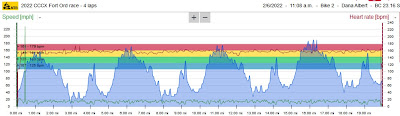
Race stats: 19.9 miles (vs. 22.4 last time); 1,987 feet of vertical gain (vs. 2,362 last time); 13.6 mph average speed (vs. 13.3 last time); 156 bpm average heart rate (vs. 153 last time); 174 bpm max heart rate (vs. 164 last time); 0:07:40 at redline (vs. 0:00:27 last time). Conclusion: I was 2% faster than two years ago, and averaged a 2% harder effort, with a 6% higher peak effort, despite being two years older. This reverses a three-year trend of slowing down every year. Before this race I had almost given up on myself, so to achieve this (albeit modest) redemption has me chuffed to bits. (Note: if you’re thinking of attributing my higher average speed to the flatter course, you have a point … but I actually do better on the hillier courses. As mentioned in my limerick, fast, technical courses like this one favor the bold and skilled, whereas hillier courses give me a chance to take back ground.)

Pre-race dinner: The bar at Los Laureles Lodge in Carmel Valley

As you’ll surely recall from my 2020 report, last time I did CCCX I carbo-loaded the night before with a delicious pasta with cream and steak tips, so you can imagine my excitement to see a similar item, creamy steak fettuccine, on the Los Laureles menu. But the price was $37! There’s no way I can do that. To be honest, I know my way around homemade pasta, not to mention a real cream sauce, so for $37 I’d have to be blown away. I couldn’t take the risk, being The World’s Cheapest Man. So I went for the $18 loaded burger (swiss, griddled onions, bacon, avocado, etc.), which was roughly the size of a cantaloupe. I had to unhinge my jaw to take a bite of that bad boy. I felt like my friendly neighborhood squirrel must feel when he eats the face off our Jack-O-Lanterns. It was a good burger, too … it was cooked rare (pretty red inside) and was really greasy, so the grease was just oozing out all over my fries (more on those in a minute). This wasn’t that gross kind of grease you’d get at an inferior restaurant, where the fry king has to occasionally skim off the skin that forms on top and/or fish out the cigarette butts. This was, like, high-end organic fair-trade grease, that had an innocence about it, almost like broth. The bun was just coming completely apart because how could it stand up to the sheer mass, and juiciness, of that burger?

Now, about those fries. They were freaking good, like they had some kind of special second-starch coating so they fried up crispier than just a strip of potato. (I know I’m not describing this very well, but what am I, a restaurant critic?) They were just great—and the portion was crazily, grotesquely, irresponsibly huge. There is only one person in existence with a high enough caloric need to justify such a huge portion, and it’s a lucky thing that person happened to be me.

Was there bread, a salad, an appetizer, a drink, or dessert? Hell no. What would be the point?

Breakfast: in the team tent at the race. I had a firm banana and an onion bagel. It’s funny: I’ve been more careful about my diet lately, so when I saw the bagel this voice in my head scolded, “Bagels have like five times the calories of a slice of bread—nobody should eat them!” How strange. Then this other voice said, “You know damn well you can’t get a real bagel outside of NYC.” That wasn’t as unexpected, because I recognized it as being my own voice. I really have no idea whose voice the first one was (and in fact a bagel has only three times the calories of a slice of bread). But the bagels weren’t from a grocery store—a team parent had taken some trouble to find fresh ones, and they looked good. So I told both voices to piss off, and slathered that bagel with cream cheese and wolfed it, chased by black coffee. And I’d do it again. Take that, diet plan! I’m back!

During race: four bottles, each two-thirds full, of fruit punch flavor Gatorade, mixed strong. The bottle I drank on the first lap was just for the sweetness, which improves performance irrespective of calories (as explained here). The second and third bottles were to fuel me, obviously. The fourth was just because it tasted good and I wanted whatever psychological comfort it could provide, and because our recently revived team had some fresh blood in the feed zone who could use the bottle hand-up practice. Speaking of blood, the drink was dribbling all down my chin, and one of our kids commented after the race that I looked like a vampire. “That’s because I fill my bottles with the blood of my rivals!” I declared. He then accused my rivals of doping, and thus me as well, by extension. These modern kids … so cynical!

Glycogen window treat: in the team tent. There were various sugary treats available to aid in my recovery, but some part of me was just too elitist to partake … I really miss the oatmeal cookies that I had in 2020, baked by the (then) team co-manager, E—. Her son L— graduated and they moved away, so she’s no longer co-manager. But L— has returned as a coach and was at the race … so why weren’t there cookies? He probably stole them, in which case all I can say is: well played! I’d have stolen them myself. Anyway, there was chocolate milk which I got excited about for a moment, but it was lactose-free and though I have no problem with lactose-free, I also have no problem with lactose so I figured I better leave most of it for whatever Cougar(s) can’t handle lactose. Besides, what did I need to recover for? My work is done for another year!

Lunch (post-race): in the team tent. Our team’s co-manager of 2020, F—, isn’t around anymore either, which, from a barbecue standpoint, is kind of like the Edmonton Oilers losing Wayne Gretzky. But some new parent was doing a yeoman’s job grilling up sausages and burgers. I had a sausage that was delicious but the entire time I was eating it (about ten seconds) I was keenly wishing there was sweet pickle relish for it. I’ve never in my life been as preoccupied with the absence of a condiment. Don’t get me wrong, I was very glad for the sausage, but that relish became an obsession. Maybe I’ll bring relish to the next race, even though I’ll only be coaching.

Dinner (post-race): back home. My wife made some innovative three-bean chili with pumpkin in it, I’m guessing for the high iron content. (Yes, I know it’s only the pumpkin seeds that are high in iron, but who actually eats those? Perhaps the proximity of the pumpkin flesh to the seeds works like a homeopathic remedy.) She also made, from scratch, macaroni & cheese. I washed it all down with a long overdue beer.

Post-race Beck’st

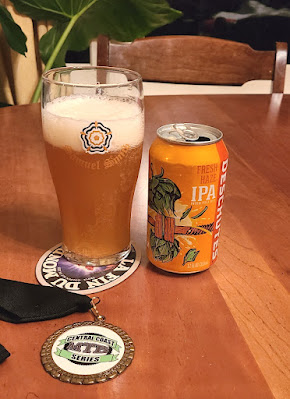
Here is the “Hardware Beck’st” I sent to my pals just before dinner. (I know I said a second ago that I washed dinner down with the beer. I didn’t. That’s just an expression, a nice idea. I drank the beer first … it’s best that way.)


(If you don’t know what a Beck’st is, get thee to a brewery! Or better yet, click here.)

Full report

I’m of the school that says your race number is always an omen. This year I got 101: how cool! It represented how I was about to get totally schooled in the race, and also how terrifying bike racing is (cf. Orwell’s “Room 101”).

I had a strange problem during my warm-up on the stationary trainer: I was listening to my workout megamix and my Bluetooth earbuds somehow got out of phase. The music in my left ear was a fraction of a second out of sync with the music in my right. The effect was extremely jarring for complicated cognitive reasons, and in fact made me almost nauseous. Meanwhile, pondering inconsistent Bluetooth latency isn’t conducive to a focused warm-up. Fortunately, being absurdly well-organized, I’d brought backup headphones and was able to proceed.

Due to some problem out on the course, they kept us sitting on the start line for at least twenty minutes. We passed the time with bike tech-talk, so you can be glad you weren’t there. I had a slow leak in my tubeless rear tire, and hadn’t gotten around to reinflating it, so instead of confidently saying, “I’m running 23 psi in the rear for the sandy conditions,” I could only describe the tire’s firmness as “al dente.” One of my student-athletes, meanwhile, was running his tires “pillow-soft.” By the time the ref rang the bell to start the race, I was no longer warmed up. Alas.

The course starts on a slight uphill, and is a wide, straight road for about a quarter mile before you turn onto the single track, so there’s no excuse for not hitting that dirt near the front (except of course being slow). I started the single track in second place. Before long my teammate M—, a fellow Albany High coach, passed me and took the lead, which was fine with me. I wasn’t feeling so hot. My legs were oddly okay, but my throat was burning and I could taste blood. My breathing was way harder than it should have been for my (albeit elevated) heart rate, and I was feeling stressed, frustrated, anxious, and agitated. In short (I suddenly realized), I had COVID! Exercise-induced COVID! Is that a thing? But I kept at it, and decided that having a burning, raspy, blood-flavored throat could become part of my new normal, like everything else. So I relaxed a bit mentally (but not physically!) and just settled into the burn.

Just a couple minutes later, on a descent, the guy ahead of me suddenly slammed on his brakes. I was like “What are you doing!?” and he said, “We missed a turn!” Dang it! By the time we got back on course, I had no idea how many guys were ahead of me.

Oh my god, I am so sorry … this is so freakin’ boring. Suffice to say, I somehow found the motivation to hammer much harder than last time for the entire race. At least some of the credit goes to my younger daughter, who—though she’d never shown much interest in my cycling before—surprised me, when I left for Fort Ord, by wishing me luck and saying, “Dig deep!” (It’s not that she’s not into sports, being a wrestler who describes herself as “secure in my masculinity.”) So I did dig deep, and it worked. By the end, I was totally satisfied with my race despite having no real idea how I’d placed. I’d given it everything I had, hadn’t miscalculated my pacing, and was perfectly empty by the end. And, as I mentioned before—and will probably mention again, until everyone is sick of hearing about it—I managed to snag a spot on the podium … which distinction I’m not sure I’ll ever achieve again.


All the guys on our podium (this being the Category 2, 45-54 group) are high school coaches. The guy on the second step is my Albany teammate, who breaks my legs twice a week. Look at the dude who got fourth … why are his legs so filthy? Did he find some puddle on the course and try to cool off?

Epilogue

No, of course I didn’t really have COVID. And no, exercise-induced COVID isn’t a thing. I confess I just worked that in to seem more timely, and to help this post perform better in search. Say, that reminds me: iPhone Samsung Galaxy Android Tesla Silicon Valley Oscars Billie Eilish Leonardo Dicaprio Emma Watson Ethereum Fortnite.

—~—~—~—~—~—~—~—~—
Email me here. For a complete index of albertnet posts, click here.

Sunday, April 22, 2018

Ode on a Double-Edged Razor


NOTE: This post is rated R for mild strong language.

Introduction

Sometimes when I’m feeling grateful for a consumer product, I am moved to write a poem. This is one of those times.

The Poem

Ode on a Double-Edged Razor

“Cheap bastard” is a name I wear with pride
And yet I cannot stand to buy cheap crap.                               2
I love that special product that provides
A point where worth and value overlap.
My razor’s made of stainless fucking steel
Instead of plastic formed in fancy shapes.                               6
My blades are double-edged—the real deal.
I might get nicked, I know—but never raped.
You know who needs expensive lubri-strips?
A bunch of soft and craven would-be men.                           10
These cartridge blades in trays like ammo-clips …
It’s shameful how Gillette is playing them.
    A Feather blade shaves close beyond compare
    Rewarding anyone who grows a pair.                                14


Footnotes & Commentary

Title: Ode on

Though I’ve titled several poems (like this one and this one) “Ode to...” I think it sounds more literary to title a poem “Ode on….” For details on this English-major-y nuance, click here.

Line 1 – cheap bastard

How is it possible to be cheap and yet insist on high-end products? For one thing, you buy as few things as possible. I select durable stuff and use it forever, so I forgo having the latest-and-greatest of anything. (My 2006 Volvo still feels new to me because I retired my old Volvo at 360,000 miles.) Even with my favorite hobby, cycling, I apply this use-what-you-got ethos. Though 11-speed gear clusters are now commonplace on bicycles, and a patent has been filed for 14-speed, I am still on 9-speed. The shift levers I use came out in 1996 but they still work great. Who needs all those gears? I’ll just pedal harder/faster.

Line 2 – cannot stand to buy

As detailed here I really don’t like buying anything. I pity the burglar who hits my house … in so many consumer product categories I am willfully bereft.

Line 4 – value

Remember when “value” simply meant “the monetary worth of something”? Now it’s commonly used as a euphemism for “budget” or “low-end.” Avoidance of embarrassment is often used to upsell people (a tactic that probably works best on poor folks).

Line 5 – stainless fucking steel

I try to keep this blog clean, but frankly no other word than “fucking” would make this phrase connote exactly what I want. Call it poetic license.

Because the blades are so much cheaper for old-school razors, you can splurge on a really nice one. I bought a Merkur razor, for $23, made in Germany. It’s beautifully built and has a nice heft. The curved steel part that holds the blade down is a nice big hunk of metal so it holds a lot of heat. I run hot water in the sink, lather up, then place the razor head-down in the water for a couple of minutes. (This gives the shaving cream time to soften my beard and skin.) When I shave, the warm steel head feels good against my face.

Look how nice the Merkur is:


Shouldn’t all the objects we engage with be well-made and attractive?

Line 6 – fancy shapes

I cannot understand why consumers—grown men and women!—continue to seem impressed by modern industry’s ability to shape plastic into very complicated and fanciful shapes. How is this impressive when cheap kids’ toys are similarly crafted? Look at this modern razor … it’s grotesque.


The women’s version (of course Gillette decided women need their own) is even worse … it looks like some Disney Cinderella-themed toy my daughters had at age four.


Look at this totally weird razor:


And, because nobody should ever have to shave with something blandly colored:


Line 7 – doubled-edged

By double-edged I mean a flat piece of steel with blades along two parallel edges, like this:


The alternative, of course, is a disposable head that has two, three, or more blades like this:


There’s actually no evidence that having more than one blade makes for a closer shave. Cecil Adams, his column The Straight Dope, denies there’s any benefit. That hasn’t stopped the Disposable Blade Industrial Complex from getting into a number-of-blades arms race. I guess it’s understandable; after all, the American consumer has trouble with complicated value propositions but anybody can understand the more-is-better idea. On top of that, Gillette has made a number of neat little videos showing how the front blade lifts a hair up, cuts most of it off, and leaves the rest sticking up so the next blade can cut it. Click here to see one of the first such simulations.


Oddly, this idea went uncontested for many years until 2005 when Gillette came out with the M3Power razor, an electric vibrating version of the Mach 3. It made the same claim about lifting hairs up to better cut them, via a new version of the video. A competitor cried foul and Gillette went on trial; a U.S. District Judge ruled that ads claiming this benefit were “unsubstantiated and inaccurate” and in fact “literally false.” The sheepish response from the Gillette spokesperson was that “the computer-generated image of the razor lifting hair away from the skin was never meant to be taken literally.”

Amusingly, mockery of the multiple-blade design brought about a life-imitates-art scenario. In 2004, The Onion presented a Commentary piece facetiously attributed to the CEO of Gillette titled, “Fuck Everything, We’re Doing Five Blades.” Here’s an excerpt: 
The Gillette Mach3 was the razor to own. Then the other guy came out with a three-blade razor. Were we scared? Hell, no. Because we hit back with a little thing called the Mach3Turbo. That's three blades and an aloe strip. For moisture. But you know what happened next? Shut up, I’m telling you what happened—the bastards went to four blades. Now we’re standing around with our cocks in our hands, selling three blades and a strip.
A couple years later, Gillette did come out with a five-blade razor, which is now their biggest seller. I guess there’s no end in sight; a South Korean company now has a six-blade razor. Look at this ridiculous thing:


The brand of that razor is Dorco; needless to say, they should spell it Dorko.

The traditional double-edged blade, meanwhile, has an undeniable benefit over modern blades: you don’t need to rinse your razor as often while shaving. You do four or five strokes, then spin the razor handle 180 degrees and do four or five strokes with the second blade (i.e., the other side of the razor head). You spend only half as much time swishing your razor in the sink.

Line 8 – might get nicked

It’s been a long time since a company directly addressed the underlying reason people will spend more money on a fancier razor: fear of shaving cuts. Norelco ran a series of such ads in the early ‘70s, like this one:


Probably this tactic was abandoned because a) conventional wisdom is to accentuate the positive, and b) nobody wants to tell customers that they don’t have the skill to shave without cutting themselves. But that’s exactly what these modern blades are about: because the blades are held at a specific angle by the plastic head that slides along your skin, you don’t have to figure out this angle for yourself. It’s pretty close to idiot-proof (though I still did occasionally nick myself back when I used them).

Yes, the retro-style razor is a bit harder to use, especially at first. My first couple of shaves were a bit nerve-racking. It takes some practice to hold the razor at the right angle, and I did nick myself a few times during the first few weeks. But hey, it’s not like we never get a chance to practice! I reckon I’ve shaved upwards of 4,000 times in my life (not including my legs), and I’ll shave at least 7,000 more times if I live to 100. By now I’ve shaved around 400 times with my Merkur and I’ve gotten quite good at it.

Line 8 – but never raped

Are users of modern razors being raped? Well, in the sense of being robbed, I would say yes. If you buy replacement razor blades at the grocery store, you’ll pay over $5 apiece. Even in bulk online (e.g., Amazon), a Fusion blade runs about $24 for  an 8-count, i.e. $3 apiece. The cheapest online price I could find for a modern blade was the (now outdated) Mach3 15-count for $26, or $1.73 each. On the other hand, my favorite double-edged blades, the Japanese-made Feather, cost $23 for 100. So modern blades cost anywhere from 7 to 22 times as much as double-edged. That’s a total rip-off.

Line 9 – lubri-strip

The lubri-strip has got to be an even bigger bunch of bullshit than the multiple blades. I mean, think about it: you’re using shaving cream or gel that lubricates the crap out of your skin. How much lubrication are you going to get out of a little strip of plastic?

Oh, I’m sorry, did I say plastic? In this video a spokesperson wearing a lab coat and speaking with a foreign accent (so she must be an authority) explains, “[The lubri-strip] has a sponge-like structure that is infused with highly water-loving polymers called polyethylene glycols or PEGs.” And that’s not all: there are now two lubri-strips per head, one before and one after the blades! Amazing! Never mind that the strip still looks and feels like a wet piece of plastic, and nothing slippery is oozing out of it.

If you use a razor with a lubri-strip, and don’t get shaving rash, it’s tempting to assume the technology is legit. I’m reminded of a joke: this guy on a city bus, to the bemusement of other passengers, is reaching into an invisible imaginary box, lifting out fingerfuls of imaginary powder, and flinging them into the air. A passenger asks, “What are you doing?” The guy responds, “It’s to keep away lions!” The passenger protests, “But there are no lions on this bus!” To which the guy responds: “See? It’s working!”

Do I miss the lubri-strip of my old Gillette razors? Not a whit. I suspect shaving rash is a fake malady, like ring-around-the-collar. Or it’s an unfortunate idiosyncrasy of some people’s skin, for which there is no easy remedy.

Line 10 – soft and craven would-be men

Okay, I’ll confess this sounds kind of harsh and unenlightened. But if I’m going to appeal to people to switch to cheaper retro-style razors, I have to take the battle to Gillette’s turf. That is, I must directly combat all the marketing that’s aimed at men’s insecurities, or my arguments will be beside the point. The fact is, Gilette’s job is to coddle men with a foolproof, easy-to-use razor—Fisher Price Baby’s First Razor, they might as well call it—without seeming to. So they use all kinds of macho imagery in their ads, along with the slogan “The best a man can get.” A man, mind you. These razors aren’t for women. If a woman tried to use them—well, that would be a disaster, like if she tried to use his grill, or his power tools.

Check out this ad. In a minute flat you’ll see just about every manly role under the sun: running race, tux-clad wedding party, football game, Army training, baseball game, astronaut mission, father with baby, Wall Street trading, discus throw, and boxing. And check out this ad for the Mach3. It shows a fighter plane going so fast the damn wings come off, and then the canopy, and then the pilot’s helmet, eventually all we have left is the pilot—i.e., the man—and his razor. And a whole lot of testosterone.

The ad for the women’s Gillette Venus razor, here, has a slower, more muted soundtrack and a notable lack of explosions. I’m pretty sure the word “curves” would never appear in a Sensor or Mach3 ad. And there’s no tagline “The best a woman can get.” That notion somehow doesn’t work—it implies something unfair, like “The best she’s able to get” or “The best we’re willing to give her.”


Is there any way to market men’s razors without appealing to masculinity? Makers of traditional razors would have a hard time appealing to frugality (for fear, I suspect, of insulting their customers). Bic did do a campaign, way back, with celebrity John McEnroe—“ I don’t have to shave with a 20-cent bic … but I do!”—but I think that’s the exception that proves the rule.

What if Gillette or a competitor decided to use the ideal celebrity to endorse their razors? Who would that be? That’s an easy one—we’d look to the ultimate man’s man, a licensed-to-kill brute who’s also an epicure. I’m talking of course about James Bond, who has taken the sartorial lead in so many other areas (suits, watches, sunglasses, etc.). The problem is, it’s just not believable that he would shave with a cheesy plastic razor with a lubri-strip. If you don’t readily agree, just watch this clip.


Not only is Bond not worried about shaving nicks, he’s not worried about Moneypenny inadvertently cutting his throat … even though, earlier in the movie, she accidently shot him. Now there’s a real man.

Line 11 – like ammo clips

I can’t get over this firearm-themed cultural messaging. The razor comes in a little holder, and in the back is a place where a five-pack clip of blades—like a magazine—snaps in. Why the extra plastic? I’m sure you’re meant to feel like you’re loading a gun. It’s all very masculine, all very reassuring, to the point of thou doth protest too much.


Look, men, there’s no fighter plane, there’s no gun … it’s a razor designed to keep you from hurting yourself. It’s like those little plastic-dipped forks they give to babies.

Line 12 – how Gillette is playing them

The marketing strategy Gillette and its competitors have embraced is selling us a razor (or “razor system”) that will only take their proprietary and pricey blades. It’s lock-in, the same market force that has us (well, most of us) still typing on inefficient QWERTY keyboards. As Wikipedia notes, “With manufacturers frequently updating their shaving systems, consumers can become locked into buying their proprietary cartridges…. Subsequent to introducing the higher-priced Mach3 in 1998, Gillette’s blade sales realized a 50% increase, and profits increased in an otherwise mature market.” Show me a company’s huge increase in profits, and I’ll show you a lot of people getting ripped off.

Incidentally, the latest innovation in razor blade marketing is Harry’s, which doesn’t charge as much for blades, but sells them on a subscription basis so you can never forget to change out your blades (i.e., you end up buying more than you really need). Harry’s advertises so aggressively online, I now see their ads on almost every page I visit, thanks to all my razor-themed Google searches.


Line 13 – Feather blade

I wouldn’t say that I’m an expert, but I’ve tried three brands of double-edged blade and I like Japanese-made Feather blades the best. They were recommended by a friend who has an English accent and thus all kinds of automatic cred. (I remember the exact conversation, years ago during a bike ride to the Hotsy Totsy club.) This guy’s dad had been into mining or something and traveled the world, and for a while had actual lackeys who would inherit his worn-out blades and sharpen them for their own use. My friend cautioned against getting caught up in the high-end retro shaving culture, which would have us mixing our own luxury shea-butter-infused shaving lather in a special purpose-built porcelain bowl, applying it to our faces with a beaver-hair brush, and buying an expensive silk dressing gown to wear while shaving.

Notwithstanding their traditional double-edged blades, Feather isn’t a totally old fashioned company. According to this timeline, they introduced a new blade as recently as 1995. (Actual new blades will naturally appear less frequently than gimmicks.) It’s not clear what was innovative about this blade; perhaps just some cool way of making it sharper. The Feather company makes scalpel blades, “microtome blades for pathology,” a “micro scalpel for ophthalmic surgery,” and a myringotomy (ear surgery) blade. So even if they don’t produce flashy videos to teach gullible consumers about polyethylene glycol lubri-strips, I reckon they’re experts at sharpening a very thin piece of stainless steel.

Line 13 – shaves close beyond compare

Believe it or not, the cheap, old-school razor blade does shave closer. I did a blind test to determine this. I shaved half my face with a Gillette Sensor3, and the other half with a double-edged Feather blade. Then I went to each of the three family members in my household and had them do a face-stroke test. All three ruled, without hesitation, that the smoother skin was on the Feather-shaved side of my face. And if their testimony isn’t good enough, just look at all the hair that the Gillette blade left on my face!


Naw, I’m just screwing with you. But the blind test was real. The results were unequivocal.

Line 14 – grows a pair

I’m not saying that it takes balls to face the risk of shaving cuts. Rather, it takes balls (not necessarily actual testicles, but nerve, basically, which is non-gender-specific) to overturn the conventional wisdom that all this fancy shaving technology is necessary or even beneficial.

Speaking of balls, I have to confess it’s kind of painful to think of them in the context of shaving. This goes back to my vasectomy—which saw me getting my scrotum dry-shaved with a 20-cent Bic. But that’s a whole other story.

--~--~--~--~--~--~--~---~--
For a complete index of albertnet posts, click here.