Showing posts with label pasta. Show all posts

Thursday, February 13, 2025

From the Archives - Bits & Bobs Volume XVIII

Introduction

This is the eighteenth and final installment in the “From the Archives – Bits & Bobs” series. (No, it’s not really the final one, so far as I know. Just seeing if you’re awake.) Volume I of the series is here, Volume II is here, Volume III is here, Volume IV is here, Volume V is here, Volume VI is here, Volume VII is here, Volume XIII is here, Volume IX is here, Volume X is here, Volume XI is here, Volume XII is here, Volume XIII is here, Volume XIV is here, Volume XV is here, Volume XVI is here, and Volume XVII is here. (The different volumes have nothing to do with one another, and can be read in order of importance, in First World Order, in the order in which they were received, in any other order you like, and/or not at all. (Note: I do not recommend that last option.)

What are Bits & Bobs, in the context of this blog? They’re like the bits of film left on the cutting room floor after a movie is made. Except you know what? That’s a nice metaphor but completely false. These are not leftovers but pertinent snippets from letters I wrote people. Some of the letters were actually printed letters, on paper, couriered by the post office. Others were of course emails. I only selected stuff that I figured any audience might find entertaining, especially nuns. Obviously snippets like “my flight gets in at 7:46 p.m.” would be excluded. (“Especially nuns?” No, I don’t know why I put that.)

Pay attention to the dates. These bits and bobs sprawl all over the place—or, to be more accurate, all over the time.


March 8, 1990

You know, there’s actually a very good reason for procrastinating on a [school] paper. The writing process is very complex, and very personal. What you write has everything to do with your life experiences, and I figure the longer I wait before writing, the more life experiences I’ll have to go on. Something could happen to me right now, for example, which could change the next paragraph of this letter. So it is with my paper. It’s not due for several more days and I’m still young … I should wait.

November 6, 1992

I sprained my right index finger about three weeks ago. I was at the bike shop after-hours truing a wheel and a customer suddenly bobbed up in front of me. Somebody must have left the shop door unlocked, and the customer ignored the “EMPLOYEES ONLY” sign. Scared the crap out of me, and as I flinched my finger went right into the spinning wheel. A few days ago , since it wasn’t healing, I jerry‑rigged a cardboard splint for it, but that didn’t help. Finally I broke down and saw a doctor. Well, a nurse, anyway. She seemed more concerned than I had been, and gave me a real splint which I’m supposed to wear for six weeks! I talked her down to three weeks, but the splint is still a major hassle since it holds my most important finger in a basically straight position.

“But wait,” you’re saying, “this letter is typed—how do you do that?” Well, I have to be able to type, since I have at least fifty pages in papers due before the end of the semester. The splint really does concern me (or rather, it did, as I shall explain). It’s a two‑centimeter‑wide aluminum plate (padded out with foam rubber) which extends beyond my fingertip, and the aluminum is curved at the end. I tried a number of typing drills—the word “jumpy” being the best challenge—and the splint would indiscriminately strike the “u,” “h,” “m,” or “n” key when I was trying for the “j.” The word “jumpy” came out anything from “hynpu” to “nhmph” or even “hunmjhupuh.” What would I do? Without the ability to type, I’d have no papers to turn in, thus failed classes, no graduation, no job, NO FUTURE. Something had to be done. It was then that I remembered the motto of the Marine Corps: Semper Fidelis. No, wait, that wasn’t it. What came to mind was a little saying I’ve somehow attributed to the Marine Corps: “Adapt, Overcome, Improvise!”

I remembered a small worn‑out mechanical pencil eraser I’d replaced a few days earlier, and dug through the trash until I found it. It’s perfect: hard rubber, about seven or eight millimeters in diameter, and maybe five millimeters thick. I glued it to the end of the aluminum splint, and you can see the results. I’ve been typing at about ninety percent of my normal speed (that is to say, about seventy or seventy‑five words per minute). While it’s somewhat trickier than normal typing, I really don’t mind it. The only minor problem is that every so often—once in three hundred words or so, perhaps—the eraser stub gets caught in the intersection of four keys, and hangs up, trapping my splinted finger. This gives me that same queer, shocking sensation as being clotheslined or when the front wheel of your bike somehow locks up.

November 10, 1992

A question my friends like to ask me is, “So what are you doing after you graduate?” I tell them, “I’m gonna get a job,” and then the real interrogation begins: “What can you do with an English degree?” they ask. At least they realize now that it’s too late to persuade me to change my major … that had gotten old over the first couple years. So, recently I was talking to a friend I hadn’t seen in ages, and she asked the same thing. “I’ve got a job lined up,” I told her, “in a factory, deburring plastic parts on an assembly line. You see, when plastics are molded, there are flashings left over from the holes the liquid material was poured through, into the mold. It’s actually pretty tricky work, because if you slip with the file you can ruin the whole piece.” I was pleased to have pulled off the entire description with a straight face. “Wow!” she said enthusiastically. “That’s great!” Sheesh. She took it hook, line, and sinker. So you can see how little respect we English majors get.

September 27, 1996

My pasta is infested. I’d bought like twenty pounds of De Cecco from the restaurant supply store down the street for super cheap, not worrying about what looked like maybe minor water damage to some of the boxes. I store most of the pasta under my bed because our kitchen is so tiny. Well, a week or so ago I saw little flecks of something when I poured the pasta in the boiling water, but wrote it off as minute cardboard debris. I made up a big batch of corn goo pasta and as E— and I began to eat, we both noticed that there were little specks in our dinner. I isolated one and determined that it was reddish in color and seemed to have a protuberance at one end. I ran and grabbed my albeit cheesy microscope and had a closer look. As I had begun to fear, it seemed to be an insect: six legs and a snout at one end. I fished out another speck and examined it; same thing. My next question was, what kind of insect could it be? I racked my brain to try to think of what kind of insects have a history of invading foodstuffs. Then it came to me: a word commonly used to describe the meals endured by peasants in Russian novels: “weevily,” as in “his grey, weevily porridge.” So I looked up “weevil” in my CD-ROM dictionary and found this definition: “Any of numerous beetles, of the superfamily Curculionoidea, especially the snout beetle, that characteristically have a downward-curving snout and are destructive to nuts, roots, stems, fruits, and pasta.” (Yeah, I added that last bit.) A picture was even provided:


E— couldn’t bear to eat the pasta, but I was hungry and just kind of ate around the weevils. I regaled my boss at work with this anecdote and he told a story of some relative who was a POW in Japan and was fed weevily rice. At first the POW refused to eat it; then he just ate around the weevils; then, eventually, realizing he wasn’t getting enough protein, would not only eat the weevils but would push them back down into his rice when they tried to escape up the side of the bowl. Reassured by this story, I’m continuing to eat the weevily pasta, since I have so much of it. Last night I made perciatelli, which is tubular like macaroni but straight and long like spaghetti. It’s particularly weevily because the weevils crawl inside of it. But it’s fine … I can’t even taste them.

September 9, 2009

A few days ago [in preparation for the Everest Challenge bike race], I shaved my legs for the first time in three years. I think it does make the legs feel a bit cooler. Plus, my leg hair was literally blowing in the wind during the Mount Diablo descent two weekends ago, which I’d found distracting. I think shaving may offer a placebo effect as well. Couldn’t hurt (unless you nick yourself). Anyhow, congrats on biting the bullet and joining me for the race. You will not suffer alone, unless you drop me.

I don’t mind driving you home on Sunday night after the race. My un-doping regimen [only using caffeine before bike rides] means that one NoDoz can wake me from the dead, and/or keep me going on a late night drive after two days of cycling overkill. And I even have a valid driver license, because I braved the DMV today to get a temporary license extension since my real license is, for some reason, moving at the speed of a glacier through the bureaucracy.

September 22, 2009

I don’t have a time trial bike you can borrow, but if you’re really, actually doing a triathlon you’ll need an appropriately dorky jersey as well, ideally one made by (well, branded by) a former pro triathlete. And you’re in luck: I still have a Scott Tinley jersey you can borrow—see attached photos.


Notwithstanding the mesh side panels, I had to make the jersey even more Tri by cutting off the sleeves so I could wear it “properly” with arm warmers (per T—’s astute observation about this dubious sartorial choice triathletes make). The hole in the chest is from when I got shot during a triathlon by an angry biker on the sidelines. Either that or I crashed on the Golden Gate Bridge and slid on my heart rate monitor transmitter; I can’t remember which. I don’t have the matching shorts anymore, which T— (in his capacity as UCSB bike club president) forbade us to wear during races; I gave those to my wife’s would-be ex-stepmother-in-law, who wore them with pride and aplomb for years. Though not in triathlons.

October 2, 2009

[To my bike team members and some other friends.] It’s been a long bike racing season. If you’ll be too tired to cook on Saturday, October 17, but not too tired to eat and drink and hang out with other bike people, celebrate your fatigue with your spouse/other and/or kids by coming to the Albert house. If you’re too tired to move, have someone drag you here. If you’re too tired to eat or drink, we’ll put you in a barber’s chair and pour beer and salsa right down your throat.

What? Salsa? Not homemade pasta? That’s right. Because we’re too tired to cook this year, and to celebrate the 50th anniversary of Mario’s La Fiesta, we’re bringing in Mexican food—lots of it. Beer and the raw materials for mixed drinks will also be provided. If you have m4d sk1llz at the blender, a spot in the kitchen is reserved for you. Bring your favorite beer if you like.

I realize now that I’ve used a vague acronym in the past: RSVP. While this can mean “Regional Senior Vice President,” it also stands for “Répondez S’il Vous Plaît.” And while this phrase literally translates to “respond if it pleases you,” it can also mean “respond, damn it.” It is in that sense I now say, “RSVP” so we’ll know how much food to order.

October 20, 2009

There’s a guy out front (visible through my office window) parking a horrible fake-wood-paneled Buick Roadmaster station wagon. He’s taking a very long time. He’s an old weird guy with plaid shorts and a jacket. Kind of a cross between L—’s husband and my dad. Now he’s done parking and is cleaning the interior meticulously. He has an unimpressive dog. He wants $6K for the car. People are mighty strange.

—~—~—~—~—~—~—~—~—
Email me here. For a complete index of albertnet posts, click here.

Tuesday, February 15, 2022

Race Report - 2022 Fort Ord CCCX XC MTB

Introduction

Last year I started a new tradition—the Non-Race Non-Report of the Bike Race That Didn’t Happen—and was looking forward to continuing it. But a number of complications arose: the COVID vaccine enabled groups to gather again, so the Albany High School Cougars mountain bike racing team (for which I’m an assistant coach) started back up; the Fort Ord CCCX Cross Country Mountain Bike Race returned to the calendar; I somehow built up enough fitness to decide to have another go; and, crucially, I realized the Non-Race Non-Report format was already too tired a concept to spawn a sequel. And so, here I am again to report on my agonizing attempt at glory in an actual race.

Note: if you care about the race itself, and my tactics, and how they played out, and all that other chess-game-on-wheels stuff, you’re in the wrong place. (Perhaps you got here because I stuffed my report with juicy SEO-friendly search terms like iPhone, Tesla, Marvel, Netflix, Disney, Coca-Cola, bacon, bitcoin, cryptocurrency, Minecraft, Halo, and PUBG, in which case I apologize.) In keeping with a long race report tradition, I focus herein mainly on the food.


Executive summary

  • I gave up beer for five weeks to lose weight for this race (and it worked, I dropped 7-8 pounds), which gave me the gumption to train and race extra hard so my great sacrifice wouldn’t be in vain
  • My pre-race dinner was so extra
  • I rode super hard through the Start/Finish section every lap but I’m not sure my student-athletes were even watching and thus may still view me as a concierge, not an actual athlete they can take seriously
  • I suffered in a novel way, which is kind of remarkable after forty years of this
  • I got poison oak again
  • I buried myself far more successfully than last time, trading short-term agony for the blissful avoidance of at least a year of self-loathing
  • I ate well post-race
  • For only the second time in five tries at CCCX, I made the podium

Executive limerick

CCCX is a course for the fearless,
Racers who shrug off the crash or the near-miss.
Alas, I’m so old that I’m utterly timid,
Braking, then having to sprint at my limit …
Doing okay only ‘cause I’ve been beerless.

Short report

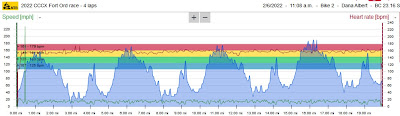
Race stats: 19.9 miles (vs. 22.4 last time); 1,987 feet of vertical gain (vs. 2,362 last time); 13.6 mph average speed (vs. 13.3 last time); 156 bpm average heart rate (vs. 153 last time); 174 bpm max heart rate (vs. 164 last time); 0:07:40 at redline (vs. 0:00:27 last time). Conclusion: I was 2% faster than two years ago, and averaged a 2% harder effort, with a 6% higher peak effort, despite being two years older. This reverses a three-year trend of slowing down every year. Before this race I had almost given up on myself, so to achieve this (albeit modest) redemption has me chuffed to bits. (Note: if you’re thinking of attributing my higher average speed to the flatter course, you have a point … but I actually do better on the hillier courses. As mentioned in my limerick, fast, technical courses like this one favor the bold and skilled, whereas hillier courses give me a chance to take back ground.)

Pre-race dinner: The bar at Los Laureles Lodge in Carmel Valley

As you’ll surely recall from my 2020 report, last time I did CCCX I carbo-loaded the night before with a delicious pasta with cream and steak tips, so you can imagine my excitement to see a similar item, creamy steak fettuccine, on the Los Laureles menu. But the price was $37! There’s no way I can do that. To be honest, I know my way around homemade pasta, not to mention a real cream sauce, so for $37 I’d have to be blown away. I couldn’t take the risk, being The World’s Cheapest Man. So I went for the $18 loaded burger (swiss, griddled onions, bacon, avocado, etc.), which was roughly the size of a cantaloupe. I had to unhinge my jaw to take a bite of that bad boy. I felt like my friendly neighborhood squirrel must feel when he eats the face off our Jack-O-Lanterns. It was a good burger, too … it was cooked rare (pretty red inside) and was really greasy, so the grease was just oozing out all over my fries (more on those in a minute). This wasn’t that gross kind of grease you’d get at an inferior restaurant, where the fry king has to occasionally skim off the skin that forms on top and/or fish out the cigarette butts. This was, like, high-end organic fair-trade grease, that had an innocence about it, almost like broth. The bun was just coming completely apart because how could it stand up to the sheer mass, and juiciness, of that burger?

Now, about those fries. They were freaking good, like they had some kind of special second-starch coating so they fried up crispier than just a strip of potato. (I know I’m not describing this very well, but what am I, a restaurant critic?) They were just great—and the portion was crazily, grotesquely, irresponsibly huge. There is only one person in existence with a high enough caloric need to justify such a huge portion, and it’s a lucky thing that person happened to be me.

Was there bread, a salad, an appetizer, a drink, or dessert? Hell no. What would be the point?

Breakfast: in the team tent at the race. I had a firm banana and an onion bagel. It’s funny: I’ve been more careful about my diet lately, so when I saw the bagel this voice in my head scolded, “Bagels have like five times the calories of a slice of bread—nobody should eat them!” How strange. Then this other voice said, “You know damn well you can’t get a real bagel outside of NYC.” That wasn’t as unexpected, because I recognized it as being my own voice. I really have no idea whose voice the first one was (and in fact a bagel has only three times the calories of a slice of bread). But the bagels weren’t from a grocery store—a team parent had taken some trouble to find fresh ones, and they looked good. So I told both voices to piss off, and slathered that bagel with cream cheese and wolfed it, chased by black coffee. And I’d do it again. Take that, diet plan! I’m back!

During race: four bottles, each two-thirds full, of fruit punch flavor Gatorade, mixed strong. The bottle I drank on the first lap was just for the sweetness, which improves performance irrespective of calories (as explained here). The second and third bottles were to fuel me, obviously. The fourth was just because it tasted good and I wanted whatever psychological comfort it could provide, and because our recently revived team had some fresh blood in the feed zone who could use the bottle hand-up practice. Speaking of blood, the drink was dribbling all down my chin, and one of our kids commented after the race that I looked like a vampire. “That’s because I fill my bottles with the blood of my rivals!” I declared. He then accused my rivals of doping, and thus me as well, by extension. These modern kids … so cynical!

Glycogen window treat: in the team tent. There were various sugary treats available to aid in my recovery, but some part of me was just too elitist to partake … I really miss the oatmeal cookies that I had in 2020, baked by the (then) team co-manager, E—. Her son L— graduated and they moved away, so she’s no longer co-manager. But L— has returned as a coach and was at the race … so why weren’t there cookies? He probably stole them, in which case all I can say is: well played! I’d have stolen them myself. Anyway, there was chocolate milk which I got excited about for a moment, but it was lactose-free and though I have no problem with lactose-free, I also have no problem with lactose so I figured I better leave most of it for whatever Cougar(s) can’t handle lactose. Besides, what did I need to recover for? My work is done for another year!

Lunch (post-race): in the team tent. Our team’s co-manager of 2020, F—, isn’t around anymore either, which, from a barbecue standpoint, is kind of like the Edmonton Oilers losing Wayne Gretzky. But some new parent was doing a yeoman’s job grilling up sausages and burgers. I had a sausage that was delicious but the entire time I was eating it (about ten seconds) I was keenly wishing there was sweet pickle relish for it. I’ve never in my life been as preoccupied with the absence of a condiment. Don’t get me wrong, I was very glad for the sausage, but that relish became an obsession. Maybe I’ll bring relish to the next race, even though I’ll only be coaching.

Dinner (post-race): back home. My wife made some innovative three-bean chili with pumpkin in it, I’m guessing for the high iron content. (Yes, I know it’s only the pumpkin seeds that are high in iron, but who actually eats those? Perhaps the proximity of the pumpkin flesh to the seeds works like a homeopathic remedy.) She also made, from scratch, macaroni & cheese. I washed it all down with a long overdue beer.

Post-race Beck’st

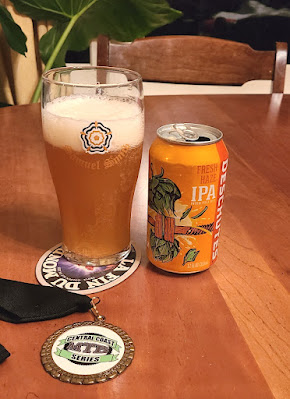
Here is the “Hardware Beck’st” I sent to my pals just before dinner. (I know I said a second ago that I washed dinner down with the beer. I didn’t. That’s just an expression, a nice idea. I drank the beer first … it’s best that way.)


(If you don’t know what a Beck’st is, get thee to a brewery! Or better yet, click here.)

Full report

I’m of the school that says your race number is always an omen. This year I got 101: how cool! It represented how I was about to get totally schooled in the race, and also how terrifying bike racing is (cf. Orwell’s “Room 101”).

I had a strange problem during my warm-up on the stationary trainer: I was listening to my workout megamix and my Bluetooth earbuds somehow got out of phase. The music in my left ear was a fraction of a second out of sync with the music in my right. The effect was extremely jarring for complicated cognitive reasons, and in fact made me almost nauseous. Meanwhile, pondering inconsistent Bluetooth latency isn’t conducive to a focused warm-up. Fortunately, being absurdly well-organized, I’d brought backup headphones and was able to proceed.

Due to some problem out on the course, they kept us sitting on the start line for at least twenty minutes. We passed the time with bike tech-talk, so you can be glad you weren’t there. I had a slow leak in my tubeless rear tire, and hadn’t gotten around to reinflating it, so instead of confidently saying, “I’m running 23 psi in the rear for the sandy conditions,” I could only describe the tire’s firmness as “al dente.” One of my student-athletes, meanwhile, was running his tires “pillow-soft.” By the time the ref rang the bell to start the race, I was no longer warmed up. Alas.

The course starts on a slight uphill, and is a wide, straight road for about a quarter mile before you turn onto the single track, so there’s no excuse for not hitting that dirt near the front (except of course being slow). I started the single track in second place. Before long my teammate M—, a fellow Albany High coach, passed me and took the lead, which was fine with me. I wasn’t feeling so hot. My legs were oddly okay, but my throat was burning and I could taste blood. My breathing was way harder than it should have been for my (albeit elevated) heart rate, and I was feeling stressed, frustrated, anxious, and agitated. In short (I suddenly realized), I had COVID! Exercise-induced COVID! Is that a thing? But I kept at it, and decided that having a burning, raspy, blood-flavored throat could become part of my new normal, like everything else. So I relaxed a bit mentally (but not physically!) and just settled into the burn.

Just a couple minutes later, on a descent, the guy ahead of me suddenly slammed on his brakes. I was like “What are you doing!?” and he said, “We missed a turn!” Dang it! By the time we got back on course, I had no idea how many guys were ahead of me.

Oh my god, I am so sorry … this is so freakin’ boring. Suffice to say, I somehow found the motivation to hammer much harder than last time for the entire race. At least some of the credit goes to my younger daughter, who—though she’d never shown much interest in my cycling before—surprised me, when I left for Fort Ord, by wishing me luck and saying, “Dig deep!” (It’s not that she’s not into sports, being a wrestler who describes herself as “secure in my masculinity.”) So I did dig deep, and it worked. By the end, I was totally satisfied with my race despite having no real idea how I’d placed. I’d given it everything I had, hadn’t miscalculated my pacing, and was perfectly empty by the end. And, as I mentioned before—and will probably mention again, until everyone is sick of hearing about it—I managed to snag a spot on the podium … which distinction I’m not sure I’ll ever achieve again.


All the guys on our podium (this being the Category 2, 45-54 group) are high school coaches. The guy on the second step is my Albany teammate, who breaks my legs twice a week. Look at the dude who got fourth … why are his legs so filthy? Did he find some puddle on the course and try to cool off?

Epilogue

No, of course I didn’t really have COVID. And no, exercise-induced COVID isn’t a thing. I confess I just worked that in to seem more timely, and to help this post perform better in search. Say, that reminds me: iPhone Samsung Galaxy Android Tesla Silicon Valley Oscars Billie Eilish Leonardo Dicaprio Emma Watson Ethereum Fortnite.

—~—~—~—~—~—~—~—~—
Email me here. For a complete index of albertnet posts, click here.

Tuesday, October 8, 2019

Homemade Macaroni & Cheese


Introduction

Sometimes you just need some starch. Whether you’ve had a hard workout or a hard day, nothing really satisfies like a giant plate of pasta. Sure, there are sophisticated ways of serving it, like with a Bolognese Ragù or a rich Alfredo, but what if you’re in a rush and/or don’t have a lot of high-end ingredients on hand? Or what if you need to satisfy your Philistine children? Well, that’s when you need some good old fashioned macaroni and cheese. I’m not talking about that lowbrow crap from a box, either. I mean the good stuff. In this post I’ll tell you, and show you, how it’s done.

As no other organizing structure suggests itself to me, I’ll give you this dispatch in the (perhaps mythic) who-what-where-when-why-how style of the newspaper reporter. In case you’re an albertnet newbie, I should warn you that I beat around the bush quite a bit on this blog, feeling that this beating is a) kind of the point, and b) something you probably deserve. If you just want the recipe, search within this page on “the actual recipe” which is buried way down in the “how” section.


Who, where, and when

Instead of telling you who makes this excellent dish, I’ll tell you who, weirdly, doesn’t: Irma S. Rombauer. Her Joy of Cooking, that indispensable cookbook no kitchen is complete without, has recipes for everything you could dream of, plus a lot of foods you’d never dream of. For example, it’s got recipes for cooking squirrel, opossum, and raccoon. In fact, the original edition (of which I’m a proud co-owner) shows you how to skin one of these varmints.


I love the boot in that drawing. You know those trendy “nose to tail” restaurants that emphasize using every part of the animal? Well, that’s nothing: how about using every part of the animal kingdom? These modern restaurants have got nothing on Ms. Rombauer.

That’s why it’s so utterly weird that The Joy of Cooking doesn’t have a recipe for macaroni and cheese. It’s so strange: the closest it comes is “boiled macaroni with cheese” and “baked macaroni.” The first is too simple (it couldn’t possibly produce the fully integrated flavor sensation we’re looking for, being basically cheese thrown on pasta) and the second looks like a lot of hassle: it sends you off to a separate recipe for “AU GRATIN III” which includes a lot of nonsense instructions like “the finished result should be neither powdery nor rubbery but ‘fondant.’”

The question of where is surprisingly relevant here: you can make this just about anywhere, so long as you have a couple of flames (one for the pasta water, one for the pan). This isn’t true of just any recipe. Sometimes a foreign kitchen just throws off your game. I’m up at my mom’s place in Oregon, where my brother Geoff’s pizza dough got a bit screwed up the other night by a strange oven that didn’t provide the right yeast-rising climate. I feel my brother’s pain: I once tried to make my Mexican-style rice at a friend’s apartment in NYC where the ingredients at the local grocery came (apparently) from Mars. But this mac ‘n’ cheese recipe is so simple, very few such pitfalls exist. The most basic kitchen tools and pantry will do.

On to when: as I touched on earlier, this is the dish you make when you’re tired, your brain is fried, your kids are disgruntled and in need of simple starchy love, you don’t have time to shop, and/or you lack the brain energy to do anything even slightly complicated. It’s an alternative to take-out, delivery, or a frozen dinner (if you even stock that sort of thing). Through this culinary mac ‘n’ cheese miracle, one moment you’re a burned-out cog of corporate industry ready to put your head in the oven, and the next moment you’re calmer than a mindful yogi, and a hero to your children.

What

My recipe is for the most basic version of this dish. I know it’s traditional and delicious to bake mac ‘n’ cheese in the oven with a bread-crumb topping, and my brother Max has even made his own bread crumbs for this purpose. A friend, emailing me years ago with a restaurant recommendation, wrote that Nizza la Bella has “the best macaroni and cheese in any restaurant I've ever had (the macaroni gran pere, baked, not that runny slop they serve at trendy macaroni specialty restaurants in utterly hapless Oakland).” Obviously there is ample opportunity to make this dish gourmet.

But I’ve never done that and I won’t start now. First of all, if I had that much energy, I’d make something fancier to begin with, like fettuccine Alfredo, maybe with homemade noodles. Second, pasta + bread crumbs = double-starch, which I’ve never seen the point of. (It’s like potato slices on pizza … what’s up with that?) To go to the extra trouble with bread crumbs, when this mac ‘n’ cheese is so good as-is, would be like putting one of those little cocktail umbrellas in a glass of beer.

Speaking of beer, check out this mac ‘n’ cheese themed Beck’st my friend John sent me years ago:


He’d just been on a brutal bike ride, he wrote, “so I made some celebratory macaroni and cheese with caramelized onions and linguiça sausage and peas. The cheese sauce is a combination of cheddar and Parmesan Reggiano. And I washed it down with the local lager.” Needless to say, I challenged him on that being macaroni at all (trying, alas unsuccessfully, to coax him and the rest of the Beck’st recipients into a debate about the correct translation of “farfalle”). He replied, “Dude, I know that’s farfalle — or ‘laços’ as they’re called here in Portugal — I was just testing you! Making sure you’re not falling asleep. However, if I make a cheese sauce (from scratch, as I do) and pour it over a pasta-like product, I have ipso facto and without question made ‘macaroni and cheese.’ You and your rules…”

Actually, I am not a purist when it comes to this dish. I have made it with macaroni, shells, farfalle, fusilli, cellentani, campanelle, rigatoni, penne, and orecchiette. I’ve used all kinds of different cheeses—whatever’s in the fridge—and I’ve added ham, peas, and even hot dog slices, for crying out loud. The basic recipe is completely adaptable and extendable, as you’ll see if you ever make it to the “how” section of this post. But first:

Why

Why take even this much trouble? Why not just make mac ‘n’ cheese from the box, like in college? Well, for one thing, once you’ve got the hang of this recipe (and really, it’s not hard, trust me), it doesn’t actually take any longer. Meanwhile, the stuff from the box doesn’t give you much yield, and if you scale it up enough to feed a hungry family, that’s a lot of wasteful packaging, and probably costs more than doing it right. Finally, there’s the matter of what you ingest.


When a product has to say, “No artificial flavors or dyes,” we’re into “thou doth protest too much” territory, like being on a first date where your date says, apropos of nothing, “Don’t worry, I don’t have any STDs … I just got tested!” And when you look at the boxed mac ingredients, you see all kinds of stuff you wouldn’t use if cooking for yourself:


The second ingredient is glycerol monostearate, whatever that is. And why couldn’t they get by with regular monoglycerides … why did they have to use acetylated monoglycerides? Okay, I’m sure somebody’s dad is a chemist and could tell us that sodium alginate and oleoresin are totally harmless, but should that be good enough? Here’s a rule of thumb: if an ingredient isn’t in your spell-checker, and/or your kid can’t pronounce it, maybe it doesn’t belong in your mouth.

And that’s just the ingredients the boxed mac manufacturers tell you about. You know the little paper/foil packet with the powdered cheese? It’s not an ingredient, of course, but it’s the reason you ingest phthalates every time you make boxed mac ‘n’ cheese. Just look at that word: “phthalates.” That’s some seriously fucked up spelling, the kind of consonant cluster that just says “dangerous chemical.” This article explains the problem and though it tells us not to panic, I’m still a little put off. Among other things, we’re warned, phthalates “can disrupt the production of testosterone.” Them’s fightin’ words!

“But wait,” you’re saying, “I’ve been boycotting Kraft for years, and only eat Annie’s boxed mac ‘n’ cheese!” Hey, me too, but we’re still not out of the woods. I consulted the Annie’s website and found that although they do address this issue, their answer is disconcertingly more complicated than “no phthalates.” In a nutshell, the level of phthalates in their product is below the European Food Safety Authority acceptable threshold (the US doesn’t have one yet). The Annie’s website states, “We are working with our trusted suppliers to understand where phthalates are coming into our supply chain and how we can evaluate and limit them.” This is all very reassuring, but no match, in my opinion, for good old fashioned home cooking. (Full disclosure: I still keep Annie’s around for when my younger daughter has to fend for herself.)

How

Okay, on to the actual recipe. The gist is this: you’re going to start with an easy white sauce called a roux. (It’s different from the dark roux used in southern or Cajun cooking. Kind of a Midwest roux, you might say.) This is the base that you’ll grate hella cheese into. Stir the pasta in and you’re done. (Here’s a Tom Swifty on the topic: “‘Ugh, I shouldn’t have eaten so much white sauce,’ Tom said ruefully.”)

You’ll need just six ingredients: 
  • Any variety of short, stubby pasta (and any brand ... De Cecco, Barilla, American Beauty, Golden Grain, house brand … doesn’t matter)
  • White flour (though wheat flour will work fine)
  • Milk (whole, skim, part-skim, organic, not-organic, pretty much anything but non-dairy “milk” or chocolate milk, which I haven’t tried yet)
  • Cheese (sharp, mild, cheddar, Swiss, gouda, just about whatever you’ve got except American/Velveeta, which is not food)
  • Salt (Morton’s, iodized, non-iodized, house brand, fancy-pants sea salt, whatever)
  • Pepper (basic pre-ground, fresh ground, ground from green peppercorns, ground from a four-foot-long grinder, whatever)

Here’s what I came up with at my mom’s house:


Using a fancy-pants pasta like cavatappi can impress your dinner guests, though classic elbows are, well, classic. I was cooking for a big group so I doubled the recipe, and had to mix pasta shapes. No problem: just compare the cooking times and delay appropriately before adding the faster-cooking pasta.

So here’s what you do. Put a big pot of water on the stove and read albertnet while it reaches a boil. (That’s right, you can wait and make the sauce in the mere 10 minutes required for the pasta to cook!) Salt the water and throw the pasta in. Now, in a large paella pan or Dutch oven, melt the butter over medium/high heat. How much? I guess something like three tablespoons per batch, a batch being defined as the amount one pound of pasta will yield. Once the butter is melted, gradually add flour, stirring continuously until you get a nice paste.


How much flour? Well, not so much that the paste loses its buttery taste. Just two or three tablespoons for a single batch. You should end up with a ball of paste the color of yellow teeth and about the size of a young mouse. (I realize these aren’t very appetizing comparisons … what can I say?)

Hey, don’t forget to stir the pasta occasionally!

Now you start gradually adding the milk to the paste. The milk might sizzle a bit in the pan, which is fine, but the heat should be low enough that nothing scorches. Integrate the milk and paste gradually, using a whisk. Keep adding milk, gradually turning your paste into a thin roux.


When you’re done the sauce should be about the consistency of paint. Salt and pepper to taste. Now you start grating the cheese in there. You can have your kid grate the cheese into a giant mound on a plate while you’re doing the sauce, or you can have your kid stir the sauce while you grate the cheese right into it. You’ll know you’ve grated enough cheese in there when the sauce is almost as thick as pudding, or when your kid stops yelling, “More cheese!” Give it a taste. The cheesy flavor should be intense. If it’s not, add more cheese. Or add more cheese for no good reason. It’s hard to go wrong … just don’t add so much that it gets greasy. That’s never happened to me, but doesn’t mean it’s not possible.


The cheese sauce should be ready right about the time the pasta is done. (By the way, this isn’t the time to show off how sophisticated you are by undercooking the pasta. This is comfort food, damn it! Cook it all the way.) Strain the pasta, pour it in the cheese sauce, and stir away. The only tricky part about this step is managing not to drool into the pan. Turn off your overhead fan so you can hear the tantalizing sound this stirring makes. It should sound like walking through thick mud. Here’s some video … turn the volume up!


For this last step, you should gather everyone around to “help.” This might be one of the few family activities left that can make your kids literally jump for joy. If one of your kids already went off to college, text her a link to the movie with a heartwarming caption like “HOW YA LIKE ME NOW!?” If all of your kids have left for college, it’s okay to cry into the sauce, so long as you’re not wearing mascara.

Now, if there’s any flaw to this dish, besides its being basically nothing but refined starch and saturated fat, it’s that the color is just a bit on the pallid side. So you’ll want to serve it with colorful, salubrious vegetables, like really good red tomatoes. (No corn, dammit! That’s even more pallid, and it’s just another starch!) Up at my mom’s place, I scrounged up some frozen green beans and dry-farmed tomatoes at the last minute. NOOICE!


Counterpoint

Is it responsible parenting to serve this starch ‘n’ fat bomb? Well, probably not. But you can limit the damage by loading your kid’s plate up with vegetables, and not letting him or her have a second helping of mac ‘n’ cheese until that plate is clean. And let’s be realistic: the odds are very high that your kid—yes, your kid!—will become a young adult who makes mac ‘n’ cheese from the box on a somewhat regular basis. If you can teach this basic technique, you might just help your family win the War on Phthalates!

A final note

Here’s a handy tech tip for storing the rest of that block of cheese. When you first cut into the plastic wrapper, start a few inches from the end. Cut it cleanly all the way around. Now you have a “cap” that you can slip down over the brick, and don’t need to waste extra plastic. This short documentary film explains it better.


--~--~--~--~--~--~--~---~--
For a complete index of albertnet posts, click here.
Wednesday, October 17, 2018

Fettuccine Alfredo


Introduction

I posted a while back about the who-what-where-when-why-how of hand-cranked homemade pasta. In a subsequent post I tackled the topic of a fittingly tasty sauce, Bolognese Ragù. That’s all well and good, but what about vegetarians? And what about a sauce that doesn’t take like six hours to create? I’ll cover that here. 


Who, where, and when

In terms of “who,” it would be great if I could say this is a family recipe handed down from generation to generation, over which I bonded with my dearly departed Italian grandmother. But my grandmother was Dutch, and didn’t teach me how to cook a damn thing (probably because the Dutch don’t really cook, other than fries, as far as I can tell).

To be honest, I don’t remember where I got this recipe, if I ever had one. I think I just tried stuff practically at random until I found something that worked. (The fact is, when you’re adding butter, cream, and cheese to pasta, it’s hard to end up with something you’re not willing to eat, no matter how badly you screw up.)

I’ve been making this for decades. The current incarnation dates from at least 1994, when my wife and I did a cross-country bicycle tour and this was our go-to splurge whenever we gained access to a kitchen. Needless to say this dish isn’t feasibly prepared on a little camp stove.

What

According to Wikipedia, fettuccine Alfredo is the same thing as fettuccine al burro (i.e., with butter). They go on about this Italian chef who invented the recipe by using more butter than those before him. There’s no mention of cream, which means that what most Americans call Alfredo is really a bastardization. This is fitting, because Alfredo himself was, literally, a bastard. (Note: I made that up.) Suffice to say, every recipe I’ve looked at online calls for heavy cream so it’s hard to say how authentic any of it actually is. But when it’s so heart-achingly good, who cares?

Why

Why would you eat this? Because it’s delicious, duh! The better question is, why make it yourself?

First of all, because you can—it’s not exactly easy, but it is quick. You could get it at a restaurant, but if you’re paying somebody to cook for you, why not order something like a Bolognese that’s much more labor-intensive? Also, even though this dish is quick, it can’t be made in advance—it has to be made to order—so it’s hard for restaurants to get it just right. You can actually make it better at home.

Why not buy it in a jar? Please. I just looked up the ingredients for Barilla brand jarred Alfredo. The first ingredient is water; the second is sunflower oil. There’s no butter in it at all, though there are “dairy product solids.” That’s almost as enticing as the “enzyme modified egg yolk,” the xanthan gum, and the gum arabic it also features. You also get “natural flavors” (i.e., artificial flavors). I had this sauce once and it was just as disgusting as it sounds.

Classico brand Alfredo is slightly better (on paper, at least) but still has xanthan gum, along with modified gum arabic, whey protein concentrate, and modified food starch. The first three consumer reviews listed are all one-star: “If you are putting up new wallpaper this will be handy but not for eating”; “Bland and tasteless” (both!); and “Watery bland.”

How

The fettuccine is the easy part. You can buy De Cecco, which is great stuff, or make your own according to my instructions. It should look like this:


Part of what fettuccine Alfredo is touted for is its golden color. Well, with proper pasta you’re halfway there!

Beyond this, I have to confess: fettuccine Alfredo is a bit tricky (as opposed to my Bolognese, which takes forever but which is so easy a rhesus monkey could probably make it, and I wish it were legal to keep them as pets because I’d consider getting one just for this purpose). Some batches of Alfredo come out great, but others not so much. I once made it for my dad, and it was a lousy batch—the sauce separated and got greasy—but he pronounced it “excellent.” (A sucker for saturated fats, I guess.)

The hardest thing is figuring out how much butter to use. I originally started with a stick of butter and a pint of cream, just as a shock-and-awe kind of brute-force approach. That wasn’t very good. I’ve gradually dialed back the butter, but haven’t figured out exactly how much should go in. The idea is to permeate the sauce with as much fat as possible without it getting greasy. Perhaps I’ll tinker with the butter quantity and update this post, if I can remember (and if my heart and arteries hold out long enough). For now, start with 2 or 3 tablespoons.

The other difficult part is melting in a maximum amount of Romano and Parmesan cheese without the sauce clumping up. The cheese needs to meld perfectly with the cream and butter, and this isn’t a perfect science. I think the trick, as is so often the case, is not to cut any corners. This means grating the cheese with a zester.

A zester? Yep. The hard cheese needs to be grated as fine as snowflakes. (Note that the powdery stuff you get in the green cardboard can melts beautifully, but tastes terrible—because it is. Totally off-limits here.) Below are three type of graters you might use (along with some recommended ingredients):


The one on the far right is a classic, though I don’t know why. It grates the cheese too coarsely, so it doesn’t melt well enough (and meanwhile that curved surface just makes things awkward, increasing the chance that you’ll grate part of a finger or thumb into the sauce). The Zyliss grater on the left is efficient, and injury-proof (other than carpal tunnel I guess), but it still doesn’t grate the cheese fine enough. I used my Zyliss recently for a batch of Alfredo and wasn’t thrilled with the results. What you really want is that one in back, the zester. And for absolutely best results you probably want to grate it right over the pasta in the pan instead of into a bowl. You’ll need strong hands for this. (Tip: be a professional bicycle mechanic for at least ten years before you turn to cooking. This will give you the strength you need, and the psychological mettle. It is said that “bicycle mechanic bleed on the inside.”)

Use equal parts Romano and Parmesan. Once grated, they should be finer than what’s shown here (which was grated with the Zyliss):


The other tricky thing is to get the right amount of nutmeg. I don’t know the precise amount because I don’t measure it with a teaspoon. How could I, when I grate it right into the sauce? This is a much more aromatic form of nutmeg than what you get in a jar (though honestly it might be the height of culinary affectation to insist on it).


If you use too little nutmeg, you won’t taste it at all so why did you bother with that fancy tool shown above? But if you use too much, it’s too strong and dominates the sauce. I’ve definitely screwed up entire batches this way, which is a shame when each plate of this food probably knocks a few months off your life.

The final challenge is the peas. You don’t have to add peas, but it imparts a nice bit of color, and just a touch of sweetness to offset the saltiness of all that cheese. If you add too many peas, that reduces the decadence and overwhelms the subtle flavors. Also, if you overcook the peas they’re mushy and only the English can get away with that. A final pitfall is if it turns out you grabbed that bag of frozen peas somebody had used to ice a knee every night for a week, so they’re powdery and inedible.

Okay, so here’s what you do. Get the pasta water boiling, salt it, throw in the pasta, and in a very large copper-bottomed pan (a paella pan works great), melt the butter (not too much!) and add the heavy cream. (Use organic—it tastes better. And find some without any thickener.) Salt and pepper that a bit. Add the nutmeg (not too much!). Now—wait! Stop! Don’t add the peas yet!

When the pasta is almost done (it should be just this side of al dente since it will continue to soften a bit from here), strain it and add it to the butter & cream. Stir that all around. You should be surprised at how thin and watery this mixture seems.


Okay, now add the frozen peas. Stir well. Don’t worry, they’ll be cooked by the end. Perfectly, as it turns out. Now sprinkle a thin, even layer of grated zested cheese on there. It should look like this just  before you put the lid on.


You want this on just the lowest heat. You know what? I used to use an ad hoc double boiler by putting the pan atop the pasta pot (with the burner off, but plenty of heat radiating up from the water because you’ve used a pot with a built-in colander insert). This works great. (Why did I stop doing this? Because I forgot about it, until I unearthed the below photo.)


(Why the pink tinge in the above photo? I can’t remember. Maybe that batch had salmon in it.)

Next, wait two or three minutes—with the lid on—until that cheese has basically melted, then mix it in. It will, ideally, blend right in with the cream without clumping.


Now repeat this step with another layer of cheese. You might repeat it several more times. How many? Depends on how thin your layer of cheese is (the thinner the better) and how finely grated the cheese is. When the sauce is on the verge of not even being creamy anymore, it’s time to stop. Here’s the finished product:


(No, it doesn't change color. I was monkeying with my camera flash.)

Now’s the scary part: plate it and hope it turned out. 
  • A so-so batch will be well worth eating, and everybody will want seconds, but it might be under-creamy, or greasy, or perhaps just a bit meh (which would be the result of too little cheese). If you over-nutmegged it, this is when you’ll curse silently. Someone might pronounce it “excellent” but you’ll know better.
  • On the other hand, if it’s a good batch, you’ll actually hear people’s eyes rolling back in their heads, unless this is drowned out by all the yummy-noises and actual whimpers of pleasure.
You might think the difference is how hungry people are, but I don’t think this is the case. Once, at my annual bike team pasta party, I whipped up a batch of Alfredo long after the Bolognese was gone, and a few friends standing around the stove—who had declared themselves stuffed already—decided to have “just a taste.” So I served some up, right there at the stove, and they ate it while standing. “Oh, shit—give me more of that!” one of them said. The others also demanded seconds. Nobody was “tasting” anymore. We all kept macking on the Alfredo until it was completely gone. By this time others had gathered around to see what all the commotion (and, frankly, profanity) was about, but they were too late. It was a truly glorious batch.

Counterpoint

I really need to point out that this dish is very, very bad for you. Refined starch, three kinds of saturated fat, only the smallest smattering of peas (which health nuts will tell you aren’t nearly as salubrious as leafy greens) … isn’t this totally irresponsible? Well, yeah. That’s practically the point. (If you’re not comfortable with this, maybe you should become a cyclist.)

Can you make Alfredo healthier, by adding broccoli, or using half-and-half, or making it a side dish? Yeah, you could, if you want to bring your joyless, priggish discipline to yet one more aspect of your puritanical life, you gastronomic prude.

What about salmon? Okay, now we’re talking … that’s actually pretty good (see the first photo in this post). I’ve thrown in smoked salmon, at the very end, to great effect. (No, don’t use canned. But farmed is totally fine.)

Postscript

I finally got a photo of the proper cheesing grating zesting process and the outcome. Look at the glorious mound my brother has produced:


Also, in case you are looking for even more ways to increase the caloric density of pasta, check out this addition to my starch-bomb canon: Homemade macaroni & cheese.

--~--~--~--~--~--~--~---~--
For a complete index of albertnet posts, click here.
Tuesday, September 19, 2017

Colorado Mountain Road Test - SRAM eTap Electronic Shifting


Introduction

So, this post will be a bit unusual. I did a Colorado mountain ride with my friend Pete recently that wasn’t quite epic or disastrous enough to warrant its own post. (For epic click here; for disastrous click here.) Meanwhile, I’ve long wanted to blog about electronic shifting, but I’m not sure I care enough about it to devote a whole post to that, either. So here’s a combo: while telling you about a not-quite-epic ride, I’ll share my firsthand experience with top-end electronic shifting. If you care about neither, read on anyway, because I’ll cover food and booze too.

Executive summary

Fun ride, even though my rental bike’s SRAM Red eTap bit the wax tadpole.

Short version

Our pre-ride carbo-load dinner was exquisite. I rented a very high-end bicycle from a good shop. This bike had electronic shifting, which I was hoping to have some trouble with so I could bag on it, which I’m predisposed to do anyway. I did have some trouble, which proves that at least this brand of top-end electronic shifting is still a pointless expenditure. The ride was fun, hard, and involved a gorgeous dirt road. It wasn’t that epic, though, which is my friend Pete’s fault.

Long version

If you know me well, you know I’ll all about fast cars, fly women, and gold chains. Hmmm. Maybe that’s not quite right. I guess more accurately I’m all about fast bikes, fine literature, and saving money.  And when I go to Boulder, I’m all about time-honored traditions like eating pasta at The Gondolier and suffering through long bike rides. Here’s my plate at the Gondo:


Look, I know some wiseguy among you is going to say, “Those noodles are too thick and ropey and don’t appear to be made of semolina flour.” That may be true, but damn it, that’s not the point. These were good enough for me as a teenager when I went every week for all-u-can-eat, and they’re good enough now. Trust me, I know from good pasta.

And look at that beer! Dogfish Head 90-Minute IPA, one of my very favorite beers. (Before I conceived of this post, I snapped this photo for Beck’sting purposes, to make my pals jealous.)

That’s Pete in the background. He’s my favorite biking pal because he’s way faster than I am but doesn’t seem to hold it against me. He also susses out all the cool routes that invariably feature gobs of climbing and remote dirt roads.

For my rental bike I went to University Bicycles, affectionately known as UBikes, which is arguably the best shop in Boulder (though I also like Vecchio’s Bicicletteria quite a lot). Now, you might not know this, but Boulder is considered a very bike-y place. “Best shop in Boulder” is kind of like being “best brothel in Amsterdam.” (I’m actually not that wild about the comparison I just made, but I don’t have time to go fix it.) Anyway, one cool thing about UBikes is their collection of very cool old bikes like this one.


When I was 13 my friend Nico (also 13) loaned me, for about a year, a Cinelli road frame of similar vintage.  When I think back to how advanced Nico and I were, compared to the current crop of ho-hum teens, I start to sound like an old person.

Last time I rented a bike from UBikes for an epic ride, I waited too long and got a real pile of crap. This time I planned ahead and, almost two hours before the shop opened, reserved a Specialized Tarmac via their website. I got to the shop about ten minutes after they opened and they’d already put on the Look pedals I requested. As the salesman helped adjust the saddle for me, he sent another guy upstairs to “get the batteries.” Batteries? Huh? Oh, wow, this bike sported SRAM eTap electronic shifting! It works like this: there are only two buttons, one per lever. To get a smaller rear cog you tap the right. For a bigger cog you tap the left. To change chainrings you tap both buttons at once.

Is electronic shifting cool? No. I can say that now that I’ve tried it. I have always been tempted to say that without even trying it (kind of like how I can confidently say heroin isn’t cool even though I haven’t tried it, either), but until now I figured I better hold my tongue. Now I’ve tried it and, as I’ll get into later, it’s not foolproof (which of course it needs to be to have any benefit over traditional shifting).

Empirical arguments aside, I will now walk you through why electronic shifting is lame in principle. First, let’s ask the question, what makes a racing bike good? Number one, the bike has got to look cool. Number two, the bike has to go fast. Let’s evaluate eTap on that basis.

Does it look cool? No. Here’s proof.


That Cinelli I showed you a bit ago? That looked cool. Those SRAM derailleurs? With the big hunks of plastic-y material sticking off of them? Those don’t look cool. They look really bad. Now, I know aesthetics are a matter of personal taste, but that doesn’t mean there’s no right or wrong. If you like the look of these derailleurs you are either delusional or have no taste, and I no more respect your opinion than if you said plastic ketchup bottles look better than glass.


Now, speed is another matter. My Giant road bike might not look better than that old Cinelli I had, but overall the Giant is better because it’s faster. That is, the Giant will get me up hills faster, given the same power applied to the pedals, because it’s lighter than the late ‘60s Cinelli. Now, here’s how the whole “is it faster?” question applies to electronic shifting.


(The SRAM Red eTap rear derailleur weighs 239 grams; the SRAM Red traditional weighs 178 grams. The levers weigh about the same between the two types. Etc.)

I guess it could be argued that eTap is better because it’s more foolproof and/or more pleasurable to use. I’ll get to that later.

Just in case you give a shit, here’s the bike I rented.


Great bike. It rode really well … stiff, comfortable, handled well. My only complaint is that it seemed a bit heavier than my Giant. Hmm, I wonder why.

The saddle was pretty comfortable too, which was a relief. You just never know with a rental bike.


I have to question Specialized’s normally spot-on branding here, though. I mean, Toupé? Are you kidding me? Look, marketing guys: since you evidently didn’t grasp this, “Toupé” is one letter away from, and pronounced exactly the same as, toupée, the artificial hairpiece that insecure men wear, which is a front-runner for the most embarrassing product a man could buy. There’s a reason slapstick comedies so often feature a man’s humiliation at having his toupée  blow away or getting it snatched off his head. Given the prevalence of baldness amoung MAMILs (hardly the most glamorous ambassadors of the sport), this is astonishingly reckless branding. If they came out with a women’s version, would they call it the Merkin?

Since I seem to be finding fault with everything, I might as well complain that the helmet UBikes loaned me didn’t have a vent setup that gave me any way to stash my sunglasses. This really surprised me, since every helmet I’ve had in the last 20 years has had sunglasses-friendly vents. But thanks to the Toupé saddle, problem solved!


I finally understand why so many modern saddles have that giant hole in them. (By the way, the above picture provides the only photo evidence that I was actually on this ride. Look closely and you can almost tell what club I ride for.)

But enough about the gear and culture. It’s time to hit the open road! Here’s where we rode, starting from Pete’s house in Golden.


The reason this ride was so short is that although Pete and I both had the day off, he had a noon conference call. I already gave him a hard time about this, but you should pile on. E-mail me your scathing gibes and I’ll pass them along.

We started out by riding up Lookout Road, featured in the US Pro Challenge and, more recently, Phil Gaimon’s successful bid for the new Strava record. We didn’t end up going as fast as Phil. I guess we forgot to hammer. Oh well. We ride Lookout in less than twice Phil’s time, which isn’t bad.

If you’re looking for an open road, Colorado is a good place to start.

I don’t have a whole lot of photos of this ride because I forgot to bring my camera. Fortunately—check this out!—my phone has a camera built in! That sure came in handy.

There was a wonderful section of brand-new bike path for a ways. Then, after another climb, I helped Pete get a new personal record on the Floyd Hill descent. (Actually, we weren’t even thinking about trying to go fast, much less doing anything on Strava. And lest you think we’re daredevils, this was only good for 144th place.)

Alongside the road were some buffalo, or “buffler” in mountain-man parlance. I’m sure these creatures are more majestic when they’re not all fenced in.


The pedaling was hard. After Lookout we braved another Category 2 climb a bit over 7 miles long, taking us to about 8,700 feet above sea level.  That may not sound like much, but I donated blood recently. Also, I’m not very strong to begin with.

Okay, let’s get back to that shifting. First impression? Kind of nifty. It didn’t take long to get used to it (though a couple times, near intersections, I tapped the wrong button.) Once I got used to it, and the novelty wore off, I realized it’s not as fun as traditional shifting. I enjoy mechanisms. After all, we’re messing about with PCs, tablets, phones, and other electronic interfaces all day long. As more and more technologies are designed to be idiot-proof and as automated as possible, what’s left for us to do? I miss the stick shift on my old Volvo. Driving a stick is more fun than letting the car decide when to shift. (And operating the clutch of my old car was more fun than using Geartronic, the so-called “manumatic” transmission of my current Volvo.)

What’s wrong with today’s wealthy cyclists that they don’t want cable-type shifters, especially considering how good they’ve gotten? Why do all these dentists and stockbrokers enjoy being coddled with pushbuttons?

So much for eTap being more fun. So does it shift faster? No. Rear shifting has been practically instantaneous for many years so there is scant room for improvement there. And when shifting the front with eTap, there’s a tiny delay when you tap both buttons before you hear this little whirring noise and the motorized front derailleur moves the chain. Granted, this delay is unimportant; the main factor in response time was never in the lever to begin with—it’s dragging that chain up to the big ring, or nudging it to the little one without letting it fall. The SRAM red front derailleur does just fine, but no better than high-end cable-type front derailleurs.

The last chance for eTap to prove itself superior would be in the “foolproof” department. This is hard to test, of course.  I will concede that cable-type front shifting isn’t perfect; everybody throws his chain once in a while. That being said, one ride on eTap without a missed front shift wouldn’t mean anything. I might go weeks or months, maybe a year or more, without my bike’s front derailleur screwing up. So my only hope for hitting the trifecta—ugly, heavy, non-foolproof—would be eTap happening to screw up within the narrow timespan of my four-hour ride.

About 2/3 of the way into the ride, all the planets lined up. Pete and I reached a point where a steep downhill led right into a steep climb, and I wanted to keep as much momentum as possible. This meant big-ringing it until the very last second and then going for the little chainring. What a perfect testing ground for electronic shifting! You can see where we were, about 43 miles into the ride:

I bombed the downhill (leaving a bit of a gap between me and Pete so maybe I could surge by him triumphantly) and tapped the two buttons at just the right moment. And guess what? The fricking chain fell off! And here’s the really weird part: it came off the right side, as if it had overshot the big ring (which it had already been in) instead of the little one. WTF!?

Now, a defender of this eTap technology might be tempted to blame the rider. But that’s silly; there should be no way to get it to mis-shift. But wait, you might say, what if I had accidentally hit the two buttons twice instead of once? Well, I suppose it’s possible I did that, but electronics should be “smart” enough  to handle this kind of user error. That is, the system should ignore a second click if it comes a fraction of a second after the first one, since obviously nobody would want to shift onto the small chainring and right back to the large. Besides, I’m not a klutz—on an old Schwinn I had with no front derailleur (it had broken off) I used to shift by hand—so I’m 99.9% sure I tapped those buttons just once.

I will continue to play the devil’s advocate and entertain the possibility that the derailleur was poorly adjusted. But remember, this was a ~$6000 rental bike that gets tuned up after every ride. It was built and maintained by arguably the top bike shop in a bicycle mecca. If UBikes can’t get it right, clearly the tolerances of this system are too tight—i.e., it’s literally too high-maintenance—to be practical. I for one would not want to own a bike with such finicky shifting (if adjustment is indeed the problem).

Pete, looking back and seeing that I’d thrown my chain, said, “See you back in Golden,” and rode off. Now, when you throw you chain off the big ring on cable-type drivetrains, it’s easy enough to get it back going again—you click the little lever on the left side to move the front derailleur left, then lift up the back of the bike so the rear wheel is off the ground, give the cranks a turn or two, and you’re back in business. It is the same process every  time so you do it without having to really think. But what would I do here? I had no idea why the bike had mis-shifted, and therefore no idea what chainring the front derailleur thought it was in. I had to look closely at the derailleur before double-tapping again, so the failure of eTap was compounded.

In the final analysis, eTap absolutely does not shift faster, nor is it easier or more enjoyable to shift, nor is it (more) foolproof. To my great delight, electronic shifting turns out to be even shittier than I’d imagined.

To those of you who shelled out a lot of money for electronic shifting: don’t feel bad. I’m not trying to bag on you. It’s your bike and your business and you can still feel good about choosing electronic, and I would never expect you to second-guess your choice based on my brief experience with it. But your derailleurs are butt-ugly and your bike is heavy.

Our third major climb, Douglas Mountain Drive, is a Category 2, mostly dirt, with an average pitch of 9%. Very scenic as well.


Some of the sights were more amusing than beautiful. For example, this one:


What’s amusing about that, you ask? Well, look a little closer:


There are grills on both the upper and lower decks! Why would that be? Maybe it’s in case members of the family can’t get along. “Just for that, I’m going to barbecue tonight, and you’re not invited!” / “Okay, fine, I’ll go downstairs and have my own barbecue! I don’t need you!”

What a glorious early evening climb this was. Being dirt, and steep, it didn’t let us climb out of the saddle much. We settled in for some really nice suffering and an even nicer view.


Of course I couldn’t snap any more photos once the descending began. With the exception of a mile-long climb I don’t even remember, it was all downhill, for 15 miles, back to Pete’s place. Fittingly, my tale ends as it began: with a beer.


--~--~--~--~--~--~--~---~--

For a complete index of albertnet posts, click here.