Tuesday, May 16, 2023

More Tom Swifties

Introduction

The other day at 5 a.m. I woke up abruptly and couldn’t fall back to sleep. My brain was restless but had nothing to do, so it just started cranking out Tom Swifties, one after another, rapid-fire. (If you don’t know what a Tom Swifty is, check out my prior blog post here.) I don’t have time to write much this week, and no ideas, so I figured I’d just compile the new Swifties and be done with it. Alas, after I finally fell back asleep for like twenty minutes and reawakened, all the Swifties were gone. So I’m starting from scratch here.

ChatGPT Tom Swifties

Now, many a modern person, faced with a deadline and writer’s block, would turn to ChatGPT. This didn’t occur to me until my project was well underway and my brother suggested it (perhaps tongue-in-cheek, as he’s read my anti-ChatGPT posts herehere, and here). By the same token, you might wonder, “Why would I read this albertnet post when I can just ask ChatGPT for some Tom Swifties?” The answer is, because ChatGPT’s suck! Just to make this point, and so you’ll properly appreciate my Swifties, I’ll start with a few AI-generated ones.

Here are some Swifties from ChatGPT:

  • “I won the marathon,” Tom said runningly.
  • “I’ll have the seafood platter,” Tom said fishily.
  • “I’ll take the train,” Tom said railingly.

WTF? Seriously? Since when is “runningly” even a word and what would it mean? I wasn’t expecting much, but ChatGPT did even worse than I’d expected. I decided to see if it could do better creating puns involving the verb rather than an adverb. I asked it, “Write some tom swifties with no adverbs.” Here are some of its responses:

  • “I’m terrible at baseball,” Tom said bat-terly.
  • “I feel so refreshed after a shower,” Tom said towel-dry.
  • “I can’t wait to go swimming,” Tom said eagerly.

Again, WTF?! Did ChatGPT not understand the prompt? Well, it said at the end, “I hope you enjoy these Tom Swifties without adverbs!” I guess if we’re going to be really technical about it, “bat-terly” isn’t even a word, so it can’t be an adverb, but it’s pretty obvious that if it were a word, it would be an adverb. In all ten responses to this prompt, ChatGPT’s verb was “said,” so clearly it missed the point. Why do some many people seem so impressed by this AI? Unbelievable.

Okay, on to the real Swifties. A few of these are from my daughter.

Tom Swifties

“The sample weighs 28 grams,” Tom announced.

“Please don’t leave me a bad review!” Tom yelped.

 “I should have warned him about the banana peel,” Tom let slip.

 “It’s so helpful that you bagged everything up for me,” said Tom gladly.

“If you smoke that weed, you’ll be useless all afternoon,” Tom said bluntly.

“I own the mineral rights here,” Tom claimed.

“I like hot dogs,” Tom said frankly.

“He’s my brother,” Tom related.

“Return to the back of the ship immediately,” Tom said sternly.

“It’s either a solid, a liquid, or a gas,” Tom stated.

“You’re welcome to borrow my old-school landline phone,” Tom said cordially.

 “We’re being attacked by a humpback!” Tom wailed.

 “No, no, no, no, no,” Tom said knowingly.

“It’s the odor of a skunk,” Tom said distinctly.

“A martini should always be made with vodka,” Tom said, with absolute certainty.

“I guess you can see right through me,” Tom said clearly.

“Above all, I’m a company man,” said Tom firmly.

“Spray ‘n’ Wash isn’t the only way to get stains out!” Tom shouted.

“She’s all into cultivating flowers,” Tom mumbled.

 “You may be judged for cohabitating before marriage,” Tom insinuated.

“I’ll not opposed to funding the project,” Tom granted.

“They just keep making these superhero movies, one after another,” Tom marveled.

“I Tased the little bastard!” Tom said shockingly.

“I teach at the college,” Tom professed.

“I’m just a teeny bit incontinent,” Tom leaked.

“I feel like I’m about to fricking suffocate!” Tom vented.

“I can’t lift it, it’s too heavy!” Tom whimpered.

“I really want some of those hiking sandals,” Tom said keenly.

“I’m about to totally lose it,” Tom stressed.

“I labeled it with a Sharpie in two places,” Tom remarked.

“My pulse is extremely strong,” Tom said heartily.

“You won something,” Tom apprised.

“You turn me on,” Tom said stiffly.

 “You should come over, I’ve been drinking cocktails all afternoon,” said Tom spiritedly.

“My ranch only has cows and steers,” Tom said nobly.

“It’s no secret my firm does lots of pro bono work,” Tom said freely.

“I just love my new lamp!” Tom said delightedly.

“Sir, sir, sir, sir, sir,” Tom whispered surreptitiously.

 “Man, you really stink!” Tom fumed.

“I’ll just give my boss the finger,” Tom said flippantly.

“I love that old oil lamp,” Tom said genially.

“We’re gonna get caught in this storm!” Tom thundered.

“I really dig Studio Ghibli,” Tom said animatedly.

“A thousand megabytes is a lot!” Tom giggled.

“Did you smuggle in the pancakes? I’ve got everything else,” Tom said surreptitiously.

 “I have no use for merely average people like you,” Tom said meanly.

“When are you going to finish that sewing project?” Tom needled.

“I can’t believe you Tased him twice,” Tom said, revolted.

“If I have to hear one more live band, I think I’ll barf,” Tom said disconcertedly.

“How do you feel about gay couples?” Tom queried.

 —~—~—~—~—~—~—~—~—
Email me here. For a complete index of albertnet posts, click here.

Monday, May 8, 2023

Cycling Smackdown - Middle Ring Tale

Introduction

I am an assistant coach for the Albany High School mountain biking team. The age difference between the student-athletes and me keeps growing, and my bike isn’t getting any younger, either. In fact, it sports a triple crankset, a technology that has all but disappeared from the mountain bike racing circuit. One of the kids said, “We were trying to imagine you on a modern bike with a one-by, but it just wouldn’t seem right.” So this configuration has, for better or worse, become part of my “personal brand.”

What’s that, you ask? What’s a “one-by”? It’s a crankset with only one chainring, which is what most modern mountain bikes have now, paired with a  wide-range cluster of gears in the back (the opposite of the “corn cob” I coveted as a youngster). The problem with the one-by setup is, how do you properly execute the maneuver required for a Big Ring Tale?

I did not coin the term “Big Ring Tale”—at least, I don’t think I did, having used this term since the early ‘80s—but when I googled this phrase just now every single hit was this blog. Suffice to say, “Big Ring Tale” refers to a story of a showdown on bikes, with the climax coming when the hero, just before launching his final, devastating attack, “throws it in the big ring”—that is, shifts into his bike’s higher gear range. But this tale takes place on a climb far too steep for the big ring, which is why we’ll have to make do with a smaller one.


Middle ring tale

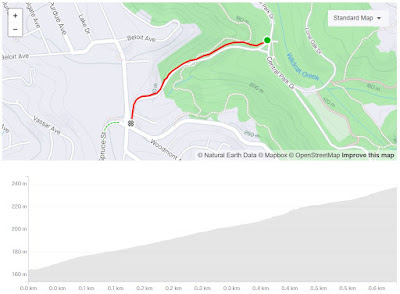
Our team rides are largely on dirt trails, but getting to them and back requires some asphalt. There’s a classic climb we do, on the road, that’s short but very steep. It’s called Canon Drive and it gains 244 feet in 0.39 miles, for an average grade of 11.7%. The top stretch is a fricking wall, topping out at 24.7%! Canon Drive is the last big hurdle we must get over during our weekday rides before descending all the way back to the high school. Most kids hate this climb because we usually have to tackle it when they’re already pretty knackered. They’ll beg for crazy long detours just to get around having to face it; one coach calls this chorus of whining “the ABCs,” for “anything but Canon.”

In my group (only the second fastest, but hey, I’m old!), there’s a kid named S— who is what we call a pocket climber. His physique is just ridiculously spare and lean, his upper body an inverted trapezoid from somewhat aerodynamic shoulders to an ideally narrow waist, and the inevitable “ripped” (i.e., lean) legs. He looks like a Pixar character, someone who could feature in the next “Incredibles” movie or something. On the big climbs I can almost never keep up with him. Today I was hoping he’d be tired enough, this having been a long ride, that I could prevail on this last, beastly climb.

So, I took the front right from the get-go, hoping to perhaps demoralize everyone into just slacking off (being teenagers, after all). I kicked out the hardest pace I could handle, which had my heart into the low 160s, which is over 90% of my maximum heart rate. The wimp that lives in my brain said, “Anyone who can come by me when I’m going this hard deserves to drop me.”


(Obviously the above photo is from a different ride when I had the opportunity to futz with a phone camera. Note the heart rate percent-of-max display, in the upper right, showing 84%, with the “ring of fire” showing in red how close to maxed out I am.)

Notwithstanding this fatalistic sentiment, my self-talk in such cases isn’t all negative. Much of the time I’m simply marveling how high I can get my heart rate when I’m riding with these kids. On no level do I feel like I need to beat them, or that anything is at stake; it’s just that their verve is infectious. Overall think my spirit animal is the cat; that is, I’m kind of a loner. But these team rides bring out my inner sled dog and I can’t help but exuberantly run with the pack, no matter how hard that is.

Soon enough, S—, the pocket climber, as if following a script, came drilling it past me. This was about 5/8 of the way to the top. (Why don’t I just say “about halfway”? Easy for you to say, armchair reader. On a climb like this, practically every foot of every effort is metered out.) S— started to pull away and I thought, “Well, he’s gone, but at least maybe I can hold off Z—.” Z— is the head coach’s kid, who has been putting the hurt on me more and more on every ride, in the process of eventually becoming faster than I, which most of these kids do (and which, let’s face it, is the whole point of coaching them, though it’s a bittersweet experience when they leave you, often literally, in the dust). Sure enough, Z— pulled level a moment later: the next thread in my weave unraveling.

Except it wasn’t Z—! It was this other kid, T—, who is a bit stockier than the others and generally isn’t a factor on the climbs. He’s not naturally built for uphills, perhaps even less than I am, plus he’s pretty new to the sport. Something about how he squares his shoulders, especially when I see him next to a pocket climber, makes me think of Frankenstein’s monster. And, when the hammer goes down, he really thrashes, body rocking all over the place. But here he was, totally going for it, attempting to burst forth and chase S— down, just flying in the face of Fate, despite the iron seeming stone cold!

It was such a cheeky move, so dismissive of  the established hierarchy, it inspired me! So I thought, heck, I’m already in the middle ring, which isn’t bad, on a grade this steep, and even though we’d just reached the final wall, where I would normally shift into my largest cog in the back, I thought: what if I just fricking shifted UP, into a harder gear? Or, even, like, two gears up? As in, what if I put the bike in the gear a real man would use here if he were going to lay down a rubber road straight to freedom?!

(Yes, I know in a classic Big Ring Tale I’d be honor-bound to throw her in the big ring at this point, but let’s be real. The grade is more than 20%. I guess I could have taken some liberties and written that I’d been in the little ring, and now threw her in the middle, but that would be false. Could I have called this a “smaller cog” story? No, that just doesn’t make any sense. And one more thing: if “lay down a rubber road straight to freedom” confuses you, you need to go watch “Mad Max” as soon as possible. I believe the expression has to do with accelerating so hard, even when already at highway speed, that you spin the tires and burn rubber.)

Could I really do this? Decide to shift up two gears, and just honor that crazy commitment? Well, my back to the wall, I was just crazy enough to try it. So I stood up (so I’d be standing already when the shift was complete) and clicked the lever twice. My derailleur is pretty bent, so under load it takes a while to shift into a smaller cog, and during this process I kind of lose some power, so mid-shift Z— finally came up next to me, like I’d known he would...

Except it still wasn’t Z—! It was this French kid, G—, the son of a fellow coach who is a brilliant world class physicist living in the US for a while helping America’s best scientists solve some crazy problem using a giant multibillion particle accelerator, but I digress. He (the kid, not the physicist) is normally off the back on these climbs, given the elite group he’s in, but he was having the ride of his life! He had dropped Z— and A— and was about to drop the fricking coach, that being me!

But it was not to be, because suddenly my bike was in gear and I fricking went! I accelerated with astonishing effect and I heard G— make this kind of odd noise, between a sigh and a puff of air bursting from his lungs through his mouth as his dream was instantly scuttled.

Okay, so, at the risk of exhausting your patience with another aside, I need to get something straight here, because when I regale my wife with tales such as this, she doesn’t quite understand the dynamic and to her, these acts of aggression are puzzling, even disconcerting. She ran track in high school but it was mostly a social thing, without much rivalry within the team. But the fact is, high school mountain bikers are just aggressive. Every climb, every descent, heck, even the rare flat section, is an opportunity to thrash your teammates. It’s automatic. It’s not the same as the road teams I was on at their age, where we were on a team with adults who let us ride with them so long as we behaved (i.e. rode predictably). And when we teen roadies went on long rides together, sure, the hammer would go down from time to time, but we also chatted quite a bit, at a casual pace, and at other times relied on each other for a good draft, taking turns facing the wind because it was a long way home. Mountain biking is different. The rides are shorter, more intense, and generally a free-for-all. And as a coach, my job is to lead, inspire, and demonstrate the subtle arts of tactics, psychology, and (when I can manage it) brute force. This isn’t like other team sports where the coach just does a lot of talking from the sidelines. We NICA coaches suffer right along with our student-athletes, on every ride. And, in the faster groups, we coaches pwn these youngsters whenever we can because our window for doing so is slowly but inexorably closing. We know it, and the kids know it: virtually anybody who sticks with the program for all four years can look forward to eventually surpassing the coach. Until that moment, we coaches are all-in, comfortably confident in the knowledge that even the most solid drubbing we can inflict won’t discourage these kids. They look at us: we’re old, we’re oddly fast, but we’re mainly old, and eventually, one day, vengeance is theirs. They will repay. [Insert winking emoticon here.]

Okay, where was I? Ah, yes, I’d completed my brave upshift and launched my quixotic attack. I was drilling it like a madman! Now, as you already know, anybody—even a guy who’s already hammering, even at >90% of his max heart rate—can stomp on the pedals and accelerate for a little while, maybe 50 or 100 feet, before he totally detonates. Such accelerations are impressive until they fizzle. Except that I didn’t! I just felt this crazy surge of power, like a giant wave had just swept me up and was hurtling me toward the beach—except it wasn’t a beach, it was a wall! The ruthless final stretch of Canon Drive! And I was flying!

The pain was so severe it just triggered some altered state where nothing could stop me, and I flew up that hellish pitch with absolutely no regard for the abuse I was inflicting on myself, much less for the laws of gravity. I felt like a squirrel running straight up a tree! It seemed impossible to catch the other two, except that suddenly they were in great difficulty—the difficulty I should have been in, but somehow wasn’t—and I was gaining on them with a quickness!

As I raged up the slope, fate caught up to T— and he detonated, right near the top, less than fifty feet from the prize, and as I overtook him I was in striking range of S—. As we went around the ridiculous corner at the top (where it’s so steep it’s impossible not to peel out in your car after stopping at the stop sign), I squeezed past S— and just nipped him at the line! Or did he nip me? There was no photo-finish camera, but either way, he must have been astonished I was even there, after having been so thoroughly distanced earlier. I looked down at my heart rate monitor, and for the first time ever, I mean in my entire life, it read 100%! So this was kind of a triple-victory! Man vs. Nature, Man vs. Man, and Man vs. Himself! Daaaaaamn!

So was there a victory salute? Applause? A ticker-tape parade? An engraving in some memorial plaque? Of course not: just a fist-bump and a breathless “NOOICE.” Of course in the moment this tête-à-tête felt like kind of a big deal, as in “What a rush!” but it was ultimately just another hill, just another sprint. And when intense, all-in suffering like this becomes routine, that’s when the humble teenager becomes an athlete, ideally for life.

—~—~—~—~—~—~—~—~—
Email me here. For a complete index of albertnet posts, click here.

Sunday, April 30, 2023

From the Archives - What Is It With TAs?

Introduction

This being a slow news day, here’s one from my archives, from when I was an undergraduate at UC Santa Barbara. Back then I wrote little essays that were essentially blog posts, but since there was no Internet I just printed and photocopied them (shrunk down to fit four pages on one sheet of paper) and mailed them around to family and friends, who probably threw them straight into the recycling, except perhaps my mom, who actually read them, and occasionally gave them to friends who probably threw them straight into the recycling. So I guess you could say I’m recycling this essay again.

What Is It With TAs? – March 6, 1989

Elementary school is pretty basic. Every year you get a new teacher, and he or she teaches you everything from spelling to math to the basics of human sexuality. It’s a pretty efficient system, because you get to know the teacher pretty well, so she knows when you’re screwing off vs. when you’ve transcended your intellectual roots. Of course, a ten-year-old’s educational roots go about a centimeter deep, which is the only reason this system works.

By the time junior high and high school roll around, things change. Presumably, the courses are much more complex, so teachers need to specialize. Still, all the lecturing, discussion, and grading for a course is done by the same person. That is, the person who was supposed to teach you something is the same one help accountable for making sure you learned it, or at least had the opportunity to learn it had you paid attention. Since each teacher handles two or three, maybe even more batches of students at a time, they’re presumably stretched thinner, so they aren’t as accessible as before. The student gets each teacher for like an hour a day and that’s it. This is fine, though, because very few high school students would ever bother seeking extra help anyway. It’s mostly the suck-ups, I think, who find the teacher after class.

College, of course, is completely different. The professor lectures to (or at) hundreds of students, completely ignorant of their individual identities. Sometimes, oversubscribed lectures are actually videotaped and played back later. No teaching professional could be expected to field visits from that many students, and the professor in particular is too busy doing research or publishing papers. Moreover, based on having managed to get such a coveted position as a tenured professor, this person is simply too important to be fraternizing with lowly undergraduates. To give these hapless kids some help, we have TA’s.

I will confess it took me a while to figure out what a TA actually is. The first dozen or so times I heard this abbreviation I thought my fellow students were talking about tits-&-ass. I was like, why are these people so obsessed with this? Then, based on context (e.g., “the TA was useless, as usual”), I thought it was an abbreviation for “total airhead.” But I kept hearing this personal pronoun, “my TA,” and I was like, huh? His airhead? Like, everyone gets an airhead? Like personal pan pizzas? Finally it dawned on me that TA stood for “teacher’s assistant,” like the student teachers we had at elementary school. But this wasn’t correct either—there are no teachers at a university, just professors, who are lecturers and researchers and don’t do any teaching per se. It turns out (and maybe you grasped this already, in which case congratulations), TA actually means Teaching Assistant.

A TA grades tests, checks homework, and holds weekly Discussion Sections to talk about the professor’s lectures. These are much smaller gatherings, typically like 15 or 20 kids, in a small classroom. It’s the same number of students each time, which at first seemed really strange to me, almost eerie, since lectures have wildly varying levels of truancy. (For example, 8:00 a.m. Monday lectures so lightly attended, it’s like a ghost town.) It turns out that for the Discussion Section, attendance is mandatory. (I realized this due to the number of students who sneak out early, right after the roll call.)

I would never skip a lecture or bail early on a Discussion Section, by the way. I pay my own tuition, and I calculated that each class costs me $3.64. You wouldn’t pay that kind of money for a matinee movie and then not go, would you?

In case you haven’t started college yet, or graduated so long ago you don’t remember TAs, or in case things were different back then, let me take you on a tour of a typical Discussion Section in this modern era.

To kick off each Section, the TA gives a really tough quiz. The quiz is actually of little value, because every sensible student knows that the TA will never bother to grade it; after all, why would he make extra work for himself? But the grade isn’t the point, since we’re here to learn, so students study pretty hard for these quizzes. Ha! Ha ha ha ha! I had you going there, didn’t I? Of course we don’t study, since without a grade we can’t summon the required motivation, so we fail pathetically on these quizzes. Actually, that’s not quite right: we fail apathetically.

After the quiz, the TA spends like ten minutes passing back checked off homework assignments. Nobody knows how it’s possible for this process to drag out for so long. This might be a fascinating thing for a scientist to try to study. The TA has a stack of homework papers, each with a student’s name at the top, and instead of calling out each name and having students come fetch their papers, the TA personally hand-delivers them, walking all the way over to each student’s desk. If the TA can’t put a face to a name, he will call out the name, the student will raise his or her hand, and then the TA will start the journey over there. By some crazy corollary to Murphy’s Law, the second student to be handed back his or her paper is as far away as possible from the first, and then the third student is clear across the room from the second, and if you plotted the course of the TA it would make a picture of a giant flower. I have pondered this matter at length because it’s the most interesting phase of the Discussion Section.

After handing back our homework the TA kicks off the Question and Answer session. This is an opportunity for the students to ask questions about the lecture, the material in general, the homework assignments, and—crucially—what’s going to be on the midterm, which is by far the most popular question, even though the answer is always the same: “Anything on the syllabus, anything mentioned in lecture, and anything in your homework.” Gee, thanks. We were looking for an inside track here but it’s clear whose side you’re on.

Most of the time, and particularly after we’ve taken a midterm but haven’t gotten it back yet, we students don’t ask very many questions. Okay, I can sense you wanting to back me up for a second and ask, “Wait, a midterm, or the midterm?” That’s a great question. The quarter lasts ten weeks here, so you’d think the midterm would be held at the end of the fifth week, and there would be exactly one of them. That’s what I myself had expected. But actually, there are usually two and sometimes even three midterms. So why aren’t they just called “tests” or “exams”? Beats me.

Often times the students are unprepared or asleep (or both), so nobody will ask any questions. The TA will wait patiently for about ten minutes before becoming irritated. This is a really long time. He or she will actually just look at the students, panning from face to face, waiting, despite no indication anyone will ever cave in. It’s like a game of chicken. At first I was tempted to fill the uncomfortable silence by asking a question, and sometimes I did, but generally the answer wasn’t very good, and eventually the uncomfortable silence became comfortable. Peaceful, even. Could the TA be trying to teach us something? Perhaps he’s into meditation or Zen or something, and is teaching us to have the same seemingly inexhaustible patience he does? It’s weird.

Eventually, perhaps to punish us for wasting his valuable time, the TA will verbally quiz us on stuff from the lectures or the reading, and—here’s the fun part—he’ll refuse to accept any answer given. Whatever we answer will be deemed incorrect. For example, my Critical Thinking TA asked the other day, “What is a sound argument?” Five or six students gave truly insufficient answers (e.g., “an argument that’s basically, like, pretty good?”). At this point, with complete conviction born of a) having attended the lecture, b) having done the reading, c) having done the homework, and d) this being a really easy question, I piped up and said, “A sound argument is logically valid and has true premises.” The TA shook his head and waited several more minutes for a better answer, which he never got. Sighing, he provided the correct answer: “It’s an argument which has true premises and is logically valid.” I told him that’s exactly what I’d said. He replied, “It’s not at all what you said.” I could have argued with him, but since I’d given my response so long ago, who would even remember it? Besides, the TA was obviously a total airhead so what would be the point?

Now, what I just described is not the only scenario. Occasionally, a student—usually a really nerdy one, like me—will have read the material and attempted the homework and will actually have a question. Perhaps this student is lost, or confused. Well, the student has come to the right place! Or so he thinks. In actuality, for the TA to simply answer the question would be far too easy. The TA turns it right around in some twisted Groupthink version of the Socratic Method.

Here’s an example. To again use the example of my Critical Thinking class, if a student asks something like, “What is the difference between cogent and sound arguments?” the TA will throw the question out to the class: “Anyone? Anyone?” After waiting for about five minutes for a response from another student, the TA will say, “Hasn’t anybody done the reading?” Then, he’ll let the question die, hoping the student has given up hope. If the student repeats the question, the TA will say, “Well, it’s in your textbook.” If the student still persists, then the TA will say, “You’ll have to come to my office hours.” This last resort is brutally effective, as no student in the history of higher education has ever gone to a TA’s office hours.

So, this was just one example of the day in the life of a TA-driven Discussion Section, but I assure you they’re all the same. Whether it’s due to spite based on being underpaid, bitterness based on being a grad student, mere incompetence based on being an amateur, or some combination of these or other factors, the TAs are all about the same: unhelpful and devoid of insight. This gives me an idea: with tuition rising, there has never been a better time to cut costs through robotics. Future generations may be lucky enough to be “taught” by robots! How cool would that be?

—~—~—~—~—~—~—~—~—
Email me here. For a complete index of albertnet posts, click here

Sunday, April 23, 2023

Errata

Introduction

I read a New York Times article about some gross-sounding cookie and at the bottom was this note:

A correction was made on April 17, 2023: An earlier version of this article misstated the day of the week the reporter visited an Upper West Side Crumbl storefront. It was Saturday, not Sunday.

Intrigued by this passion for confessing their errors, I read the Times policy around corrections, which states, “We recognize an ethical responsibility to correct all factual errors, large and small, promptly and in a prominent space … Even when we catch a mistake mere seconds after publishing, we still acknowledge it with a correction. There is no five-second rule.” 

This got me thinking: I should really account for the many errors on this blog, even if that means providing corrections that are, in some cases, more than fourteen years overdue. The problem is, due to the way Blogger’s platform works, making even a tiny change to the text of an already-published post screws up the formatting when it’s viewed on a mobile device. What’s worse, for really old posts, any revision basically nukes the entire layout. So instead of making corrections to each post, I’m just going to provide them all here, in this post. I may not get to all 677 of my past posts in one shot, so this project may take me a few installments over time. I guess I’ll start with the most egregious goofs.


Errata

In “Everything You Wanted to Know About Getting A Vasectomy - But Were Afraid To Ask,” I wrote, “The nurse arranged towels around my groin until the entire area was reduced to the pink-red scrotum shrouded in white, like a sunburned toad poking out of a field of freshly fallen snow.” Upon reflection I realize that my freshly-shaved scrotum more closely resembled a frog than a toad.

In “New Cycling World Record Set in Berkeley!” I made two errors. The first I already corrected: I originally wrote that for cyclist Craig Cannon to beat the existing bicycling record of 94,452 feet of elevation gain in 48 hours, on the section of South Park Drive he had chosen, he’d need to ride about 160 miles. That did not factor in the descent required on each lap, so the actual mileage needed to be over 320 (and in fact Craig rode 339.52 miles to reach the new world record of 95,623 vertical feet). The other error, which I’ve more recently discovered, is that I said part of why he chose South Park Drive is that “he needed a route that has restrooms.” In fact South Park has only one restroom, unless you count ladies’ and men’s separately.

In “Spelling Focus - Is It ‘Kindergartner’ or ‘Kindergartener’?” I pointed out a grammatical error made by the bestselling author Mary Doria Russell but also mentioned that “I envy Russell’s ability to write good fiction.” This implies that I had actually read her fiction, which I hadn’t. (The grammatical error I’d spotted must have been in the forward to her book, which—possibly on the basis of that error—I elected not to read.) I should have written “I envy Russell’s ability to actually get published.”

In “Highbrow vs. Lowbrow” I wrote about attending a 3-D movie in an IMAX theater, and posted a photo of my wife and me wearing 3-D glasses. The obvious implication was that the photo was of the actual 3-D glasses we received at the IMAX theater. In fact the photo was from a 4-D movie we saw in London. (4D?! Yeah, that’s what the British venue called it, because in addition to providing video and audio, they added “stimulating effects like water, wind, scent and strobe lighting.” Clearly America does not have a stranglehold on cheesiness.)

In “What You Didn’t Know About Giraffes!” I made two errors. The first I acknowledged in the post itself: in claiming that giraffes engage in brood parasitism, I had confused them with cuckoo birds. The second error is that I insinuated (and, okay, to be honest, stated outright and carefully explained) that E.E. Cummings invented non-rhyming poetry because he couldn’t figure out how to rhyme anything with “giraffe.” This is not technically true. It’s not even halfway true. It is in fact completely made-up. I did admit this in the post, but not until the very end, which was disingenuous of me since I’m pretty sure nobody has ever made it all the way to the end of one of my posts.

In the introduction to “Runner-Up: A Divorce Tale” I wrote that this was “a 100% fictional story I generated entirely out of my own imagination, with any resemblance of any character to any actual person—living, dead, or undead—being entirely coincidental.” In fact, this story is completely true—that is, I told it as truthfully as memory could allow. I gave the characters fake names and declared it fiction so as not to risk embarrassing my father. (He’s dead now, so I can finally come clean on this.)

The pro bike race report “Biased Blow-By-Blow - 2020 Tour of Sweden Stage 4” contains at least 200 factual errors. This race never happened; my “coverage” was pure fabrication. I suppose I should have confessed to my deception at the end of the post (instead of adding a postscript a week or so later) but I wanted to see how many readers I could fool. I actually received emails about that post from two former professional racers (one of whom is a cycling commentator for Peacock), and neither of them spotted the ruse!

In “Corn Cob” I stated this:

The [rear derailleur of my childhood bike] was a Suntour V-GT Luxe, which my dad installed along with a larger freewheel to give me—you guessed it—lower gearing, which of course was a bit humiliating. Why me? Was I such the runt that I alone needed lower gearing? Oddly enough, the larger freewheel actually made the pie plate look smaller—but just try telling my brothers that.

In reality, the freewheel my dad installed was probably only slightly larger (perhaps a 32- or 34-tooth cog instead of a 28) and the difference in size was most likely not visible, even to the trained eye, due to that giant pie plate. Of course the freewheel looked bigger to me because I was so ashamed to have low gearing. I should have pointed out this delusion because it makes the sad story even sadder.

In “The Case for Dvorak,” concerning the more efficiently designed Dvorak keyboard layout, I mentioned the economists Stan Liebowitz and Stephen E. Margolis, who were outspoken in discrediting the layout. I neglected to mention in that post that they are both total douchebags . I sincerely regret the omission.

In “Trouble with Tire Chains” I wrote that one of my car’s tire chains, which had broken and gotten wrapped around the axle, was “dragging behind us like the Ghost of Christmas Past.” I was referring of course to A Christmas Carol by Charles Dickens, but was clearly remembering it wrong. It was Marley’s ghost, not the Ghost of Christmas Past, who dragged chains behind him. Interestingly, this was the one correction that the Oakland Tribune made when they ran my story, as you can see here.

 In “The British Faucet Conundrum” I wrote that the Internet was an American invention. An anonymous commenter wrote below the post, “Tim Berners-Lee INVENTED THE INTERNET WORLD WIDE WEB AND HE IS BRITISH NOT AMERICAN... so stick that in your hat and smoke it. In typical fashion of most americans you try to take credit for most when you don't have a creative bone in your bodies..” I neglected to reply “USA #1 let’s roll! These colors don’t run!” I also missed an opportunity to point out that Berners-Lee was educated at Arizona State University (which isn’t true, but would have goaded this anonymous commenter quite effectively). I didn’t need to point out that the Internet and the World Wide Web are not the same thing.

In “The Lotion Sniper” I asserted that holiday season shoppers are easy prey because they’re dazed by the Christmas music playing in the stores, and I provided as example the song “Sleigh Ride” that seemed to have acquired new lyrics such as “Giddy-up giddy-up giddy-up it’s grand/ Just holding your hand.” I should have written “Giddy-up giddy-up giddy-up don’t barf/ Just look at your scarf.” This would have been completely inaccurate, of course, since I totally made it up, but it would have been truer to the spirit of the post.

In this very post, “Errata,” I asserted that I never read Mary Doria Russell’s fiction, and that her grammatical error must have been in the forward. Actually, I did read The Sparrow. I totally forgot that I had done so until just now, when doing some routine (yes, believe it or not, routine) fact-checking. However, given that her book was so clearly forgettable, I stand by my earlier correction: I cannot truly say I envy her ability.

—~—~—~—~—~—~—~—~—
Email me here. For a complete index of albertnet posts, click here.

Sunday, April 16, 2023

Ode on an IPA

Introduction

Sometimes when I’m feeling grateful for something, I am moved to write an ode to it. This is one of those times. Also, I’m planning to create a new category in the albertnet index, “Drink,” and it’ll be nice to have a fresh post to top the list.

The poem

Ode on an IPA

Of any beverage, I like beer the most.
But not just any rotgut swill will do.                        2
In fact, I’d like to now propose a toast:
To holding out for only first-rate brew.

What use have I for lagers, which are weak?
Or stouts and porters, cloying as they are?             6
It’s strength and bitterness my palate seeks.
In this regard, the IPA’s the star.

I can’t imagine any better booze:
It’s hard to beat in terms of ABV,                             10
And truly unsurpassed in IBUs,
With feisty hops that add to its esprit.

   So what should therefore fill our holy grail?
   A hearty, hazy India pale ale.                                 14


Footnotes & commentary

Title: Ode on

Why is it sometimes “ode on” and sometimes “ode to”? Beats me. I almost wrote “Keats me,” because it’s hard to think of “ode on” without remembering Keats’ famous “Ode on a Grecian Urn.” Hmm. Perhaps I can only speak for myself here. You may have no idea who Keats was. You might be saying, “Wasn’t he that groundbreaking economist?” No, that was Keynes. And I see we’re getting way off track here, only two words into the title of this freaking poem.

Title: IPA

It’s tempting to think if you don’t know what an IPA is, you’re on the wrong blog. But in fact you should read on … you’re about to be educated on something really important!

Line 1: beverage

I think “beverage” is a really corny word. It’s right up there with “luncheon.” I can hear it now: “Okay, ladies, what beverages would we like for our luncheon? Shall we set out doilies? Perhaps we can sit out on the veranda.” But I couldn’t use the word “drink,” because a) I’d have to fuss with the meter some more, and b) “drink” has connotations of alcoholic beverage, and I want to be clear that I like beer more than any other ingestible liquid, alcoholic or not. (I’m not counting water here; if I could only drink one thing the rest of my life, beer would be an obviously fraught choice.)

Line 2: rotgut swill

After reluctantly settling for “beverage” in the first line, I was very pleased to pen “rotgut swill will do.” I think “rotgut” is a word that deserves more usage, though we’re fortunate in our life circumstances if we have little need to trot it out. For guidance on using “rotgut” in a poem, click here.

Line 3: toast

Next time I have a drink with friends, I’ll propose a toast, and it’ll be this one: holding out for a first-rate brew. Of course, if my next drink happens to be a Coors Light, this would be a pretty hypocritical toast. Fortunately, the likelihood of that scenario is slim. This was not always the case, I hasten to add. As a starving student, I sometimes had to make do. For example, I was once headed to a BYOB BBQ (in this case, the “B” was for both “beer” and “beef”) and was hoping to mooch off my friend. Alas, he was hoping to mooch off of me. So we dug around in the change jar, under sofa cushions, etc. and came up with around five dollars total. This was enough to purchase some house brand chicken franks and buns (fortuitously on sale!) and a twelve-pack of Meister Brau, so we were good to go. In some ways I don’t really miss those days.

Line 5: lagers

In case you’re not an aficionado, there are essentially two main categories of beer: ales and lagers. There are wide variances within these, of course. Most watery American macro-brews (e.g., Coors, Budweiser, Miller) and most Mexican beers (e.g., Corona, Tecate, Pacifico) are lagers. Lagers really are weak and watery. This can be objectively confirmed by looking at their alcohol content and IBUs (more on this later). I’m tempted to say lagers are for people who don’t actually like beer and would like it to be as close to water as possible, but that’s not really fair. Lagers have their place, like after a really long, hot hike, or when you’re eating Mexican food, or when somebody offers you one.

(To the wise guy in the back claiming the two main categories of beer are regular and light: you are not funny, and there’s no valid reason to even acknowledge the existence of light beer.)

Line 6: stouts and porters, cloying

Full disclosure: I probably couldn’t tell a stout from a porter in a blind taste test, and I doubt I’m alone in this. But then, I’m no expert; as I said, I have little use for them. I almost wrote “stouts and lambics.” Although one source claims that lambic is actually the third main category of beer, it’s really not very common. It comes only from a single region in Belgium and although every one I’ve ever tried has been sweet, I’ve read they can be sour. I figured I ought to focus on beers readers are familiar with, rather than trying to act like some kind of know-it-all.

I do enjoy a Guinness now and then, actually, and though it really is kind of sweet, I will acknowledge that “cloying” is a bit of an exaggeration. (Chalk it up to poetic license.) I recently read somewhere a very believable account of why Guinness, a very low-alcohol ale, is so popular in Ireland: it has to do with the pub culture and the desire for patrons, typically men, to spend a very long time socializing there. A strong beer wouldn’t do; everyone would be passed out, unless they developed a strong tolerance, which would of course destroy their livers.

Line 7: strength and bitterness

I do like a strong taste, in pretty much everything. Ever been at a restaurant, and you ask the waiter about some fish entree, and he says, “Don’t worry, it’s mild, not too fishy”? I never got that. Why shouldn’t it taste fishy? It’s a fish! I never eat tilapia because it tastes like nothing. It’s the lager of fish.

The other sense of strength has to do with alcohol content, which I’ll get to later.

I’ll grant you that bitterness is an odd thing to desire, outside of the obvious metaphorical sense (i.e., “I want a beer as strong and bitter as I am!”). Bitter beer is certainly an acquired taste, just like strong black coffee, espresso, green tea, very dark chocolate, and arugula. (I personally don’t see the point of espresso, other than European affectation, but that’s why the Americano exists.)

I remember the first time I had an IPA. It was like fifteen years ago, and it was the excellent Racer 5 from Bear Republic Brewing Company in nearby Cloverdale, California. I was throwing a surprise birthday party for my friend Trevor. I chose Racer 5 without regard to its quality, actually: I simply liked that the “5” on the logo was red, because Trevor’s nickname was Red 5. (He was the best sprinter on our UCSB cycling team, and, particularly if he got a good lead-out, he almost never lost. I once gave him a lead-out and as I pulled off, I thought of the scene in Star Wars when Han Solo sets up Luke Skywalker to blow up the Death Star, and yells, “You’re all clear, kid!” Red 5 being the name of Luke’s X-wing fighter, I tried pinning that name to Trevor and it stuck.) At the party, a pal complimented me on my excellent taste in beer. At the time I totally disagreed: the Racer 5 was far too bitter for me. But now it’s one of my favorites.


Line 8: the star

This is a bit problematic, since arguably Stella Artois could claim to be the star since it’s their name, or Heineken because there’s a star on their label. But “star” makes sense here, and it rhymes properly, and I’m sticking with it.

Line 9: booze

The point here is that in my book, an IPA not only beats out other beers, but beer beats out all other alcoholic beverages. Mixed drinks can get you into trouble, as can the imprecision of pouring wine. Moreover, I just like beer.

Line 10: ABV

ABV is alcohol by volume expressed as a percentage: the other measure of a beer’s strength. Legend has it IPAs were stronger in order to survive the trip from England to India, but Wikipedia says this is a myth. For whatever reason, IPAs are traditionally more highly hopped than other beers, and stronger. Most beers put the ABV number right on the bottle. This is kind of handy if you’re making an effort to modulate your intake.

You might think I prefer a higher ABV because I want a strong buzz when I drink. Not so. I will readily admit that part of the point of beer is the alcohol, which is pleasant, and which does aid in relaxation at the end of the day, and helps ease any residual pain in my legs from a hard bike ride. But I’m a big guy and a 12-ounce, 5% lager just doesn’t do it for me, while two beers is more than I care to drink at a sitting. A 12-ounce IPA in the realm of 6.2% (the ABV of a Lagunitas IPA) or 7.5% (a Racer 5) is perfect. Two lagers would be like a 10% IPA; not even the Drake’s Denogginizer Double IPA has that (though it’s close).

Line 11: IBUs

IBU stands for International Bitterness Unit, an objective measurement of bitterness (details here). I’m not sure how scientific or accurate it truly is, but I do find it helpful. Anything over 50 is a good, strong beer. (A small number doesn’t mean a lousy beer; I like Fat Tire ale and it’s only 15, which is typical of a lager.) The highest I like to go is the Denogginizer at 90 IBUs. The main use for this figure, for me, is when I’m at a pub with my wife mansplaining to her what watery lager she’ll like the best.

Line 12: feisty

Did you know that the word “feisty” comes from the word “feist,” meaning a small mongrel dog, especially an ill-tempered one? Fun fact!

Line 12: hops

Hops make beer bitter, but that’s only part of the story. I think, or like to think, hops make beer sprightly in other ways. Maybe this is all in my head, but who cares? Placebos are legit.

Line 12: esprit

From the Latin spiritus, spirit. Pun intended.

Line 13: grail

Let’s not forget that a grail isn’t just something that’s sought after. It’s a chalice. And what’s the point of an empty vessel? Let’s fill it! With good beer!

Line 14: hazy

Lots of IPAs are hazy these days. Wikipedia says this is “achieved using a combination of brewing techniques, including the use of particular strains of yeast, the timing of adding the hops, and adjusting the chemistry of the water.” I just love the taste of a hazy IPA. It seems to be the specialty of my favorite brewery, Fieldwork, which—just my luck—is walking distance from my house. Look how different this Fieldwork hazy is from the red ale next to it:


I think of a Fieldwork hazy as the grapefruit juice of beers. Just delicious. In fact, I would have worked the name Fieldwork into the poem itself except that I can’t: the word is dactylic (i.e., the first of its three syllables is stressed and the next two unstressed), which is incompatible with the iambic meter of a sonnet. I thought of writing the whole poem in dactylic trimeter just to work in Fieldwork, but that would have taken too much effort.

—~—~—~—~—~—~—~—~—
Email me here. For a complete index of albertnet posts, click here.

Saturday, April 8, 2023

Human vs. CATgpt

Introduction

My daughter texted me, “Perhaps your next blog post can be about CatGPT lol, it’s a thing apparently.” I misread this as “ChatGPT” and though she was taking the piss, since I’ve blogged three times already about ChatGPT (here, here, and here). I was like, fair enough, I’ve exhausted this topic (at least for now). But then I realized no, she actually meant CatGPT. So, I decided to check it out. This blog answers the burning question: does CatGPT offer better A.I. than its (highly overrated) cousin, ChatGPT? 

Getting started

For some reason, the website is not at catgpt.com (probably because somebody snapped up that domain and is holding it ransom for a gazillion dollars). The feline A.I. chatbot is at https://cat-gpt.com. There’s a free version and a paid version. Since everything on the Internet is supposed to be free (or rather, cost us nothing but our privacy), I chafed at the $5/month version and ignored that option completely. (As should you—it’s probably a scam.) Other than that, the website is fairly straightforward, with a user interface pretty much identical to ChatGPT’s.


With no further ado, let’s get started. My inquiries are shown in italics. The CatGPT’s responses are in plain text. Where CatGPT uses images to enhance its responses, I’ve substituted my own, out of concern for possible copyright infringement … something ChatGPT doesn’t seem to bother with, disconcertingly enough

Hi CatGPT. What are you? Are you a natural language processing engine?


Meow. Meow meow. Meow - meow meow. Meow meow, meow. Meow meow - meow meow meow. Meow meow. Meow meow - meow. Meow meow meow. Meow meow meow meow. Meow.

Interesting. You seem even more verbose than ChatGPT.


Meow meow, meow. Meow meow - meow meow meow. Meow meow. Meow meow - meow. Meow meow meow. Meow meow meow meow. Meow.

Okay, I see that I’ve perhaps offended you. I guess I can’t blame you for being voluble at times, such as mealtime. Humans just don’t listen, so some repetition is necessary … I get it. Okay, so let’s see how good your A.I. truly is. Can you write a quatrain of iambic pentameter with an ABAB rhyme scheme, on the topic “why cats refuse to look at their reflection in a mirror”?


Meow meow meow meow meow

Hmmm. I think maybe you just got lucky, since “meow” is naturally iambic, and it rhymes with itself—on two syllables, no less! So how about a couple lines of dactylic trimeter on the subject of “do cats fling their litter everywhere on purpose”?


Meow meow meow
Meow meow meow

Just as I thought: you have no concept of meter. I’ll bet you can’t even count syllables. You’re no better than ChatGPT at verse, I’m afraid. But then, I guess that makes sense: an A.I. is trained on gobs of data from the Internet, whereas everyone knows you can’t train a cat. But answer me this simple yes/no question: if you actually caught a bird, would you even eat it?


Meow, meow meow meow, meow - meow meow! Meow meow, meow - meow meow meow. Meow meow meow meow, meow meow - meow meow? Meow meow meow meow, meow meow - meow meow meow meow, meow meow.

I am realizing that one of the things I like about cats is how quiet they are. Watching you stalk prey is delightful. That said, it’s also calming for me to watch a cat sleep. Which reminds me: you and your ilk seem to sleep an awful lot. Are you depressed?


Meow meow meow meow - meow meow! Meow meow - meow meow meow. Meow meow meow meow meow - meow meow?

Fair point – you seem to relish your sleep, and all the activity surrounding it: getting comfortable, washing, settling in, periodically awaking so you can stretch, etc. We humans might learn from that, a universal lesson about enjoying an activity even if it is routine and born of simple biological necessity. Oh, hey, speaking of “universal,” if cats all speak the same language, why do non-English-speakers render your utterance in such varied ways as “meo” (Vietnamese), “meong” (Indonesian), “miaou” (French), “miav” (Danish), and “maiow” (British English)?


Meow meow meow meow meow meow - meow meow meow meow. Meow meow meow meow meow - meow meow meow meow meow meow.

I guess you’re a real American! Fair enough. Moving right along, I want to ask something that’s been on my mind for years: do you resent having been neutered? Did that rob your life of all its meaning?


Meow meow meow meow meow meow meow meow meow meow meow.

Yeah, I kind of figured that was a sore subject. Perhaps you’re heading for your cat dish assuming I’m going to give you a snack now, like I always do when I accidentally step on your tail and you shriek with pain and outrage. So … I guess this is as good a time as any to bring up something else I’ve felt kind of bad about: when we got you from the pound, they explained that they’d already embedded a microchip in you, in case you ever got lost, and all we had to do is register it on the Internet and pay a monthly fee to maintain your file, but I’m too cheap. Does that bother you?


Meow meow meow meow meow meow meow-meow meow meow meow meow meow.

I do wish you’d say something more eloquent. I’m reminded of Edgar Allen Poe’s famous poem “The Raven,” where the narrator keeps asking questions but always gets the same response, and eventually develops a theory about the bird:

“Doubtless,” said I, “what it utters is its only stock and store
Caught from some unhappy master whom unmerciful Disaster
Followed fast & followed faster till his songs one burden bore—
Till the dirges of his Hope that melancholy burden bore
Of ‘Never—nevermore.’”

Eventually the narrator, who evidently has a masochistic streak, starts asking the raven loaded questions, just to suffer the repeated stab of pain from this “thing of evil—prophet still, if bird or devil!” and its never-changing reply. In that vein, answer me this, feline chatbot: is Noam Chomsky onto something when he posits that A.I., when challenged on its “moral indifference born of unintelligence,” exhibits “something like the banality of evil: plagiarism and apathy and obviation”?


Meow. Meow meow meow meow meow meow meow meow meow!

You know what, CatGPT? I tire of this pointless exchange. Cats—real ones, I mean—aren’t about dialogue. They’re about fur and fluff and soft bellies and expressive tails and above all, about petting and pouncing and washing and snuggling. They don’t need Internet, they don’t need keyboards, and they arguably don’t even need a mouse. So I’m not going to hit Enter now. I’m going to have the last word for once, and then go find my actual cat for some nice, quiet quality time.


—~—~—~—~—~—~—~—~—
Email me here. For a complete index of albertnet posts, click here.

Friday, March 31, 2023

From the Archives - a Rather Snotty Letter

Introduction

It being a slow news day, here’s another offering from my archives. But first, a little background.

A friend of mine is pursuing a second college degree and recently received an offer to join the Phi Theta Kappa honor society. I’d never heard of this and thought maybe it was a misspelling of Phi Beta Kappa. Either that or some kind of scam. A quick online search put that question to rest (it’s apparently legit, even if it’s obscure). This reminded me of a similar offer I received over thirty years ago to join the Golden Key Honour Society. I’d never heard of that one either, and in those days there was no Internet with which to vet such things. Figuring it was probably some kind of hustle, but also holding out some vague hope I could apply for membership without risking any money, I wrote them the letter below. You will find it’s very snotty indeed, but in my defense a) I was just a belligerent young man, well within spec for a college kid, and b) the offer really did look fraudulent, so why be polite?

A snotty letter – March, 1992


Dr. Patricia T—
National President
Golden Key National Honour Society
1189 Ponce de Leon Ave
Atlanta, GA 30306

Dear Dr. T—, 

First, the bad news: I am not enclosing a check for $45. However, I think you will see that I’m enclosing something even more exciting: my completed application for membership in your National Honour Society. I think you’re going to like what you see. Because here’s the thing: I’m not just any other Golden Key nominee. And that’s not just because I’m refusing to pay.

It would be a shame if this letter were thrown away according to some mail handling routine, much like that which surely leads to most of your offer letters being thrown out with the junk mail. That’s what happened to the first offer you sent me; I almost didn’t even note the name above the return address. But I’m giving you a second chance, so I hope you’ll give me one too.

This time around, impressed at your tenacity, I took the offer letter to my roommate M—, a current Ph.D. student with a master’s in mechanical engineering, to see if he’d heard of your Society. “Don’t do it—it’s a racket,” he said. “They just want your money.” I gather he hasn’t heard of you, and I haven’t either. So how do I know you’re not just some shell organization cashing suckers’ checks? That’s when I hit upon this offer to sign up as a member, bringing my good name and prestige to your Society, for free. This way, if my roommate is right and this is a scam, I’m out nothing. But if he’s wrong, well … your Society and I can help propel each other to dizzying new heights. Together.

But before I got too carried away, I figured I’d better address the pamphlet you enclosed, in which you declared, “Golden Key provides recognition … prestige … scholarships … fellowship … service.” That seems like a lot of value for just $45 … but bear with me, because I think in each of these categories I bring more to the table than just $45. (Which, I hasten to remind you, I’m not bringing to the table.)

Recognition: This must be the big one, because it’s in boldface heading up the entire pamphlet, along with the statement ,“You are the very best.” At first I was like, wait—me? The very best? But then I thought, hang on a second, only one person can be the very best, and you are surely sending this to thousands of students. So I guess what you mean is, I’m among the very best. But that’s still a pretty wide category, particularly considering that neither my roommate nor I have ever heard of your Society. So maybe all your offer recipients are in, say, the top third or so. But I’m not just any candidate: I’ve already been offered, and have accepted, membership in Phi Beta Kappa, the nation’s most prestigious academic honor society, which everybody has heard of. So I’m not just your run-of-the-mill candidate! Imagine how I could elevate your profile! And consider this: if you will waive your membership fee, and I end up one day printing special stationery listing the honor societies I’m a member of, I will consider putting Golden Key at the top of that list.

Prestige: To be honest, I’m kind of struggling with how prestige is different from recognition. I guess recognition is just attention or favorable notice, whereas prestige represents the level of respect that can be granted or observed. If this is the case, does that mean lesser students get a Pewter Key and a brochure that says “You’re pretty darn good”? And are there higher levels, like Platinum Key, and if so, why wasn’t I offered that? And even if I’m at your top tier, why “Golden”? Why not Gold Key? Let’s face it, “golden” sounds a little second tier. (Gold is money. Golden is margarine.) But once again, I’ll accept this honor, if (and only if) it’s free. One more thing, on this financial note: instead of charging members, what about corporate sponsorship? To avoid shelling out any money, I would happily tout my status as, say, a Pentel Golden Key member (though if Pentel goes on my stationery I will expect royalties).

Scholarships: Okay, now we’re talking … a little quid pro quo, am I right? This was certainly the most alluring bait for me, until I paused to consider that I’m already a senior. It’s a little late to have my undergraduate education paid for. As for grad school, why would either of us want me to do that? Surely you want your members to be captains of industry, getting out there and making it big, not moldering away in some campus library, growing increasingly bitter and getting nowhere on their dissertations. And as you may know, I’m an English major, which means in grad school I’d have to focus on the critical literary theory of the moment, which is eggheads like Derrida blathering on about how “the concept of structure and even the word ‘structure’ itself are as old as the episteme—that is to say, as old as western science and western philosophy—and that their roots thrust deep into the soil of ordinary language, into whose deepest recesses the episteme plunges to gather them together once more, making them part of itself in a metaphorical displacement.” You couldn’t pay me enough to suffer through several years of that, and what’s more, you probably wouldn’t.

Fellowship: I’m all for fellowship, but if I’ve never even heard of the Golden Key Honor Society—oh, I’m sorry, Honour Society—then how am I going to meet up with other members? Is there like a clubhouse or something? Your pamphlet doesn’t go into this, so I’m suspecting this is more of a metaphorical feeling of fellowship, which is all well and good except I’m going to graduate soon and need to get a job, so an abstract concept like “metaphorical fellowship” is kind of a sore subject at the moment.

Service: I’m just going to be honest here: this one makes me nervous. The last time I encountered the nexus between an honor society and service was when I was a member of the National Honor Society in high school. I guess that Society knew that teenagers didn’t have a lot of money to throw at membership fees, so they took it out of us in forced labor. We were required to volunteer some number of hours per week fundraising, which meant selling doughnuts to our classmates before school. I wasn’t even a coffee achiever, so those early mornings were a drag, plus it dawned on me (get it?) that there’s really nothing honorable about selling junk food to teenagers. So I refused to put the time in, and was eventually kicked out of that Society. For some reason, what rankled the most was how many chances they gave me before finally terminating me. It was like a slow, wasting death. I don’t wish to go through that again so let’s just drop this whole Service thing right now, okay? Along with the membership fee.

I hope I’ve made a compelling case for non-paid membership in the Golden Key Honour Society. And if I haven’t, well, you haven’t even gotten to the good part yet: enclosed is my completed Member Profile Form! Not to blow my own horn or anything (since that’s your job, after all), I think it’s gonna knock your socks off. I look forward to hearing from you soon!

Sincerely,

Dana Albert
UC Berkeley Class of ‘92

Epilogue

So did I ever hear back from the Golden Key folks? In fact I did. I received what appeared to be a personal letter, the gist of which was, “We regret that we cannot waive the fee, but you really should join anyway, and since we already have your Membership Profile Form, all we need now is the money so please send it right away.” I didn’t.

—~—~—~—~—~—~—~—~—
Email me here. For a complete index of albertnet posts, click here.