Tuesday, February 15, 2022

Race Report - 2022 Fort Ord CCCX XC MTB

Introduction

Last year I started a new tradition—the Non-Race Non-Report of the Bike Race That Didn’t Happen—and was looking forward to continuing it. But a number of complications arose: the COVID vaccine enabled groups to gather again, so the Albany High School Cougars mountain bike racing team (for which I’m an assistant coach) started back up; the Fort Ord CCCX Cross Country Mountain Bike Race returned to the calendar; I somehow built up enough fitness to decide to have another go; and, crucially, I realized the Non-Race Non-Report format was already too tired a concept to spawn a sequel. And so, here I am again to report on my agonizing attempt at glory in an actual race.

Note: if you care about the race itself, and my tactics, and how they played out, and all that other chess-game-on-wheels stuff, you’re in the wrong place. (Perhaps you got here because I stuffed my report with juicy SEO-friendly search terms like iPhone, Tesla, Marvel, Netflix, Disney, Coca-Cola, bacon, bitcoin, cryptocurrency, Minecraft, Halo, and PUBG, in which case I apologize.) In keeping with a long race report tradition, I focus herein mainly on the food.

Executive summary

  • I gave up beer for five weeks to lose weight for this race (and it worked, I dropped 7-8 pounds), which gave me the gumption to train and race extra hard so my great sacrifice wouldn’t be in vain
  • My pre-race dinner was so extra
  • I rode super hard through the Start/Finish section every lap but I’m not sure my student-athletes were even watching and thus may still view me as a concierge, not an actual athlete they can take seriously
  • I suffered in a novel way, which is kind of remarkable after forty years of this
  • I got poison oak again
  • I buried myself far more successfully than last time, trading short-term agony for the blissful avoidance of at least a year of self-loathing
  • I ate well post-race
  • For only the second time in five tries at CCCX, I made the podium

Executive limerick

CCCX is a course for the fearless,
Racers who shrug off the crash or the near-miss.
Alas, I’m so old that I’m utterly timid,
Braking, then having to sprint at my limit …
Doing okay only ‘cause I’ve been beerless.

Short report

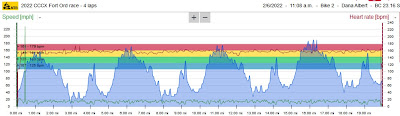
Race stats: 19.9 miles (vs. 22.4 last time); 1,987 feet of vertical gain (vs. 2,362 last time); 13.6 mph average speed (vs. 13.3 last time); 156 bpm average heart rate (vs. 153 last time); 174 bpm max heart rate (vs. 164 last time); 0:07:40 at redline (vs. 0:00:27 last time). Conclusion: I was 2% faster than two years ago, and averaged a 2% harder effort, with a 6% higher peak effort, despite being two years older. This reverses a three-year trend of slowing down every year. Before this race I had almost given up on myself, so to achieve this (albeit modest) redemption has me chuffed to bits. (Note: if you’re thinking of attributing my higher average speed to the flatter course, you have a point … but I actually do better on the hillier courses. As mentioned in my limerick, fast, technical courses like this one favor the bold and skilled, whereas hillier courses give me a chance to take back ground.)

Pre-race dinner: The bar at Los Laureles Lodge in Carmel Valley

As you’ll surely recall from my 2020 report, last time I did CCCX I carbo-loaded the night before with a delicious pasta with cream and steak tips, so you can imagine my excitement to see a similar item, creamy steak fettuccine, on the Los Laureles menu. But the price was $37! There’s no way I can do that. To be honest, I know my way around homemade pasta, not to mention a real cream sauce, so for $37 I’d have to be blown away. I couldn’t take the risk, being The World’s Cheapest Man. So I went for the $18 loaded burger (swiss, griddled onions, bacon, avocado, etc.), which was roughly the size of a cantaloupe. I had to unhinge my jaw to take a bite of that bad boy. I felt like my friendly neighborhood squirrel must feel when he eats the face off our Jack-O-Lanterns. It was a good burger, too … it was cooked rare (pretty red inside) and was really greasy, so the grease was just oozing out all over my fries (more on those in a minute). This wasn’t that gross kind of grease you’d get at an inferior restaurant, where the fry king has to occasionally skim off the skin that forms on top and/or fish out the cigarette butts. This was, like, high-end organic fair-trade grease, that had an innocence about it, almost like broth. The bun was just coming completely apart because how could it stand up to the sheer mass, and juiciness, of that burger?

Now, about those fries. They were freaking good, like they had some kind of special second-starch coating so they fried up crispier than just a strip of potato. (I know I’m not describing this very well, but what am I, a restaurant critic?) They were just great—and the portion was crazily, grotesquely, irresponsibly huge. There is only one person in existence with a high enough caloric need to justify such a huge portion, and it’s a lucky thing that person happened to be me.

Was there bread, a salad, an appetizer, a drink, or dessert? Hell no. What would be the point?

Breakfast: in the team tent at the race. I had a firm banana and an onion bagel. It’s funny: I’ve been more careful about my diet lately, so when I saw the bagel this voice in my head scolded, “Bagels have like five times the calories of a slice of bread—nobody should eat them!” How strange. Then this other voice said, “You know damn well you can’t get a real bagel outside of NYC.” That wasn’t as unexpected, because I recognized it as being my own voice. I really have no idea whose voice the first one was (and in fact a bagel has only three times the calories of a slice of bread). But the bagels weren’t from a grocery store—a team parent had taken some trouble to find fresh ones, and they looked good. So I told both voices to piss off, and slathered that bagel with cream cheese and wolfed it, chased by black coffee. And I’d do it again. Take that, diet plan! I’m back!

During race: four bottles, each two-thirds full, of fruit punch flavor Gatorade, mixed strong. The bottle I drank on the first lap was just for the sweetness, which improves performance irrespective of calories (as explained here). The second and third bottles were to fuel me, obviously. The fourth was just because it tasted good and I wanted whatever psychological comfort it could provide, and because our recently revived team had some fresh blood in the feed zone who could use the bottle hand-up practice. Speaking of blood, the drink was dribbling all down my chin, and one of our kids commented after the race that I looked like a vampire. “That’s because I fill my bottles with the blood of my rivals!” I declared. He then accused my rivals of doping, and thus me as well, by extension. These modern kids … so cynical!

Glycogen window treat: in the team tent. There were various sugary treats available to aid in my recovery, but some part of me was just too elitist to partake … I really miss the oatmeal cookies that I had in 2020, baked by the (then) team co-manager, E—. Her son L— graduated and they moved away, so she’s no longer co-manager. But L— has returned as a coach and was at the race … so why weren’t there cookies? He probably stole them, in which case all I can say is: well played! I’d have stolen them myself. Anyway, there was chocolate milk which I got excited about for a moment, but it was lactose-free and though I have no problem with lactose-free, I also have no problem with lactose so I figured I better leave most of it for whatever Cougar(s) can’t handle lactose. Besides, what did I need to recover for? My work is done for another year!

Lunch (post-race): in the team tent. Our team’s co-manager of 2020, F—, isn’t around anymore either, which, from a barbecue standpoint, is kind of like the Edmonton Oilers losing Wayne Gretzky. But some new parent was doing a yeoman’s job grilling up sausages and burgers. I had a sausage that was delicious but the entire time I was eating it (about ten seconds) I was keenly wishing there was sweet pickle relish for it. I’ve never in my life been as preoccupied with the absence of a condiment. Don’t get me wrong, I was very glad for the sausage, but that relish became an obsession. Maybe I’ll bring relish to the next race, even though I’ll only be coaching.

Dinner (post-race): back home. My wife made some innovative three-bean chili with pumpkin in it, I’m guessing for the high iron content. (Yes, I know it’s only the pumpkin seeds that are high in iron, but who actually eats those? Perhaps the proximity of the pumpkin flesh to the seeds works like a homeopathic remedy.) She also made, from scratch, macaroni & cheese. I washed it all down with a long overdue beer.

Post-race Beck’st

Here is the “Hardware Beck’st” I sent to my pals just before dinner. (I know I said a second ago that I washed dinner down with the beer. I didn’t. That’s just an expression, a nice idea. I drank the beer first … it’s best that way.)
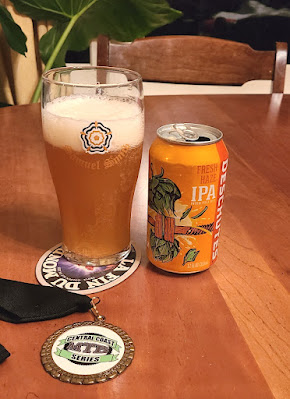

(If you don’t know what a Beck’st is, get thee to a brewery! Or better yet, click here.)

Full report

I’m of the school that says your race number is always an omen. This year I got 101: how cool! It represented how I was about to get totally schooled in the race, and also how terrifying bike racing is (cf. Orwell’s “Room 101”).

I had a strange problem during my warm-up on the stationary trainer: I was listening to my workout megamix and my Bluetooth earbuds somehow got out of phase. The music in my left ear was a fraction of a second out of sync with the music in my right. The effect was extremely jarring for complicated cognitive reasons, and in fact made me almost nauseous. Meanwhile, pondering inconsistent Bluetooth latency isn’t conducive to a focused warm-up. Fortunately, being absurdly well-organized, I’d brought backup headphones and was able to proceed.

Due to some problem out on the course, they kept us sitting on the start line for at least twenty minutes. We passed the time with bike tech-talk, so you can be glad you weren’t there. I had a slow leak in my tubeless rear tire, and hadn’t gotten around to reinflating it, so instead of confidently saying, “I’m running 23 psi in the rear for the sandy conditions,” I could only describe the tire’s firmness as “al dente.” One of my student-athletes, meanwhile, was running his tires “pillow-soft.” By the time the ref rang the bell to start the race, I was no longer warmed up. Alas.

The course starts on a slight uphill, and is a wide, straight road for about a quarter mile before you turn onto the single track, so there’s no excuse for not hitting that dirt near the front (except of course being slow). I started the single track in second place. Before long my teammate M—, a fellow Albany High coach, passed me and took the lead, which was fine with me. I wasn’t feeling so hot. My legs were oddly okay, but my throat was burning and I could taste blood. My breathing was way harder than it should have been for my (albeit elevated) heart rate, and I was feeling stressed, frustrated, anxious, and agitated. In short (I suddenly realized), I had COVID! Exercise-induced COVID! Is that a thing? But I kept at it, and decided that having a burning, raspy, blood-flavored throat could become part of my new normal, like everything else. So I relaxed a bit mentally (but not physically!) and just settled into the burn.

Just a couple minutes later, on a descent, the guy ahead of me suddenly slammed on his brakes. I was like “What are you doing!?” and he said, “We missed a turn!” Dang it! By the time we got back on course, I had no idea how many guys were ahead of me.

Oh my god, I am so sorry … this is so freakin’ boring. Suffice to say, I somehow found the motivation to hammer much harder than last time for the entire race. At least some of the credit goes to my younger daughter, who—though she’d never shown much interest in my cycling before—surprised me, when I left for Fort Ord, by wishing me luck and saying, “Dig deep!” (It’s not that she’s not into sports, being a wrestler who describes herself as “secure in my masculinity.”) So I did dig deep, and it worked. By the end, I was totally satisfied with my race despite having no real idea how I’d placed. I’d given it everything I had, hadn’t miscalculated my pacing, and was perfectly empty by the end. And, as I mentioned before—and will probably mention again, until everyone is sick of hearing about it—I managed to snag a spot on the podium … which distinction I’m not sure I’ll ever achieve again.


All the guys on our podium (this being the Category 2, 45-54 group) are high school coaches. The guy on the second step is my Albany teammate, who breaks my legs twice a week. Look at the dude who got fourth … why are his legs so filthy? Did he find some puddle on the course and try to cool off?

Epilogue

No, of course I didn’t really have COVID. And no, exercise-induced COVID isn’t a thing. I confess I just worked that in to seem more timely, and to help this post perform better in search. Say, that reminds me: iPhone Samsung Galaxy Android Tesla Silicon Valley Oscars Billie Eilish Leonardo Dicaprio Emma Watson Ethereum Fortnite.

—~—~—~—~—~—~—~—~—
Email me here. For a complete index of albertnet posts, click here.

Monday, February 7, 2022

Never Discuss Politics

Introduction

The frank discussion of politics among a governed people is absolutely crucial to preserving democracy.

Bullshit. I didn’t mean a word of that … I think it’s a grand sentiment but essentially untrue. In this post I explain why nobody should discuss politics with friends, family, or other lay people.


Why do people talk about politics?

I’d guess most people who talk about politics are doing so for one of two reasons. The first reason is a simple one: to showcase their deep knowledge to others, so as to gain admiration and respect. These are, I believe, the people who advance positions their audience shares—that is, they pontificate to those who already agree with them. Sure, you might say they’re looking for a real dialogue so they can learn more and have a deeper understanding, but I doubt it. Public policy just isn’t that interesting.

A second group comprises highly opinionated people who seem to want to rile others up, and be contrarian, and dramatic, and surprising. I suppose the goal in this case is also to increase one’s influence or stature (though more through bullying than persuasion). Perhaps some of these instigators simply find this kind of discord stimulating. I can only guess.

Recently I’m getting to understand why the outcomes of polarized political dialogue are so overwhelmingly bad. Simply put, when people challenge others about politics, they tend to break all the rules of effective communication. I took a Rhetoric class in college and we studied the three main tools for advancing an argument: logos (logic); ethos (authority); and pathos (feeling). As I shall explain, discussions of politics often fall down on all three legs.

The logos (logic) problem

In courses I’ve taken on management and leadership, the most interesting thing I’ve learned is how brain chemistry affects human behavior as we react to conflict. Managers are discouraged from criticizing employees, especially in a brusque fashion. The reason, we’re advised, is that humans evolved to constantly be on the lookout for threats, and “several domains of social experience draw upon the same brain networks to maximize reward and minimize threat as the brain networks use for primary survival needs” (as explained here). Thus, we have a limbic system (i.e., lizard brain) response to being challenged, a fight-or-flight reaction, which interferes with our ability to reason: when we’re challenged like this, the “resources available for overall executive functions in the prefrontal cortex decrease.” Studies have shown that criticizing an employee lowers his or her productivity for a significant period, and that’s one reason companies want to discourage it.

Talking about politics is similar in the sense of challenging someone in a negative way. By asserting something you know a person doesn’t agree with, especially if you’re emphatic about it, you’re essentially attacking him. You can’t expect a person to react calmly and rationally to that. It is pointless to put someone on the spot and expect him to suddenly reconsider his long-held opinions or values.

My political positions are decades old, built upon a fairly basic and predictable foundation, and I am not up for debating them. If my beliefs change at all it is due to the gradual influence of a collection of professional journalistic sources that I trust, not any individual person trying to ram ideas down my throat. I am perfectly capable of evaluating a good article in terms of its rational merit—when nobody is up in my face. That’s a lot different, though, from easily engaging when somebody is sputtering doctrine. Then I would rather just roll over and disengage. This isn’t because I’m lame. It’s because I’m human and my brain chemistry is subject to the same limbic override as everyone else’s.

The ethos (authority) problem

Okay, so where challenging political discussions are concerned, rational thought is vanquished. But the problem gets worse. Much of the time, the person who wants to discuss politics has very strong opinions. These can eventually become part of a person’s self-identity, to where pursuing a political credo can become kind of a hobby. The person may seek out openly biased blogs, radio shows, or podcasts or whatever, having decided that mainstream news is “fake” in the sense of slyly pretending to be non-partisan. The problem with these non-mainstream media is that they target, select, and nurture those loyal readers, viewers, and/or listeners whose natural skepticism can be made to decrease over time until it all but vanishes. The student pundits, having decided they’ve found the only trustworthy authorities, practically decide in advance to believe whatever they’re told by these sources.

This in turn changes their media consumption experience such that they’re not looking to actually tease apart complexity and appreciate nuance … they’re just looking for the punch lines, the basic talking points, the gist. This further undermines the role logic could have played in conveying their messages—that is, because these people weren’t themselves convinced through reason, reason doesn’t form the foundation of their arguments. Thus, when they set out to challenge those who don’t share their beliefs, they subconsciously encounter an obstacle: they themselves accepted their doctrine based on the (presumed) authority of their favored pundit, but the person they’re talking to won’t acknowledge this authority. A liberal blathering to a conservative won’t get anywhere saying, “According to this thing I heard on NPR,” any more than a conservative blathering to a liberal could gain traction by quoting Fox News. And yet, ethos is the basis of the arguer’s position, so they can’t just abandon it. So they cite sources very vaguely, talking about “top scientists” or “the guys who really get it,” or simply “the experts.” Of course, citing an unnamed authority is rhetorically useless.

The pathos problem

So when logos is obliterated and ethos falls down, what does the political crusader do? Well, for one thing, he or she gets frustrated, and thus his or her temper heats up. Meanwhile, stirred up humans have the tendency to use volume, emphasis, and repetition to get their points across, particularly when this is the literary or oratorical style their highly opinionated sources are constantly modeling. This style of persuasion can occasionally be powerful, like in the hands of a master orator (think MLK). But this only works when the audience already agrees with the speaker. Pathos (and its cousin, the one-sided argument) is useful when you’re trying to whip a crowd into a lather, to galvanize them into action, but it’s not very helpful when you’re trying to change somebody’s mind about something.

Meanwhile, most people simply aren’t master orators, and their pathos is a blunt, ineffective tool. Too much of the time such talk comes across as harsh, unwelcome braying. The listener feels attacked and may wonder where this aggression is even coming from. This of course compounds the lizard brain response: the unwelcome pathos obliterates our ability to rationally weigh our opponent’s words.

The result

What does this scenario feel like for me? It’s a sense of horror at the conversational morass I’ve suddenly stepped in, and dread at how long I might be stuck there. And this scenario isn’t limited to traditional party politics. Due to the bizarre politicalization of the COVID-19 pandemic, most discussion of vaccination, masking, and other realms of public health policy becomes as annoying and unwelcome as an election year partisan diatribe.

You might reasonably wonder why I’m blogging about this instead of just telling certain people to bug off when they try to involve me in a political discussion. After all, most of my readers will never have the opportunity to talk to me about politics (or anything else). The reason is, I want everybody possible to understand how this kind of talk can damage their relationships with friends and/or family.

How? Well, I’ve already mentioned how frustrating and pointless it is to argue about this crap with someone whose prefrontal cortex has been temporarily crippled (i.e., anyone who doesn’t agree with you). Either this person takes the bait and gets into an acrimonious debate with you, or they sort of go limp, and make little noises like “hmmm,” and “oh,” or whatever, hoping they can minimize the duration of the dialogue and somehow guide the conversation back to safe ground. Out of tact, they sort of humor the antagonist. This might be the saddest scenario of all, because having to humor someone is the opposite of enjoying and preserving closeness.

What makes our friends our friends, and what determines whether we’re close to this or that family member? It’s rapport. This is why close friends and family have great conversations: they get each other and there is a huge reservoir of goodwill built up. Trust tends to grow as well, which is what makes our friends and family so valuable when we do reach out for help or advice.

This foundation of goodwill can see a relationship through difficult times, which is a godsend, because sometimes it’s appropriate to challenge those close to us. For example, if I were to worry that a good friend of mine were drinking too much, I might take it as my responsibility to try to intervene somehow. Of course I would have to proceed carefully, knowing that this would be a very delicate matter. It might take all the built-up trust and rapport we have for the friendship to withstand such an intervention, but I would have reason to hope that friend would respect my intentions (perhaps upon reflection, when the grip of his amygdala had relaxed). But why burn up rapport frivolously, just wasting it, by throwing a political harangue in someone’s face? If you have fifty topics you could bring up to your friend or family member—most of which celebrate what the two of you have in common—why on earth would you choose politics, a topic that is either boring or divisive?

Why even indulge strong opinions?

This brings me to my final point, which is that I cannot see why anyone should be immersing him/herself in highly opinionated political news to begin with. What is the point? What actions would any of us ever take based on all this information? I suppose there’s some attraction in the idea that once you’re versed in these ideas you can share them with others, and thus bring those people out of darkness … but as I’ve tried to make clear, I think the chances of this playing out successfully are pretty remote.

There’s this widespread idea that to be good citizens we need to be well informed. Well, perhaps that’s true, but there’s probably a such thing as being too informed, and there’s certainly a such thing as being too polarized, and too stirred up, and too influenced—or harassed—by those with an axe to grind. I saw this bumper sticker that said, “IF YOU’RE NOT ANGRY, YOU’RE NOT PAYING ATTENTION!” I hate that. It’s ungrateful. It’s suggesting that the person lucky enough to live in a rich country and own a car and have the right to free speech is a bad citizen if he doesn’t go around in a constant state of anger. I think if the bumper sticker has to exist, it should say, “IF YOU ARE ANGRY, YOU’RE NOT PAYING ATTENTION!” That is, if you’re angry in some general way, you’re not grateful for how good we really have it. Think of the asshole responsible for this graffiti:


Too much news

How much news is enough? Well, I think we should be sufficiently aware of the goings on in the world to be able to react when necessary. This means using less water during a drought, not traveling during a blizzard, and having enough information to participate in democracy every two years. It means satisfying our curiosity about things. I don’t think news should be a hobby, and it shouldn’t be a way to become a mouthpiece. If somebody wants the news, I let him get it himself. I don’t rebroadcast anything unless I’m recommending an article to somebody because I think he’ll appreciate and enjoy it.

I really believe that too much news, and the wrong kind of news (i.e., that which is infused with opinion and especially that which is soaked in vitriol) is bad for one’s health. When we are made aware of a terrible situation (e.g., the end of democracy, the world being doomed, the bad guys winning), and we have no means to change the situation, we feel helpless and hopeless. This is no way to live.

The Seven Habits of Highly Effective People differentiates between our “circle of influence” vs. our “circle of concern.”  Below is their schematic. The idea is that we should spend most of our mental energy on what we can influence; for example, the rapport we have with others. We should avoid spending too much energy on the circle of concern, because that’s where we’re largely helpless.


It’s possible to expand one’s circle of influence slightly, but that’s a lot of work. I mean, honestly, if you hate this or that politician, what can you really do about it, beyond the one vote you can cast against him? And when you wield that one vote, couldn’t you have decided on it without spending umpteen hours fanning the flames of your discontent? And what good is complaining about this stuff to family and friends? What do we expect them to do about it? Drop everything and join a campaign? (This isn’t a bad idea, of course, but if your friend were to decide to commit to this, it surely wouldn’t be because of anything you said.) So why immerse ourselves in this crap? There’s no good reason. Ignore the highly opinionated columnists, radio hosts, and podcasters. Don’t let them have their way with you.

I don’t read much news, and to the extent that my favorite magazine has become more political in the last couple of decades, I spend less time with it—not because I disagree with its writers’ views, but because I just don’t care. There is a world of better reading out there: novels, short stories, memoirs, general interest nonfiction, humor writing, all kinds of good stuff. It does not make me an irresponsible citizen to read all that instead of the news. It makes me a happier, more interesting person, and it mitigates the stress in my life. And when I talk to somebody, I want more of the same: curiosity, fascination, wonder, humor. I don’t want discord, and I don’t want to have to humor anybody.

—~—~—~—~—~—~—~—~—
Email me here. For a complete index of albertnet posts, click here.

Monday, January 31, 2022

The Pros & Cons of Co-Sleeping

vlog

I’m told by an expert blogger that most readers are scared off by large amounts of text (even if these people read thousands of words per day on Twitter). Meanwhile, I refuse to partake in illiteracy-shaming by providing only a written version of albertnet. Thus, I’m offering this post as a vlog, and as a podcast (click Play and don’t look). The full text follows the video.

Introduction

Co-sleeping is a very controversial practice: you either swear by it or utterly denounce it. The chances of constructive dialogue between people on opposing sides of this issue are negligible. Here I examine both perspectives to help you make an informed choice.

The benefits of co-sleeping

It’s pretty obvious why co-sleeping seems desirable: there’s no putting-to-bed ritual required, which simplifies the bedtime routine. Even more obviously, there’s the intimacy and bonding that are so crucial—and so sweet! “There is an instinctive desire to be close to your babyface,” says Sunita Gupta, a pediatric RN in Austin, Texas, in this article. “Working people who don’t get this closeness throughout the day often look to bedtime to achieve it.”

This is the easy side of the equation, of course. So why are so many people dead-set against this fairly intuitive practice?

The downsides of co-sleeping

Consider this scenario: you’ve fallen asleep reading in bed, and as you roll over on your side and turn out the lamp, you’re aware of this warm presence right up against your belly, all snuggled up. How wonderful! Perhaps you even sigh contentedly as you drift off to sleep … and all is well until the wee hours, perhaps 2:00 or 3:00 a.m., when you realize something is wrong. You feel this strange pricking sensation against your fingertips. Not quite awake, you move your hand—but then you feel that pricking feeling again. And again. It’s like a very faint electrical shock. And then there’s this warm breath in your face, and you realize your little darling is wide awake. And bored. And biting you.

No, she’s not trying to hurt you … just to wake you up. She seems to think it’s feeding time. And here’s where things get really messy: in the next few moments, your every move is crucial—your good night’s sleep hangs in the balance.

Perhaps your best hope is to the grab the little rascal very quickly so you can relocate her—because no way is she going back to sleep. But you’re delusional if you think this is going to be easy. After all, you’re half-asleep and she’s wide awake, not to mention possessed of lightning-fast reflexes. If that first attempt at a bear-hug fails, you won’t get a second one. And let’s face it, your chances of catching her the first time are minimal to begin with. She’s going to squirt out of your arms in a flash, like you stomped on an uncapped tube of toothpaste, and then she’s leaping from the bed and off and running.

Sure, at this point you could do nothing and just try to go back to sleep … but this is nonsense. You know she’ll be back, poking and prodding you, jumping on your stomach, and running all around the bed. There’s nothing to be done but to run after her—and good luck with that. As you chase her around the house, you’re stumbling and bumping into things, but she’s not—cats have six times better night vision than humans, and at a full sprint can reach 30 mph.

Ideally, you could chase her into another room and then leave, closing the door behind you … but how many cats would fall for that? They’re crafty little beasts—and if you’re devoted to the practice of co-sleeping, you’ve inadvertently left them all kinds of escape routes. The conventional wisdom says that if you simply feed your furry feline, she’ll be satisfied and will come back to bed. This is kind of true, in the sense that she will come back—but she’s not coming back to sleep. She’s bored. She wants to play. Cats never sleep through the night—hence the term “catnap.” Your night is ruined, unless wiggling a piece of yarn for five minutes while your cat gets ready to attack it sounds like fun. Congratulations: you’ve just learned the hard way why so many warn against co-sleeping.

A way forward?

“Okay,” you might be saying, “If co-sleeping is so fraught, do you have a better idea?!” Or maybe you’re saying, “Isn’t this the epitome of a ‘first-world problem’?” Or you’re wondering, “What is this blog and how did I get here?” Well, I’ll concede that decrying one bedtime formula without suggesting another isn’t very helpful. So I’ll do my best.

Note that the longer you’ve been co-sleeping, the harder this is going to be. I’m not saying your cat will have developed a “crutch” or anything, in terms of needing to co-sleep, because it’s established fact that cats barely need humans at all, other than as providers of food and shelter. But they do develop habits, which can make it difficult to end the co-sleeping cycle. When one night your cat finds your bedroom door closed, she’ll just sit there and meow. Don’t bother trying to outlast her—a cat cannot be Ferberized. Cats have evolved to be almost infinitely patient, because patience is useful when ambushing prey. Of course they don’t sound patient, the way they meow almost continuously—but rest assured, they can go on forever. You might as well try to outlast a dripping faucet.

But habits can be changed. Chances are, there’s a way to strand your little kitty in a part of the house where her cries can’t be heard from the bedroom. I know this sounds cruel, but bear in mind this animal would happily eat your eyeballs if you died in your home and could no longer feed her. It’s a dog-eat-dog world. (Okay, perhaps not the best metaphor.)

To be clear, sequestering your cat is probably less Machiavellian than Ferberizing a human, because unlike a human baby whose need for you is existential, and whose developing brain cannot reconcile this sense of abandonment, cats are very straightforward thinkers. For them, this is simply operant conditioning. If meowing at the kitchen door doesn’t produce results, they will eventually shrug it off, like if their cat door stopping swinging one day. It’s no more troublesome to them than it would be for you if the guest WiFi password stopped working at your favorite café, and the barista told you guest WiFi was only available on weekdays. (And good on her, frankly … but I digress.)

But what about your needs as a pet owner (or to be more “woke” about it, as the human guardian of a companion animal)? Honestly, this snuggle time probably means more to you than to your cat. Cats are loners, after all, which is why you can leave them home alone all day without them howling miserably throughout your absence like an abandoned pack animal (e.g., dog).

The solution, I think, is to get lap time with kitty during the day, perhaps after dinner (by which I mean her dinner), when you’re reading a book or watching a video. To many guardians, this seems like a recipe for rejection: here you are, reclined in your La-Z-Boy, blanket across your lap, book in your hand, clearly not going anywhere, but the cat simply doesn’t show up. Happily, this is easy to solve: just turn down your thermostat. You might be wearing the coziest cashmere sweater in the world, but if there’s deliciously warm air gushing out of a heater vent, the cat’s going to choose that every time. Get yourself a warmer throw blanket (I have a down-filled one), nix the central heat, and you should be in business.

This way, when it’s your bedtime, it’s hers too. Figure out a nice place for her to sleep—the crook of an armchair, a gap between throw pillows on a sofa, sometimes even a cardboard box, if that’s where your little darling likes to sleep—and put her there before you retire. It’s possible she will start to appreciate the ritual and won’t even jump up and try to race you to the door as you leave.

Caveat: ssshhhhh!

Whatever approach you take to co-sleeping, I highly recommend you not talk about it with anybody. And why not? Because if your interlocutor agrees with you, that’s bound to be a pretty boring conversation. And if he doesn’t—well, then you’ve got a pointless argument on your hands and all you’ll do is lose face. This is too emotionally charged an issue to discuss rationally … you might as well talk about politics or religion. This other person’s good night’s sleep is not your problem.

(Am I a hypocrite, then? No. This blog post being a one-way broadcast, I am not putting you on the spot here. Sleep with your cat, or don’t … I don’t need to hear about it. If you found this post useful, great. If you disagree with me, just close your browser, and accept my apologies for wasting your time. And if you don’t even have a cat … well, then, why are you here?!)

—~—~—~—~—~—~—~—~—
Email me here. For a complete index of albertnet posts, click here. 

Monday, January 24, 2022

From the Archives - Bits & Bobs Volume II

Introduction

It’s another slow news day. So, taking a cue from Can’t and Won’t, a collection of very short stories, essays, letters, and recounted dreams from Lydia Davis (click here for details), I’m assembling and posting some excerpts from some old letters to my brothers. (My first set of these is here.) These bits and bobs should be better than actual diary excerpts because at least I wrote them with an audience in mind, so I had incentive to make them good. I’ve provided, for each snippet below, the locale I was writing from.


April 24, 1989 – UC Santa Barbara

I went to see this movie, required for my English class, in one of the lecture halls on campus tonight. I planned to hit Gold’s Gym afterward since it was closed at 6:00 this morning when we rode down there (they said due to “water damage,” whatever that means). Anyhow, the movie’s supposed to be at 7:30, but the bozos can’t figure out how to lower the screen. They spend twenty minutes on that. Then, they can’t figure out how to turn off the lights—another ten minutes down the drain. Then, for twenty more minutes they can’t get any sound for the movie. Meanwhile I’m sitting next to this funny looking guy and this stupid girl with him who’s staring at the ceiling and laughing at everything and reminding me of one of one of the groupies I’d have if I were a rock star. Out of the blue, the guy turns to me and says, “You want gum?” Is it okay to accept gum from strangers? It’s Extra gum so I take the risk. It’s really rubbery, really slippery, good for blowing bubbles. Finally, after forty-five minutes they get the movie going. Halfway through, I blow a bubble a bit too aggressively and the gum goes flying out of my mouth, and you know what? I never found it! I was really slouching, with my feet up on the seat in front of me, so I was sure it landed on my clothes, but it was nowhere to be found. Not on the floor, my clothes, anywhere. Gone. Vanished. Anyhow, the movie was great but needless to say I didn’t have time to lift weights afterward.

I’ve got some new music. First of all, and don’t scream, I’ve been turned on to rap music by Captain John Pelstar. So I’m getting into Kool Moe Dee, Public Enemy, and Ice-T. You can hate me if you want, but once you start listening to this shit it’ll probably grow on you too.

Jesus, what the hell am I doing? I’ve gotta read Huis Clos (aka No Exit) by Sartre, in the original French; memorize about 4.5 billion vocab words for same; and write a 6-8 page paper on a 400-page book! I’ve got a final exam on Friday, on Saturday, on Monday, on Wednesday, and the following Friday! Holy shit!

But wait, there’s one more thing I gotta tell you. I’m spreading a new rumor through the cycling team. The rumor is: we’re being sponsored by Club Tan this season! Unlimited free tanning for everybody on the team! But you didn’t hear it from me! What’s scary is we’re scraping so low now for sponsors that everybody actually believes this. I told Mike B–, who’s on the sponsorship committee, and even he believed it! Now that he knows it’s just a BS rumor, he’s been spreading it around too. By the time the season rolls around, everybody will “know” about it. Shit, I really gotta go.

October 28, 1989 – Isla Vista

So I’m riding with Brett, a really cool guy on the cycling team (aren’t they all) and we’re exiting Highway 101 toward Goleta. The exit is long and uphill, and we’re going really slow because it’s a rest day. We pass this racer type, wearing some fancy Rincon team outfit, and we say hi but she doesn’t even acknowledge our existence. So we keep riding up the hill, and at the top there’s a stop sign where we turn right. I always run it, since there’s never any cars there. In fact, I once ran it right in front of a cop and he didn’t bat an eye. It’s that much of a blow-off. So I’m behind Brett, and oddly enough he actually starts to slow down. So I decide to go around him on the right, and no sooner do I start to pass him than the Rincon girl comes surging up the right side, without warning, almost plowing into me. Stunned, but still unwilling to brake, I decide to go around Brett’s left side instead. As I’m coming around, I look again at the girl, like, “What is she thinkin’?” Then, I hear a noise behind me. I look over my left shoulder and this truck is suddenly bearing down on us. No problem, he has plenty of room, I think. So I look forward again, and to my horror, Brett has slowed down even more and I’m hopelessly hooked on him. I have nowhere to go because of the truck, and my bike seems to have locked into his somehow. My bike gets pulled out from under me, and my butt is falling towards the rear wheel. If my butt were to land on the wheel, it would drag my balls into the brake caliper and drag me along like that, ruining my chances of ever being a father. In the nick of time, I manage to pull my right foot out of the toe-clip and stand up on it, though the bike is still being dragged along, and my left foot is still in its pedal. My left hand is holding onto the top of the handlebar, and I’m sliding on my right foot now, with my right arm swung high like a cowboy on a bucking bronco. To give you a better perspective of how grave the situation is, I should perhaps mention that the right side of the handlebar is dragging on the ground, while my puny left arm is holding the bike up as I watch my brand new Dura-Ace Integrated 8 rear derailleur coming precariously close to hitting the asphalt. I also need to protect my precious Dura-Ace right brake lever so I’m yarding on that handlebar with all my might. I slide like this for some fifteen feet, before Brett’s bike finally lets go of mine and I grind slowly to a stop. Total damage: to body, none. To bike, three inches of torn Benotto tape valued at 95 cents. (I fixed it up with electrical tape; I don’t use that part of the handlebar anyway.) I can’t believe I didn’t go down; indeed, Brett said later he was just waiting for the terrible scraping sound and my blood-curdling scream. So the end result was that disaster was once again narrowly averted, making me more cocky than ever.

October 31, 1990 – Berkeley

The owner of the bike shop has got a really cute kid, like eighteen months old. The wife brings him by daily. He already seems intrigued with the bike parts, and likes to drag a floor pump around the shop with him. He’ll hold the hose up to his face and point the handle towards you, so you pump it and give him a blast of air. This makes him giggle like crazy. Every now and then he’ll wander into the shop area and look up at me and say “Papa?” Today I said, “Can you say Dana?” and he did, the little rascal. Then he took a few swipes at a bottom bracket with a screwdriver, which is about the level of proficiency of most of our mechanics, so I figure he’ll be doing spot repairs within a year and everything else before kindergarten. That’ll be good for the shop, because he’ll be free to work full time unlike us college kids who only do 10 or 12 hours a week.

September 12, 1991 – Berkeley

So I’m biking down Bancroft, a street that borders the campus to the south, and I see this young female student being heckled by a homeless dude in army fatigues. He’s in the street spitting on a car (presumably hers), and she’s across the car on the sidewalk, and in a rage she throws this jar at him. Of course it misses, and hits the ground like a foot from me, sending broken glass flying across my legs. In shocked disbelief I watch as the homeless dude runs around the car at her as if to attack her, but before I can see what happens this car behind me, totally oblivious to the mêlée, starts honking at me and I have to get out of the way. I tell you, this is a weird place.

September 22, 1993 – San Francisco

Planetary Gear is a kinda dumb name for a really cool bike shop. It’s this tiny, cramped place with a giant Simplex clock on the wall, posters of great racers of the past, and old antique bikes everywhere. All kinds of ancient celeste-green Bianchi framesets, these cool Dutch Mary Poppins bikes like Geoff’s probably riding these days, old Gazelles and Allegros and an occasional Basso. It definitely has that old, retro Euro flavor. Not a click shifter or clipless pedal in the place. The owner, Grant, is this youngish looking guy, as Euro as his shop, who coolly dangles a cigarette from his lips and looks at you with a curious, slightly judgmental look, his eyes twinkling boyishly like Mickey Rourke’s, as if he’s deciding whether to laugh at you or take your money or both. He’s an expert at maximizing the flash and panache of a tired old Italian road bike, and selling it for more than it cost when it was new and state-of-the-art. I’ve seen him really rip some people off, but I figure, heck, at least they’re not being ripped off on something lame, like one of those Allsop Softride monstrosities. Besides, he is selling the last vestige of Western Civilization; he should be well compensated for that.

I drop by every so often, but I never actually do any business. For the most part, my bikes are pretty modern. And then when I finally did go in on Saturday to do buy something—I needed a spring for the ancient Mafac cantilever brake on my commuting bike—Grant wasn’t even there. Some other guy was working who didn’t seem too with it. No shirt, no shoes, no service—and I mean the guy, not the shop policy. Anyway, he ignored me for a while, but after I stared at him long enough he finally said, “Yeah.” I asked if they had a Mafac cantilever spring, and I pointed to an old cross bike that, of course, had them. “For this brake right here.”

He smirked. “Yeah, I’ve got that, but I can’t sell it to you.” This seemed to please him and—oddly enough—me as well. “You gotta come in Wednesday or Thursday and talk to Grant about that,” he said.

          “Why,” I said.

          “Well, because … huh. Let me see your bike.”

          “It’s not here. I’ll bring it in Wednesday and show it to Grant.”

          “Yeah. Do that. Cause he’s real picky about where that stuff goes.”

December 11, 1995 – San Francisco

I started my new job today. They took me out to lunch to a really cool place. It was nice, but not exactly posh—very old-fashioned San Francisco-ey. Our booth was solid oak. There was a button on the wall that rang a buzzer to call our waiter. He was an old but spunky fellow with a mouth. Somebody asked if the lemonade was fresh squeezed; he returned with a glass of water and pointed to a bowl of fresh lemon wedges that had been on the table the whole time. “Make it yourself,” he said. Later, when somebody tried to order a chicken dish, he said, “Come back at dinner. We haven’t killed the chicken yet. It would be way underdone.”

Our discussion during lunch ranged from the industry and technology itself—which is sufficiently interesting that even non-dorks can participate—to the tale of a fellow employee who, when skydiving for pleasure, had a parachute failure. The failure, the raconteur explained, was of the “Mae West” variety: the cord somehow got flung up over the parachute, causing it to fail to fill all the way. The name derives from its looking like a bra. It is less drastic than another type of failure called the “candle,” which is almost always fatal. This colleague lived, but was in traction for a while.

September 18, 2008 – Albany/Boulder

Sorry to hear about [your daughter] Lydia’s bike crash. You can tell her the following story to cheer her up. On the day of freshman orientation [back in 1984] at Fairview High [in Boulder, Colorado], I somehow found myself in the position of getting a ride there from D—. But not in a car, of course, but on the rack of his bike. So we were flying down Greenbriar Blvd, where it drops down from Shanahan Ridge, and D—’s Dr. Who scarf was flying out behind him, and he let out a couple of whoops, for sheer joy. Suddenly, the weak part of my brain, the insecure part, the part that fixates about good First Impressions and whatnot, kind of took over, and I worried about what people would think, since I was starting at this new school that none of my junior high classmates were attending, so I had to make all new friends. What would my classmates think if they saw me on the back of D—’s bike? They’d probably think I was his bitch.

I decided I just couldn’t stay on there, on the rack of this bike piloted by Dr. Who. So I bailed off the back. The weak, insecure part of my brain is pretty stupid, of course, and neglected to notice that we were really flying. How fast? Well, it was a steep downhill, so we probably doing like 20 mph, and I’m thinking maybe even more. I mean, it was enough speed to start D— whooping, after all.

So, you can guess the rest. I didn’t exactly hit the ground running, but I sure hit the ground. I did one of those stage slides like heavy metal rockers were doing during that era, where I slid on the tops of my shoes and—more importantly—my knees. Just ripped those kneecaps right open, like you’d taken a planer or a rasp to them or something. (I was wearing shorts, unfortunately.)

So after that I was going around freshman orientation gushing blood from both knees. I considered for a moment that the girls might be impressed by my toughness and my stoicism, but of course they were just grossed out, I mean just totally disgusted. I’m amazed I don’t have scars from it. And of course I had to try to answer to D— when he asked, incredulously, “What did you do that for?”

I really didn’t know what to say. I guess I just shrugged. “Didn’t realize how fast we were going, I guess.” It was odd, though ... I felt somehow as though justice had been served. I felt like I deserved the pain and the public scorn, for thinking I was too cool for my friend.

—~—~—~—~—~—~—~—~—
Email me here. For a complete index of albertnet posts, click here.

Monday, January 17, 2022

COVID-19: Helping Teens Cope

vlog

In case you are suffering a migraine, or your contact lenses are too strong, or you can’t find your reading glasses, or you just plain hate to read, I am offering this post as a vlog. You can even blindfold yourself and pretend it’s a podcast. On the other hand, if you can’t stand the sight of my face and/or are teaching somebody how to read, scroll past the video ... the entire text awaits. Don’t miss the artwork from my daughter Lindsay!

Introduction

Obviously the COVID-19 pandemic is a grind for everyone. It’s tempting to think teenagers have it easier since they’re invincible, invulnerable, and impervious to disease, or at least think they are—but actually, the pandemic could be especially hard on them. Why? It’s because they’re in the very flower of life as opposed to those of us who kind of gave up long ago and are just running out the clock.

If you’re a parent of a teen or young adult, perhaps this post will help you support your child. And if you’re not a parent, but have a taste for schadenfreude, you should read on, too.


The pitfalls of COVID for the young

According to this article, typical teens’ reactions to global crises like the pandemic include feeling “stressed or overwhelmed, frustrated or angry, worried or anxious, restless, agitated, … teary, sad, fatigued or tired,” and they could be “losing interest in usually enjoyable activities or finding it difficult to feel happy.” Unfortunately, these are also totally normal symptoms of being a teenager, so it’s really hard to tell how, or whether, the pandemic is affecting your teen or young adult.

Some problems are undeniable, of course. Outside of the anxiety and stress, there’s the simple matter of not getting to hang out with friends, or doing so with all kinds of restrictions. Resentment can develop when your kids’ friends have cooler, more permissive parents. On top of that, kids are understandably just sick of everything: the online schooling, the distancing, the masking, and the hand washing. Yes, we parents are sick of these things too, but at least we grasp that they’re actually important, since we don’t have delusions of invincibility.

So what is to be done? Articles like this one and this one recommend getting more exercise. This is a fine idea, except that a) it’s so eye-rolling-ly obvious, and b) the likelihood of its adoption is empirically low. According to this article a study has just found that only 1 in 10 teens is getting enough exercise right now, vs. the (already poor) figure of 16 percent who were exercising enough pre-pandemic.

Can parents help? Well, you could start by setting the right example. If you suit up and go running or biking, there’s a chance your kid will notice. Better yet, try taking an online Zumba class with your kid. That should help, I think … though I’ll admit I haven’t tried it. (I just mentioned it because I like the word “Zumba” and am hoping it’ll help this post show up in Google searches.) My wife and I did do an impromptu dance party today, which got our eighteen-year-old giggling quite a bit, while also introducing to her the novelty of actual rock music coming out of actual speakers instead of just earbuds. (I would explore this dance party concept even more, except that my wife made fun of my moves, and my kid gets gobs of exercise anyway.)

Self-care

As pointed out by this website, you should “teach self love,” starting with self-care. Unfortunately, the advice is given only via an infographic so there aren’t actual instructions, but I have a few suggestions. First off, it’s not enough to just advise self-care; you need to practice what you preach. I’m talking about that stupid COVID beard you’ve grown. It doesn’t make you hip, and there’s too much grey in it, and it lowers the effectiveness of your KN95 mask, for crying out loud. Shave it off already. And if you’re a mom, keep your legs shaved and make sure your daughter notices. (Note that leg-shaving can be a highly political matter; if you leave your legs hairy on purpose, point this out, and celebrate it. Tell your daughter, “I want my legs lush, like I’m a coed at UC Santa Cruz. And I always shampoo them when I shower.”)

Self-care isn’t limited to nice things we can do for our bodies; it’s also about the damaging behaviors we should avoid. Remind your teenager not to seek comfort in drugs or alcohol. According to the CDC, “These substances can weaken your body’s ability to fight infections, and increase the risk of certain complications associated with COVID-19.” Beyond that, it’s obviously harder to remember to wear a mask or socially distance when you’re totally tripping or drunk off your gourd.

You should also bear in mind that there’s more to self love than self-care. Self love can include a bit of good old fashioned vanity and/or self absorption. Maybe it’s time to finally give your kid that “DAMN I’M GOOD” bracelet your dad bought back in the ‘70s and passed down to you.

But don’t go overboard with self love! When people are suffering, there’s always the risk they’ll become insufferably self-absorbed. It’s important to try to remind them of the larger world around them and the unique problems others face. Start with the fiscal waste of the pandemic. If your child is in college, bemoan the already egregious cost of their tuition and dorm fees, which are basically being totally wasted. If your kid is in high school, talk about the heinous property taxes you pay to support that school, and how it’s all for naught because so little actual learning is happening. Explain how you’re being robbed blind on these KN95 masks, and how rising inflation, fueled by supply chain problems, could be the next great economic crisis. (In general you should try to work the phrase “supply chain” into conversation whenever possible, because it totally improves your cred.)

How to draw teens out about COVID

Where can teens and young adults go for advice, sympathy, or just someone to vent to? Certainly not their friends, to whom they have to present a brave, stoic front. And their teachers—overwhelmed with technical issues such as remote learning, COVID tests, and contact tracing—clearly don’t have time. Once again, the job falls to us parents, as if we asked for this. So the question becomes, how do we get our kids to open up?

Here’s one way: announce to your kid(s), “Let’s all sit down in the living room. Your father and I are creating for you a safe space to share your feelings while we listen without judgment.” It might take a moment or two before your kids open the floodgates, but as long as you just sit still, with your hands in your lap, gazing at your children with pure love and devotion spread across your face, they’ll launch right in before you can say “mindfulness training.”

Naw, I was just screwin’ with you. Of course that would never work. Let’s turn to the experts for suggestions. Dr. Lisa Damour, a psychologist and school counselor, advises here that you should “make space for relief and joy.” Sounds easier said than done, eh? I for one have no idea how such a thing could be accomplished. But remember, our kids are smarter than we think. Why not put it to them to figure this out? You can say to your son, “Brent … I know this pandemic is hard on you. You’re hurting, I get that. But the thing is: you need to make space for relief and joy.” Then just watch as he tries (or doesn’t even try) to keep a straight face. Smirking, giggling, or outright laughing at you isn’t exactly the same thing as joy, but it’s somewhat close. Obviously this is a short-lived pleasure, just a little burst, so follow it up with another: use the word “quaranteenagers” in a sentence. Then hit him with the one-two punch of “lean in” and “show up.” He’ll be in stitches.

It’s crucial to show your support by communicating with your children on their own terms. It’s tempting to hover over them dropping bits of advice here and there, like shaking bacon-bits on a salad, but remember, lots of modern kids are vegetarians, figuratively speaking. (Okay, that metaphor got kind of screwed up … sorry.) Suffice to say, words are not necessarily what our kids need. Gestures, behaviors, and actions “speak” louder. For example, my younger daughter doesn’t exactly gush when I meet her eye and say, as sympathetically and authentically as possible, “How are you doing?” But recently I bought her a totally sweet camera and she really responded well. I mean, she didn’t talk too much (other than to say thank you, having not been raised in a barn thank you very much), but weeks later, she spontaneously kissed my forehead. (I’ll confess I flubbed the moment, because as she approached I instinctively recoiled, but so long as I remain gainfully employed, I’ll surely have other opportunities like this.)

Managing our own distress

This helpful article reminds us not to snap at our teens, pointing out that “this is good advice at any time, but it’s particularly important right now.” Well, this is a simple enough concept, but what about us parents … aren’t we totally stressed too? What if venting like this is necessary for our own coping?

It’s tempting to ignore this “don’t snap” advice as wildly unpractical, but actually, there is a way forward. If you have a cat, you can berate her as a proxy for your child. “Now Fluffy,” you can say, “you’re an absolute disgrace. I’ve seen you washing, which looks life self-care, but I know where that disgusting tongue has been. And I can smell your cat box from here. Ugh.” Fluffy couldn’t care less (unless you raise your voice, which could startle her). Best of all, you’ll feel terrible after admonishing that innocent creature, so you’ll give her all kinds of love, which makes you both feel better. (Well, okay, maybe it only makes you feel better, but still.)

Note: do not try this with your dog! As tempting as it is to say, “BAD Waldo! You are a VERY BAD DOG!” you simply mustn’t. Dogs are very sensitive. At least, I think they are … I’ve never had a dog. Anyway, if your pet happens to be canine, leave the poor animal alone. Go out and buy one of those Hasbro Ugly Dolls, or even a Yoda action figure or something, and just chew its freaking head off! Tell it how awful it is, how useless, how selfish, how lame. You’ll feel a lot better, and if you don’t, then alternately abuse and comfort the doll, in kind of a lather-rinse-repeat style. Or not. I actually have no idea how/if this would work. Forget I said anything. (Man this pandemic thing is hard!)

Confronting fear

Perhaps the biggest problem for teens isn’t how to wash their hands more effectively, or how to best maintain social distance, or how to tolerate the 0.5-second-long pin-prick of being vaccinated. The real issue is their fear. This kind of global crisis has never before happened in their lifetimes, and none of them ever paid attention in History class during that unit on the Spanish flu pandemic of 1918. (If my teachers even covered that, I sure as hell wasn’t awake.)

So you need to confront this fear thing head-on. Convey to your teenager that it’s okay to be scared. Note that teens don’t want to be preached to, so it’s important to let this sentiment seem like their idea. The best way to do this is reverse-psychology. Say to them, “Oh, are you scared? Can’t handle a little stay-at-home? Totally freaked out just because your little world got shaken up a bit? Oh, is that needle gonna hurt too bad?!” (Stop short of the old “Chicken! Braaawk-brak-brak-braaawk braawk!” bit because they won’t get the reference.) When your kids push back and say, “Hey, Dad, it’s a global pandemic, I have every right to feel afraid!” then you know they’ve become true believers, because this will be coming from them. (Just don’t ruin the moment by pointing out that “global pandemic” is technically redundant.)

The tech dilemma

Remember my comment earlier, about the problems that can arise when your kids’ parents are cooler and more permissive than you? Well, you should be careful when your draconian policies extend to the virtual world, with restrictions on your kids’ Internet use. Some experts, such as the authors of this article, are actually advising parents to lighten up on “tech time” restrictions. And yet, others (like this one) warn that too much social media, and too much COVID news, can really bring your kid down. Here’s one way forward: if your WiFi equipment is sophisticated enough, consider removing the time-of-day restrictions, but implement a DNS blacklist so that the only site your child can reach is albertnet. This blog is like 99% news-free and all the hateful comments are directed at me … so it’s a safe space on the Internet for your teen.

Surely some experts would find my solution extreme, and that’s fine … but why haven’t they addressed the increase in bullying and other insensitive behavior our kids can expect as their so-called friendships go virtual? It’s much harder to be sensitive online than in person … meaning the pandemic will just compound the problem. If you’re lucky, your kid will mention to you the anguish that is gradually building through this ongoing fusillade of small-scale abuse. This is the time to “be there” for your kid, to make sure he knows you’re on his side. Tell him, for example, “Really, Ricky posted that? Well you know what? He’s an asshole.”

What about videogames? I’ve heard they’re a great way to blow off steam. Should parents be worried about violence and other thematic content? Probably not, so long as their kids don’t actually play these games. I know almost nothing about them, but a little bit of research turned up a game called Boyfriend Dungeon, which (according to this Wikipedia article) is “a role-playing game mixed with a dating simulator, in which the potential romantic interests are generally male characters that can turn into weapons that can be used within dungeons,” with “stalking and emotional manipulation of the player-character.” With games like this, who needs a deadly virus?

Now, I’m probably not being totally fair here, since my knowledge of these games isn’t firsthand. A neighbor of mine was going through a divorce some years back, and I asked how his son (aged eight or so) was doing. My neighbor replied, “Oh, he’s got his [World of] Warcraft, he’ll be fine.” I am happy to report that this kid, who’s probably in high school now, hasn’t yet opened fire on anybody. So I suppose you should go ahead and allow gaming to be your child’s pandemic panacea if that seems to be their thing.

What if the pandemic is helping your kid?

Now, is it possible your child is feeling stress or guilt because the pandemic is going just fine, and in fact has its benefits for her? Of course! This article acknowledges that some kids may have “commitments they didn’t want to keep or some people (classmates, teachers, coaches) they didn’t want to see, so this crisis might actually bring some relief,” but assures us this doesn’t need to be seen as a problem, since “it’s also OK to be happy.” The article suggests you tell your kid, “There’s no right or wrong way to feel.” I actually disagree with this (for example, it’s wrong to feel compassion for anti-vaxxers, those fricking savages) but the overall idea is a good one. You can tell your kid, “Look, the reality is, your standard of living has always been higher than that of most of the world’s population; this country was built on slavery and the eradication of the native population; and all your clothing and electronics are made in overseas sweat shops by underpaid children with no benefits. So there’s ample precedent for you to come out just fine while others across the globe are suffering. Why worry about that now? Just be happy that you’re happy!” I’m sure she will feel much better.

Your teen has COVID … now what?

If your teen gets COVID, he or she is bound to feel pretty humiliated, given all the haranguing you did about staying safe, and all the resources available that he or she obviously failed to take advantage of. In this instance you need to take an honest look at how your teen is doing overall vs. yourself. If you’re in an even worse way, then it may be time to go ahead and rub it in, saying, “I told you so!” and “You should have listened!” and maybe even “You’re getting what you deserve!” This will of course be devastating for your child, but it’ll feel so good for you, it’s probably worth it. On the other hand, if your kid has been suffering even more than you, then his or her feelings come first and you need to do whatever is necessary to prevent guilt or shame from surfacing. “Whatever is necessary” basically means saying, with utter sincerity, “Hey, don’t feel bad—it happens to the best of us.” Now, “sincerity” in this case means you speak from experience. That’s right, it’s time to go get COVID. Head down to an indoor megachurch service, replete with a full choir, preferably in Houston, and don’t you dare wear a mask!

But seriously…

Okay, I had a little fun here, but you might be thinking, “Hey, this is no laughing matter.” I would politely disagree—to me, almost everything is a laughing matter—but I will concede that we should take this issue seriously. Perhaps this post at least has you thinking about how the pandemic affects your teen, and if nothing else I’ve linked to ten perfectly sincere and potentially helpful articles.

More reading on the pandemic

—~—~—~—~—~—~—~—~—
Email me here. For a complete index of albertnet posts, click here.

Saturday, January 8, 2022

The DUMB Approach to New Year’s Resolutions

Introduction

Well, it’s that time of year again, when people start sentences with “it’s that time of year again.” What’s worse, it’s the time for countless articles about New Year’s Resolutions, and why people fail at them, and how to finally get them right. As you can see, I’m just adding to the problem—but this post is different because I’m right, whereas all those other articles are wrong. So keep reading!


Why not SMART resolutions?

One of the most hackneyed mnemonics for setting the right resolutions is taken from preexisting theory about goal-setting (another quagmire of behavioral theory). We’re told to make our resolutions SMART: that is, specific, measurable, achievable, relevant, and time-bound. Even the New York Times published a New Year’s Resolution article on that theme, here. Now, to be fair, that article does go into some other stuff that is useful, like breaking bad habits down into cues, routines, rewards, and alternatives (for example, if the cue is you’re tired, and the routine is you light a cigarette, and the reward is you feel stimulated, the proposed change in behavior is, “Instead of smoking a cigarette, replace the stimulus with something else, like cocaine”). But all the stuff about SMART is so tired (the NYT cited it in another article here, for example), and it’s empirically ineffective. People have been touting SMART goals since 1981 and yet it’s still just this hypothetical notion of what behavioral framework people should adapt to. If it were that great an idea, its actual practice would be commonplace.

(Note: my fact-checker has just alerted me to a typo in the preceding paragraph. The NYT did not in fact recommend cocaine as a nicotine alternative. They recommended coffee. But it’s too late to go back and fix my error now. Also, my fact-checker has just pointed out that “hackneyed mnemonics” would be a good name for a rock band. Fair enough, but this guy is starting to bug me.)

So, where was I? Oh yeah: it’s bad enough how old and tired SMART is, but actually, I think most New Year’s Resolutions fail because they’re SMART. So I’m going to teach you how to succeed by making DUMB Resolutions.

DUMB? Am I kidding? No, for once I’m not. I believe the best New Year’s Resolutions are duplicate, unimpressive, mealy-mouthed, and best-effort. I shall explain.

Duplicate

This article in Forbes declares that the #1 “really bad” New Year’s Resolution is something you’ve failed at before. The writer snarks, “If you haven’t been able to keep a resolution before, what makes you think that things will be different this year?” To me, this is just defeatist thinking. Is that how life works—if you ever fail at something, you should just give up? I’m reminded of Homer Simpson’s advice to Bart (which I’ve repeated, albeit ironically, many times to my children), “If something’s hard to do, then it’s not worth doing.”

This “fail fast” notion is specifically refuted in another article, in the New York Times, which points out that many Resolutions fail because the new behaviors are difficult and have to be worked up to gradually. The writer advises, “No marathon runner ever steps up to the start line in a big race without putting in the training miles. He or she has been practicing for months, if not years. You should do the same with your New Year’s resolutions.” He recommends starting on your Resolutions in December, so that even if you stumble at first and your Resolution feels futile, January hasn’t even started yet so you won’t get discouraged.

Great point, but why limit yourself to starting a month in advance? If you spent the first three months of last year trying to implement a lifestyle change but abandoned it, you surely learned a lot in that time and there’s no harm making adjustments and trying again. I doubt many smokers have kicked the habit on their first try, but many have indeed kicked their habit eventually.

(Note: my fact-checker has just asserted that “duplicate” might not be exactly the right “D” word here, because a recycled-but-tweaked Resolution isn’t in fact an exact replica. He suggests the D should be for “derivative,” and though he has a point, you may be pleased to learn that I just whacked him and told him to shut up.)

Unimpressive

That’s right, I’m actually going to explain why impressive Resolutions are more likely to fail. Why? Well, the question to ask yourself is, why am I even doing this? If your goal is to be able to tout something, that Resolution will probably only last as long as the annual chatter about Resolutions. I read some article ages ago (and I tried to have my fact-checker go chase it down, but he’s not talking to me) which was really interesting: it asserted that boasting in advance can actually lower your chances of achieving something, if the approval of your peers is the main point. Why? It’s because, having enjoyed the accolades already, the person no longer has much motivation to actually do the thing.

I have seen this play out. I worked with a guy over twenty years ago who was, it must be said, kind of a douche. For example, he once called in sick so he could go skiing, instead of just using his vacation time like an honest person, and was found out because when he left his “cough-cough gosh I’m feeling too sick to come in today cough-cough” voicemail for his boss, he was calling from the ski lodge and accidently put the call on hold instead of hanging up, and instead of hold music they had a running ad for the various amenities of the resort. His boss played the voicemail for all of us in the lunchroom, following which another colleague called the guy’s cell phone and left a voicemail of his own: “Enjoy the slopes, dude!” with all of us laughing in the background. (No, that has nothing to do with bragging-in-advance; it’s just to convey this guy’s douchiness.)

So anyway, that spring the douche announced to the whole office that he was going to run some local marathon on such-and-such a date. Seems like a SMART goal, right? And then for the next two or three months I had to endure all his updates about how the training was going, etc., and everyone was really interested and supportive and impressed, which got old since the guy was such a douche. Finally, the day of the marathon came and went but I didn’t hear any updates. So I asked him about it and he said, “Oh, I didn’t end up running it. I got sick.” Where had I heard that before?

An unimpressive Resolution won’t lead you into this scenario, and besides, self-improvement should be private anyway, and its benefits should be their own reward, rather than anything you’d tout. For example, I could resolve to bore people less. You could never try to impress people by sharing this Resolution with them (i.e., admitting something lame about yourself), and isn’t that kind of the point? Instead, if I’m successful with this, people might gradually decide, “You know, I always thought that Dana guy was kind of a tool, I mean just totally boring, always blathering about stupid stuff like farting, or the spelling of “kindergartner,” or his frickin’ colonoscopy or whatever, but lately I find him a lot less annoying somehow … maybe he’s okay.”

Mealy-mouthed

Yes, I sincerely contend that your Resolutions should be mealy-mouthed—that is, I refute the idea that Resolutions should be specific and measurable. Consider this: the NYT article says, “If, for example, you want to stop biting your nails, take pictures of your nails over time so you can track your progress in how those nails grow back out.” Doesn’t this seem like exactly the kind of fussy and annoying task that would cause somebody to abandon this Resolution? You’d have to be really organized to achieve this, and I speak from experience. Last year I went to a dermatologist to have some moles looked at. She said they looked fine but need to be monitored to make sure they don’t change, so she took some photos of them as a benchmark and scheduled a follow-up exam six months out. Just because I’m a very thorough person, I asked her to snap photos with my phone as well, which she seemed slightly annoyed by, but nevertheless did. Well, I went in for my follow-up and she breezily confessed she’d lost the original photos. And this is a medical doctor! Who does this for a living! And melanoma is a matter of life and death! It’s a good thing I’m so organized I had my own photos with me for the follow-up … but of course this is a very rare thing (and I can see why you hate me for it). It’s just not practical to add a lot of extra accounting bullshit to a behavior change that’s already hard to make.

But even if measuring your progress isn’t hard to do, it’s a bad idea. Why? Well, for one thing, when your goals are specific and data-driven, that makes it easier to decide you’ve failed, when in fact you may have made some progress. For example, let’s say you’ve resolved to lose five pounds by February, and so you’ve cut out dessert, and cream in your coffee, and are eating out less, and meanwhile you’ve really increased your exercise. Then you step on the scale on February 1 and you’ve only lost three pounds. Despondent, you cry out, “It’s hopeless! Eating right and exercising don’t work!” and then you chalk up another failure, feel bad about yourself, and go back to your previous habits. And yet what if you’d actually (but unknowingly) lost five pounds of fat and added two pounds of muscle, thus improving your lean-to-fat ratio, which is more important than weight anyway? You just let specificity and measurability ruin a perfectly good health improvement trajectory!

That’s why mealy-mouthed goals are better. For example, you could resolve to eat more fruit—and gauge your performance via something vague, like thinking, “Hey, I was still a bit hungry after my main course and saw that bowl of fruit and actually grabbed an apple, I’m doing okay!” or, conversely, “Oh, crap, I just ate a bunch of chips when there’s a bowl of fruit right over there—next time I’m going for that.”

(My fact-checker, seeing an opening to deride me, has just pointed out that I myself keep detailed digital records of my bike ride data, which practice complies with the M in SMART. To this, I’d like to point out that the data about my rides is actually trivial. I’m not measurably fitter, based on average speed and the times I’m clocking on climbs, than I was a year ago, despite riding a whopping 87% more miles in 2021 than in 2020. So you can see how setting a specific goal, such as “improving fitness,” and measuring it using data, can be demoralizing as we age. A truly mealy-mouthed goal like “stay in shape” or “age well” is clearly better. Take that, fact-checker!)

Best-effort

The NYT confidently asserts, “There’s no single reason that most people fail to stick to their New Year’s resolutions.” This is false. There is a single reason: we fail because we assess. A college student could take a midterm and fill out the multiple-choice bubbles completely at random, but won’t get an F on the test unless somebody grades it. Grading exams is necessary for deciding who passes a class and ultimately gets a degree, but judgment is totally unnecessary where New Year’s Resolutions are concerned.

Instead, we should just consider our Resolutions best-effort. I can decide I’m going to try to eat more fruit and be less boring, and not worry about whether I can ever check these off as “done.” I mean, what if, in late December of this year, I look back and decide I nailed these? Does that mean I can stop now, and go back to eating chips and droning on about Simplex bike shifters or my vasectomy? No, that would undo the Resolution!

Meanwhile, if on March 31 I look back and realize that I haven’t had a bite of fruit in months, and that all winter I’ve been blathering nonstop about family shibboleths and high school wrestling, should I now just give up and conclude that my Resolutions weren’t good ones? Of course not. It’s never too late to try harder.

Finally, if I realize at this time next year that I’ve become truly carpophagous, and that everybody hangs on my every word, I can come up with new Resolutions (though without any fanfare or celebration that would suggest completion of the previous ones). On the other hand, if I’m as boring as ever, still prattling on about mirrorless cameras, epic bike rides, and the metric system, I’ll have my first duplicate/derivative Resolution identified for 2023 … and I already know it’ll be DUMB!

(A final note: my fact-checker, still sulking, has just announced that he’s found a factual error in this post but won’t tell me what it is. If you find anything, please let me know.)

Further reading

—~—~—~—~—~—~—~—~—
Email me here. For a complete index of albertnet posts, click here.